Tag Archives: Economics

If you want to know what’s ahead for America, look north to Canada

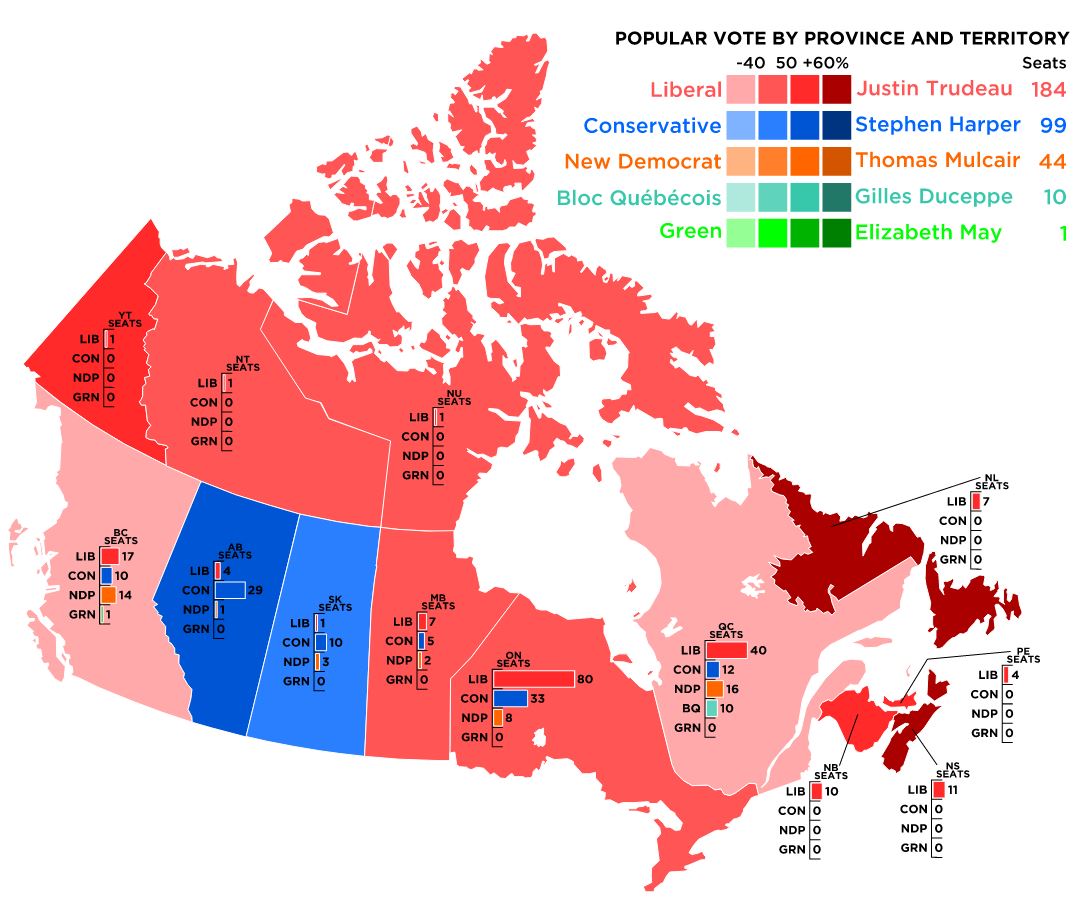
Canada election results 2015
Canada election results 2015 (click for larger image)

A friend of mine pointed out this post by a pro-life woman based in Calgary, Alberta named McKenzie. As you all know, Canada lurched hard left last Monday, electing a strongly pro-abortion Liberal Party government, led by a man who insisted that candidates in his party swear their allegiance to abortion on demand, through all 9 months of pregnancy.

I took a look at some of the pro-life Members of Parliament and noticed that a bunch of them stepped down this election, and many others were defeated by Liberals. So, McKenzie is looking forward and seeing where the pro-abortion Liberal Party is going next now that they have a majority government.

She writes:

As tempting as it is to write a semi-encouraging post about the state of affairs for the next two to four years, the reality is that the political sphere of the pro-life movement has been dealt a treacherous blow in seeking to protect the most defenseless lives among us.

In the foreseeable future, here are three possible federal pressures we can expect from our Parliament over the next few months and years:

1. Legislation inhibiting, directly or indirectly, the freedom and mobility of life-affirming organizations, including pregnancy resource centres, and their ability to reach women seeking abortions. We’ve had zero laws restricting abortion access throughout all nine months of pregnancy since 1988, but that hasn’t stopped our new Prime Minister from enforcing a strictly pro-choice view among his party. The question at the front of their minds seems to be, “how much further could we go in promoting abortion in our society – and overseas?” A reasonable prediction is that the CRA and Human Rights Commissions will put additional pressure on Christian or pro-life charities to comply with any new laws enacted, regardless of their protections under the Charter – similar to our friends in California presently forced to give out abortion information alongside life-affirming options at pregnancy resource centres, though abortion clinics are not required to reciprocate.

CRA = Canada Revenue Agency, their IRS. We’ve already had a scandal where the IRS, probably under the direction of the White House, went after charities that were working against the Democrats on certain issues like stopping voter fraud. She is expecting to see the CRA used similarly to go after pro-lifers. As you know, the Human Rights Commissions are tools used by the secular left to punish conservatives for offending people on the secular left. The laws are only ever applied against conservatives, and they almost always lose their cases. Well, pro-lifers are offensive. McKenzie thinks that the HRCs are going to go after them.

Another one:

3. Economic policies directly and/or indirectly inhibiting our ability to donate towards charities and charitable causes, especially pro-life or pro-family causes. Less money in the hands of private donors (especially those in the middle class) in a recession, coupled with higher redistribution through taxes, hits families the hardest when men and women are in their peak income-earning years. Less resources to go around means less charitable giving when mom and dad need to put their own needs for bills, food, and shelter first.

This is not surprising. The left is always anxious to go after charitable giving, because people are giving their money to causes they care about and the left doesn’t get any benefit. What the left prefers is that they take the money from potential charitable donors and then use it to buy votes. Obama’s latest budget of 2015 was the latest attempt to limit charitable contributions. She is expecting that pro-life donors will be targeted by the new Liberal majority government. And she undertstands that whatever impact she is going to have as a Christian is going to be funded by her own efforts to work for money, he husbands efforts to work for money, and the charitable donations she can get. The government never funds the efforts of Christians and/or conservatives to push Christian or conservative views. Which is why it makes zero sense for Christians to vote to expand the federal government outside of its Constitutional responsibilities.

So what are my thoughts on all this?

Well, I wish more pro-lifers down here were as aware of the effects of laws and policies on life plans. If you read the rest of her post, McKenzie clearly has some kind of pro-life plan there, and it’s a good one in that it’s practical and evidence based. She intends to get results. But she’s not looking inside at her own feelings and thoughts when she makes these life plans, she’s looking at politics and laws and trying to anticipate where the threats will come from, and how to adjust. I wish pro-lifers here were more like that… especially when it comes to size of government. We need to keep our own money and not give it to the government. We need to keep the government away from our rights, e.g. – free speech and religious liberty.

Anyway, if you follow the gay rights vs religious liberties battles we are having now with florists, bakers, photographers, etc., then you might recall that similar things were happening in Canada 10-20 years ago. Canada was going through these problems in the late 90s, early 2000s, when the Liberals were in charge. It sort of died out when the Conservatives took over, but there’s no reason I can see for it not to come back now that Canada has elected a Liberal majority. I’m going to be watching the situation closely up there, because whatever the Liberals do up there now is likely to make its way down here in the next 10-15 years – if we elect Democrats.

In fact, with respect to what she said about restricting pro-lifers, the Democrat Party already introduced a bill to remove all restrictions on abortion at the state and local levels. This is what they do. Laws, taxes and politics do matter.
Is there any downside to raising the minimum wage to $15 an hour?

They told me if I voted Republican, we'd lose jobs, and they were right!
They told me if I voted Republican, we’d lose jobs, and they were right!

This article is from the libertarian Reason.com. They’re terrible at social issues, but really really good at economics.

They write:

Raising the minimum wage like this is an idea that’s become increasingly common amongst more liberal Democratic politicians and policymakers: The city of Seattle, Washington passed a law raising its minimum wage to $15 last year, and the Los Angeles city council voted to follow suit. Soon after, New York state announced a plan to raise the minimum wage of all fast food workers to $15, and the state’s governor, Andrew Cuomo, recently said he believes it should apply to all workers.

Many of these plans start from the assumption, implicitly or explicitly, that these minimum wage hikes would be relatively cost-free, pointing to several studies seeming to show that increases in the minimum wage don’t have much effect on jobs.

Here is what the author of some of the most influential of those studies, former Obama administration economic adviser Alan B. Krueger, had to say about raising the federal minimum wage to $15 an hour in an op-ed for The New York Times last week:

15 an hour is beyond international experience, and could well be counterproductive. Although some high-wage cities and states could probably absorb a $15-an-hour minimum wage with little or no job loss, it is far from clear that the same could be said for every state, city and town in the United States.

Krueger goes on to warn of greater risk, and the potential for “severe” trade-offs, if policymakers pursue a $15 minimum wage, warning that it would go beyond what any research supports. Ultimately, he concludes, it is  “a risk not worth taking.”

Krueger wasn’t disowning his own work or abandoning his position. He still supports raising the minimum wage to $12 an hour over a period of years, which he thinks could be done with essentially no job loss.

There are some reasons to be skeptical of that claim too: The Congressional Budget Office, which generally tries to take a moderate approach to economic evidence and put its estimates right in the middle of the consensus range, found that even a more modest hike to $10.10 an hour nationally would most likely cost about a half a million jobs, and while it’s possible such a raise might produce minimal job loss, it’s equally possible that it would cost a million jobs.

Overall, as David Neumark and William Wascher have found, the bulk of the evidence from research into the minimum wage suggests that hikes tend to decrease employment.

Let’s review the facts on minimum wage.

Abstract from a National Bureau of Economic Research study:

We estimate the minimum wage’s effects on low-skilled workers’ employment and income trajectories. Our approach exploits two dimensions of the data we analyze. First, we compare workers in states that were bound by recent increases in the federal minimum wage to workers in states that were not. Second, we use 12 months of baseline data to divide low-skilled workers into a “target” group, whose baseline wage rates were directly affected, and a “within-state control” group with slightly higher baseline wage rates. Over three subsequent years, we find that binding minimum wage increases had significant, negative effects on the employment and income growth of targeted workers.

[…]Over the late 2000s, the average effective minimum wage rose by 30 percent across the United States. We estimate that these minimum wage increases reduced the national employment-to-population ratio by 0.7 percentage point.

That comes out to 1.4 million workers who lost their jobs, thanks to minimum wage mandates. And those are primarily young, unskilled workers who are affected – people trying to get a start in the workplace and build their resumes, so they can move up.

Harvard economist Greg Mankiw explains the top 14 views that a majority professional economists agree on, and here’s #12:

12. A minimum wage increases unemployment among young and unskilled workers. (79%)

This is not controversial. This is the kind of basic “how America works” economics stuff that people used to learn in their civics classes before the schools became so politicized.

Bernie Sanders says his spending proposals will tax everyone, not just the rich

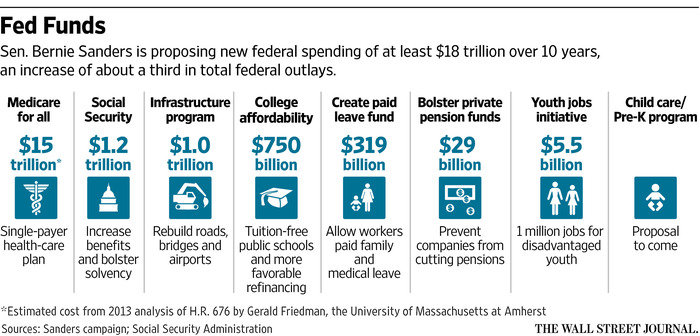
Wall Street Journal calculates cost of Sanders spending plan
Wall Street Journal calculates the cost of Bernie Sanders’ spending plan

This story is from ABC News.

Excerpt:

Sanders is perhaps best known in political life for his efforts to champion the middle class, saying that in order to bridge the widening wealth and income inequality gap in America, the country needs a revamped tax policy that forces Wall Street, big corporations, millionaires and billionaires –like Trump – to pay up – and doesn’t impose further taxes on the middle and working class.

However, when pressed by Stephanopoulos about whether the proposed Senate tax legislation he backs, which would use a payroll tax to fund a mandate for 12 weeks of paid family and medical leave from all U.S. employers, Sander confirmed that the bill would require taxing all citizens -– not just the top 1 percent.

“[The payroll tax] would hit everyone –- yeah, it would. But it would mean we would join the rest of the industrialized world and make sure that when a mom has a baby she can in fact stay home with that baby for three months, rather than going back to work at the end of one week,” Sanders said.

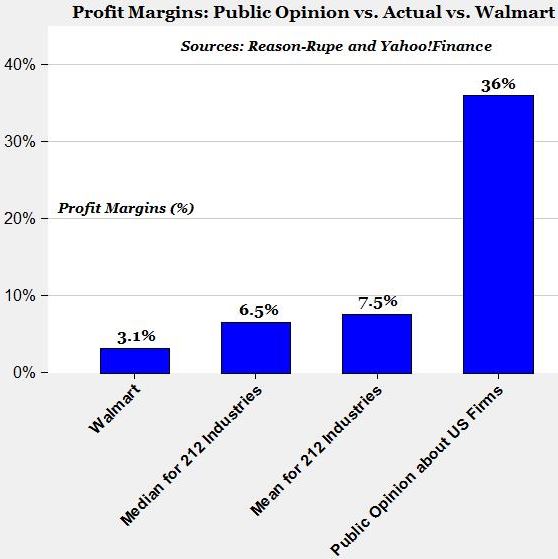
What most Democrats (all?) don’t understand, is that when you tax the rich, the costs filter down to consumers and employees. If a company is making a 5% profit (and Wal-mart makes a 3% profit), then slapping even a 5% tax increase on them will cause layoffs, outsourcing and other repercussions. We have a serious problem in this country with economic illiteracy – a widespread lack of familiarity with how the private sector works, and how jobs are created. For one thing, the public thinks that the average profit margin of companies is over 32%, when it fact it is much lower.

Public perceptions of corporate profit margins

So the real question is, how much does Bernie Sanders want to spend, and pass on to “the rich”? Because if it’s more than a 1% or 2% increase in corporate taxes, we are all – all of us – going to feel the burn. And it’s not going to a slight increase to our payroll taxes, it’s going to be a huge number of people losing their jobs, and the prices of consumer goods and services rising to pay for the new taxes.

How much does all this Bernie Sanders spending cost? 

The Wall Street Journal – which knows something about business and economics – has done an analysis of how much the socialist agenda of Bernie Sanders will cost. The final price tag? $18 trillion dollars!

Read it:

Sen. Bernie Sanders, whose liberal call to action has propelled his long-shot presidential campaign, is proposing an array of new programs that would amount to the largest peacetime expansion of government in modern American history.

In all, he backs at least $18 trillion in new spending over a decade, according to a tally by The Wall Street Journal, a sum that alarms conservatives and gives even many Democrats pause. Mr. Sanders sees the money as going to essential government services at a time of increasing strain on the middle class.

[…]To pay for it, Mr. Sanders, a Vermont independent running for the Democratic nomination, has so far detailed tax increases that could bring in as much as $6.5 trillion over 10 years, according to his staff.

A campaign aide said additional tax proposals would be offered to offset the cost of some, and possibly all, of his health program. A Democratic proposal for such a “single-payer” health plan, now in Congress, would be funded in part through a new payroll tax on employers and workers, with the trade-off being that employers would no longer have to pay for or arrange their workers’ insurance.

Investors Business Daily has more to say about Sanders’ proposals:

His “Medicare for All” single-payer health plan alone would cost roughly $15 trillion over a decade.

He wants the government to provide “universal” child care and pre-kindergarten programs, along with free tuition at any public college, and proposes spending an additional $1 trillion on infrastructure and expanding Social Security by $1.2 trillion. Add up just these and a few other items on Sanders’ list, and price tag tops $18 trillion over a decade.

[…]And this doesn’t count the massive costs of mandates and regulations Sanders wants to impose on businesses, such as a $15 minimum wage, plus mandatory paid medical leave, vacations and sick days.

He’d also make it far easier for unions to organize.

Keep in mind that when Obama became president, the national debt was about $8 trillion. Now it’s $18.5 trillion, thanks to the Democrats. And if Bernie Sanders is elected, it will go to over $36.5 trillion. This is what Bernie Sanders expects to solve by “taxing the rich”. And Hillary Clinton expects to get the money for her spending from “taxing the wealthy”, as she said in the CNN debate. Do the rich have enough money lying around for the Democrats to confiscate?

Can we pay for it by “taxing the rich”?

A while back, the libertarian Cato Institute had an article talking about who would pay for Obama’s $1 trillion health care plan. They asked whether Obama could pay for it by “taxing the rich”.

The answer is no:

Funding the new health-care plan on the backs of households making $200,000 or more per year would require permanently increasing their annual total tax payments by about 50 percent. So, for example, a household that currently pays $50,000 in federal income taxes would need to pay another $25,000. Remember, however, that Social Security and Medicare already face enormous shortfalls. Shoring up these programs — another Obama campaign promise — would require collecting 328 percent more tax revenue from the rich. No, we didn’t forget a decimal point: That is three hundred and twenty-eight percent.

And what follows from taxing the rich?

[…]A major tax increase causes the tax capacity of the rich to shrink gradually as two factors kick in. First, many of the households falling into Obama’s “rich” definition are married couples in which both partners are working professionals. When tax rates rise, the lower-earning spouses in these couples tend to work less. Often, they quit work entirely. Second, many of the “rich” are budding entrepreneurs and small-business owners. They finance their operations using their own after-tax income, or with after-tax resources from family and friends. Small-business innovation is the fuel for long-term economic growth. In fact, many of the largest companies in the United States today were either small or nonexistent just 25 years ago. Killing small business kills the American economy.

The rich in France abandoned France in droves when the socialist Francois Hollande passed a 75% top income tax rate. Why do Democrat voters think that this would not happen here? We have to learn economics by watching what happens after the policies are enacted, in other times and places. Higher taxes on the rich cause them to produce less, lowering tax revenues.

I myself have been planning to stop working within the next 5 years, exactly because I can see that the Democrat voters are taking us in the direction of massive taxes on employment. I don’t intend to be working when that happens. If enough people respond to higher tax rates like me, the Democrats are going to have an even bigger problem paying for their spending promises.