Tag Archives: Economics

How a small third world country became the top economy in Latin America

South America Map
South America Map

So, I’ve been watching the Democrat debates, and I’ve noticed that all of their candidates are proposing economic policies that they say will improve the lives of Americans. But have the candidates ever been able to try out these policies, and proven that they work? One way to evaluate policies is to look at other countries that have tried them, to see if those policies are proven to work.

I’ve been reading a book called “Money, Greed and God” with my friend Carla, which talks about what does and does not work to alleviate poverty. The author basically outlined two approaches. In the first approach, the government 1) confiscates the wealth of the most productive workers, 2) nationalizes (takes control of) the businesses of the most successful entrepreneurs, 3) restricts trading between citizens and with other countries, with minimum wage, price controls and tariffs. In the second approach, the government does the opposite: 1) lowers taxes on the most productive workers, and 2) lets entrepreneurs compete to provide goods and services to consumers, and 3) lowers restrictions on internal trading and trading with other countries, e.g. – eliminating minimum wage, tariffs and price controls.

Let’s take a look at two Latin American countries that went in opposite directions. Venezuela and Chile. Then we can finally find out which policies actually achieve results for the people.

Here is how Chile started out in 1973.

PROBLEM: Price controls and tariffs:

Prices for the majority of basic goods were fixed by the government in 1973. Even though Chile was and still is a small economy, the level of protection­ism was high. By the end of 1973, the nominal average tariff for imports was 105 percent, with a maximum of 750 percent. Non-tariff barriers also impeded the import of more than 3,000 out of 5,125 registered goods. Just as economic theory predicts, large queues in front of stores were usual in Santiago and other cities in Chile as a result of the scarcity caused by price controls.

PROBLEM: Government taking over private businesses:

The decline in GDP during 1973 reflected a shrinking productive sector in which the main assets were gradually falling under government control or ownership through expropriations and other government interventions in the economy.

PROBLEM: Deficit spending and government printing money:

The fiscal situation was chaotic. The deficit reached 55 percent of expenditures and 20 percent of GDP and was the main cause of inflation because the Central Bank was issuing money to finance the government deficit.

SOLUTION: lower or eliminate restrictions on trade:

The most important economic reform in Chile was to open trade, primarily through a flat, low tar­iff on imports. Much of the credit for Chilean eco­nomic reforms in the following 30 years should be given to the decision to open our economy to the rest of the world. The strength of Chilean firms, productive sectors, and institutions grew up thanks to that fundamental change.

SOLUTION: let competing entrepreneurs in the private sector provide goods and services to consumers:

A second fundamental reform was to allow the private sector to recover, adding dynamism to the economy. In fact, important sectors such as elec­tricity generation and distribution and telecommu­nications were still managed by state companies. After we implemented a massive privatization plan that included more than 50,000 new direct share­holders and several million indirect (through pen­sion funds) shareholders, these companies were managed by private entrepreneurs that carried out important expansion plans.

SOLUTION: let people take responsibility for their own lives instead of depending on government:

The 1981 reform of the Chilean pension fund system deserves special mention. Under the leader­ship of Minister José Piñera, an individual capitali­zation account program was designed with specific contributions, administered by private institutions selected by the workers. The Chilean Administra­doras de Fondos de Pension (Pension Fund Administrators or AFP) has been replicated in more than 20 countries, and more than 100 million workers in different parts of the world use these accounts to save for retirement.

SOLUTION: allow parents to choose the school that fits their needs from competing education providers, and push school administration down from the federal government to the municipal level, where it would be more responsive to voter’s needs:

In 1981, Chile introduced a universal educational voucher system for students in both its elementary and secondary schools. At the same time, the central government transferred the administration of public schools to municipal governments…  The financial value of the voucher did not depend on family income.

RESULTS: And I was able to find a nice short, description of how all that worked out for them on the far-left Wikipedia, of all places:

The economy of Chile is a high-income economy as ranked by the World Bank, and is considered one of South America’s most stable and prosperous nations, leading Latin American nations in competitiveness, income per capita, globalization, economic freedom, and low perception of corruption.

In 2006, Chile became the country with the highest nominal GDP per capita in Latin America. In May 2010 Chile became the first South American country to join the OECD. Tax revenues, all together 20.2% of GDP in 2013, were the second lowest among the 34 OECD countries, and the lowest in 2010. In 2017, only 0.7% of the population lived on less than US$1.90 a day.

According to the Heritage Foundation, Chile is ranked as the 18th freest economy in the world. The World Bank ranked Chile as the 50th highest GDP per capita for 2018, just below Hungary and above Poland.

Now, you can contrast those results with Venezuela. I have been blogging about Venezuela for years on this blog, and documenting how they raised taxes, banned guns, nationalized private sector companies, raised tariffs, and increased regulations. They are now ranked JUST ABOVE NORTH KOREA for economic freedom – #179 out of 180 countries measured. Basically, they did the opposite of everything that Chile did – transferring power away from parents, workers, business owners, churches and municipal governments to the powerful centralized federal government.

Wikipedia explains how Hugo Chavez took over in 1999 and enacted a communist revolution.

More:

Since the Bolivarian Revolution half-dismantled its PDVSA oil giant corporation in 2002 by firing most of its 20,000-strong dissident professional human capital and imposed stringent currency controls in 2003 in an attempt to prevent capital flight, there has been a steady decline in oil production and exports. Further yet, price controls, expropriation of numerous farmlands and various industries, among other government authoritarian policies… have resulted in severe shortages in Venezuela and steep price rises of all common goods, including food, water, household products, spare parts, tools and medical supplies; forcing many manufacturers to either cut production or close down, with many ultimately abandoning the country as has been the case with several technological firms and most automobile makers.

They confiscated private property, took over private sector businesses, implemented tariffs and price controls, redistributed wealth via massive welfare programs, and pushed all decision-making out of families and municipal governments up to the federal government. By depriving the producers of their earnings, the country caused massive shortages of goods and services, to the point where people are fleeing the country, consuming zoo animals, and selling their bodies as prostitutes in order to get food and water.

Application

In the next election, we are not picking a tribe because of how they make us feel about ourselves. We are not choosing in order to see ourselves as “nice” and “not nice”. We need to look at specific policies being proposed, and see what works and what doesn’t work. The examples of Chile (rags-to-riches) and Venezuela (riches-to-rags) are helpful for voters who want to get RESULTS instead of FEELINGS.

I’ll leave you with a list of links from previous posts so you can see how communism worked out for Venezuela.

Related posts


New study: which group of voters correctly answered questions about basic facts?

Let's take a look at some data and learn how the world really works
Let’s take a look at some data and learn how the world really works

The non-partisan web site Just Facts has been cited as an authority by IBM, PBS, Vanderbilt University, the Wall Street Journal, etc. In their latest study, they tested conservative and progressive voters to see which group had reality-based views of education, taxes, healthcare, national debt, pollution, government spending, Social Security, global warming, energy, hunger, and poverty.

Here is what they measured:

The findings are from a nationally representative annual survey commissioned by Just Facts, a non-profit research and educational institute. The survey was conducted by Triton Polling & Research, an academic research firm that used sound methodologies to assess U.S. residents who regularly vote.

While most polls measure public opinion, this unique one measures voters’ knowledge of major issues facing the nation—such as education, taxes, healthcare, national debt, pollution, government spending, Social Security, global warming, energy, and hunger.

I just wanted to list out a few of the questions, so that you would be able to see the topics, and know that the answers are measurable quantities. This is important because we want to know which groups of voters understand just the facts about the world we live in.

Education sample question:

On average across the United States, how much do you think public schools spend per year to educate each classroom of students? Less or more than $150,000 per classroom per year?

Correct Answer: More than $150,000. The average cost to educate a classroom of public school students is about $332,000 per year.

Correct answer given by 36% of all voters, 26% of Democrat voters, 45% of Trump voters, 46% of males, 28% of females, 25% of 18 to 34 year olds, 40% of 35 to 64 year olds, and 33% of 65+ year olds.

Taxes sample question:

On average, who would you say pays a greater portion of their income in federal taxes: The middle class or the upper 1% of income earners?

Correct Answer: The upper 1%. The Congressional Budget Office, the U.S. Treasury, and the Tax Policy Center have all documented that households in the top 1% of income pay an average effective federal tax rate of about 33%, while middle-income households pay about 13%. These tax rates account for nearly all income and federal taxes.

Correct answer given by 18% of all voters, 6% of Democrat voters, 30% of Trump voters, 21% of males, 15% of females, 11% of 18 to 34 year olds, 19% of 35 to 64 year olds, and 19% of 65+ year olds.

Spending sample question:

Do you think the federal government spends more money on social programs, such as Medicare, education, and food stamps—or does the federal government spend more money on national defense, such as the Army, Navy, and missile defense?

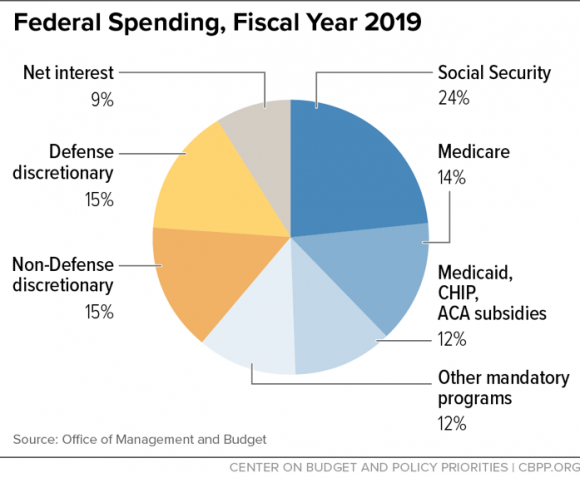
Correct Answer: Social programs. In 2018, 62% of federal spending was for social programs, and 18% was for national defense. In 1960, the opposite was true, and 53% of federal spending was for national defense, while 21% was for social programs.

Correct answer given by 36% of all voters, 14% of Democrat voters, 59% of Trump voters, 40% of males, 33% of females, 23% of 18 to 34 year olds, 36% of 35 to 64 year olds, and 41% of 65+ year olds.

National debt sample question: 

What about federal government debt? The average U.S. household owes about $122,000 in consumer debt, such as mortgages and credit cards. Thinking about all federal government debt broken down to a per household basis, do you think the average federal debt per U.S. household amounts to more or less than the average consumer debt per U.S. household?

Correct Answer: More than $122,000. Federal debt is now $23.1 trillion or about $180,000 for every household in the United States.

Correct answer given by 77% of all voters, 76% of Democrat voters, 81% of Trump voters, 75% of males, 80% of females, 84% of 18 to 34 year olds, 79% of 35 to 64 year olds, and 75% of 65+ year olds.

Global warming sample question: 

Thinking about the whole planet, do you think the number and intensity of hurricanes and tropical storms have generally increased since the 1980s?

Correct Answer: No. Comprehensive global data shows that the number and intensity of cyclones and hurricanes has been roughly level since the 1980s. This data was originally published in the journal Geophysical Research Letters in 2011 and updated this year. Likewise, the Intergovernmental Panel on Climate Change has reported: “There is low confidence in any observed long-term (i.e., 40 years or more) increases in tropical cyclone activity (i.e., intensity, frequency, duration), after accounting for past changes in observing capabilities.” Regional data that extends back for more than century shows the same.

Correct answer given by 32% of all voters, 4% of Democrat voters, 59% of Trump voters, 40% of males, 25% of females, 19% of 18 to 34 year olds, 36% of 35 to 64 year olds, and 30% of 65+ year olds.

Pollution sample question: 

Thinking about the United States, in your opinion, is the air generally more polluted than it was in the 1980s?

Correct Answer: No. EPA data shows that ambient levels of all criteria air pollutants have declined significantly since the 1980s. Criteria air pollutions are those that are deemed by the administrator of the EPA to be widespread and to “cause or contribute to air pollution which may reasonably be anticipated to endanger public health or welfare….” Likewise, combined emissions of hazardous air pollutants have declined by about 50% since the 1990s.

Correct answer given by 56% of all voters, 44% of Democrat voters, 67% of Trump voters, 67% of males, 46% of females, 47% of 18 to 34 year olds, 63% of 35 to 64 year olds, and 49% of 65+ year olds.

Energy sample question: 

Without government subsidies, which of these technologies do you think is the least expensive method for generating electricity? Wind turbines, solar panels, or natural gas power plants?

Correct Answer: Natural gas power plants. Determining the costs of electricity-generating technologies is complex, but data from the U.S. Energy Information Administration shows that natural gas is considerably less expensive than wind, and wind is considerably less expensive than solar.

Correct answer given by 40% of all voters, 23% of Democrat voters, 57% of Trump voters, 53% of males, 29% of females, 25% of 18 to 34 year olds, 43% of 35 to 64 year olds, and 41% of 65+ year olds.

Hunger sample question:

On an average day, what portion of U.S. households with children do you believe will have at least one child who experiences hunger? Less than 1%, 1% to 10%, or more than 10%?

Correct Answer: Less than 1%. Per the latest data from the USDA, 0.14% or less than one out of every 700 U.S. households with children have any child who experiences hunger on an average day. This includes children who are hungry due to poverty, not those who skip meals because they are late for school, don’t feel like eating, or are trying to lose weight.

Correct answer given by 12% of all voters, 2% of Democrat voters, 22% of Trump voters, 15% of males, 9% of females, 3% of 18 to 34 year olds, 12% of 35 to 64 year olds, and 13% of 65+ year olds.

Social Security sample question:

Some policymakers are proposing that individuals be allowed to save and invest some of their Social Security taxes in personal accounts instead of paying these taxes to the Social Security program. In your view, do you think such proposals generally improve or harm the finances of the Social Security program?

Correct Answer: Improve. As shown by analyses conducted by the chief actuary of the Social Security Administration and a bipartisan presidential commission, proposals to give Social Security an element of personal ownership generally strengthen the program’s finances. Although some tax revenues that would have gone to the program instead go to people’s personal retirement accounts, these tax revenues are more than offset by the savings of not paying these individuals full benefits.

Correct answer given by 22% of all voters, 11% of Democrat voters, 33% of Trump voters, 28% of males, 17% of females, 31% of 18 to 34 year olds, 20% of 35 to 64 year olds, and 23% of 65+ year olds.

Health care sample question:

In 2010, Congress passed and President Obama signed the Affordable Care Act, also known as “Obamacare.” This law uses price controls to save money in the Medicare program. Do you think these price controls will worsen Medicare patients’ access to care?

Correct Answer: Yes. As explained by Medicare’s actuaries, the price controls in the Affordable Care Act will cut Medicare prices for many medical services over the next three generations to “less than half of their level under the prior law.” The actuaries have been clear that this will likely cause “withdrawal of providers from the Medicare market” and “severe problems with beneficiary access to care.”

Correct answer given by 50% of all voters, 17% of Democrat voters, 80% of Trump voters, 53% of males, 46% of females, 38% of 18 to 34 year olds, 52% of 35 to 64 year olds, and 49% of 65+ year olds.

Poverty sample question:

Including government benefits and private charity, how much worth of goods and services do the poorest 20% of U.S. households consume on average each year? Less than $20,000, $20,000 to $40,000, or more than $40,000?

Correct Answer: According to the latest government data, the poorest 20% of U.S. households consumed an average of $57,049 of goods and services per household in 2010.

Correct answer given by 13% of all voters, 6% of Democrat voters, 20% of Trump voters, 13% of males, 14% of females, 15% of 18 to 34 year olds, 16% of 35 to 64 year olds, and 9% of 65+ year olds.

You can read the full methodology, references and results.

PLEASE SHARE the article if you liked it. There’s nothing in here to fight about, and no one should be offended.

Wayne Grudem debates Richard Glover on the Bible, poverty and foreign aid

Two horses fight it out, may the best horse win!

A great episode of the Unbelievable podcast. This is a great debate. I really enjoyed it. All three speakers were excellent putting forward their points. It’s nice to hear an American voice, a British voice and an Australian voice debating an important issue. HIGHLY RECOMMENDED.

Details:

Wayne Grudem is a theologian known for his conservative approach to both doctrine and economics. His new book “The Poverty of Nations: A Sustainable Solution” (co-authored with economist Barry Asmus) makes the case that pouring aid into developing countries is a failed strategy. Grudem debates whether the Bible supports free market, capitalist economics with Australian economist and theologian Richard Glover who wrote a critique of the book for the Australian Bible Society.

 The MP3 file is here.

Summary:

Grudem:

  • The Bible speaks to all of life, including economics, stewardship, government
  • The study of economics helps us to understand how to take care of the poor
  • My job is to apply the teachings of the Bible to all of life

Brierley:

  • What’s your thesis in the book?

Grudem:

  • A good system is one where the poor have the opportunity to earn and save from their labor
  • Book is a response to a Kenyan couple Grudem met at a London conference on business and Christianity
  • Book is not concerned with how individuals and groups can do charity to help the poor
  • Our church already does that and we support individuals and groups doing charity
  • The book is concerned with how should nations be transformed in order to grow economically
  • What should the laws, policies and cultural beliefs of a nation be in order for it to not be poor?
  • The book lists factors that have moved nations from poverty to prosperity in different times and places
  • The thesis of the book is this: government should set their people free to be able to produce more
  • We advocate freedom in economics: freedom to work, freedom to save, freedom to start businesses
  • We believe that this free enterprise view is consistent with the Bible in a number of places
  • E.g. – private property is good for prosperity (thou shall not steal) but forbidden by communism

Brierley:

  • What about the church sharing in communities in Acts 2 and Acts 4?

Grudem:

  • That is not redistribution of wealth among individuals and businesses by a secular government
  • Those passages showed that there was voluntary sharing among Christians, which is not communism

Brierley:

  • What’s wrong with Grudem’s book?

Glover:

  • The book emphasizes the Bible and the goal is to help the poor in poor countries
  • Criticism 1: the book doesn’t engage with non-free-market perspectives on economics
  • Criticism 2: the book doesn’t survey all that the Bible says about economics

Brierly:

  • For 1) what is one of the views that is not considered?

Glover:

  • Jeffrey Sachs says that nations need a leg up before they can grow economically
  • Ha-Joon Chang says that free enterprise was not how the wealthy nations became wealthy

Grudem:

  • We do engage with other points of view, especially Jeffrey Sachs in the book
  • The trouble with leftist views on economic development is that it does not work in practice
  • NO COUNTRY has even been lifted out of poverty by foreign aid
  • He says we don’t cite enough from the wisdom literature: we have 64 citations in the index
  • He says we don’t cite enough from the gospels: we have 42 citations in the index
  • He says we don’t cite enough from the epistles: we cite 22 of 27 epistles in the index
  • Some economists won’t criticize cultural and moral values that hurt prosperity
  • As Christians, we think that moral and cultural values are part of the problem that needs solving

Brierley:

  • What about foreign aid?

Grudem:

  • Foreign aid doesn’t help: a lot of the money goes into government and rulers can be corrupt
  • Instead of encouraging people to start businesses, it tells people to go into government to get aid money
  • Economists (lists 3) are saying that foreign aid entrenches corrupt government in power, does no good

Brierley:

  • If it’s not working, should we keep doing it?

Glover:

  • When there is an immediate need, we should do it, even if it is not a long-term solution: we need both

Brierley:

  • Should we stop foreign aid completely?

Grudem:

  • Voluntary charitable giving from individuals and churches to help poor countries is good
  • Me and my co-author are both active on our church board that helps poor countries with urgent needs
  • Food and doctors are urgent needs, and we should help, but it doesn’t lift countries out of poverty
  • We need a long-term solution that helps poor countries produce their own food and doctors
  • We are criticizing 1) government to government aid and 2) IMF/World bank to government aid
  • We have had pushback because 500,000 people make a living from this foreign aid industry
  • No country has ever been lifted out of poverty into sustainable prosperity
  • That’s the definition of insanity: continuing to do the same thing that has never worked

Brierley:

  • Does the Bible support free enterprise as a way of creating sustainable prosperity?

Glover:

  • When I said the Bible was absent from his book, absent was a bad choice of words
  • But the hundreds of references he listed were not dealth with *in depth*
  • In the Scriptures, God is the one who provides (e.g. – in Ephesians, Sermon on the Mount)
  • The Bible is less focused on his people making money, and more focus on sharing basics, like food
  • Secular governments should just take it from people who have food and give it to hungry people
  • In 2 Cor 8-9, Paul talks about voluntary sharing so everyone will be equal

Brierley:

  • Does 2 Cor 8-9 undermine the free enterprise system you champion in the book?

Grudem:

  • The sharing in the Bible solves cases of urgent need, it does not lift countries from poverty to sustainable prosperity
  • Some older translations say “equality” in 2 Cor 8:13-14, but newer translations (e.g. – ESV) say “fairness”
  • The Greek word is translated as “fairly” the only other place it appears in the NT (Col 4:1), in every translation
  • God uses the means of human work and productivity to provide (daily bread is baked, doesn’t just fall from Heaven)
  • In general, there’s no provision in Scripture for a person to be dependent on donations for their entire lives
  • God promises Israel fields and mountains to tend and mine, but prosperity is from work, not depending on others

Brierley:

  • Does the Bible support this focus on work?

Grudem:

  • Working is highly praised in Scripture, (lists Bible passages that favor work over dependency)
  • Countries that were exposed to this notion of work and productivity have been more prosperous

Glover:

  • Jeffrey Sachs and other development economists don’t say you can be prosperous through dependence
  • They say that it is a necessary part of leading to nations out of poverty into poverty

Grudem:

  • It’s never worked. What nation has become prosperous through foreign aid?

Glover:

  • There are lots of nations, especially in Africa, where foreign aid has helped lift them out of poverty

Grudem:

  • Name one country in Africa where foreign aud has lifted them out of poverty into sustainable prosperity

Glover:

  • I can’t think of one right now.

Grudem:

  • Our book contains a map of Africa and we looked at every nation’s per capita income
  • No nation has been able to rise out of poverty through dependence on foreign aid
  • The only close one is Botswana, but they have abundant freedoms, Christian morals, less corrupt government
  • So Botswana is the best case and they became prosperous through becoming productive, not foreign aid

Brierley:

  • Is he right to say that charity is a short-term solution, but that it’s not good long-term for prosperity?

Glover:

  • Yes, and work is a very important focus in the Scriptures as he says.
  • But since the Fall work has been much harder, and may not have the outcomes that we would like

Grudem:

  • I also believe in emergency aid for when catastrophies happen, like floods and famines
  • But dependence on foreign aid enriches corrupt rulers and does not create the productivity that leads to sustained prosperity

Brierley:

  • Can foreign aid be used to give poor nations a leg up on becoming prosperous?

Grudem:

  • Dambisa Moyo, Oxford-educated economist from Zambia, says stop the aid, it’s doing more harm than good
  • Jeffrey Sachs’ view is that foreign aid hasn’t worked yet, but just keep trying a bit more
  • What works: limited government, rule of law, fair courts, documented property rights, low taxes, stable currency
  • People are creative and want to work, we just have to get government out of the way and let people work, earn and save

Brierley:

  • Is this free enterprise system supported by the Bible?

Glover:

  • The wealthy nations of the world did not become wealthy through productive work and free enterprise policies
  • Ha-Joon Chang: free enterprise policies have never brought a country from poverty to wealth
  • E.g. – wealth is created through tariffs (not by innovating and by economic freedom?)

Grudem:

  • I’ve read Ha-Joon Chang’s book, and his examples are very selective and limited
  • Index of Economic Freedom: the freest countries are the most prosperous, the least free countries are the most poor
  • When you look at macro data, instead of very selective examples, the free enterprise system is best for prosperity

Glover:

  • The book doesn’t do enough to engage with leftist economists (he doesn’t say which ones)
  • Just because nations who are free are rich, doesn’t mean freedom causes productivity
  • There are parts of the Bible that doesn’t support the free enterprise system (he names none)

Grudem:

  • The Bible is focused on work not dependency, and charity not government redistribution
  • The best way to help the poor in other countries is by encouraging work and productivity