Tag Archives: Economics

Capital punishment and deterrence: what the research shows

This post has a twin post which talks about the evidence against capital punishment from the Bible.

Why do people support the death penalty? Because research conducted by multiple teams of scholars at multiple universities have shown that capital punishment deters crime.

Excerpt:

“Science does really draw a conclusion. It did. There is no question about it,” said Naci Mocan, an economics professor at the University of Colorado at Denver. “The conclusion is there is a deterrent effect.”

A 2003 study he co-authored, and a 2006 study that re-examined the data, found that each execution results in five fewer homicides, and commuting a death sentence means five more homicides. “The results are robust, they don’t really go away,” he said. “I oppose the death penalty. But my results show that the death penalty (deters) — what am I going to do, hide them?”

Statistical studies like his are among a dozen papers since 2001 that capital punishment has deterrent effects. They all explore the same basic theory — if the cost of something (be it the purchase of an apple or the act of killing someone) becomes too high, people will change their behavior (forego apples or shy from murder).

And specifically:

• Each execution deters an average of 18 murders, according to a 2003 nationwide study by professors at Emory University. (Other studies have estimated the deterred murders per execution at three, five and 14).

• The Illinois moratorium on executions in 2000 led to 150 additional homicides over four years following, according to a 2006 study by professors at the University of Houston.

• Speeding up executions would strengthen the deterrent effect. For every 2.75 years cut from time spent on death row, one murder would be prevented, according to a 2004 study by an Emory University professor.

In case anyone is wondering what sort of crimes are deterred by the death penalty, you can read this graphic description of a recent death-penalty crime.

What sort of crimes are eligible for the death penalty?

Here’s an example of a dealth-penalty eligible crime from the Hartford Courant. (WARNING: graphic!)

Excerpt:

A Superior Court jury today sentenced Steven Hayes to death for the murders of Jennifer Hawke-Petit and her daughters, Hayley and Michaela, during a seven-hour home invasion, robbery and arson at their Cheshire home in July 2007.

Outside the courthouse after the verdicts, Hawke-Petit’s father, the Rev. Richard Hawke, said “There are some people who do not deserve to live in God’s world.”

Asked what he had in his heart, Dr. William Petit Jr. struggled with his answer. “….Probably many of you have kids,” he said, pausing to choke back tears. “Michaela was an 11-year-old little girl…tortured and killed in her own bedroom, surrounded by her stuffed animals….”

Petit then talked about his daughter Hayley’s bright future and her strength and the children that his wife, Jennifer, helped.

“So, I was really thinking of the tremendous loss” during the verdict, Petit said, adding that he was pleased with it, but “mostly I was sad for the loss we have all suffered.”

Asked if he thought there’d be closure now, Petit said, “There’s never closure. There’s a hole…. with jagged edges…that may smooth out with time, but the hole in your heart and the hole in your soul” remains.

“This isn’t about revenge,” Petit said. “Vengeance belongs to the Lord. This is about justice.”

[…]The jury sentenced Hayes to death on six counts: killing Hawke-Petit and Michaela and Hayley in the course of a single action; killing a child under the age of 16; killing Hawke-Petit in the course of a kidnapping; killing Hayley in the course of a kidnapping; killing Michaela in the course of a kidnapping; and killing Hawke-Petit in the course of a sexual assault.

[…]Hayes, 47, of Winsted, was convicted Oct. 5 of breaking into the Petit home, beating Petit, tying up and torturing the family as Hayes and another man ransacked the home for cash and valuables and tortured the family for seven hours. Testimony during Hayes’ trial showed that at one point in the break-in, Hayes forced Hawke-Petit to go to the bank to withdraw money. During that time, according to testimony, Komisarjevsky sexually assaulted Michaela Petit, 11.

When Hawke-Petit and Hayes returned from the bank, Hayes raped and strangled Hawke-Petit. The house was doused with gasoline and set on fire as the intruders fled, testimony showed. Hayley, 17, and Michaela died of smoke inhalation.

[…]Prosecutors used the words of Hayes’ younger brother Matthew to counter testimony that home-invasion crime was an aberration in Hayes otherwise troubled but basically nonviolent life.

Matthew Hayes portrayed his brother as a conniving, sadistic, violent thief who saw Matthew take countless beatings from his brutal father for Steven Hayes’ misdeeds. At one point, Steven Hayes held a gun to Matthew’s head, according to the statement, which was given to state police after the home invasion.

Examples of Hayes’ sadistic behavior toward his brother included hooking Matthew to the garage door by his belt and raising the door up and down, and holding Matthew’s hand to a red-hot burner. Matthew said his brother’s life of crime was not a result of bad parenting or poor childhood. He said Hayes never learned to take responsibility for his actions.

Sometimes, I think that we have stopped judging others because we do not want to be judged ourselves. We hope that by not judging anyone, that we will somehow escape being judged by anyone – especially by God himself. The opposition to punishing the guilty is, I think, really just a way of expressing our desire to do away with punishment entirely. We would rather have the freedom to sin with impunity than to protect the victims of sinfulness from harm. We want to escape responsibility for anything we do that harms others.

Dennis Prager has a neat expression from Rabbinical literature that describes the problem with people who are anti-death-penalty: “those who are kind to the cruel, will be cruel to the kind”.

I actually consider the death penalty to be an important test of whether a person is a Christian or not, because it shows what they think about the serious of moral crimes, and whether they accept what research says, and what the Bible says, instead of valuing peer approval more than justice. It tells you how seriously a person feels about their own sinfulness. Death penalty supporters don’t view sinners as victims – they view victims as victims, and they believe that evil people need to be punished. It’s hard for me to see how someone can claim to be a Christian and oppose justice.

Obama administration knew $535 million Solyndra loan was too risky

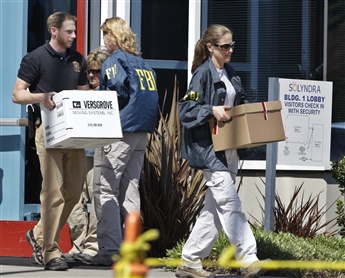
FBI agents remove evidence from Solyndra Headquarters

Here’s the latest from the radically leftist New York Times.

Excerpt:

Republican lawmakers, escalating the political furor over the collapse of a solar equipment manufacturer that received a $528 million government loan, released excerpts from Obama administration e-mails on Wednesday suggesting that the White House pressed federal officials to wrap up their review of the loan quickly for political purposes.

In the e-mails, officials at the Office of Management and Budget expressed frustration that they were being put under time pressure to sign off on the loan to the company, Solyndra, two years ago so that Vice President Joseph R. Biden Jr. could announce its approval at a groundbreaking for a factory. The White House wanted an announcement that would show progress on job creation.

The disclosure became a focus of a House Energy and Commerce subcommittee hearing on Wednesday about the loan to Solyndra, which has developed into a political headache for the Obama administration. The administration used the company as a prime example of stimulus bill dollars creating “green jobs.” But Solyndra recently filed for bankruptcy protection and closed its factory, and its headquarters was raided by the Federal Bureau of Investigation, apparently in connection with the loan.

The bankruptcy filing and the raid “clearly show that the committee was more than justified in its scrutiny of the deal,” said the panel’s chairman, Representative Fred Upton, Republican of Michigan. “Why did the administration think Solyndra was such a good bet?”

[…]Suspicions that the administration might have pushed the loan for political reasons have centered on the fact that a major investor in the company is a charitable foundation associated with George B. Kaiser, a billionaire from Tulsa, Okla., who raised $50,000 to $100,000 as a “bundler” for President Obama’s 2008 presidential campaign.

Logs show that Mr. Kaiser visited the White House on several occasions during the spring and summer of 2009, while the loan to Solyndra was being considered. Among the officials he met with were the chief of staff, Rahm Emanuel, and Pete Rouse and Valerie Jarrett, both senior advisers to Mr. Obama.

[…]While Mr. Kaiser’s connection to the Obama campaign and to Solyndra, based in Fremont, Calif., have helped draw attention to the loan, he was not a major topic of discussion at the hearing on Wednesday. Republicans did, however, press those testifying on whether the Solyndra bankruptcy offered proof that the government should not be lending to companies that have trouble raising money from private investors.

“In this time of record debt, I question whether the government is qualified to act as a venture capitalist, picking winners and losers in speculative ventures and shelling out billions of taxpayer dollars to keep them afloat,” Mr. Upton said.

ABC News reported on the contents of the e-mails: (H/T Director Blue)

The company’s solar panel factory was heralded as a centerpiece of the president’s green energy plan — billed as a way to jump start a promising new industry. And internal emails uncovered by investigators for the House Energy and Commerce Committee that were shared exclusively with ABC News show the Obama administration was keenly monitoring the progress of the loan, even as analysts were voicing serious concerns about the risk involved. “This deal is NOT ready for prime time,” one White House budget analyst wrote in a March 10, 2009 email, nine days before the administration formally announced the loan.

“If you guys think this is a bad idea, I need to unwind the W[est] W[ing] QUICKLY,” wrote Ronald A. Klain, who was chief of staff to Vice President Joe Biden, in another email sent March 7, 2009. The “West Wing” is the portion of the White House complex that holds the offices of the president and his top staffers. Klain declined comment to ABC News.

I think people need to get very clear on what “stimulus” spending is. Stimulus spending is nothing more and nothing less than taking money from the private sector job creators (“tax the wealthiest Americans”) and giving it to the people who got the socialists elected (“rebuilding our crumbling roads”).

More details from the Daily Caller.

Excerpt:

In light of the Solyndra bankruptcy, terms like “economic stimulus package” and “green jobs” now appear to be Team Obama code words for “kickbacks to political supporters so huge they would make a third-world despot green with envy.”

Solyndra is (or, more accurately, was) a California solar energy company that was the crown jewel of Obama’s first economic stimulus package, which cost $787 billion. Solyndra’s chief investor, George Kaiser, was also a bundler for Obama’s 2008 campaign, gathering over $50,000 in campaign contributions. Kaiser, together with Solyndra executives and board members, donated $87,050 to Obama’s campaign.

As part of the economic stimulus, Obama’s Department of Energy (DOE) fast-tracked a loan of $535 million (at the lowest interest rate granted by the DOE program) to Solyndra in 2009 to create green jobs. All other energy companies that received loans are paying an interest rate three to four times higher, and Solyndra got this amazing deal despite a Dun & Bradstreet credit rating that was only “fair.”

About a year later, Solyndra wasn’t making the payments and needed refinancing. In 2011, Solyndra’s CEO communicated with members of Congress, claiming that the company was on sound financial footing and would be able to repay a refinanced loan. DOE had a man attending Solyndra’s meetings, so they should have known whether the CEO was telling the truth. DOE arranged for refinancing.

Just a few months later, Solyndra laid off nearly all of its 1,100 workers and declared bankruptcy. Just a few days after that, agents of the FBI and the inspector general were raiding Solyndra headquarters and the homes of the CEO and two other executives, with search warrants.

That means that criminal charges are possible. But in the bankruptcy, DOE allowed Kaiser and other investors to recover their investments first, before DOE attempted to recover the $535 million in taxpayers’ money. What a sweetheart deal. America’s taxpayers have been left holding the bag.

Mark Levin took a call from a Solyndra worker who says that “everyone already knew that China had developed a more inexpensive way to manufacture these solar panels. Everyone knew that the plant wouldn’t work. But they still did it. They still built it.”