Tag Archives: Economics

Two black economists explain how to end poverty in America

These days, everyone seems to think that being good to the poor means looking around to see what people are saying is good to the poor, then loudly shouting your agreement with it. People want to look good to others more than they want to help others. Besides, looking good by loud virtue signaling is free. If we really wanted to help people, though, we should tell them to do what will work.

So let’s talk about poverty in America, with help from famous black economist Walter Williams.

First, he says real poverty is not common in America:

There is no material poverty in the U.S. Here are a few facts about people whom the Census Bureau labels as poor. Dr. Robert Rector and Rachel Sheffield, in their study “Understanding Poverty in the United States: Surprising Facts About America’s Poor”, report that 80 percent of poor households have air conditioning; nearly three-quarters have a car or truck, and 31 percent have two or more. Two-thirds have cable or satellite TV. Half have one or more computers. Forty-two percent own their homes. Poor Americans have more living space than the typical non-poor person in Sweden, France or the U.K. What we have in our nation are dependency and poverty of the spirit, with people making unwise choices and leading pathological lives aided and abetted by the welfare state.

Second, the “poverty” is not caused by racism, but by poor choices:

The Census Bureau pegs the poverty rate among blacks at 35 percent and among whites at 13 percent. The illegitimacy rate among blacks is 72 percent, and among whites it’s 30 percent. A statistic that one doesn’t hear much about is that the poverty rate among black married families has been in the single digits for more than two decades, currently at 8 percent. For married white families, it’s 5 percent. Now the politically incorrect questions: Whose fault is it to have children without the benefit of marriage and risk a life of dependency? Do people have free will, or are they governed by instincts?

There may be some pinhead sociologists who blame the weak black family structure on racial discrimination. But why was the black illegitimacy rate only 14 percent in 1940, and why, as Dr. Thomas Sowell reports, do we find that census data “going back a hundred years, when blacks were just one generation out of slavery … showed that a slightly higher percentage of black adults had married than white adults. This fact remained true in every census from 1890 to 1940”? Is anyone willing to advance the argument that the reason the illegitimacy rate among blacks was lower and marriage rates higher in earlier periods was there was less racial discrimination and greater opportunity?

Third, avoiding poverty is the result of good choices:

No one can blame a person if he starts out in life poor, because how one starts out is not his fault.

If he stays poor, he is to blame because it is his fault. Avoiding long-term poverty is not rocket science. First, graduate from high school. Second, get married before you have children, and stay married. Third, work at any kind of job, even one that starts out paying the minimum wage. And finally, avoid engaging in criminal behavior. It turns out that a married couple, each earning the minimum wage, would earn an annual combined income of $30,000. The Census Bureau poverty line for a family of two is $15,500, and for a family of four, it’s $23,000. By the way, no adult who starts out earning the minimum wage does so for very long.

Fourth, what stops people from making good choices is big government:

Since President Lyndon Johnson declared war on poverty, the nation has spent about $18 trillion at the federal, state and local levels of government on programs justified by the “need” to deal with some aspect of poverty. In a column of mine in 1995, I pointed out that at that time, the nation had spent $5.4 trillion on the War on Poverty, and with that princely sum, “you could purchase every U.S. factory, all manufacturing equipment, and every office building. With what’s left over, one could buy every airline, trucking company and our commercial maritime fleet. If you’re still in the shopping mood, you could also buy every television, radio and power company, plus every retail and wholesale store in the entire nation”. Today’s total of $18 trillion spent on poverty means you could purchase everything produced in our country each year and then some.

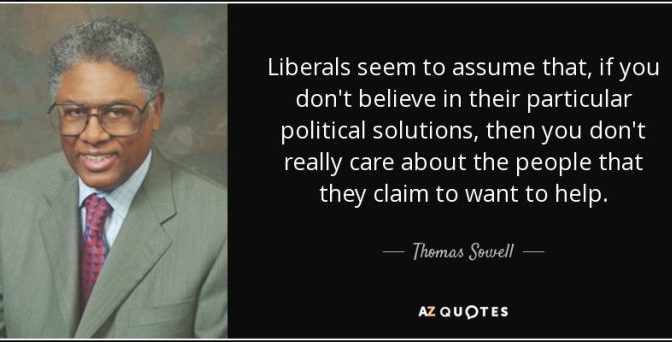
Regarding those last two points, here is another famous black economist, Thomas Sowell:
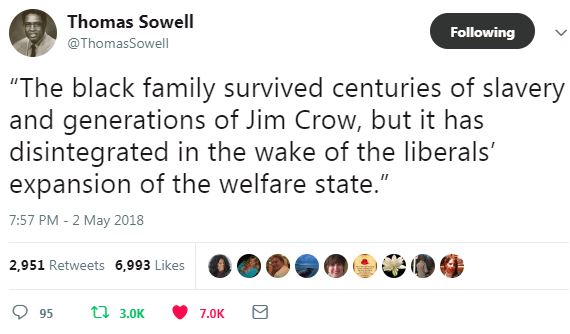
Economist Thomas Sowell blames welfare for killing the black family

To illustrate this point, here’s a graph with some helpful data taken from the U. S. Census.

In fact, there is a whole video featuring Thomas Sowell to go with this graph:

Black women were more likely to be married before welfare programs

And an article to go with it:

If we wanted to be serious about evidence, we might compare where blacks stood a hundred years after the end of slavery with where they stood after 30 years of the liberal welfare state. In other words, we could compare hard evidence on “the legacy of slavery” with hard evidence on the legacy of liberals.

Despite the grand myth that black economic progress began or accelerated with the passage of the civil rights laws and “war on poverty” programs of the 1960s, the cold fact is that the poverty rate among blacks fell from 87 percent in 1940 to 47 percent by 1960. This was before any of those programs began.

Over the next 20 years, the poverty rate among blacks fell another 18 percentage points, compared to the 40-point drop in the previous 20 years. This was the continuation of a previous economic trend, at a slower rate of progress, not the economic grand deliverance proclaimed by liberals and self-serving black “leaders.”

Ending the Jim Crow laws was a landmark achievement. But, despite the great proliferation of black political and other “leaders” that resulted from the laws and policies of the 1960s, nothing comparable happened economically. And there were serious retrogressions socially.

Nearly a hundred years of the supposed “legacy of slavery” found most black children being raised in two-parent families in 1960. But thirty years after the liberal welfare state found the great majority of black children being raised by a single parent.

The rest of the article points out how even crime rates among blacks were caused by the implementation of soft law enforcement policies by progressives. Just look at the big cities if you want to know what it is like for blacks to be ruled by Democrats. It sucks!

If everybody started to read more Thomas Sowell books, we would be much better off as a country! Only good things happen when people stop watching TV and listening to music and watching movies, and instead settle down in a chair with a Thomas Sowell book. I recommended a bunch of them in a previous post.

Jay Richards: what should Christians know about economics?

Here’s a good basic introduction to the free enterprise system by Dr. Jay Richards:

Here is the description:

In this edition of the Evangel Guest Lecture Series, Jay W. Richards discusses his book on the capitalist system within the context of the Christian faith and examine how enterprise based on hard work, honesty, and trust fosters creativity and growth.

Jay W. Richards, PhD, is author of many books including the New York Times bestseller Infiltrated (2013). Richards is a senior fellow at the Discovery Institute, and executive editor of The Stream. In recent years he has been a distinguished fellow at the Institute for Faith, Work & Economics, contributing editor of The American at the American Enterprise Institute, a visiting fellow at the Heritage Foundation, and research fellow and director of Acton Media at the Acton Institute.

It turns out that the best system for lifting the poor out of poverty – by work or charity – is the economic system that creates wealth through human ingenuity and hard work. That system is the free enterprise system.

Something to read?

If you can’t listen to the lecture and don’t want to buy the whole book “Money, Greed and God?” Then I have a series of posts on each chapter for you.

The index post is here.

Here are the posts in the series:

  • Part 1: The Eight Most Common Myths about Wealth, Poverty, and Free Enterprise
  • Part 2: Can’t We Build A Just Society?
  • Part 3: The Piety Myth
  • Part 4: The Myth of the Zero Sum Game
  • Part 5: Is Wealth Created or Transferred?
  • Part 6: Is Free Enterprise Based on Greed?
  • Part 7: Hasn’t Christianity Always Opposed Free Enterprise?
  • Part 8: Does Free Enterprise Lead to An Ugly Consumerist Culture?
  • Part 9: Will We Use Up All Our Resources?
  • Part 10: Are Markets An Example of Providence?

Parts 4 and 5 are my favorites. It’s so hard to choose one to excerpt, but I must. I will choose… Part 4.

Here’s the problem:

Myth #3: The Zero Sum Game Myth – believing that trade requires a winner and a loser. 

One reason people believe this myth is because they misunderstand how economic value is determined. Economic thinkers with views as diverse as Adam Smith and Karl Marx believed economic value was determined by the labor theory of value. This theory stipulates that the cost to produce an object determines its economic value.

According to this theory, if you build a house that costs you $500,000 to build, that house is worth $500,000. But what if no one can or wants to buy the house? Then what is it worth?

Medieval church scholars put forth a very different theory, one derived from human nature: economic value is in the eye of the beholder. The economic value of an object is determined by how much someone is willing to give up to get that object. This is the subjective theory of value.

And here’s an example of how to avoid the problem:

How you determine economic value affects whether you view free enterprise as a zero-sum game, or a win-win game in which both participants benefit.

Let’s return to the example of the $500,000 house. As the developer of the house, you hire workers to build the house. You then sell it for more than $500,000. According to the labor theory of value, you have taken more than the good is actually worth. You’ve exploited the buyer and your workers by taking this surplus value. You win, they lose.

Yet this situation looks different according to the subjective theory of value. Here, everybody wins. You market and sell the house for more than it cost to produce, but not more than customers will freely pay. The buyer is not forced to pay a cost he doesn’t agree to. You are rewarded for your entrepreneurial effort. Your workers benefit, because you paid them the wages they agreed to when you hired them.

This illustration brings up a couple important points about free enterprise that are often overlooked:

1. Free exchange is a win-win game.

In win-win games, some players may end up better off than others, but everyone ends up better off than they were at the beginning. As the developer, you might make more than your workers. Yet the workers determined they would be better off by freely exchanging their labor for wages, than if they didn’t have the job at all.

A free market doesn’t guarantee that everyone wins in every competition. Rather, it allows many more win-win encounters than any other alternative.

2. The game is win-win because of rules set-up beforehand. 

A free market is not a free-for-all in which everybody can do what they want. Any exchange must be free on both sides. Rule of law, contracts, and property rights are needed to ensure exchanges are conducted rightly. As the developer of the house, you’d be held accountable if you broke your contract and failed to pay workers what you promised.

An exchange that is free on both sides, in which no one is forced or tricked into participating, is a win-win game.

If you do get the book, be sure and skip the chapter on usury. It’s just not as engaging as the others, in my opinion.

Why are teachers and other talkers paid less than engineers and other doers?

The meme below makes fun of unionized public school teachers, who feel entitled to the same salary and benefits as doctors, software engineers, etc. in the private sector. So, the point of this meme is simple, it’s to point out that the teachers who belong to teacher unions are ignorant of basic economics, specifically, the law of supply and demand.

Basic Economics: Prices are set by supply and demand
Basic Economics: In a free market, prices are set by supply and demand

When there is more demand for a product or service than there is a supply for it, then prices go up. When there is more supply for a product or service than there is a demand for it, prices go down.

A good place to see this explained is in a book by famous black economist Thomas Sowell. Thomas Sowell has written many books, but he wrote one book in particular for people who have no knowledge of basic economics. It’s called “Basic Economics: A Citizen’s Guide to the Economy“. And the first few chapters explain how prices are set by supply and demand:

  1. What is Economics?
  2. The Role of Prices
  3. Price Controls
  4. An Overview of Prices

It turns out that there are two views of how wages are set in an economy:

The labor theory of value (LTV) is a theory of value that argues that the economic value of a good or service is determined by the total amount of “socially necessary labor” required to produce it.

LTV is usually associated with Marxian economics… The LTV is central to Marxist theory, which holds that the working class is exploited under capitalism, and dissociates price and value. Marx did not refer to his own theory of value as a “labour theory of value”.

Mainstream neoclassical economics tends to reject the need for a LTV, concentrating instead on a theory of price determined by supply and demand.

Marxists economists believe that the value of a good or service is determined by the “social utility” of the work produced. But classical (“free market”) economists believe that value is determined by the scarcity of the good or service relative to the demand from consumers.

So, a Marxist economist might say “teaching English to 5 year olds is valuable because it is relevant and meaningful”. But, a classical economist would say “conducting a security audit on distributed point-of-sale system is valuable, because very few people can do it, but many people want it”.

I’ve noticed that school teachers and non-STEM university students and professors are very likely  to hold to the labor theory of prices and wages. Robert Nozick wrote a paper about why this happens. It turns out that “wordsmiths” (his word) are conditioned by their performance in the classroom to expect success in the free market economy. But when they find that their “brilliance” in English poetry, Medieval history, or lesbian dance theory has no value to anyone else, they complain that the economy is being manipulated by powerful people. Marxism is a coping mechanism for people who value academic acclaim more than doing something useful for their neighbors. The Marxists study easy things that no one cares about, and then they can’t get paid because millions of people can do them. The free market people focus on the customer, so they study hard things like computer science and petroleum engineering that are in demand from customers. And they get paid more.

Starting and Mid-Career salaries by profession (click for larger image)

Consider this article from College Pulse about a survey of 10,590 undergraduate students:

Students with certain majors are far more likely than their peers to approve of socialism. Philosophy majors, in particular, have a positive view of socialism. Nearly 8 in 10 (78%) say they view the economic system favorably, followed by 64% of anthropology majors, and 58% of both English and international relations majors. Accounting and finance majors are least likely to view socialism positively (20% and 22% respectively).

Do you know what accounting and finance students have to study? Basic economics.

As soon as I got my first job as a software engineer, and finished my study of Christian apologetics, the very next thing I studied was economics. It was Dr. Jay Richards who got me interested in it, when I heard him speaking about economics in an apologetics lecture for Stand to Reason. I contacted him, and he recommended the works of two famous economists, F. A. Hayek and Thomas Sowell. And that’s what I want to recommend to you, too. Our continued liberty and prosperity depends on ordinary Americans taking the time to educate themselves about basic economics.