Video here. (H/T Big Government via ECM)
What can we learn about capitalism and socialism from Sweden?
Video here. (H/T Big Government via ECM)

Video here. (H/T Big Government via ECM)
Article from Forbes magazine. (H/T Muddling Towards Maturity)
Excerpt:
Whatever the results of the Copenhagen conference on climate change, one thing is for sure: Draconian reductions on carbon emissions will be tacitly accepted by the most developed economies and sloughed off by many developing ones. In essence, emerging economies get to cut their “carbon” intensity–a natural product of their economic evolution–while we get to cut our throats.
[…]Our leaders will dutifully accept cuts in our carbon emissions–up to 80% by 2050–while developing countries increasetheirs, albeit at a lower rate. Oh, we also pledge to send billions in aid to help them achieve this goal.The media shills, scientists, bureaucrats and corporate rent-seekers gathered at Copenhagen won’t give much thought to what this means to the industrialized world’s middle and working class. For many of them the new carbon regime means a gradual decline in living standards. Huge increases in energy costs, taxes and a spate of regulatory mandates will restrict their access to everything from single-family housing and personal mobility to employment in carbon-intensive industries like construction, manufacturing, warehousing and agriculture.
You can get a glimpse of this future in high-unemployment California. Here a burgeoning regulatory regime tied to global warming threatens to turn the state into a total “no go” economic development zone. Not only do companies have to deal with high taxes, cascading energy prices and regulations, they now face audits of their impact on global warming. Far easier to move your project to Texas–or if necessary, China.
Now consider this Wall Street Journal article regarding the EPA decision to call carbon dioxide a threat to public health.
Excerpt:
An endangerment finding would allow the EPA to use the federal Clean Air Act to regulate carbon-dioxide emissions, which are produced whenever fossil fuel is burned. Under that law, the EPA could require emitters of as little as 250 tons of carbon dioxide per year to install new technology to curb their emissions starting as soon as 2012.
The EPA has said it will only require permits from big emitters — facilities that put out 25,000 tons of carbon dioxide a year. But that effort to tailor the regulations to avoid slamming small businesses with new costs is expected to be challenged in court.
Legislators are aware that polls show the public appetite for action that would raise energy prices to protect the environment has fallen precipitously amid the recession.
Congressional legislation also faces plenty of U.S. industry opposition. Under the legislation, which has been passed by the House but is now stuck in the Senate, the federal government would set a cap on the amount of greenhouse gas the economy could emit every year. The government would distribute a set number of emission permits to various industries. Companies that wanted to be able to emit more than their quota could buy extra permits from those that had figured out how to emit less.
Proponents of the cap-and-trade approach say emission-permit trading will encourage industries to find the least-expensive ways to curb greenhouse-gas output. But opponents say it will saddle key industries with high costs not borne by rivals in China or India, and potentially cost the U.S. jobs.
There will be an economic impact on ordinary Americans from the Democrats trying to “do something” about global warming. The economic impact will not be felt primarily by liberal elites in government.
First, let’s see Obama’s record on economic policy. (H/T ECM)
$1,650,971,205,167 added to the national debt, bringing the total to $7.5 trillion.
99 banks taken over by the Federal Deposit Insurance Company.
684 banks receiving support from the Troubled Asset Relief Program that doesn’t buy troubled assets.
11.2 percent: the percentage of the federal deficit to GDP. This is the highest that ratio has been since Japan surrendered in 1945.
$164 billion spent out of the entire $787 billion in stimulus funding in the American Recovery and Reinvestment Act. Most of this has gone to Medicaid, unemployment and the Making Work Pay Tax Credit.
And, now, Keith Hennessey takes a look at Obama’s record on reducing unemployment.
Here’s the graph of total employment since Obama took office:
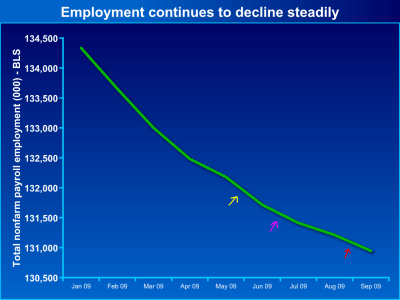
Now, you may be hearing Obama say that we’ve turned the corner on unemployment. For instance, look at how the White House is spinning this graph.
Hennessey writes:
Check out the slightly different slopes of the three line segments indicated by arrows. The purple arrow shows a segment that slopes downward slightly less than the yellow arrow. A mathematician would say the shift from yellow to purple was an inflection point, shifting the curve from convex to concave.
This is what led the President in early August to say the economy was “pointed in the right direction.” The red arrow shows the worse news of last Friday’s jobs report, with a line that slopes downward slightly more sharply. The curve shifted back to a convex shape, in which the slope was more sharply downward than in the prior month.
If you’re saying to yourself, “That’s ridiculous! They’re all going down, and the differences in slopes are almost too hard to see!” then you’ve got my point.
And below I’m going to explain why Obama’s massive government spending created this worsening unemployment.
Economics in One Lesson
We are going to have to pay for all this spending on Obama’s favored special interest groups eventually, and that means that taxes will go up, or that the value of the dollar will go down, due to inflation. It has to be one or the other or both. There is no third way. When employers see that higher taxes or inflation are coming, they stop hiring people because they know that higher taxes and/or inflation kills the economy.
Perhaps it is time to review Henry Hazlitt’s Economics in One Lesson, chapter 4, entitled “Public Works Mean Taxes”.
Excerpt:
Therefore, for every public job created by the bridge project a private job has been destroyed somewhere else. We can see the men employed on the bridge. We can watch them at work. The employment argument of the government spenders becomes vivid, and probably for most people convincing. But there are other things that we do not see, because, alas, they have never been permitted to come into existence. They are the jobs destroyed by the $10 million taken from the taxpayers. All that has happened, at best, is that there has been a diversion of jobs because of the project. More bridge builders; fewer automobile workers, television technicians, clothing workers, farmers.
And consider Chapter 5 as well, entitled “Taxes Discourage Production”.
In our modern world there is never the same percentage of income tax levied on everybody. The great burden of income taxes is imposed on a minor percentage of the nation’s income; and these income taxes have to be supplemented by taxes of other kinds. These taxes inevitably affect the actions and incentives of those from whom they are taken. When a corporation loses a hundred cents of every dollar it loses, and is permitted to keep only fifty-two cents of every dollar it gains, and when it cannot adequately offset its years of losses against its years of gains, its policies are affected. It does not expand its operations, or it expands only those attended with a minimum of risk. People who recognize this situation are deterred from starting new enterprises. Thus old employers do not give more employment, or not as much more as they might have; and others decide not to become employers at all. Improved machinery and better-equipped factories come into existence much more slowly than they otherwise would. The result in the long run is that consumers are prevented from getting better and cheaper products to the extent that they otherwise would, and that real wages are held down, compared with what they might have been.
There is a similar effect when personal incomes are taxed 50, 60 or 70 percent. People begin to ask themselves why they should work six, eight or nine months of the entire year for the government, and only six, four or three months for themselves and their families. If they lose the whole dollar when they lose, but can keep only a fraction of it when they win, they decide that it is foolish to take risks with their capital. In addition, the capital available for risk-taking itself shrinks enormously. It is being taxed away before it can be accumulated. In brief, capital to provide new private jobs is first prevented from coming into existence, and the part that does come into existence is then discouraged from starting new enterprises. The government spenders create the very problem of unemployment that they profess to solve.
What Obama did, in effect, is to fire all of those millions of private sector people, so that he could reward the people who voted for him. And jobs are created far more efficiently by small businesses than they are by big government. What creates new jobs is entrepreneurs with ideas who hire people. And government spending diverts money away from these efficient entrepreneurs and towards inefficient government bureaucracies.
 WINTERY KNIGHT