
Tag Archives: Divorce

New study: conservatives are more likely to be happily married than progressives

If you want a very happy marriage, don't be a progressive
If you want a very happy marriage, don’t be a progressive

New study from social science researchers W. Bradford Wilcox and Nicholas Wolfinger.

It’s written up in The Federalist.

Excerpt:

In the General Social Survey (GSS), one of the best barometers of American society, ideology is measured by asking respondents to rate their political attitudes on a liberal-conservative continuum (1 = extremely liberal, 7 = extremely conservative). We coded those men and women answering 1 to 3 as “liberal,” those answering with a 4 as “moderate,” and those answering 5 to 7 as “conservative.”

Figure 1 indicates that conservatives are significantly more likely to be married than are moderates and liberals. In fact, they are about 15 percentage points more likely to be married than their liberal fellow citizens. Moreover, this relationship remains strong after controlling for race or ethnicity, age, sex, and… income and education.

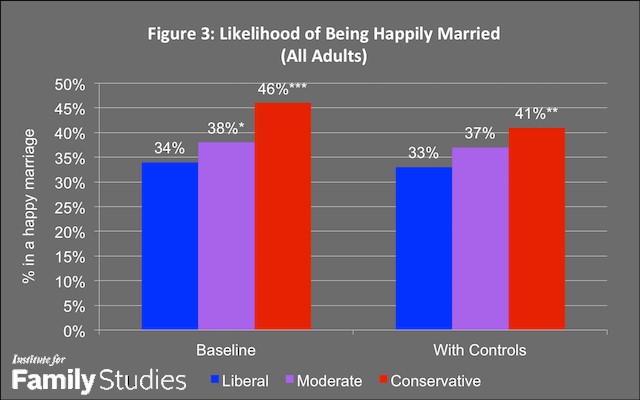
[…]Figure 3 examines the effects of political ideology on the chances of being in a very happy marriage among all Americans, not just those who are currently married, as Figure 2 depicted. Figure 3 shows that in the baseline model, conservatives are 12 percentage points more likely to be in happy marriages than are liberals. This gap persists, albeit to a diminished extent, after controlling for race or ethnicity, age, sex, income, and education. After adjusting for these differences between General Social Survey respondents, conservatives are about eight percentage points more likely than liberals to be in a happy marriage.

So basically, if you are a leftist, then you are much less likely to be happily married. And if you are a conservative, then you are much more likely to be happily married.

Why?

The answer lies in the design of marriage. Marriage is not about two people moving in together so that they can feel good about doing whatever they want to do. Marriage is a design that works best with a man and a women who are equipped at the worldview level with the capacity for resilient, self-sacrifice love.

Progressives are not equipped for the kind of self-denial, self-control, and self-sacrifice that marriage requires. They don’t believe in God, generally, so they don’t believe in objective morality. And if you don’t believe in objective morality, then there is no foundation there for self-sacrificial love, and honoring moral obligations when it goes against your self-interest. Atheism as a worldview doesn’t have the foundation for the kinds of behaviors that marriage entails. And that’s why you see Peter Atkins, Richard Dawkins, Richard Carrier, Michael Shermer, etc. divorcing their wives. The atheist worldview and the atheist community do not enable the sort of character that is suited for the design of marriage.

In contrast, conservatives typically do have a rationally-grounded morality. They tend to believe in God, and so the rightness of following the moral law when it goes against their self-interest makes sense to them. They think that there is a design to marriage, and design for the flourishing of children. They are more likely to be able to compromise and solve problems in order to keep a commitment going. There is an “ought to do” there in the conservative worldview that is objective – it exists independent of their feelings. The obligations to override selfishness is there regardless of how unfair life seems – it is resilient to challenges.

One of the ways you can tell how serious someone is about their religion, and therefore their morality, is by looking at the person’s church attendance. Church attendance is typically not as fun as other things you can do in life. So people who go are indicating that they put their relationship with God and their dedication to following the moral law above their own self-interest. So does that tendency help religious people to stay married?

Yes it does:

Brad Wilcox, director of the National Marriage Project at the University of Virginia, agrees there’s been some confusion.

“You do hear, both in Christian and non-Christian circles, that Christians are no different from anyone else when it comes to divorce and that is not true if you are focusing on Christians who are regular church attendees,” he said.

Wilcox’s analysis of the National Survey of Families and Households has found that Americans who attend religious services several times a month were about 35% less likely to divorce than those with no religious affiliation.

Nominal conservative Protestants, on the other hand, were 20% more likely to divorce than the religiously unaffiliated.

“There’s something about being a nominal ‘Christian’ that is linked to a lot of negative outcomes when it comes to family life,” Wilcox said.

So the bottom line is that marriage is a moral enterprise. It works better when each spouse has a worldview and a community that recognizes objective, prescriptive morality. And objective, prescriptive morality has no rational foundation in a non-theistic worldview. Progressives tend to be non-theists, so of course they are going to struggle with any enterprise that requires them to set aside their natural self-centeredness in order to honor moral obligations to another person.

New study: the majority (69%) of divorces are initiated by women

Is it OK to tell women they are wrong?
Is this “I’ll do what I want” attitude compatible with life-long married love?

This new report from Live Science gives us some numbers about who initiates divorces most frequently.

It says:

Women are more likely than men to initiate divorce in the United States, but they are no more likely than men to initiate breakups in a dating relationship, a new study finds.

“The breakups of nonmarital heterosexual relationships in the U.S. are quite gender-neutral and fairly egalitarian,” study author Michael Rosenfeld, an associate professor of sociology at Stanford University, said in a statement. “This was a surprise because the only prior research that had been done on who wanted the breakup was research on marital divorces.”

Previous research had found that women are more likely to initiate divorce, at least in the United States, Europe and Australia. In the new study, Rosenfeld compared divorces to nonmarital breakups, in an effort to understand the driving forces behind each type of breakup.

To investigate, he looked at data from the 2009 to 2015 waves of How Couples Meet and Stay Together, a nationally representative survey spearheaded by Rosenfeld and his colleagues. The new study includes 2,262 adults, ages 19 to 64, who reported having opposite-sex partners in 2009. By 2015, 371 of the participants had broken up or gotten divorced.

Women initiated 69 percent of the 92 divorces, Rosenfeld found. But there was no statistically significant difference between women and men when it came to nonmarital breakups, regardless of whether they were living together, he said.

So I am seeing a couple of problems in young, unmarried women that might explain this.

Feminism is bad

First, there is the feminism. Feminism was the driving force behind no-fault divorce. Today, young unmarried women are being taught to view marriage as stifling to their freedom. So if they do get married, they are often resolved that marriage should not affect their freedom in any way. That is just not the way marriage works, though – both spouses need to be equally ready to have their freedom infringed upon by things that HAVE TO GET DONE. Lots of things that have to get done will not be fun, thrilling or amusing – and that’s why it’s good to be prepared to do them before you marry.

My friend Dina says that she only knows one happily married couple from among her friends. The most frequent case she sees is wife is working in order to pay for big house, two cars, etc. and wife is denying husband sex, which makes him disengage from the marriage. A working wife tends to not be as responsive to the needs of husband and kids as a non-working wife, probably in part due to work stress. There is an epidemic of sex-withholding by women, and it causes men to disengage from marriage because they feel unloved. Although women tend to rebel against the idea that the man’s bad behavior is their fault, and that there is a “contractual” nature to marriage, that is how marriage works. You cannot stay married, women, by just doing whatever you feel like, and NOT doing whatever you DON’T feel like. Men will disengage when their needs are not supplied, and that’s no fault of theirs. It’s your fault. Denying relationship obligations causes men to underperform.

Feminism is often linked closely to “independence”. There is a lot of confusion over what the word independence means among young, unmarried women. A man uses that word to mean “lack of financial dependence on parents, the state, etc. because of good decisions in education, career and finances”. But a woman means “not having to care about the needs of a man and the leadership of a man, or the needs of children while still getting what I want from men and children”. That’s not compatible with life-long married love.

Emotions are bad

Second, emotions. In my experience, young, unmarried women are less likely to have reasoned out their own life plan in a practical step-by-step manner. (Although, all the women I advise have, but they are exceptional) Instead, they tend to do whatever makes them feel good moment-by-moment without any realistic plan. Peer-approval and culture play a large part in determining their goals and what they do day-to-day – and these day-to-day choices do not lead to achieving their goals. “Live in the moment”, they often tell me. If you try to talk to them about roles and responsibilities in a marriage, they will withdraw and rebel. But marriage is about each spouse doing his or her job, and feeling content about what the couple is building together. You can’t make life-long married love from emotional craziness and pursuing fun and thrills. You can’t make anything out of emotional craziness and pursuing fun and thrills.

How to pick a woman who won’t divorce you

Young men, I advise you to choose wives who have had to do things that they did not feel like doing. That can involve things like getting a STEM degree, getting a job in STEM, moving out of her parents’ house, getting a “boring” job that helps her pay off her debts, keeping commitments when she doesn’t feel like it, and caring for other people and even animals.

Basically, the more the woman has ground down any narcissism and hedonism she may have, by having to do nasty calculus and horrid lab work, the better. The more accustomed she is to constraints, responsibilities, expectations and obligations, the less likely it is that she’ll divorce you for unhappiness. And all of this goes for men, as well. STEM degree, STEM job, save money, serve others, give to charity.

Marriage is not the time for people to be carried away by their emotions. It’s an enterprise, and it works when both people are rational, practical, hard-working and self-controlled.

My editors

My friend Dina edited this post. She has a hilarious line she tells me whenever I ask her why some feminists think that I am so demanding. She says “You are demanding, but nothing you ask me to do is as bad as what I had to do at work today”. Her job is a billion  times harder than mine. She has a BS and MS in a STEM discipline, and has been working full-time since she was 18. She owns her own car, her own home, and has loads of investments. Whatever I want from her (e.g. – play Orcs Must Die! 2 with me) is pretty minor. She is a tough girl, and that’s what you want in a wife. Marriage is not happily ever after for the woman, it’s actually a lot of work for her. Hard work  before marriage prepares her for the responsibilities, expectations and obligations of marriage.

My friend Lindsay, who also has a STEM BS and MS and a resume, edited an early version of this post. She gave up her college teaching career to get married, have kids, and homeschool the kids. She sent me this story of a woman who abandoned her husband and 4 kids for a convicted rapist and serial killer. I think this story captures the radical feminism and emotional craziness that I am warning about in this post. Avoid women who run away from responsibilities and prefer men who meet their emotional needs without holding them accountable. Listen up, single women: you can’t choose a bad man because he makes you feel good (by not demanding anything from you) and then expect him to perform husband and father duties. That’s just causing your own divorce through your own poor choices.

Are same-sex unions the same as heterosexual married unions?

Marriage and family
Marriage and family

Note: I am re-posting this post because my friend Papa Giorgio informs me that the post is referenced in a new book on homosexuality and culture, authored by Dr. Michael Brown. Papa Giorgio says it’s a good book so far, so I’m going to get it. In the meantime, here’s the post Dr. Brown linked to.

I’ve written before about the differences between same-sex unions and opposite sex married couples.

Here’s a post from Canon and Culture on the same topic by social scientist Glenn Stanton.

He finds two differences.

First, instability:

[T]he research is strong and numerous enough that a recent and very provocative Atlantic cover story on what straights could learn from gay marriage couldn’t ignore it. Liza Mundy, the article’s author, doesn’t appear to have a conservative bone in her body, yet she is fair and straight-up honest with the research on the nature of committed same-sex relationships.

[…]Mundy explains that studies have found “higher dissolution rates among same-sex couples” in Scandinavia – one of the world’s most gay-friendly cultures — than married heterosexual couples. This study, published in Demography, found that even though same-sex couples enter their legal unions at older ages — a marker related to greater relational stability – male same-sex marriages break up at twice the rate of heterosexual marriages.  And the break-up rate for lesbians? A stunning 77% higher  than the same-sex male unions! When controlling for possible confounding factors, the “risk of divorce for female partnerships actually is more than twice than that for male unions.”

[…]A study of two generations of British couples (one born 1958, the other 1970) in same-sex cohabiting, opposite-sex cohabiting and opposite-sex marriage relationships found the same-sex relationships dramatically more likely to break up than the opposite-sex cohabiting and married relationships.

According to that British study, only 25% of same-sex co-habitating couples are intact after  8 years. The stability number for married couples after 8 years is 82%. That’s a big difference.

But there’s more:

Other studies – conducted by celebrated lesbian scholars – find notable instability in lesbian homes, even those with children. The current National Longitudinal Lesbian Family Study (NLLFS) found “a significant difference” in family dissolution rates when comparing lesbian with mother/father headed families, 56% and 36% respectively. (p. 1201)

Another research study by two celebrated gay-friendly scholars, highlights a major comparative study between hetero and lesbian homes where, in the 5-year period of the study, 6 of the 14 lesbian mother-headed homes had broken up compared to only 5 of the 38 mom/dad headed homes. (p. 11) These scholars creatively explains that this stability imbalance is likely due to the “high standards lesbians bring to their intimate unions…” (p.12)

Ever heard of lesbian bed death?

And Mundy points something else predictable in lesbian relationships. In fact, its consistency has earned it a name in the LGBT community: lesbian bed death. Seriously.  This is the truth that sexual interest and frequency in many long-term lesbian relationships tends to decline considerably and even die over the years.

Usually, in relationships, men tend to be the ones who want more frequent sex. What happens when you have no aggressors and two gatekeepers? Lesbian bed death.

Next up, something common in male homosexual relationships: infidelity.

Stanton writes:

A noted 2010 study on non-monogamy in long-term gay relationships by two gay-affirming scholars — the Couples Study — observes in their report’s first sentence: “…non-monogamous relationships are very common in the gay community…” Their data showed that of the non-monogamous, long-term couples in their study, 42 percent made an arrangement for outside-sexual relationships within the first three months of the relationship’s beginning and by the end of the first year, that number increased to 49 percent. At the seventh anniversary mark, an additional 24 percent of gay couples adopted such agreements. So such agreements are increasingly made as these relationships grow longer.

The Atlantic piece is notes this as well; explaining that after the AIDS crisis, “gay male couples are more monogamous than they used to be, but not nearly to the same degree as other kinds of couples.” One study Mundy cites asked those in various relationships whether they had any agreed-upon rules permitting extra-curricular activities. The differences were astonishing. Only 4% of male/female couples had them compared to 40% of gay men in legally recognized unions and 49% in long-term cohabiting unions.

Another widely respected investigation, found that only a third of gay couples had monogamous agreements and truly honored them with no outside sex. In fact, it found that in the openly nonmonogamous gay relationships, the frequency of extra-dyadic sex from its start ranged from 2 to a whopping 2,500 separate incidents. The median was a remarkable 41.5 extracurricular incidents since the relationship’s beginning. Frequency in the last year was startling was well, ranging from 0 to 350 occurrences of outside sex, with a median of 8 incidences in the last twelve months. Even those who pledged true monogamy, the range was from 1 to 63 “slip-ups” with a median of 5. Five “slip-ups” are not slip-ups. The corresponding numbers for men in heterosexual marriages are microscopic in comparison.

So what does all this mean?

It means that if you are interested in a definition of marriage that involves stability and marital fidelity, then you shouldn’t be in favor of legalizing gay marriage. When you open up the term marriage to include relationships that seem to be very unstable and/or very unfaithful, you change the definition of marriage. Marriage means life-long married love. If we just turn around and call any association of adults “marriage”, then we are losing the distinctiveness of marriage in the process. Think about it. We did the same thing in the previous redefinition of marriage (no-fault divorce) which attacked the permanence of marriage. Marriage has a specific meaning and we should not be redefining it every few years for the benefit of selfish adults.