Recently, I picked up the audio book version of “The Privileged Planet”, which is a book by philosopher / economist Jay Richards and astronomer Guillermo Gonzalez. This book is different from books about the origin of the universe and cosmic fine-tuning. It talks about what it takes to make a habitable planet. And it talks about how the habitable places in the universe are also the best places to make scientific discoveries.
Christian scholar Jay Richards was interviewed by Brian Auten of Apologetics 315.
This lecture is 29 minutes long, the Q&A is 15 minutes. I highly recommend this lecture to all audiences of all levels of ability, for the simple reasons that apart from the content, this lecture is a how-to clinic in the tone, body language, slides and so on for you to use when trying to be persuasive when making your case. Science is king in this lecture. The scientific method is defined and applied in a winsome way. Making science understandable should be the bread and butter approach to Christian apologetics, and this lecture rivals the Mike Strauss lecture at Stanford University and the Mike Strauss lecture at the University of Texas – Dallas as the ideal lectures for showing that. It’s not just the scientific material that makes this lecture by Collins work, it’s the narrative and the style that make the lecture work.
Robin Collins (PhD, University of Notre Dame, 1993), is professor of philosophy at Messiah College, Grantham, PA specializing in the area of science and religion. He has written over twenty-five articles and book chapters on a wide range of topics, such as the fine-tuning of the cosmos as evidence for the existence of God, evolution and original sin, the Doctrine of Atonement, Asian religions and Christianity, and Bohm’s theory of quantum mechanics. Some of his most recent articles/book chapters are “Philosophy of Science and Religion” in The Oxford Handbook of Science and Religion, “Divine Action and Evolution” in The Oxford Handbook of Philosophical Theology (2009) “The Multiverse Hypothesis: A Theistic Perspective,” in Universe or Multiverse? (Cambridge University Press), and “God and the Laws of Nature,” in Theism or Naturalism: New Philosophical Perspectives (Oxford University Press, forthcoming). He recently received a grant from the John Templeton Foundation to finish a book that presents the case for design based on physics and cosmology, tentatively entitled The Well-Tempered Universe: God, Cosmic Fine-tuning, and the Laws of Nature.
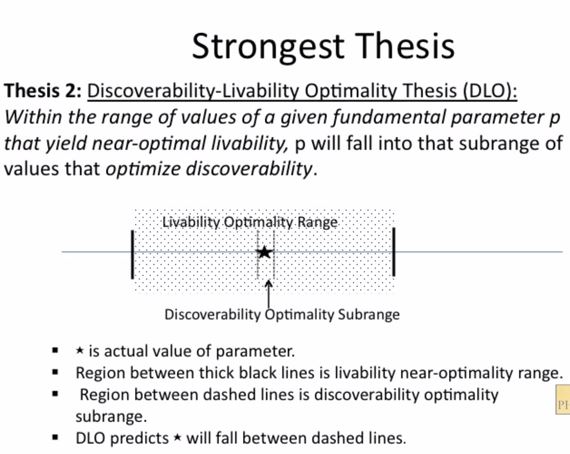
His thesis in one slide:
Fine-tuning for discoverability – the DLO thesis
Summary:
Thesis: the universe is more intelligible than we would expect it by chance
The regular fine-tuning argument says that complex embodied observers are very rare
But the number of highly-discoverable universes that have complex embodied observers is rarer still
Why do we exist in a highly-discoverable universe?
Can we quantify and test discoverability?
Yes: by varying fundamental parameters and seeing how it affects discoverability
Conclusion of his calculations: The Discoverability-Liveability Optimality range is an even smaller range within the Liveablity Optimality range of the standard fine-tuning argument
Fine-tuning #1: the fine structure constant, governs the strength of the electro-magnetic force
If larger, wood-burning fire becomes impossible because fires won’t stay lit, and therefore forging metals becomes unlikely
If smaller, wood-burning fires won’t go out, e.g. – from lightning strikes, so that wood would be less accessible
Other constraints: smaller value decreases effectiveness of light microscopes, drastically lowers efficiency of transformers and motors
Fine-tuning #2: the cosmic microwave background radiation (CMBR), radiation left over from the Big Bang
humans need to discover the CMBR in order to confirm the Big Bang creation out of nothing, and it depends on baryon/pothon ratio
his calculations show that the actual value of CMBR is exactly at the peak for detectability by humans
if baryon/photon ratio larger, CMBR is less discoverable
if baryon/photon ratio smaller, CMBR is less discoverable
Fine-tuning #3: parameters related to subatomic particles are fine-tuned for their discovery and usefulness, e.g. – the bottom quark, the charm quark, the tau lepton and the Higgs Boson
the lifetime of the particles affects their usefulness to scientists who want to investigate the Standard Model of physics
decay rates of these subatomic particles are related to several of the finely-tuned parameters
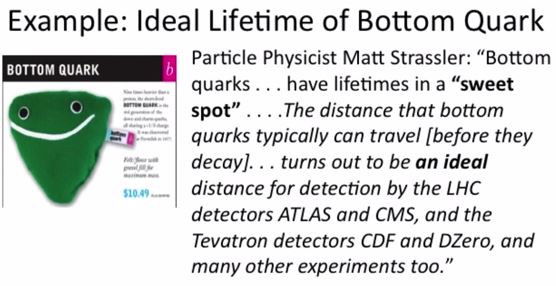
for example, the mass of the bottom quark is finely-tuned for its discoverability by scientists
the tau lepton and the charm quark are similarly fine-tuned for disoverability
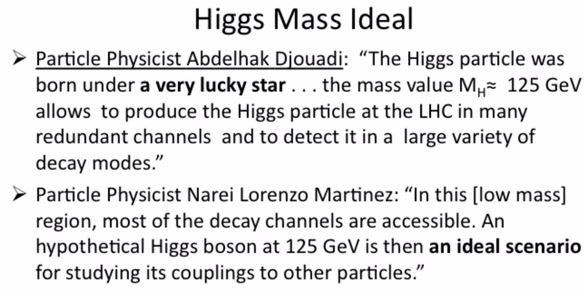
the mass of the Higgs boson is finely-tuned for discoverability and for making further discoveries
Conclusion: the DLO thesis is strongly confirmed – this is an even greater degree of fine-tuning that the already astonishing probabilities of the fine-tuning for complex, embodied intelligent beings
The formalized version of the philosophical argument based on this evidence is impervious with some of the traditional objections to the standard fine-tuning argument
#1 multiverse/selection effect: it is not subject to multiverse / observer selection objections
#2 normalizeability: it is not subject to the McGrew-Vestrup objection because the range of possible values is finite not infinite
#3 falsifiability: it makes falsifiable predictions, and in fact Collins’ earlier calculations of the CMBR discoverability contained an error that falsified the thesis – until he found the error and corrected for it
#4 usefulness: it gives clues about the Creator’s purpose for us, namely that the universe was created for us to be able to do science and find evidence of the Creator’s existence – there is no expectation for us to exercise blind faith, trust in God is meant to be a plausible deduction from the progress of experimental science
Sample slide:
Bottom quark lifetime is finely-tuned for discoverability
And another:
Higgs boson mass is finely-tuned for discoverability
Earlier, I blogged about a Robin Collins lecture on the fine-tuning that allows complex, embodied life to exist. Another must-see lecture. If you are looking for something to study in university, and you have funding, then physics, mathematics and philosophy are the best places to be for a Christian scholar.
This lecture is 29 minutes long, the Q&A is 15 minutes. I highly recommend this lecture to all audiences of all levels of ability, for the simple reasons that apart from the content, this lecture is a how-to clinic in the tone, body language, slides and so on for you to use when trying to be persuasive when making your case. Science is king in this lecture. The scientific method is defined and applied in a winsome way. Making science understandable should be the bread and butter approach to Christian apologetics, and this lecture rivals the Mike Strauss lecture at Stanford University and the Mike Strauss lecture at the University of Texas – Dallas as the ideal lectures for showing that. It’s not just the scientific material that makes this lecture by Collins work, it’s the narrative and the style that make the lecture work.
Robin Collins (PhD, University of Notre Dame, 1993), is professor of philosophy at Messiah College, Grantham, PA specializing in the area of science and religion. He has written over twenty-five articles and book chapters on a wide range of topics, such as the fine-tuning of the cosmos as evidence for the existence of God, evolution and original sin, the Doctrine of Atonement, Asian religions and Christianity, and Bohm’s theory of quantum mechanics. Some of his most recent articles/book chapters are “Philosophy of Science and Religion” in The Oxford Handbook of Science and Religion, “Divine Action and Evolution” in The Oxford Handbook of Philosophical Theology (2009) “The Multiverse Hypothesis: A Theistic Perspective,” in Universe or Multiverse? (Cambridge University Press), and “God and the Laws of Nature,” in Theism or Naturalism: New Philosophical Perspectives (Oxford University Press, forthcoming). He recently received a grant from the John Templeton Foundation to finish a book that presents the case for design based on physics and cosmology, tentatively entitled The Well-Tempered Universe: God, Cosmic Fine-tuning, and the Laws of Nature.
His thesis in one slide:
Fine-tuning for discoverability – the DLO thesis
Summary:
Thesis: the universe is more intelligible than we would expect it by chance
The regular fine-tuning argument says that complex embodied observers are very rare
But the number of highly-discoverable universes that have complex embodied observers is rarer still
Why do we exist in a highly-discoverable universe?
Can we quantify and test discoverability?
Yes: by varying fundamental parameters and seeing how it affects discoverability
Conclusion of his calculations: The Discoverability-Liveability Optimality range is an even smaller range within the Liveablity Optimality range of the standard fine-tuning argument
Fine-tuning #1: the fine structure constant, governs the strength of the electro-magnetic force
If larger, wood-burning fire becomes impossible because fires won’t stay lit, and therefore forging metals becomes unlikely
If smaller, wood-burning fires won’t go out, e.g. – from lightning strikes, so that wood would be less accessible
Other constraints: smaller value decreases effectiveness of light microscopes, drastically lowers efficiency of transformers and motors
Fine-tuning #2: the cosmic microwave background radiation (CMBR), radiation left over from the Big Bang
humans need to discover the CMBR in order to confirm the Big Bang creation out of nothing, and it depends on baryon/pothon ratio
his calculations show that the actual value of CMBR is exactly at the peak for detectability by humans
if baryon/photon ratio larger, CMBR is less discoverable
if baryon/photon ratio smaller, CMBR is less discoverable
Fine-tuning #3: parameters related to subatomic particles are fine-tuned for their discovery and usefulness, e.g. – the bottom quark, the charm quark, the tau lepton and the Higgs Boson
the lifetime of the particles affects their usefulness to scientists who want to investigate the Standard Model of physics
decay rates of these subatomic particles are related to several of the finely-tuned parameters
for example, the mass of the bottom quark is finely-tuned for its discoverability by scientists
the tau lepton and the charm quark are similarly fine-tuned for disoverability
the mass of the Higgs boson is finely-tuned for discoverability and for making further discoveries
Conclusion: the DLO thesis is strongly confirmed – this is an even greater degree of fine-tuning that the already astonishing probabilities of the fine-tuning for complex, embodied intelligent beings
The formalized version of the philosophical argument based on this evidence is impervious with some of the traditional objections to the standard fine-tuning argument
#1 multiverse/selection effect: it is not subject to multiverse / observer selection objections
#2 normalizeability: it is not subject to the McGrew-Vestrup objection because the range of possible values is finite not infinite
#3 falsifiability: it makes falsifiable predictions, and in fact Collins’ earlier calculations of the CMBR discoverability contained an error that falsified the thesis – until he found the error and corrected for it
#4 usefulness: it gives clues about the Creator’s purpose for us, namely that the universe was created for us to be able to do science and find evidence of the Creator’s existence – there is no expectation for us to exercise blind faith, trust in God is meant to be a plausible deduction from the progress of experimental science
Sample slide:
Bottom quark lifetime is finely-tuned for discoverability
And another:
Higgs boson mass is finely-tuned for discoverability
Earlier, I blogged about a Robin Collins lecture on the fine-tuning that allows complex, embodied life to exist. Another must-see lecture. If you are looking for something to study in university, and you have funding, then physics, mathematics and philosophy are the best places to be for a Christian scholar.



 WINTERY KNIGHT