Tag Archives: Dependency

Republicans propose expansion of 529 college savings plans

I guess by now everyone has heard about Obama’s plan to eliminate college savings plans.

The left-leaning New York Times reported on it:

President Obama is proposing a radical change to the 529 college savings plans held by millions of families, which would require those who use them to rethink their approach to college savings.

As part of his plan to simplify the tax code and help the middle class, one of the 529 plan’s most attractive benefits would be eliminated: Money could no longer be withdrawn tax-free. (The new rules would apply only to new contributions.)

The accounts, many of which are run by the states, allow people to make contributions that grow tax-free. The money can be withdrawn without the paying of capital gains taxes as long as the proceeds are used for education expenses. Many states provide state income tax deductions for contributions as well.

The proposal has now been withdrawn after a huge uproar. The real question is, why would he propose such a stupid thing?

First, it’s important to understand that government raises the cost of higher education with subsidies, which the Democrats favor:

A new study by Dennis Epple, Richard Romano, Sinan Sarpca and Holger Sieg for the National Bureau of Economic Research suggests that the impact of these aid programs is clearly different from what federal policy makers intended. “We show that private colleges game the federal financial aid system,” they conclude. Every dollar in new financial aid to students leads to about 40 cents less spent by the colleges on institutional financial aid — so students benefit far less than federal policy makers intended.

In 1987, Secretary of Education William Bennett argued that more federal aid leads to higher tuitions, enabling schools to increase spending. This seems broadly consistent with the latest research results. The net attendance impact of these federal programs, according to the study for NBER, is “modest.” In short, these programs haven’t substantially spurred student access to colleges, all the while burdening taxpayers and student borrowers.

The ballooning federal aid increases schools’ spending. The researchers don’t analyze changes in university spending, but an examination of other evidence suggests that money isn’t going primarily into improving instruction. Colleges have gone on a building spree (financed in part by amassing large debt — more than $220 billion at schools whose bonds are rated by Moody’s alone), and pay and perquisites for top university administrators has risen sharply.

The Democrats already want higher education to be out of reach – that’s why they keep increasing subsidies. So, eliminating college savings plans is in line with this goal of putting higher education out of reach. It’s another way to cause people to have fewer children, something that Democrats are very passionate about. After all, if you can’t pay for higher education for four kids, you’ll only have two. Democrats have this terrible fear of over-population, and it drives a lot of their policies, including abortion.

But that’s not all – there’s another reason to stop people from saving for college.

Second, it stops people from saving their own money:

Megan McArdle suggests, quite reasonably, that this is a desperate move by those who need to finance ever bigger government and are simply going where the money is: the vast American middle class. You can understand why the champions of big government would be slavering over the very thing that defines the middle class, its savings. As she points out, 529s are not the first target. There have already been trial balloons about raiding 401(k)s and IRAs. The truly committed leftist looks upon our private savings as a vast reserve of capital unfairly withheld from its proper function of servicing the needs of the state.

I think that’s the real explanation. This is not so much a rational calculation about how to finance the behemoth state. This is an admission by a man who has no more election campaigns to run, and therefore no pragmatic constraints, about his real outlook and real preferences. A president who just a few weeks ago hailed the triumph of a supposed “middle-class economics” is revealing his hatred and contempt for the middle class.

Republicans would like to see people saving more and more money so that they are less and less dependent on the government. This is because the more independent you are, the more fre you are – and Republicans are for personal liberty.

This is GOP Congressman Lynn Jenkins:
Kansas Congresswoman Lynn Jenkins

Here is her Republican response to Obama’s proposal to eliminate 529s:

Good morning. I’m Lynn Jenkins, Congresswoman from the Second District of Kansas and Vice-Chair of the House Republican Conference.

This is the time of year when high school seniors are putting the final touches on their college applications. That means it’s also the time when families are preparing to start paying for that education — whether it’s a 4-year college, community college, or a technical school. (Scroll down for video of these remarks.)

As a parent with two children in college, I know this can be one of the most rewarding, and at the same time challenging, aspects of being a parent — particularly at a time when costs are going up while wages stay about the same. All told, Americans now owe more than $1 trillion in student loan debt.

And so in the new Congress, Republicans are working to lower costs for middle-class families and empower folks with bottom-up solutions that help prepare you for the future.

That’s why, this week, I introduced a bipartisan plan to expand popular 529 college savings accounts.

As you know, these 529 plans were created to help middle-class families save and plan for college. Many parents open them not long after their children are born. And ever since Congress allowed folks to withdraw from these accounts tax-free for college expenses, 1 million account holders have turned into 12 million.

Unfortunately, instead of expanding 529s, the president recently proposed raising taxes on college savings. If implemented his scheme would have turned back the clock on middle-class families, and taken money from your savings to pay for more government. This would have discouraged families from using 529s, meaning less savings, more debt, and more government dependence.

This proposal increases middle-class independence from the government, and makes people more free to work, earn, save and chart their own course. It’s different from the Democrat proposals which increase dependence on government and reduces liberty.
As Christianity declines in Europe, churches are put up for sale

This sad story is from the Wall Street Journal.

Excerpt:

Two dozen scruffy skateboarders launched perilous jumps in a soaring old church building here on a recent night, watched over by a mosaic likeness of Jesus and a solemn array of stone saints.

This is the Arnhem Skate Hall, an uneasy reincarnation of the Church of St. Joseph, which once rang with the prayers of nearly 1,000 worshipers.

It is one of hundreds of churches, closed or threatened by plunging membership, that pose a question for communities, and even governments, across Western Europe: What to do with once-holy, now-empty buildings that increasingly mark the countryside from Britain to Denmark?

[…]The closing of Europe’s churches reflects the rapid weakening of the faith in Europe, a phenomenon that is painful to both worshipers and others who see religion as a unifying factor in a disparate society.

[…]The Church of England closes about 20 churches a year. Roughly 200 Danish churches have been deemed nonviable or underused. The Roman Catholic Church in Germany has shut about 515 churches in the past decade.

But it is in the Netherlands where the trend appears to be most advanced. The country’s Roman Catholic leaders estimate that two-thirds of their 1,600 churches will be out of commission in a decade, and 700 of Holland’s Protestant churches are expected to close within four years.

[…]As communities struggle to reinvent their old churches, some solutions are less dignified than others. In Holland, one ex-church has become a supermarket, another is a florist, a third is a bookstore and a fourth is a gym. In Arnhem, a fashionable store called Humanoid occupies a church building dating to 1889, with racks of stylish women’s clothing arrayed under stained-glass windows.

In Bristol, England, the former St. Paul’s church has become the Circomedia circus training school. Operators say the high ceilings are perfect for aerial equipment like trapezes.

In Edinburgh, Scotland, a Lutheran church has become a Frankenstein-themed bar, featuring bubbling test tubes, lasers and a life-size Frankenstein’s monster descending from the ceiling at midnight.

Jason MacDonald, a supervisor at the pub, says he has never heard complaints about the reuse. “It’s for one simple reason: There are hundreds and hundreds of old churches and no one to go to them,” Mr. MacDonald said. “If they weren’t repurposed, they would just lie empty.”

Many churches, especially smaller ones, are becoming homes, and that has spawned an entire industry to connect would-be buyers with old churches.

The churches of England and Scotland list available properties online, with descriptions worthy of a realty firm. St. John’s church in Bacup, England, for example, is said to feature “a lofty nave as well as basement rooms with stone-vaulted ceilings,” and can be had for about $160,000.

There are many reasons why Christianity has declined in Europe, but surely the widespread embrace of left-wing economic policies – even by evangelical Christians – is one of the largest.

Here’s a fairly recent paper (PDF) that explains it:

What accounts for cross-national variation in religiosity as measured by church attendance and non-religious rates? Examining answers from both secularization theory and the religious economy perspective, we assert that cross-national variation in religious participation is a function of government welfare spending and provide a theory that links macro-sociological outcomes with individual rationality. Churches historically have provided social welfare. As governments gradually assume many of these welfare functions, individuals with elastic preferences for spiritual goods will reduce their level of participation since the desired welfare goods can be obtained from secular sources. Cross-national data on welfare spending and religious participation show a strong negative relationship between these two variables after controlling for other aspects of modernization.

I have many friends in the UK who classify themselves as evangelical Christians. They almost all embrace moderate to leftist economics, and they complain to me about why the church is in decline, why there is no interest in apologetics, why they can’t find Christian girlfriends, why they can’t get speaking engagements. The answer is, of course, that by majoring only in theology and apologetics, they have crafted the rope that their secular allies in government are using to hang them. Leftism is embraced by European Christians in part because they don’t want to be like those dastardly Americans with their free enterprise system and their rule of law and their private property and their law-abiding gun ownership.

It just goes to show you why Christianity suffers when we focus on piety at the expense of practicality. Too much A. W. Tozer, not enough F.A. Hayek. I doubt my well-meaning UK Christian friends – who are so proud of their laughable NHS health care – even know who F.A. Hayek is. To think that Lady Thatcher ones brandished “The Constitution of Liberty” by F.A. Hayek and declared “this is what we believe!”. But ordinary UK Christians do not believe what she believes, and now they must reap what they sowed with their knee-jerk rejection of the free enterprise system. Ignorance of economics killed Christianity in Europe, and pious, risk-averse Christians were willing participants in the murder.

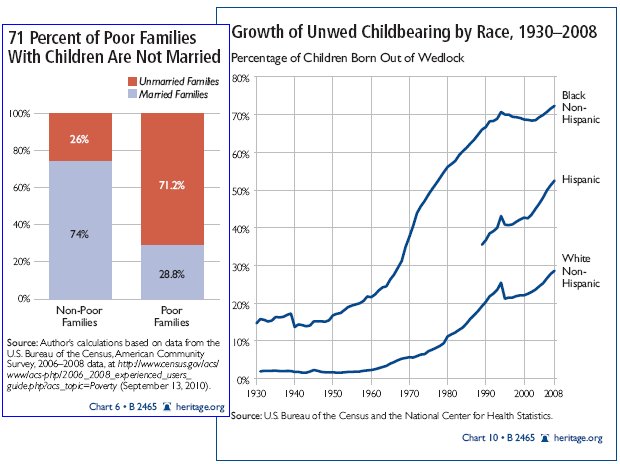
The biggest driver of income inequality is single motherhood

Welfare and out-of-wedlock births

Indian economist Aparna Mathur, whose work I’ve featured here before, writes about it in Forbes magazine.

Excerpt:

The fabric of our society is changing. In 1980, approximately 78 percent of families with children were headed by married parents. In 2012, married parents headed only 66 percent of families with children. In a new report, Bradford Wilcox and Robert Lerman explore the role of family structure with new data and analysis, and document how this retreat from marriage is not simply a social and cultural phenomenon. It has important economic implications for, amongst others, men’s labor force participation rates, children’s high school dropout rates and teen pregnancy rates. Since these factors are highly correlated with economic opportunity and the ability to move up the income ladder, this suggests that income inequality and economic mobility across generations are critically influenced by people’s decisions and attitudes towards marriage. Understanding the role of family structure is therefore key to understanding the big economic challenges of our time.

[…]Wilcox and Lerman document how the shift away from marriage and traditional family structures has had important consequences for family incomes, and has been correlated with rising family-income inequality and declines in men’s labor force participation rates. Using data from the Current Population Survey, the authors find that between 1980 and 2012, median family income rose 30 percent for married parent families, For unmarried parents, family incomes rose only 14 percent.

These differential patterns of changes in family income have exacerbated family-income inequality. Since unmarried parent families generally expand the ranks of low-income families, while high-income, high-education adults increasingly marry partners from similar socioeconomic backgrounds, inequality trends are worsened. Comparing the 90th percentile families to the 10th percentile families in 2012, the top 10 percent had incomes that were more than 11 times higher than the bottom 10 percent. However, if we restrict the sample to married families with children, the ratio drops to nearly 7, suggesting that within married families, income inequality is less stark. The authors estimate that approximately 32 percent of the growth in family-income inequality between 1979 and 2012 is associated with changes in family structure. Other research, studying the period 1968-2000, finds that the changing family structure, accounted for 11 percent of the rise widening of the income gap between the bottom and top deciles.

Another interesting observation relates to the trends in employment participation by men. The Wilcox-Lerman study finds that for married fathers, employment and participation rates have remained consistently higher than for married men with no children and unmarried men with no children. The authors speculate that between 1980 and 2008, about 51 percent of the decline in men’s employment rates can be associated with the retreat from marriage.

And why is single motherhood so ascendant today? Well, part of it is the loss of morality caused by secularism. If there is no God, then there is no way we ought to be, so let’s just do whatever makes us feel good, and pass the bill to the taxpayers. That only works, though, if we elect politicians who want taxpayers who are responsible to pay for the ones who are irresponsible.

So have we done that? Yes – Robert Rector explains in The Daily Signal.

He writes:

It is no accident that the collapse of marriage in America largely began with the War on Poverty and the proliferation of means-tested welfare programs that it fostered.

When the War on Poverty began, only a single welfare program—Aid to Families with Dependent Children —assisted single parents.

Today, dozens of programs provide benefits to families with children, including the Earned Income Tax Credit, Temporary Assistance for Needy Families, the Women, Infants and Children food program, Supplemental Security Income, food stamps, child nutrition programs, public housing and Section 8 housing, and Medicaid.

Although married couples with children can also receive aid through these programs, the overwhelming majority of assistance to families with children goes to single-parent households.

The burgeoning welfare state has promoted single parenthood in two ways. First, means-tested welfare programs such as those described above financially enable single parenthood. It is difficult for single mothers with a high school degree or less to support children without the aid of another parent.

Means-tested welfare programs substantially reduce this difficulty by providing extensive support to single parents. Welfare thereby reduces the financial need for marriage. Since the beginning of the War on Poverty, less-educated mothers have increasingly become married to the welfare state and to the U.S. taxpayer rather than to the fathers of their children.

As means-tested benefits expanded, welfare began to serve as a substitute for a husband in the home, and low-income marriage began to disappear. As husbands left the home, the need for more welfare to support single mothers increased. The War on Poverty created a destructive feedback loop: Welfare promoted the decline of marriage, which generated a need for more welfare.

A second major problem is that the means-tested welfare system actively penalizes low-income parents who do marry. All means-tested welfare programs are designed so that a family’s benefits are reduced as earnings rise. In practice, this means that, if a low-income single mother marries an employed father, her welfare benefits will generally be substantially reduced. The mother can maximize welfare by remaining unmarried and keeping the father’s income “off the books.”

For example, a single mother with two children who earns $15,000 per year would generally receive around $5,200 per year of food stamp benefits. However, if she marries a father with the same earnings level, her food stamps would be cut to zero.

So you see, the thing the left complains about the most is actually the thing they do the most to cause. They are all about taxpayer-funded welfare programs and growing government to make more and more people dependent. They are causing the income inequality and then complaining about what they cause.