
Tag Archives: Deficit

John Boehner stands up for spending cuts and job creation

Obama went on television last night to argue for more wasteful spending and higher taxes on job creators. I guess he thinks that 1.65 trillion dollar deficits and a 9.2% unemployment rate is acceptable for working families, as long as he isn’t personally affected by it.

The Wall Street Journal did not like Obama’s speech at all.

Excerpt:

The Obama Presidency has been unprecedented in many ways, and last night we saw another startling illustration: A President using a national TV address from the White House to call out his political opposition as unreasonable and radical and blame them as the sole reason for the “stalemate” over spending and the national debt.

We’ve watched dozens of these speeches over the years, and this was more like a DNC fund-raiser than an Oval Office address. Though President Obama referred to the need to compromise, his idea of compromise was to call on the public to overwhelm Republicans with demands to raise taxes. He demeaned the GOP for protecting, in his poll-tested language, “millionaires and billionaires,” for favoring “corporate jet owners and oil companies” over seniors on Medicare, and “hedge fund managers” over “their secretaries.” While he invoked Ronald Reagan, the Gipper would never have used such rhetoric about his opposition on an issue of national moment.

[…]Apart from shifting blame for any debt default, the speech was also an attempt to inoculate Mr. Obama in case the U.S. loses its AAA credit rating. He cleverly, if dishonestly, elided the credit-rating issue with the debt-ceiling debate. But he knows that Standard & Poor’s has said that it may cut the U.S. rating even if Congress moves on the debt ceiling. Mr. Obama wants to avoid any accountability for the spending blowout of the last three years that has raised the national debt held by the public—the kind we have to pay back—from 40% in 2008 to 72% next year, and rising. This will be the real cause of any downgrade.

Speaker John Boehner made clear in his speech that the GOP doesn’t want a default but wants more genuine cuts in spending. Mr. Obama is betting his rhetoric will cause the public to turn against the GOP, but we wonder if voters will be persuaded by a man whose concept of leadership is the politics of blame.

Thankfully, John Boehner isn’t going to let Obama get away with wrecking the economy any more.

Here’s Boehner’s response:

The transcript is here.

Obama’s Monday night speech was insulting, deceptive, vindictive and divisive. He doesn’t know how to solve a problem by getting people who are opposed to him to buy into a compromise plan. Instead, he just goes in front of cameras and insults the people he has to work with. That is not the right way to get people to work together. Imagine if a manager in a private company called a press conference to excoriate some people on a different team in that company. Is that any way to get people working together to solve a problem? To point fingers at your co-workers and poison the well? It’s juvenile. Where is his plan? How is he solving the problem?

The only people I see solving the problem are intelligent people like Paul Ryan, John Campbell, Tom Price, Tom McClintock, Mike Simpson, Ken Calvert and Tom Cole. People who work weekends developing solutions. People who understand how to write policies. People with degrees in economics, business and finance. People with private sector experience running businesses and creating jobs. Obama isn’t one of those people. Obama just reads a teleprompter. He doesn’t know how to create jobs – he never did it before becoming President. So why did we elect him?
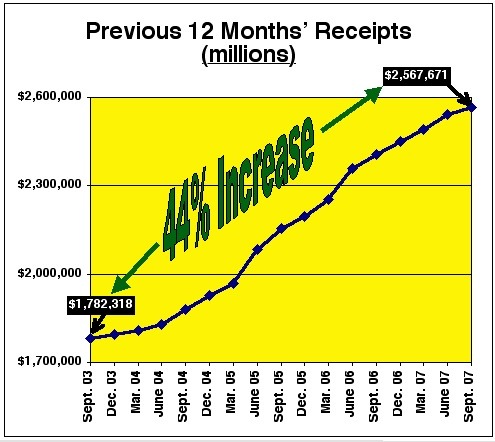
Bush’s tax cuts led to a 44% increase in revenues from 2003 to 2007

Federal Receipts 2003 through 2007

From Newsbusters. It turns out that Bush’s tax cuts in 2001 and 2003 were not responsible for adding to the deficit. They actually increased the amount of tax money being collected, as the economy grew, and more jobs were created. People pay more in taxes when they have jobs.

Excerpt:

The graph doesn’t show collections tanking, does it? Instead, the graph shows that collections increased by 44%, or almost $800 billion, in four years. Adding up the individual increments in each of the four years compared to 2003 (2004 – $98B; 2005 – $371B; 2006 – $624B; 2007 – $785B; 2008, not shown, treating IRS stimulus payments as outlays instead of negative receipts – $835B), what really happened is that in the five full fiscal years after George W. Bush got the across-the-board and investment-related tax cuts he had been pushing for since taking office in 2001, the cumulative increase in tax collections was over $2.7 trillion.

Doubtless, the static analysis crowd will claim that collections would have been even higher (I guess by a cumulative $1.6 trillion, given the AP’s Democratic Party talking point above) if the Bush cuts hadn’t been enacted. Two words, guys: Prove it. Two follow-up words: You can’t.

We can argue all day long about the how much of the increase in collections was due to the incentive effects of the tax cuts and how of the improvement might have occurred anyway, but no one can credibly act as if it’s an established fact that the Bush cuts somehow caused collections to go $1.6 trillion in the opposite direction. There is absolutely no proof for this contention, and plenty of evidence that the Bush cuts jump-started an economy and federal collections, both of which had been flat or declining during the two years leading up to mid-2003. The more reasonable conclusion to reach is that the country would already be dead in the water if the Bush tax cuts hadn’t passed in 2003. Instead, the wire service hopes that its “Bush tax cuts cost us” meme will be gullibly recited during the next several days at its subscribing newspaper, TV, and radio outlets. “Disgraceful” doesn’t even begin to describe this pathetic promotion of self-evident falsehood.

The fact is that the federal budget was one good year away from balancing after the $162 deficit reported in fiscal 2007. Unfortunately, that was the last budget passed by a Republican-controlled Congress, and it was the only year which showed a modest increase in overall spending. Beginning in 2007 with effects beginning in fiscal 2008, the House and Senate controlled by Nancy Pelosi and Harry Reid began increasing spending at rates far beyond what profligate Republicans spent earlier in the decade, and, unfortunately, Bush 43 made no real effort to stop them…

Read the whole thing.

UPDATE: Reggie sent me this article showing that the Reagan tax cuts also increased revenues.

Excerpt:

In 1980, the last year before the tax cuts, tax revenues were $956 billion (in constant 1996 dollars).

Revenues exceeded that 1980 level in eight of the next 10 years. Annual revenues over the next decade averaged $102 billion above their 1980 level (in constant 1996 dollars).

The graph is here.

When you get people to start engaging in the economy, you can collect more taxes from them. They engage when they think that they will be able to keep more of what they make from their labor.

On “Face the Nation”: Marco Rubio says the President has no plan

Marco Rubio takes on Obama spokesman Bob Schieffer on CBS’ “Face the Nation”. (H/T Mariangela)

In this speech on the floor of the Senate, he lays the whole debt problem and the solutions.

I just wish that the voters would compare Obama’s class-warfare rhetoric and his performance on job create with Marco Rubio’s clear explanation of the incentives and motives of job creators. We don’t need redistribution of wealth, we need people to have jobs. When people have jobs, they feel comfortable to investing or spend money.