The policies of this administration make it risky to lend money, with Washington politicians coming up with one reason after another why borrowers shouldn’t have to pay it back when it is due, or perhaps not pay it all back at all. That’s called “loan modification” or various other fancy names for welshing on debts. Is it surprising that lenders have become reluctant to lend?
Private businesses have amassed record amounts of cash, which they could use to hire more people — if this administration were not generating vast amounts of uncertainty about what the costs are going to be for ObamaCare, among other unpredictable employer costs, from a government heedless or hostile toward business.
As a result, it is often cheaper or less risky for employers to work the existing employees overtime, or to hire temporary workers who are not eligible for employee benefits. But lack of money is not the problem.
Those who are true believers in the old-time Keynesian economic religion will always say that the only reason creating more money hasn’t worked is because there has not yet been enough money created. To them, if QE2 hasn’t worked, then we need QE3. And if that doesn’t work, then we will need QE4, etc.
Like most of the mistakes being made in Washington today, this dogmatic faith in government spending is something that has been tried before — and failed before.
[…]It is not politically possible for either the Federal Reserve or the Obama administration to leave the economy alone and let it recover on its own.
Both are under pressure to “do something.” If one thing doesn’t work, then they have to try something else. And if that doesn’t work, they have to come up with yet another gimmick.
All this constant experimentation by the government makes it more risky for investors to invest or employers to employ, when neither of them knows when the government’s rules of the game are going to change again. Whatever the merits or demerits of particular government policies, the uncertainty that such ever-changing policies generate can paralyze an economy today, just as it did back in the days of FDR.
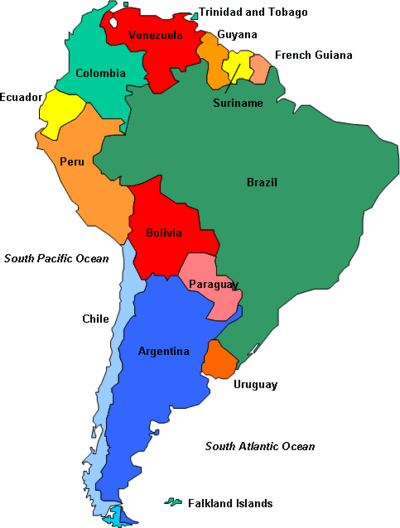
As the U.S. languishes, Chile posted a head-turning 15.2% yearly gain in GDP in March, and forecasts for the year are rising. Why can’t we do that here?
A year ago, Chile lay in rubble, victim of the world’s fifth most powerful earthquake. So Chile’s 15.2% growth is a big bounce from a bad setback.
But it shouldn’t be dismissed as an anomaly. It’s a showy number, but not the only one.
The same day Chile released its data, Goldman Sachs raised its 2011 growth forecast for the country to 6.4% from 6%. In its annual regional business index, Latin Business Chronicle ranked Chile as having the best business climate in Latin America in 2011.
Such numbers are so alien to the U.S. in the economically debilitated Obama era, it makes sense to look at what Chile has done.
First, Chile’s policies for long-term growth were put into effect in the 1980s by the group of Milton Friedman-inspired economists known as the Chicago Boys.
Under them, Chile’s pension privatization cost nothing and left the country with no net debt. The private funds now hold assets worth 90% of GNP ($185 billion) — capital used to develop the country. Already, Chile’s education and infrastructure are the best in Latin America as a result.
Second, there’s free trade, of which Chile is a global champion, signing at least 58 treaties to gain access to 2 billion customers.
That’s a big reason Chile is close to full employment and is scrambling to attract growth-hungry U.S. entrepreneurs — and getting them.
[…]Bamrud says Chile has been turning heads with investors the past year and a half because of its emphasis on improving its corporate environment, its tax regime and its economic freedom, all of which rate highly.
“Chile has always been held out as a model for Latin America, but the reality is … it’s now a model for the U.S.,” he said.
Corporate taxes are the second lowest in Latin America at 18%, behind Paraguay’s 10%. The Latin average is 28%.
Meanwhile, Goldman Sachs’ chief economist for Latin America, Alberto Ramos, says Chile has wisely fostered growth by reducing the size of government and not printing too much money.
In 2011, it cut government spending to 5% of GDP, or $700 million, more than its projected 5.5%. So GDP has room to grow 6.4%, rather than 6% as first estimated.
Chile is doing the exact opposite of the socialist Barack Obama. Chile is cutting government spending, removing tariffs, enacting free trade deals, and cutting corporate taxes. Businesses and investors are moving there, and there are not enough people to work at all the jobs that are being created. Meanwhile, in Venezuela, communist dictator Hugo Chavez just reported 0.6% gain in the last quarter of 2010.
May Day — socialists’ paean to class warfare — evokes memories of Soviet tanks in Red Square and leftist radicals rioting. But Chile celebrates the actual empowerment of workers.
May 1 marks the 30 years since Chile became the first nation to privatize its social security system. By turning workers into investors, the move solved an entitlement crisis much like the one America faces today.
“I like symbols, so I chose May Day as the birth date of Chile’s ‘ownership society’ that allowed every worker to become a small capitalist,” wrote Jose Pinera, former secretary of labor and social security and the architect of this pension revolution. He is now a senior fellow at the Cato Institute in Washington, D.C.
What he designed has succeeded beyond all expectations. Yet Congress remains reluctant to adopt anything like it, despite efforts by Presidents Bill Clinton and George W. Bush to partially privatize an American system.
Instead of paying a 12.4% Social Security tax as we do here, Chilean workers must pay in 10% of their wages (they can send up to 20%) to one of several conservatively managed and regulated pension funds. From the accumulated savings, they get a life annuity or make programmed withdrawals (inheriting any funds left over).
Over the last three decades these accounts have averaged annual returns of 9.23% above inflation. By contrast, U.S. Social Security pays a 1% to 2% (theoretical) return, and even less for new workers.
[…]In 2005, New York Times reporter John Tierney worked out his own Social Security contributions on the Chilean model and found that his privatized pension would have been $53,000 a year plus a one-time payout of $223,000. The same contributions paid into Social Security would have paid him $18,000.
The biggest threat to American solvency is the growth in entitlement spending on Medicare, Medicaid and Social Security. The Democrats are stubbornly opposed to reforming these benefits, because they like the idea of transferring wealth from children, who cannot vote, to people who depend on government hand-outs, who can vote. And the best part of their scheme is that young people can be easily indoctrinated by the public schools to believe that have their future mortgaged away to buy votes is a good idea. It’s really very sad and unfair to young people.
The number of Americans filing for jobless aid rose to an eight-month high last week and productivity growth slowed in the first quarter, clouding the outlook for an economy that is struggling to gain speed.
While the surprise jump in initial claims for unemployment benefits was blamed on factors ranging from spring break layoffs to the introduction of an emergency benefits program, economists said it corroborated reports this week indicating a loss of momentum in job creation.
New claims for state jobless benefits rose 43,000 to 474,000, the highest since mid-August, the Labor Department said on Thursday. Economists had expected claims to fall.
[…]Other reports this week showed weaker employment growth in the manufacturing and services sectors in April and a step back in private hiring, suggesting Friday’s closely watched data could prove weaker than economists have been expecting.
An industry survey released on Thursday found hiring by U.S. small businesses almost ground to a halt in April.
This isn’t surprising. Government spending takes money OUT of the private sector and puts money IN to the non-productive public sector.
Indeed, President Obama’s stimulus bill failed by its own standards. In a January 2009 report, White House economists predicted that the stimulus bill would create (not merely save) 3.3 million net jobs by 2010. Since then, 3.5 million more net jobs have been lost, pushing the unemployment rate above 10 percent.[1] The fact that government failed to spend its way to prosperity is not an isolated incident:
During the 1930s, New Deal lawmakers doubled federal spending–yet unemployment remained above 20 percent until World War II.
Japan responded to a 1990 recession by passing 10 stimulus spending bills over 8 years (building the largest national debt in the industrialized world)–yet its economy remained stagnant.
In 2001, President Bush responded to a recession by “injecting” tax rebates into the economy. The economy did not respond until two years later, when tax rate reductions were implemented.
In 2008, President Bush tried to head off the current recession with another round of tax rebates. The recession continued to worsen.
Now, the most recent $787 billion stimulus bill was intended to keep the unemployment rate from exceeding 8 percent. In November, it topped 10 percent.[2]
So obviously government spending reduces employment – it could never happen any other way. And everyone who has ever held a job in private industry knows this. Government spending only works in the university classrooms, where the right answer is always the answer that makes academic wordsmiths feel good about themselves. Good intentions are the right answer in the classroom – good results are the right answer in the free market.
Drilling moratorium = higher gas prices = low consumer confidence
Consumer confidence dropped last week to the lowest level in more than a month as rising fuel costs squeezed American household budgets.
The Bloomberg Consumer Comfort Index decreased to minus 46.2 in the week ended May 1, the lowest level since the end of March, from minus 45.1 the prior period. Another report showed claims for unemployment benefits unexpectedly surged last week, raising the risk the improvement in the jobs market has stalled.
Stocks dropped and Treasury securities rose on concern that rising expenses, including the highest gasoline prices in almost three years, may prompt companies and households to cut back on spending. The reports bolster the arguments of Federal Reserve policy makers like Chairman Ben S. Bernanke who’ve said job growth is too slow to remove record monetary stimulus.
Obama has been printing money in order to goose people into spending more instead of saving. The problem with devaluing the currency, which is what he is doing, occurs when you reach the stage where consumers stop spending because prices must increase when you print money. We are now at that stage, and our economy is about to go down the drain. Interest rates will have to rise, which is going to slow economic growth even more. This is all known.
When you don’t understand economics, you take the whack-a-mole approach to fixing the economy. That’s what Obama has done. He keeps trying to control things from the top instead of trusting businesses and consumers with their own money. Everything Obama does makes the economy worst. He doesn’t know what he is doing, and he won’t listen to people who do know. His baseless confidence (arrogance) should have been a red flag to the American people. There is nothing worse than hiring someone who thinks that they know everything, but who hasn’t the qualifications to run a lemonade stand.

 WINTERY KNIGHT