
Tag Archives: Debt

Young workers pay into entitlements that will be bankrupt when they retire

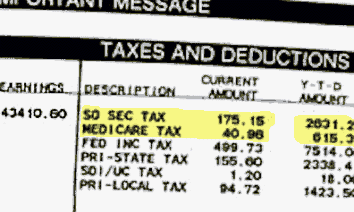
Payroll taxes for Social Security and Medicare

Doug Ross from Director Blue has a public service announcement for young people. Even if they are able to find jobs, they can look forward to paying a large chunk of their income to the government for retirement programs, Social Security and Medicare, that will be bankrupt by the time they are ready to retire.

Excerpt:

Ever seen these numbers on your pay stub? The numbers I’ve highlighted?

That money is being taken from you — or, more properly, it’s being stolen from you — to fund a myth. A mirage.

You’re never going to see a dime of that “Social Security Retirement Insurance” you’re paying for.

You’ll never a see a nickel of that “Medicare Health Care Insurance” either.

That money is being taken from your pay — your livelihood — to fund a system that will be bankrupt in less than a dozen years.

Oh, and it’s not me saying that: Medicare’s own actuary, Richard Foster, is. Social Security is in a similar situation, according to Treasury Secretary Timothy F. Geithner, who serves as the system’s senior trustee.

Suffice it to say that these systems will actually go broke far sooner than anyone’s really admitting because the economy remains poor and appears to be slowing down even further.

My public service message is this: this money is being taken from your pay in exchange for a promise that will be broken in just a few years. You’ll never see that money again. And it is the government — the government, not “the rich”, not the Koch brothers, not the oil companies — that is ripping you off.

It is the government, not corporations, spending untold billions on “green energy” scams like Solyndra. It is the government, not “the rich”, slathering EBT-welfare cards around like confetti. And it is the government, not “the Tea Party”, that is promoting illegal immigration and offering huge financial benefits to those in the country illegally. All with your money.

Medicare is the one that is really in trouble, as Forbes magazine explains:

The Trustees of the Medicare program have released their annual report on the solvency of the program. They calculate that the program is “expected to remain solvent until 2024, the same as last year’s estimate.” But what that headline obfuscates is that Obamacare’s tax increases and spending cuts are counted towards the program’s alleged “deficit-neutrality,” Medicare is to go bankrupt in 2016. And if you listen to Medicare’s own actuary, Richard Foster, the program’s bankruptcy could come even sooner than that.

See, the funny, funny thing about young people is that they are almost complete uninformed about basic economics. They don’t know where jobs come from. They don’t know where the money that the government spends come from. They don’t know how much the government spends. They don’t know about our debt-to-gdp ratio. Their view of economics is all determined by socialist public schools and socialist Hollywood and socialist mainstream media. It’s all emotional for them. They have feelings that the rich are greedy, and must be taxed, and that the government is Santa Claus, helping the poor with money from the rich. It’s the ultimate system of slavery, except the slaves want to be enslaved.

Will raising taxes on the rich help the economy and create more jobs?

The presidents of my two favorite think tanks, Arthur Brooks (AEI) and Edwin Feulner (Heritage) explain in this USA Today editorial.

Excerpt: (links removed)

First, there is no evidence that tax increases will actually solve our troubles. On the contrary, years of data from around the world show that when nations try to solve a fiscal crisis primarily by raising tax revenues, they tend to fail. In contrast, fiscal approaches based on entitlement reform and spending cuts tend to succeed.

American Enterprise Institute economists Kevin Hassett, Andrew Biggs and Matthew Jensen examined the experiences of 21 Organization for Economic Cooperation and Development (OECD) countries between 1970 and 2007. They found that countries with successful fiscal reforms, on average, closed 85% of their budget gaps with spending cuts. The countries with failed reforms, on average, relied at least 50% on tax increases. President Obama’s strategy falls firmly in the latter camp. After discounting the accounting tricks that create fictitious spending cuts, the president’s plan would impose about $3 in tax hikes for every $1 in spending cuts.

That is, his approach would probably land America in the “failed attempt” column. Five years down the line, we would be in the same fiscal mess we are in today, just with higher taxes and a bigger government.

Second, tax hikes aimed at small segments of the population wouldn’t raise much in revenues. Consider the “Buffett Rule” that the president spent many months promoting. According to the Joint Committee on Taxation, it would raise about $47 billion over a decade. The federal government currently spends about $4 billion more per day than it takes in. The Buffett Rule, then, would raise about enough next year to cover 28 hours of government overspending. Heritage Foundation economist Curtis Dubay finds that closing the deficit solely by raising the two highest tax brackets would require hiking them to 159% and 166%, respectively.

Third, as economists and business executives have noted repeatedly, raising taxes on families earning over $250,000 per year is effectively a massive tax hike on small businesses. Most small businesses today organize as S-corporations or other pass-through entities; their income is taxed as personal income. A study by Ernst and Young shows that Obama’s proposed tax hike would force these small businesses to eliminate about 710,000 jobs. Moreover, these households already bear a great deal of tax liability. According to the most recent Internal Revenue Service data, those earning $250,000 and above — roughly 2% of all taxpayers — earn 22% of income, but pay 45% of all federal income taxes.

Simply put, increasing tax rates on the wealthy is not a serious approach to solving America’s fiscal woes. The problem is purely one of excessive spending, not inadequate taxing.

Revenues haven’t changed substantially over the last decade, but government spending is way, way up. That’s what’s causing us to go into debt – massive government spending on turtle tunnels and Solyndra. We can do better than socialism.

Mark Steyn: Americans must choose between low taxes and big government

I noticed that John Hawkins at Right Wing News had come up with his list of the top conservative commentators, and guess who is at the top of the list? Canadian writer Mark Steyn.

Here’s Mark Steyn writing in Investors Business Daily.

Excerpt:

According to the most recent (2009) OECD statistics: Government expenditures per person in France, $18,866.00; in the U.S., $19,266.00. That’s adjusted for purchasing-power parity, and yes, no comparison is perfect, but did you ever think the difference between America and the cheese-eating surrender monkeys would come down to quibbling over the fine print?

In that sense, the federal debt might be better understood as an American Self-Delusion Index, measuring the ever-widening gap between the national mythology (a republic of limited government and self-reliant citizens) and the reality (a 21st century cradle-to-grave nanny state in which Democrats boast,  “Government is the only thing we do together”).

Generally speaking, functioning societies make good-faith efforts to raise what they spend, subject to fluctuations in economic fortune: Government spending in Australia is 33.1% of GDP, and tax revenues are 27.1%. Likewise, government spending in Norway is 46.4% and revenues are 41% — a shortfall, but in the ballpark. Government spending in the U.S. is 42.2%, but revenues are 24% — the widest spending/taxing gulf in any major economy.

So the agonizing over our annual trillion-plus deficits overlooks the obvious solution: Given that we’re spending like Norwegians, why don’t we just pay Norwegian tax rates? No danger of that. If Jews earn like Episcopalians but vote like Puerto Ricans, Americans are taxed like Puerto Ricans but vote like Scandinavians.

We already have a more severely redistributive taxation system than Europe in which the wealthiest 20% of Americans pay 70% of income tax while the poorest 20% shoulder just three-fifths of 1%. By comparison, the Norwegian tax burden is relatively equitably distributed.

Yet Obama now wishes “the rich” to pay their “fair share” — presumably 80% or 90%. After all, as Warren Buffett pointed out in the New York Times last week, the Forbes 400 richest Americans have a combined wealth of $1.7 trillion. That sounds a lot, and once upon a time it was. But today, if you confiscated every penny the Forbes 400 have, it would be enough to cover just over one year’s federal deficit. And after that you’re back to square one.

It’s not that “the rich” aren’t paying their “fair share,” it’s that America isn’t. A majority of the electorate has voted itself a size of government it’s not willing to pay for.

[…]So given that the ruling party will not permit spending cuts, what should Republicans do? If I were John Boehner, I’d say: “Clearly there’s no mandate for small government in the election results. So, if you milquetoast pantywaist sad-sack excuses for the sorriest bunch of so-called Americans who ever lived want to vote for Swede-sized statism, it’s time to pony up.”

And this view is shared by many conservative commentators.

Marc Thiessen wants the Republicans to let the Bush tax cuts expire for everyone:

During the campaign, President Obama repeatedly told us how he wants to “go back to the income tax rates we were paying under Bill Clinton — back when our economy created nearly 23 million new jobs, the biggest budget surplus in history, and plenty of millionaires to boot.” Well if the Clinton tax rates were so great, let’s go back to all of the Clinton rates and relive the booming ’90s.

At least going back to the Clinton rates would put more people on the tax rolls, and give more Americans a stake in constraining government spending. It would also force all Americans — including the middle class — to pay for growing government services, instead of borrowing the money from China and passing the costs on to the next generation.

Americans had a choice this November, and they voted for bigger government. Rather shielding voters from the consequences of their decisions, let them pay for it.

And now he’s being backed up by Charles Krauthammer:

Why are the Republicans playing along? Because it is assumed that Obama has the upper hand. Unless Republicans acquiesce and get the best deal they can right now, tax rates will rise across the board on Jan. 1, and the GOP will be left without any bargaining chips.

But what about Obama? If we all cliff-dive, he gets to preside over yet another recession. It will wreck his second term. Sure, Republicans will get blamed. But Obama is never running again. He cares about his legacy. You think he wants a second term with a double-dip recession, 9 percent unemployment and a totally gridlocked Congress? Republicans have to stop playing as if they have no cards.

Obama is claiming an electoral mandate to raise taxes on the top 2 percent. Perhaps, but remember those incessant campaign ads promising a return to the economic nirvana of the Clinton years? Well, George W. Bush cut rates across the board, not just for the top 2 percent. Going back to the Clinton rates means middle-class tax hikes that yield four times the revenue that you get from just the rich.

So give Obama the full Clinton. Let him live with that. And with what also lies on the other side of the cliff: 28 million Americans newly subject to the ruinous alternative minimum tax.

Republicans must stop acting like supplicants. If Obama so loves those Clinton rates, Republicans should say: Then go over the cliff and have them all.

That’s my view as well. Americans voted for big government, and now we must pay for it. Maybe next time, we will put the remote control down and pay attention to the issues.