Tag Archives: Debt

Young Texan earns $140,000 a year, with a two-year degree and hard work

I love this story from the Wall Street Journal. I’m linking to the free version on Yahoo News, though!

Excerpt:

Justin Friend ’s parents have doctoral degrees and have worked as university lecturers and researchers. So Mr. Friend might have been expected to head for a university after graduating from high school in Bryan, Texas, five years ago.

Instead, he attended Texas State Technical College in Waco, and received a two-year degree in welding. In 2013, his first full year as a welder, his income was about $130,000, more than triple the average annual wages for welders in the U.S. In 2014, Mr. Friend’s income rose to about $140,000.

[…]The risks of a mismatch between costly university degrees and job opportunities have become clearer in recent years. Anthony Carnevale, director of the Center on Education and the Workforce at Georgetown University, said nearly a third of people aged 22 through 26 with a Bachelor of Arts degree either don’t have a job or are working at one that doesn’t require a university degree. The numbers are similar for young people with vocational degrees, but those lower-cost degrees don’t typically lead to heavy debts.

Student loan debt outstanding in the U.S. totaled $1.13 trillion as of Sept. 30, up by $100 billion from a year earlier, according to the Federal Reserve Bank of New York. (Mr. Friend has no debts.)

[…]Mr. Friend, who is single, typically works 72 hours a week, usually including at least one day of the weekend, often on an overnight shift. His base pay is more than $25 an hour, up from about $22 when he started in 2012. He gets overtime after 40 hours a week. Pay is doubled on Sundays and tripled on holidays. He receives health insurance, a 401k retirement plan and paid vacation.

With little free time, expenses are low. He rents a one-bedroom apartment for $1,080 a month in a building with a pool and gym. To stay in shape for mountain-climbing trips, he sometimes runs up and down steps wearing a weighted backpack.

He showed an early inclination to make things. “At three years old, he was using a screwdriver and a hacksaw skillfully,” said Dr. Vaughan, his mother. Later, dyslexia made writing and math a struggle for him.

In junior high school, he took a course in welding. Within a few years, he was earning money repairing fences and doing other welding jobs for neighbors.

A documentary on World War II stirred Mr. Friend’s interest in pulse jet engines, which were used by Germany to propel bombs. He and his father, Ted Friend, a professor of animal science at Texas A&M, together built such an engine. “We used a leaf blower to start it,” pumping in air needed to ignite the engine, the younger Mr. Friend said. “It ran on propane.” When he attached the engine to a golf cart, he said, the vehicle proved difficult to steer after reaching 30 miles an hour.

“Mom didn’t like it,” he said. “She thought I was going to blow myself up.” One of his goals is to put a jet engine on a motorcycle, he says, adding: “I’d try to make it as safe as I could.”

On a recent day, while country music played on a colleague’s radio, Mr. Friend used gas tungsten arc welding techniques to attach two steel parts destined for an oil apparatus. Wearing a T-shirt and Wrangler jeans, he hunched over work requiring the precision of a jewelry maker. After welding, he buffed the part with a wire brush. Colleagues would later X-ray the part to make sure the weld was flawless.

The long hours mean “it’s hard to have a life,” Mr. Friend said. Eventually, he said he may pursue an advanced degree in metallurgy and research welding materials and techniques. For now, he’s building up his savings.

He’s debt-free, and probably didn’t even need student loans for this program. You couldn’t say that about most college students these days – and the ones in non-STEM fields will never be able to pay their loans back. What causes people to go into programs that don’t produce a return on investment? I think I know why. I think that many Americans have the idea that life should be about personal fulfillment, and not about doing things that don’t feel right to them. Hard work doesn’t “feel” right to many young Americans. They want work to make them famous, and to make them happy. Well, work isn’t supposed to be like that. Work is about making money, and very often the most difficult degrees and jobs are the least fame-making, and the least happiness-inducing. This guy is a welder! It’s not glamorous.

I would advise my younger readers, especially my male readers, to take a page out of this welder’s handbook. Make a plan to avoid debt, and stick to it.
National debt up more than $10 trillion since Pelosi/Reid budgets of 2007

This post is from Red State.

Excerpt:

Despite his promises to cut the deficit in half by the end of his “first” term, Obama  racked up the largest deficits in U.S. history:

  • FY2009: The federal budget deficit was $1.413 trillion, the highest in U.S. history. (“Monthly Budget Review: November 2011,” Congressional Budget Office, 11/7/11)
  • FY2011: The federal budget deficit was $1.299 trillion, the second highest in U.S. history. (“Monthly Budget Review: November 2011,” Congressional Budget Office, 11/7/11)
  • FY2010: The federal budget deficit was $1.294 trillion, the third highest in U.S. history. (“Monthly Budget Review: November 2011,” Congressional Budget Office, 11/7/11)
  • FY2012 The federal budget deficit was $1.090 trillion, the fourth highest in U.S. history. (“An Analysis of the President’s 2013 Budget,” Congressional Budget Office, 10/5/12)

You shouldn’t be shocked by Obama’s failure to reduce the deficit in half by the end of his first term in office. He did warn us there would be “trillion-dollar deficits for years to come.”

Interest expense on the national debt is what sinks countries. The zero interest rate environment we have today masks the problem. When we return to normal interest rates, say 6%, our interest expense will jump to approximately to 25% of tax receipts. We have recently seen what happens to countries with debt problems similar to ours. Spain, Portugal, Greece, and Argentina all brought to their knees by excessive debt.

Heritage Foundation economist Stephen Moore:

Here is the biggest worry about an $18 trillion debt: What happens if/when interest rates start to drift back upward? Answer: This is the economic equivalent of the nuclear option.

Each 1-percentage-point rise in interest rates causes the U.S. deficit to rise by more than $1 trillion over ten years. So a 300-basis-point rise in rates — nothing more than a return to normalcy — would mean about $5 trillion in federal deficits.

If that happens, the debt-servicing costs grow astronomically and interest payments would become the biggest expense item in the budget. We start to pay more and more taxes just to finance past borrowing. This is what happened in Detroit; look at how that turned out.

Maybe this debt bubble won’t burst. Let’s pray that it doesn’t. If it does, the 2008–09 real-estate crash could look like a picnic by comparison.

[…]Oh, and we’re still borrowing half a trillion a year, so the debt will likely hit $20 trillion sometime before 2018. Have a nice day.

In 2007, when Nancy Pelosi and Harry Reid took over the spending, the national debt was only 8.5 trillion!

I am really hoping that interest rates will go up. Not only would it help me personally to get a predictable return on my investments, but I would like the people who voted for the Democrats to perceive (when it blows up) that lowering interest rates and borrowing trillions of dollars was not the right way to achieve real economic growth. The economy looks better if you throw 10 trillion dollars of borrowed money at it, but it’s not sustainable. In fact, it seems as if the left is always trying to wreck the economy with one bubble or another. It’s not just reducing mortgage lending requirements to create a housing bubble, it’s reducing student loans requirements to create a higher education bubble, and it’s reducing interest rates to create a debt bubble. It’s almost as if they were trying to destroy the economy.

Will the Social Security and Medicare programs be there for young Americans?

Of course not, and the voting in Democrats that they seem to like to do is making it worse.

Here’s an article from the Daily Signal to tell about it.

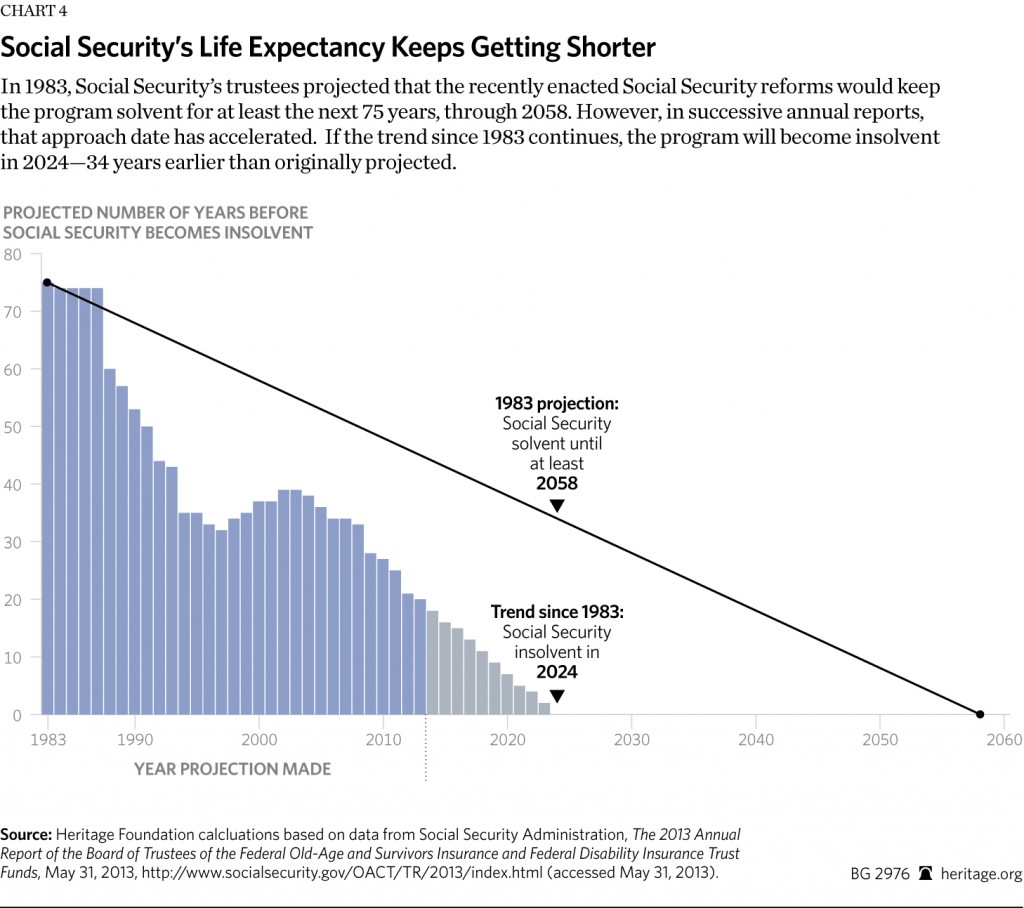
Chart first:

Social Security insolvent in 2024

And now the story:

Social Security’s trustees projected in 1983 that the recently enacted Social Security reforms would keep the program active for at least the next 75 years, through 2058. However, according to research by Rachel Greszler, a senior policy analyst, and James M. Roberts, research fellow for economic freedom and growth at The Heritage Foundation, that approach date has accelerated.

“If the trend since 1983 continues, the program will become insolvent in 2024—34 years earlier than originally projected,” Roberts writes.

Now you might think that the way Democrats appeal to younger voters, that they are taking care of this problem for them.

Well, here’s an article from Investors Business Daily.

Excerpt:

The White House recently conceded that President Obama’s executive order effectively legalizing an estimated 5 million undocumented immigrants means that newly legalized workers will contribute to Social Security and Medicare and be eligible for benefits.

Does the president have any idea how much money his action could cost the country — i.e., taxpayers?

[…]The Social Security and Medicare Trust Fund trustees estimate the two program’s combined long-term unfunded liabilities — the estimated amount the government will have to pay in benefits above what it expects to receive — at about $49 trillion. Obama’s amnesty action greatly exacerbates the problem, because retirees get back far more than they pay in.

[…]Because the U.S. pays hundreds of thousands of dollars in retirement benefits, on average, for each new retiree, whether part of Obama’s amnesty program or not, the president has just vastly worsened the long-term financial condition of the country’s two primary retirement safety nets.

But Obama’s newly legalized workers will impose even heavier losses than Steuerle’s examples.

Most workers pay into the programs for their working careers, between 40 and 50 years. But millions of Obama’s newly legalized are working-age adults with children, so many could be in their 40s or older.

Thus they could pay FICA taxes for the next, say, 15 or 20 years — less than half the average American worker — and be eligible for the full array of Social Security and Medicare benefits.

In addition, most will be lower-income workers. The U.S. Bureau of Labor Statistics estimates that foreign-born, full-time workers earn about 80% of native-born Americans ($33,500 vs. $41,900).

Social Security is a social insurance program and is structured to provide disproportionately more benefits for lower-income workers. Medicare pays the same regardless of how much a worker pays in.

To be sure, these new workers’ entry will likely help the trust funds initially, because most will be paying in rather than taking out.

Under current rules, workers must pay FICA taxes for 40 quarters (10 years total) before being fully eligible for the programs. But within a few decades the oldest will start retiring.

Given the demographic unknowns, estimating the amnesty’s financial cost to our retirement programs — and so to U.S. taxpayers — can only be approximate.

But using a basic simulation model, we believe the government will receive about $500 billion in payroll tax revenue (including Part B and drug premiums), and expect it to pay out some $2 trillion in benefits over several decades.

Yeah, so they are actually making it worse. But hey, at least we have redefined marriage, right?

As if that were not enough, there’s this lovely story from CNS News.

Excerpt:

The Daily Treasury Statement that was released Wednesday afternoon as Americans were preparing to celebrate Thanksgiving revealed that the U.S. Treasury has been forced to issue $1,040,965,000,000 in new debt since fiscal 2015 started just eight weeks ago in order to raise the money to pay off Treasury securities that were maturing and to cover new deficit spending by the government.

The only way the Treasury could handle the $942,103,000,000 in old debt that matured during the period plus finance the new deficit spending the government engaged in was to roll over the old debt into new debt and issue enough additional new debt to cover the new deficit spending.

This mode of financing the federal government resembles what the Securities and Exchange Commission calls a Ponzi scheme. “A Ponzi scheme,” says the Securities and Exchange Commission, “is an investment fraud that involves the payment of purported returns to existing investors from funds contributed by new investors,” says the Securities and Exchange Commission.

“With little or no legitimate earnings, the schemes require a consistent flow of money from new investors to continue,” explains the SEC. “Ponzi schemes tend to collapse when it becomes difficult to recruit new investors or when a large number of investors ask to cash out.”

Now you might ask yourself – are young people aware of these things? Of course not. What they learn in university is how to escape their repressive religious backgrounds by experimenting with risky, irresponsible sexual behavior. They are not aware of the situation, and when they vote, they vote like they were picking candidates on American Idol. I guess I can understand why young people act stupidly. They are concerned with what the culture tells them to be concerned about, and that’s legal baby-killing, redefining marriage to separate kids from their mom or dad, police shooting people who commit crimes, a nonexistent gender pay gap and global warming. What is appalling to me is when their parents vote Democrat… which is basically voting to have a higher standard of living for themselves, then passing the bill onto to their kids. It’s especially amazing when married women do this to their own kids. What are they thinking?