Tag Archives: Debt

Bernie Sanders says his spending proposals will tax everyone, not just the rich

Wall Street Journal calculates cost of Sanders spending plan
Wall Street Journal calculates the cost of Bernie Sanders’ spending plan

This story is from ABC News.

Excerpt:

Sanders is perhaps best known in political life for his efforts to champion the middle class, saying that in order to bridge the widening wealth and income inequality gap in America, the country needs a revamped tax policy that forces Wall Street, big corporations, millionaires and billionaires –like Trump – to pay up – and doesn’t impose further taxes on the middle and working class.

However, when pressed by Stephanopoulos about whether the proposed Senate tax legislation he backs, which would use a payroll tax to fund a mandate for 12 weeks of paid family and medical leave from all U.S. employers, Sander confirmed that the bill would require taxing all citizens -– not just the top 1 percent.

“[The payroll tax] would hit everyone –- yeah, it would. But it would mean we would join the rest of the industrialized world and make sure that when a mom has a baby she can in fact stay home with that baby for three months, rather than going back to work at the end of one week,” Sanders said.

What most Democrats (all?) don’t understand, is that when you tax the rich, the costs filter down to consumers and employees. If a company is making a 5% profit (and Wal-mart makes a 3% profit), then slapping even a 5% tax increase on them will cause layoffs, outsourcing and other repercussions. We have a serious problem in this country with economic illiteracy – a widespread lack of familiarity with how the private sector works, and how jobs are created. For one thing, the public thinks that the average profit margin of companies is over 32%, when it fact it is much lower.
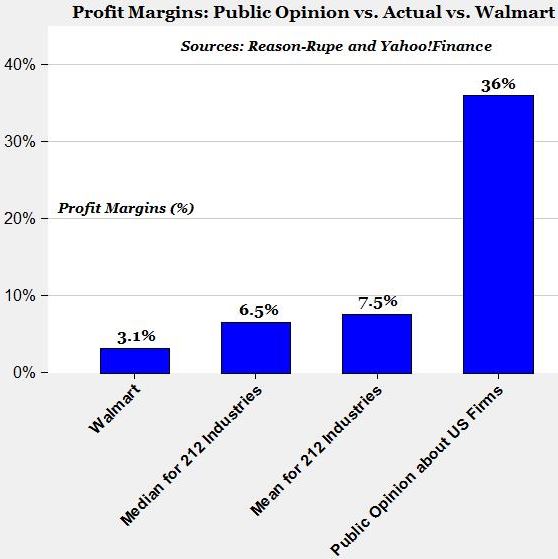
Public perceptions of corporate profit margins

So the real question is, how much does Bernie Sanders want to spend, and pass on to “the rich”? Because if it’s more than a 1% or 2% increase in corporate taxes, we are all – all of us – going to feel the burn. And it’s not going to a slight increase to our payroll taxes, it’s going to be a huge number of people losing their jobs, and the prices of consumer goods and services rising to pay for the new taxes.

How much does all this Bernie Sanders spending cost? 

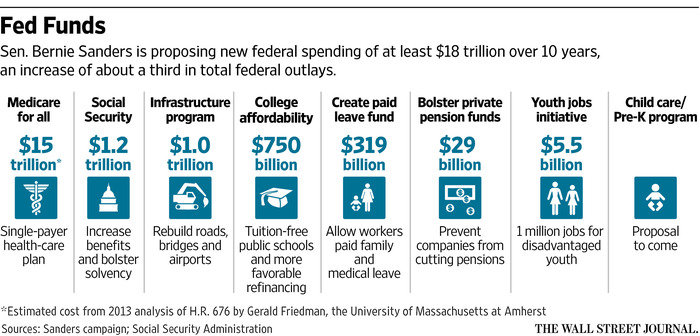
The Wall Street Journal – which knows something about business and economics – has done an analysis of how much the socialist agenda of Bernie Sanders will cost. The final price tag? $18 trillion dollars!

Read it:

Sen. Bernie Sanders, whose liberal call to action has propelled his long-shot presidential campaign, is proposing an array of new programs that would amount to the largest peacetime expansion of government in modern American history.

In all, he backs at least $18 trillion in new spending over a decade, according to a tally by The Wall Street Journal, a sum that alarms conservatives and gives even many Democrats pause. Mr. Sanders sees the money as going to essential government services at a time of increasing strain on the middle class.

[…]To pay for it, Mr. Sanders, a Vermont independent running for the Democratic nomination, has so far detailed tax increases that could bring in as much as $6.5 trillion over 10 years, according to his staff.

A campaign aide said additional tax proposals would be offered to offset the cost of some, and possibly all, of his health program. A Democratic proposal for such a “single-payer” health plan, now in Congress, would be funded in part through a new payroll tax on employers and workers, with the trade-off being that employers would no longer have to pay for or arrange their workers’ insurance.

Investors Business Daily has more to say about Sanders’ proposals:

His “Medicare for All” single-payer health plan alone would cost roughly $15 trillion over a decade.

He wants the government to provide “universal” child care and pre-kindergarten programs, along with free tuition at any public college, and proposes spending an additional $1 trillion on infrastructure and expanding Social Security by $1.2 trillion. Add up just these and a few other items on Sanders’ list, and price tag tops $18 trillion over a decade.

[…]And this doesn’t count the massive costs of mandates and regulations Sanders wants to impose on businesses, such as a $15 minimum wage, plus mandatory paid medical leave, vacations and sick days.

He’d also make it far easier for unions to organize.

Keep in mind that when Obama became president, the national debt was about $8 trillion. Now it’s $18.5 trillion, thanks to the Democrats. And if Bernie Sanders is elected, it will go to over $36.5 trillion. This is what Bernie Sanders expects to solve by “taxing the rich”. And Hillary Clinton expects to get the money for her spending from “taxing the wealthy”, as she said in the CNN debate. Do the rich have enough money lying around for the Democrats to confiscate?

Can we pay for it by “taxing the rich”?

A while back, the libertarian Cato Institute had an article talking about who would pay for Obama’s $1 trillion health care plan. They asked whether Obama could pay for it by “taxing the rich”.

The answer is no:

Funding the new health-care plan on the backs of households making $200,000 or more per year would require permanently increasing their annual total tax payments by about 50 percent. So, for example, a household that currently pays $50,000 in federal income taxes would need to pay another $25,000. Remember, however, that Social Security and Medicare already face enormous shortfalls. Shoring up these programs — another Obama campaign promise — would require collecting 328 percent more tax revenue from the rich. No, we didn’t forget a decimal point: That is three hundred and twenty-eight percent.

And what follows from taxing the rich?

[…]A major tax increase causes the tax capacity of the rich to shrink gradually as two factors kick in. First, many of the households falling into Obama’s “rich” definition are married couples in which both partners are working professionals. When tax rates rise, the lower-earning spouses in these couples tend to work less. Often, they quit work entirely. Second, many of the “rich” are budding entrepreneurs and small-business owners. They finance their operations using their own after-tax income, or with after-tax resources from family and friends. Small-business innovation is the fuel for long-term economic growth. In fact, many of the largest companies in the United States today were either small or nonexistent just 25 years ago. Killing small business kills the American economy.

The rich in France abandoned France in droves when the socialist Francois Hollande passed a 75% top income tax rate. Why do Democrat voters think that this would not happen here? We have to learn economics by watching what happens after the policies are enacted, in other times and places. Higher taxes on the rich cause them to produce less, lowering tax revenues.

I myself have been planning to stop working within the next 5 years, exactly because I can see that the Democrat voters are taking us in the direction of massive taxes on employment. I don’t intend to be working when that happens. If enough people respond to higher tax rates like me, the Democrats are going to have an even bigger problem paying for their spending promises.
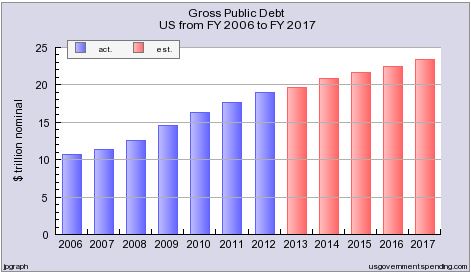
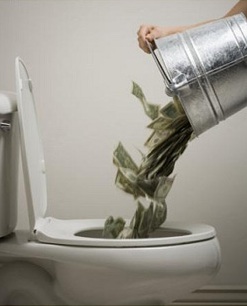
Eight years of socialism: more debt, more regulation, fewer Americans working:

Has the economy been doing well lately? When I ask Democrats that question, they often point me to the stock market. I know that the stock market has done very well in the last 8 years. But I really question which Democrat policies have been responsible for this winfall.

Certainly, policies like Obamacare, Dodd-Frank, green energy subsidies, blocking Keystone XL, creating a student loan bubble, and even loosening mortgage lending again to create another housing bubble, cannot cause any economics growth. My personal opinion is that all the growth came from adding over $10 trillion dollars to the debt – a process that started with the election of Nancy Pelosi and Harry Reid to the House and Senate majorities, respectively, in 2007.

Look at the national debt:

Gross public debt, Democrats control spending in 2007
Gross public debt, Democrats control spending starting in 2007

If you add $10 trillion to the national debt in 8 years then OF COURSE the stock prices will go up. You would look richer too if you took your credit card balance from $8,500 to $18,500. But what is behind all this consumer spending and government spending? Just trillions of dollars of new debt.

I think a better measure of how the economy is doing is to ask job creators how it is doing. For example, we can ask small businesses, since they are responsible for so much of the job creation in this economy.

Here’s an article from the Daily Signal about that.

It says:

More than five years after the end of the “Great Recession,” only 21 percent of small businesses* say they have fully recovered. During the recession, lack of sales ranked as the top problem small business faced. Taxes placed second, and “government regulations and red tape” placed third. And since 2012, at least one in five small business owners identify government regulations as their most important problem.

The reason for this is simple—small business owners directly feel the impact of federal regulation in the daily life of their businesses. The small business owner is often the main person in a business who bears the burden of complying with regulations and paperwork requirements. According to a 2010 study, small businesses spend $10,585 per employee on regulation, which amounts to 36 percent more per employee than larger companies spend.

With that as a backdrop, it is easy to see how small business owners continue to wonder why Washington just does not get it when it comes to regulation. For decades, Congress has sought to solve societal problems through mandates on business. Too many Americans without health insurance? Congress tries to solve that by requiring businesses to provide health insurance to their employees (regardless of whether or not they can afford it) or pay hefty penalties. Too many Americans unable to care for a sick relative? Congress seeks to address that by mandating that a business keep a position open three months out of every year for qualified employees, using a cumbersome reporting system.

Always entrepreneurial, with a keen focus on the bottom line, the American small business owner looks for ways to minimize the time and money spent on things other than running his or her business. Since many of these regulations wisely exempt the smallest of small businesses, some employers purposefully do not increase hiring because they do not want to have to comply with the regulatory regimes that await businesses that expand to 10, 15, and 50 or more employees.

This might be why the labor force participation rate is at a 38-year low.

CNS News explains:

A record 94,031,000 Americans were not in the American labor force last month — 261,000 more than July — and the labor force participation rate stayed stuck at 62.6 percent, a 38-year low, for a third straight month in August, the Labor Department reported on Friday, as the nation heads into the Labor Day weekend.

[…]In August, according to BLS, the nation’s civilian noninstitutional population, consisting of all people 16 or older who were not in the military or an institution, reached 251,096,000. Of those, 157,065,000 participated in the labor force by either holding a job or actively seeking one.

The 157,065,000 who participated in the labor force equaled only 62.6 percent of the 251,096,000 civilian noninstitutional population — the same as it was in July and June. Not since October 1977, when the participation rate dropped to 62.4, has the percentage been this low.

So… do you still think that the economy is in good shape? Any economy is going to look better if you take an $8.5 trillion debt and run it up to $18.5 trillion. But if you look a little closer, you see that small businesses are hard-pressed, and it’s affected the real unemployment rate.

Ideas for higher education reform from a disillusioned professor

We need to reform higher education

A friend of mine who is a full professor sent me this article from the radically leftist site Vox. I was so surprised to find that I agreed with the author – a university professor  – pretty much across the board. See what you think of some of his points about how higher education needs to be reformed, and then I’ll comment at the end.

He complains about the university bureacracy and the office politics, then says this:

I realized not even students were too invested. When my best friend visited my campus to give a talk, he observed one of my lectures. I’ve got many shortcomings as an academic, but lecturing isn’t one of them. I’ve been on TV, radio, podcasts — you name it. By professor standards, which admittedly aren’t that high, I could rock the mic. But while my friend sat there, semi-engrossed in the lecture, he found himself increasingly distracted by the student in front of him.  That student, who like all in-state students was paying $50 per lecture to hear me talk, was watching season one of Breaking Bad. In a class with no attendance grade, where the lectures were at least halfway decent, he was watching Breaking Bad.

Later during that same visit, my friend asked me, in total sincerity, “Why aren’t you doing something meaningful with your life?”

“This is important,” I insisted. But there was no passion behind my words. I was a priest who had lost his faith, performing the sacraments without any sense of their importance.

So why are there so many students who have no interest in university who nevertheless attend in order to get the credential? After all, university is very expensive.

Here is his explanation:

As recently as a year ago, I remained willing to work inside that fractured system of pay-to-play higher education. If students wanted to take out federal loans to buy degrees, who was I to stop them? Let the chips fall where they may; graduate them all and let the invisible hand sort them out.

But that system is unsustainable. Liberal arts programs, and the humanities in particular, have become a place to warehouse students seeking generic bachelor’s degrees not out of any particular interest in the field, but in order to receive raises at work or improve their position in a crowded job market.

Once upon a time, in a postwar America starved for middle managers who could file TPS reports, relying on the BA as an assurance of quality, proof of the ability to follow orders and complete tasks, made perfect sense. But in today’s world of service workers and coders and freelancers struggling to brand themselves, wasting four years sitting in classes like mine makes no economic sense for the country or for the students — particularly when they’re borrowing money to do so.

See, this is not going to make any sense to my readers who have STEM degrees or vocational training. When STEM or vocational training students are in class, we learn, because we expect to have to do the job shortly after. We were not preparing for easy “talking” jobs, we were preparing for “doing” jobs. We were there to learn how to do something for money, not to have fun. We were there to learn how to produce value for customers, not to be indoctrinated by liberal professors holding red marking pens. Many liberal arts students are not there to learn to do a job, they are there to get a credential. In fact, many of the graduates of liberal arts programs these days have to be retrained by their employers.

The author of the Vox article has a solution:

Our federally backed approach to subsidizing higher education through low-interest loans has created perverse incentives with disastrous consequences. This system must be reformed.

When I started out, I believed that government regulation could solve every problem with relatively simple intervention. But after four years of wading though this morass, I’m convinced these solutions should be reevaluated constantly. If they’re not achieving their objectives, or if they’re producing too much waste in the process, they ought to be scrapped. We can start with federal funding for higher education.

The quickest and most painful solution to the crisis would involve greatly reducing the amount of money that students can borrow to attend college. Such reductions could be phased in over a span of years to alleviate their harshness, but the goal would remain the same: to force underperforming private and public universities out of business. For-profit universities — notorious for their lack of anything resembling good academic intention — should be barred altogether from accessing these programs; let them charge only what consumers in a genuinely free market can afford to pay for their questionable services.

Without the carrot of easy access to student loans, enrollments would shrink. Universities would be forced to compete on a cost-per-student basis, and those students still paying to attend college would likely focus their studies on subjects with an immediate return on investment. Lower tuition costs, perhaps dramatically lower at some institutions, would still enable impoverished students eligible for Pell Grant assistance to attend college.  Vocational education programs, which would likely expand in the wake of such a massive adjustment, would offer inexpensive skills training for others. The liberal arts wouldn’t necessarily die out — they’d remain on the Ivy League prix-fixe menu, to be sure, and curious minds of all sorts would continue to seek them out — but they’d no longer serve as a final destination for unenthusiastic credential seekers.

I agree with this idea, in fact I blogged about it before. This is the right solution to the problem. The problem of higher education costing too much will be solved when we stop attaching taxpayer money to students and urging them to attend university. If they want to get a job, then they should be trained to do a job. Only the students who are really interested in liberal arts should be there, and they should have to weigh the costs against the benefits. Maybe we should be taking the student loan decisions out of the hands of the government, and back in the hands of bankers who actually expect the money to be paid back. Or maybe we should give a tax credit to private sector businesses who agree to stake a student through his education, in exchange for working for them for some period after graduation. Anything is better than the mess we have now.