Tag Archives: Debate

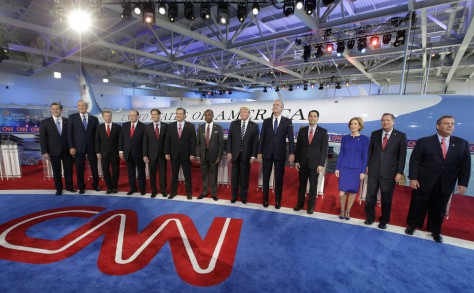
Bobby Jindal won first CNN debate, Carly and Rubio win second CNN debate


CNN Debate at the Ronald Reagan Presidential Library

First of all, if you missed the two debates on CNN on Wednesday night, you missed two great political debates. Hugh Hewitt asked great questions of the candidates. Jake Tapper and Dana Bash were slightly biased against Republicans. Really both debates were so good, and a million times better than the two Fox News debates. There were no gotcha questions, there were plenty of issue-focused exchanges between the candidate.

First debate:

Here’s an exchange between Jindal and Graham:

Jindal: “If we can’t defund Planned Parenthood… It is time to be done with the Republican Party.”

JIndal on Trump and Obama:

Jindal: “He’s declared war on trans fats, and a truce with Iran. Think about that – he’s more worried about Twinkies than he is about the Ayatollahs having a nuclear weapon!”

Jindal on the refugee crisis and illegal immigration:

Jindal: “Simply allowing more people into this country doesn’t solve this problem.”

Jindal on radical Islam, and discrimination against Christians in America:

Jindal: “In America … right now, the biggest discrimination going on is against Christian business owners and individuals who believe in traditional forms of marriage.”

Here are my ratings, candidates in red are the ones I support.

First debate grades:

  • Bobby Jindal: A-
  • Lindsay Graham: B+
  • Rick Santorum: C
  • George Pataki: D

Jindal went after Trump hard, but didn’t talk enough about policy and his own record. LIndsay Graham was solid on foreign policy. He is far too liberal on fiscal issues and social issues, and especially on illegal immigration. Graham is one of the most establishment RINOs in the Senate. It was fun watching Jindal take him on. Jindal is still my favorite candidate, and I hope he gets a bump in the polls from his debate performance.

Second debate:

Carly Fiorina on Planned Parenthood:

Marco Rubio on foreign policy:

If you watch only one clip, watch this one – Rubio and Christie on global warming:

Ted Cruz on illegal immigration:

Scott Walker on minimum wage, jobs and Obamacare:

Second debate grades:

  • Carly Fiorina: A
  • Marco Rubio: A
  • Chris Christie: B+
  • Ted Cruz: B
  • Scott Walker: B-
  • Ben Carson: C+
  • Jeb Bush: C+
  • Rand Paul: C
  • Mike Huckabee: C
  • John Kasich: D
  • Donald Trump: F

Fiorina solid on the facts, but took a few hits on her record at Hewlett Packard, which was not good. She is much too liberal and inexperienced for me, but she talks about these issues very seriously. I am more conservative than she is on abortion, marriage, religious liberty, criminal justice, and many other issues. She has no record of achievement as a governor, either. Marco Rubio is amazing at foreign policy, and knocked a question on global warming out of the park. I love to see a Republican explain the global warming issue so that people understand what is at stake. Rand Paul made some great points about federalism, which I think was valuable in explain conservative principles to the CNN audience.

I’m glad to see that Erick Erickson of the grassroots site Red State agrees with me on the winner of the first debate, and the winners of the second debate.

For a good review of the second debate, here’s something from The Weekly Standard and a new episode of the The Weekly Standard podcast, as well.

My top 4 candidates are still Jindal, Walker, Cruz, Rubio.
Tim McGrew debates Peter Boghossian on the definition of faith

I have tried very hard to avoid writing about Peter Boghossian because I kept hoping that someone would speak to him and set him straight before he went too far.

Basically, when you listen to the debate below, you’ll find that Boghossian redefines the word faith so that it basically means “stupidity”, and then he tries to get people of faith to accept that they are stupid according to his new definition of faith. The new definition is not found in any dictionary, and it’s not used commonly, either.

Anyway, here are the details:

This Week on Unbelievable : Peter Boghossian vs Tim McGrew – debate on ‘A Manual For Creating Atheists”

Peter Boghossian teaches philosophy and is the author of ‘A Manual for Creating Atheists’. He believes that faith is a ‘false epistemology’ (way of knowing things) and even describes it as a ‘virus of the mind’. Tim McGrew is a Christian philosophy professor specialising in epistemology. He contests Boghossian’s definition of faith and debates the merits of his recent book. To cast your vote on the definition of faith visit www.facebook.com/unbelievablejb.

The MP3 file is here.

Topics: (I reserve the right to satirize Boghossian in this. Listen to the audio if you want his exact words)

  • PB: My book tries to avoid the “obfuscations” of reputable, credentialed Christian scholars and discusses faith at my intellectual level
  • PB: The goal of the book is to help people abandon the dictionary definition of the word “faith” and accept the definition I invented
  • TM: Defining the word “faith” in the wrong way is not the right way to start an authentic, respectful conversation
  • TM: Faith does not mean “pretending to know things you don’t know” – that is not a standard definition
  • TM: the only people who accept your definition of faith are you and the people who follow you online
  • TM: your whole book is predicated on on a wrong definition of faith
  • PB: that is my definition of faith based on my experience of talking to lots of people
  • TM: He says this is how billions of people define faith – but not in my experience, maybe satirists like Ambrose Bierce and Mark Twain do
  • TM: Your definition of faith is not in the Oxford English Dictionary and that definition is based on common usage of the word faith
  • TM: The New Testament definition of faith “pistis” means trust
  • PB: There are 50-100 people who use the term that way, and only in academia
  • TM: How about “The Good Atheist” who interviewed you? He is not an academic or a theist, but he didn’t accept your definition
  • PB: You are “extraordinarily isolated” from the real definition of faith
  • TM: Faith is not belief without evidence, it is trust based on at least some evidence
  • PB: Christian leaders use the word according my definition, I won’t name any or quote any, though
  • JB: So you are basically saying that Christians are lying when they express their faith, since they know what they are saying isn’t true but they say it anyway
  • PB: What percentage of Christians use the word faith to mean “belief without evidence”
  • TM: Well below 1%. It may be the case that their evidence is not very good, but they do rest their beliefs on evidence
  • TM: Faith is trusting, holding to, and acting on what one has good reasons to believe is true in the face of difficulties
  • PB: That’s not what people mean by faith, they mean my definition
  • JB: What do you mean when you say that faith is a “virus of the mind”, and a “mental illness”? School programs to remove faith?
  • PB: Think about how atheists feel when they are told they will go Hell
  • PB: Christians are hurting people, so that means they have a mental disorder that needs to be cured in a systematic way
  • PB: Faith is an epistemic virus that hijacks the reasoning process

At that point I quit summarizing, because I didn’t think he was worth listening to any more.

He is clearly not aware of how even basic Christian apologetics books that are bestsellers cover evidences like the Big Bang, the cosmic fine-tuning, the origin of life, the Cambrian explosion, galactic habitability, stellar habitability, New Testament reliability, historical Jesus, philosophical arguments for theism, and so on. This is the bottom-shelf of Christian apologetics, widely read by rank-and-file Christians, but Boghossian seems to be completely unaware of it. He needs to get out more and talk to people outside of radical atheist circles. Maybe he needs to pick up a serious book like “Debating Christian Theism” and read it before he opens his mouth on topics he knows nothing about.

But that’s not all. As, I explained before, the concept of faith presented in the Bible agrees with what Dr. McGrew said – faith is trust based on evidence. That is the Biblical view.

And finally, this:

John 10:37-38: [NASB]

37 If I do not do the works of My Father, do not believe Me;

38 but if I do them, though you do not believe Me, believe the works, so that you may know and understand that the Father is in Me, and I in the Father.”

The words of Jesus – he is saying: believe me because of the evidence I provide from miracles that you can see with your own eyes. Period. End of discussion.

So Boghossian’s view of faith is nowhere except in his own mind. Not in the apologetics literature. Not in the writings of any reputable Christian scholar. Not in the Bible. Not in the words of Jesus. It’s enough to make me think that this talk about “mental disorders” and “viruses of the mind” is just projection.

Vote in the poll

Please vote in this poll:

Thank goodness we have debates like this so that we can find out where Christians really come down on faith.

Peter J. Williams lectures on the historical reliability of the gospel narratives

Peter J. Williams
Peter J. Williams

Here’s the main lecture: (54 minutes)

And here’s the Q&A: (9 minutes)

About Peter Williams:

Peter J. Williams is the Warden (CEO) of Tyndale House and a member of the Faculty of Divinity in the University of Cambridge. He received his MA, MPhil and PhD, in the study of ancient languages related to the Bible from Cambridge University. After his PhD, he was on staff in the Faculty of Divinity, Cambridge University (1997–1998), and thereafter taught Hebrew and Old Testament there as Affiliated Lecturer in Hebrew and Aramaic and as Research Fellow in Old Testament at Tyndale House, Cambridge (1998–2003). From 2003 to 2007 he was on the faculty of the University of Aberdeen, Scotland, where he became a Senior Lecturer in New Testament and Deputy Head of the School of Divinity, History and Philosophy. In July 2007 he became the youngest Warden in the history of Tyndale House. He also retains his position as an honorary Senior Lecturer in Biblical Studies at the University of Aberdeen.

Summary of the lecture:

  • What if the stories about Jesus are legendary?
  • were the gospels transmitted accurately?
  • were the gospels written in the same place as where the events happened?
  • do the gospel authors know the customs and locations where the events happened?
  • do the gospels use the right names for the time and place where the events took place?
  • do the gospels disambiguate people’s names depending on how common those names were?
  • how do the New Testament gospels compare to the later gnostic gospels?
  • how do the gospels refer to the main character? How non-Biblical sources refer to Jesus?
  • how does Jesus refer to himself in the gospels? do the later Christians refer to him that way?
  • how does Jesus teach? do later Christians teach the same way?
  • why didn’t Jesus say anything about early conflicts in the church (the Gentiles, church services)?
  • did the writers of the gospels know the places where the events took place?
  • how many places are named in the gospels? how about in the later gnostic gospels?
  • are the botanical details mentioned in the gospels accurate? how about the later gnostic gospels?

And here are the questions from the audience:

  • how what about the discrepancies in the resurrection narratives that Bart Ehrman is obsessed with?
  • what do you think of the new 2011 NIV translation (Peter is on the ESV translation committee)?
  • how did untrained, ordinary men produce complex, sophisticated documents like the gospels?
  • is oral tradition a strong enough bridge between the events and the writers who interviewed the eyewitnesses?
  • what does the name John mean?
  • why did the gospel writers wait so long before writing their gospels?
  • do you think that Matthew and Luke used a hypothetical source which historians call “Q”?
  • which gospel do critical historians trust the least and why?

I really enjoyed watching this lecture. He’s getting some of this material from Richard Bauckham’s awesome book “Jesus and the Eyewitnesses”, so if you aren’t familiar with it, you can get an idea of what’s in it. Peter Williams is a lot of fun to listen to – an excellent speaker.