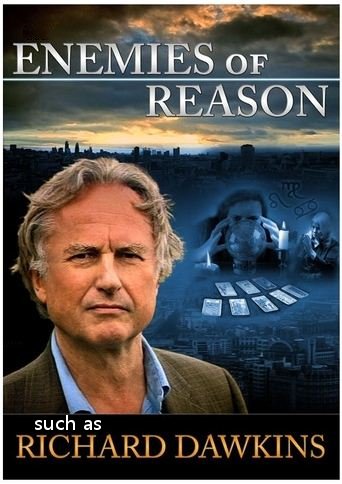
The Free Church of Scotland has challenged Richard Dawkins, the world-famous atheist, to a debate on his next visit to the Outer Hebrides.
Professor Dawkins is headlining Faclan, the Hebridean Book Festival, on the Isle of Lewis where he is scheduled to promote his book the God Delusion on Friday 2 November.
Despite calls of a boycott from a member of the Lord’s Day Observance Society, Stornoway Free Church minister Reverend Iver Martin (pictured below), who is minister of one of the biggest congregations on the island, said he welcomed the visit as an opportunity for debate.
[…]“The Free Church of Scotland endorses freedom of discussion and the exchange of argument.
“However, with Richard Dawkins presenting a particularly one-sided narrative, I would hope that there would be opportunity for fair, even handed, reasoned debate at which both sides of the theistic argument can be heard.”
Would Richard Dawkins, champion of militant fundamentalist atheism, rise to the challenge of debating his views in a public forum?
A Scottish Church leader has labeled evolutionary biologist and famed atheist Richard Dawkins a “snob” over his decision to turn down a debate on religion. Dawkins has refused a debate invitation for the faith-themed Faclan Hebridean Book Festival in Scotland in November.
The Rev David Robertson, a Free Church minister in Dundee, responded to Dawkins’ decision to avoid debate by saying that he does not believe the atheist to be a “coward,” but sees him as a “elitist snob, who once told me he would consider debating with me if I was the Archbishop of Canterbury, the Pope or Chief Rabbi.”
Robertson added: “Dawkins considers, like so many of his fellow new atheists, that there is no debate and they, and they alone, have the truth. Ironically, such arrogance and intolerance of others is the very definition of the fundamentalism that Dawkins professes to hate. I suspect that Richard Dawkins’ problem is that he is not a good debater.”
Yes, that’s it exactly. He cannot bear to hear other viewpoints other than his own. He is not intelligent enough to prove what he asserts in private to a skeptical audience in public. That’s why he doesn’t debate in public. He would prefer to preach in private to those who accept his dogma, and to receive their praise and adulation – and their money!
If Dawkins did agree to have his ideas tested in a debate, it would be a good thing if whoever was doing the testing asked him why he affirms the moral goodness of adultery and infanticide, as well as asking him what he means by his desire to “destroy Christianity“, especially given that he refuses to debate with Christians like William Lane Craig. Does he mean something similar to what his fellow atheists like Stalin and Mao meant, i.e. – mass murder? Or does he mean something else? It would be a good question to ask, anyway.
I don’t want anyone to think that atheism is some sort of immature, non-cognitive tantrum that consists largely of insulting Christians and giggling like children who have discovered a new curse word. There are serious atheistic scholars, and they do debate. Richard Dawkins is not a serious scholar, and he does not debate his views. He is therefore very much like those sweating, foam-flecked televangelists you see bloviating on the telly on Sunday mornings. All bluster, no substance.
I want to raise another question that interests me. Why are we so obsessed with monogamous fidelity in the first place?
[…]The underlying presumption — that a human being has some kind of property rights over another human being’s body — is unspoken because it is assumed to be obvious. But with what justification?
In one of the most disgusting stories to hit the British newspapers last year, the wife of a well-known television personality, Chris Tarrant, hired a private detective to spy on him. The detective reported evidence of adultery and Tarrant’s wife divorced him, in unusually vicious style. But what shocked me was the way public opinion sided with Tarrant’s horrible wife. Far from despising, as I do, anybody who would stoop so low as to hire a detective for such a purpose, large numbers of people, including even Mr. Tarrant himself, seemed to think she was fully justified. Far from concluding, as I would, that he was well rid of her, he was covered with contrition and his unfortunate mistress was ejected, covered with odium. The explanation of all these anomalous behavior patterns is the ingrained assumption of the deep rightness and appropriateness of sexual jealousy. It is manifest all the way from Othello to the French “crime passionnel” law, down to the “love rat” language of tabloid newspapers.
[…]Why should you deny your loved one the pleasure of sexual encounters with others, if he or she is that way inclined?
I, for one, feel drawn to the idea that there is something noble and virtuous in rising above nature in this way.
[…]And why don’t we all admire — as I increasingly do — those rare free spirits confident enough to rise above jealousy, stop fretting about who is “cheating on” whom,
In 1984, Dawkins divorced his wife of 17 years, Marian Stamp; later that same year, he married Eve Barham. Dawkins also divorced Barham, though the precise circumstances of this divorce are unclear. He married science fiction actress Lalla Ward in 1992; at present, the two are still married.
I have been advised that the full article featuring Dawkins’ views is far, far worse that what was excerpted by UD.
What does atheist morality amount to, in practice? It amounts to the strong acting selfishly and allowing the weak to suffer for it. That’s why atheists are almost entirely for abortion and sexual permissiveness – the children are the first to be screwed by the moral relativism of the adults. That’s where abortion, no-fault divorce, fatherlessness, etc. come from – they are crimes committed by selfish adults against vulnerable children – because they can. It’s the strong abusing the weak, exactly as Darwinism would have them do. There are no human rights on atheism, and there is no reason for self-sacrificial moral behavior, either. Do what you want, and don’t get caught. Get them, before they can get you. Don’t let anyone diminish your happiness with their moral rules. That’s “atheist morality”.
This isn’t the first time that we’ve caught a glimpse of Dawkins’ atheist perspective on morality, either.
But the centrepiece of this Christmas edition is the main coup for the New Statesman – an interview by Prof. Dawkins with Christopher Hitchens, the great polymath who today lost his fight against cancer. It’s a fascinating read over three double-page spreads. Not least because Prof. Dawkins reveals a charming humility, allowing Hitchens to show his intellectual superiority at his own expense. Hitchens is thoughtful about CS Lewis and Christianity and rather leaves Prof. Dawkins floundering in his wake, occasionally interjecting little assents to show that he’s still there, as he struggles to keep up.
But one of these interjections is most revealing. About half-way through, the Prof gets this in edgeways: ‘Do you ever worry that if we win and, so to speak, destroy Christianity, that vacuum would be filled by Islam?’
So, ‘if we win…and destroy Christianity’. True, there’s a ‘so to speak’ in there, but it doesn’t do much. Try ‘If we win and, so to speak, kill all the Jews’ as an alternative. Doesn’t really work, does it? And Prof Dawkins can hardly claim that he was misquoted or taken out of context. He was editing the magazine, after all – there’s even a picture of him doing so, pen poised masterfully over page proofs.
Now you might think that Dawkins intends to destroy Christianity in debates, and not in the wars and purges of atheism that occurred last century in North Korea, Cambodia, China, the Soviet Union, and so on. Those atheist regimes caused the deaths of 100 million people, according to Harvard University Press. But Dawkins has refused to debate William Lane Craig on more than one occasion. So whatever he means by “destroy Christianity”, he doesn’t mean “defeat them in rational debate, using superior arguments and evidence”. He had his chance to do that, and he passed on it. So, he must mean something else by “destroying Christianity” other than persuasion.
Let’s find out what Richard Dawkins thinks about morality. Dawkins has previously written this:
The total amount of suffering per year in the natural world is beyond all decent contemplation. During the minute that it takes me to compose this sentence, thousands of animals are being eaten alive, many others are running for their lives, whimpering with fear, others are slowly being devoured from within by rasping parasites, thousands of all kinds are dying of starvation, thirst, and disease. It must be so. If there ever is a time of plenty, this very fact will automatically lead to an increase in the population until the natural state of starvation and misery is restored. In a universe of electrons and selfish genes, blind physical forces and genetic replication, some people are going to get hurt, other people are going to get lucky, and you won’t find any rhyme or reason in it, nor any justice. The universe that we observe has precisely the properties we should expect if there is, at bottom, no design, no purpose, no evil, no good, nothing but pitiless indifference.
(“God’s Utility Function,” Scientific American, November, 1995, p. 85)
Dawkins’ view is that nothing is really good or bad objectively. Cultures just evolve certain conventions, and those conventions vary arbitrarily by time and place. I think we need to interpret his goal of destroying Christianity against the backdrop of his nihilism. 50 million unborn children have been killed in the United States since 1973 alone. That’s 50 million people with distinct genetic codes different from their mothers or their fathers, who will never grow up to achieve their potential.
Dawkins himself is in favor of infanticide:
So what might destroying Christianity look like to an atheist?
A Christian woman accused of distributing the Bible, a book banned in communist North Korea, was publicly executed last month for the crime, South Korean activists said Friday.
The 33-year-old mother of three, Ri Hyon Ok, also was accused of spying for South Korea and the United States, and of organizing dissidents, a rights group said in Seoul, citing documents obtained from the North.
The Investigative Commission on Crime Against Humanity report included a copy of Ri’s government-issued photo ID and said her husband, children and parents were sent to a political prison the day after her June 16 execution.
That’s what Kim Jong Il means by “destroy Christianity”. What does Dawkins mean by it?
From Sarah’s Think on These Things blog, a post about how to NOT argue contructively. If you don’t do any of the bad things on her list, you’ll be an excellent person to debate with. Consider this post your Saturday fun!
Excerpt:
1. Foster the conviction that all with whom you disagree are personally attacking you.
Even if the individual doesn’t know you, your ideas are your identity. Never mind the fact that this introduces all sorts of strange problems for understanding personal identity. That stuff is not important. What is important is that your very person, and all you hold dear, are being assaulted.
2. Don’t accept the author or speaker’s own definitions of his terms.
For instance, if someone is using the term “idealist” to mean a person who has lofty goals, you could show off your philosophical prowess and point out that he has gotten philosophical idealism (something else entirely) all wrong. It would also be fun to attack a Lutheran who believes in Christian orthodoxy (small “o”) for being a closet Orthodox Christian!
3. Embrace category confusion.
Here is a time-tested example: If the argument is about economics, you may wish to respond by claiming that the author is just racist. You get bonus points here, as this tactic also functions as an ad hominem and as a red herring fallacy (look them up if you are curious).
4. Ignore all qualifiers.
This most often takes the form of responding with a counterexample to an admitted generalization. Example: Your interlocutor is evaluating the drawbacks to social media, and then says “interactions on social media tend to encourage more rudeness than would be likely in person.” You can fire back a response like this: “I’m always nice on Facebook! See? You’re wrong.” Or, “Uncle Joe uses Facebook to encourage invalids connecting to the world via laptop,” etc. You don’t want your counterexample to actually work. So, avoid using the skill in situations where the author has clearly made a universal statement such as, “There are no black swans.” Then, those who are still slaves to logic could refute the universal statement by saying– truthfully– that “Uncle Joe has a black swan.”
These are the things that happen to me daily in dealing with commenters like Sarah stone on this blog. If only Sarah had read this nice list!
I think #2 is the funniest.
The list contains 17 items. If you know someone who would benefit from it, please forward it along!