
Tag Archives: Darwinism

Did your science textbook tell you that embryo drawings prove evolution?

When you learned about evolution in public school, what did they show you for evidence to support the theory? Some people say finch beaks changing size, some people say a feathered dinosaur, some people say similar features in different animals, and some people say embryo drawings. Let’s take a look at that last one and see if it’s good evidence for evolution.

Jonathan Wells, a biologist with Ph.Ds from Yale and UC Berkeley, writes about one example of fake evidence here:

Charles Darwin thought that “by far the strongest” evidence that humans and fish are descended from a common ancestor was the striking similarity of their early embryos. According to Darwin, the fact that “the embryos of the most distinct species belonging to the same class are closely similar, but become, when fully developed, widely dissimilar… reveals community of descent.” 2 To illustrate this, German Darwinist Ernst Haeckel made some drawings in the 1860s to show that the embryos of vertebrates (fish, amphibians, reptiles, birds and mammals) look almost identical in their earliest stages.

But Haeckel faked his drawings. Not only do they distort vertebrate embryos by making them appear more similar than they really are (in a way that Stephen Jay Gould wrote “can only be called fraudulent” 3), but they also omit classes and stages that do not fit Darwin’s theory. Most significantly, Haeckel omitted the earliest stages, in which vertebrate embryos are strikingly different from each other. The stage he portrayed as the first is actually midway through development. Yet according to Darwin’s logic, early dis-similarities do not provide evidence for common ancestry.

Haeckel used his faked drawings to support not only Darwinian evolution, but also his own “Biogenetic Law,” which stated that embryos pass through the adult stages of their ancestors in the process of development.

…Haeckel’s drawings were exposed as fakes by his own contemporaries, and his Biogenetic Law was thoroughly discredited by 20th century biologists. It is now generally acknowledged that early embryos never resemble the adults of their supposed ancestors. A modern version of recapitulation claims that early embryos resemble the embryos of their ancestors, but since fossil embryos are extremely rare, this claim is little more than speculation based on the assumption that Darwin’s theory is true.

Now the standard response from Darwinists: no textbooks are still using the fraudulent embryo images.

Haeckel's embryos and scientific fraud
Haeckel’s embryos and scientific fraud

You can see the actual faked pictures from the modern textbooks here. These textbooks were being produced as late as 2004, even though the fraud was detected in the 1800s! Is this the vaunted self-correction of science, or science being twisted to support social and political goals?

And this excerpt from that article is interesting:

Some Darwinists continue to deny that there has been any misuse of Haeckel in recent times. If that is the case, why did Stephen Jay Gould attack how textbooks use Haeckel in 2000? Gould wrote: “We should… not be surprised that Haeckel’s drawings entered nineteenth-century textbooks. But we do, I think, have the right to be both astonished and ashamed by the century of mindless recycling that has led to the persistence of these drawings in a large number, if not a majority, of modern textbooks!” (emphasis added) Similarly, in 1997, the leading embryologist Michael K. Richardson lamented in the journal Anatomy and Embyology that “Another point to emerge from this study is the considerable inaccuracy of Haeckel’s famous figures. These drawings are still widely reproduced in textbooks and review articles, and continue to exert a significant influence on the development of ideas in this field.” (emphases added)

Here is a link to the peer-reviewed journal Science, where there is an article talking about the fraudulent embryo drawings. Yes – the drawings really are fraudulent.

And finally, Casey Luskin has a post up at Evolution News that lists all the textbooks that contain the fraudulent drawings. One is dated 2013! The drawings just keep getting recycled over and over as a “proof” of evolution.

By the way, if you were told that finch beaks prove evolution, then read this post.
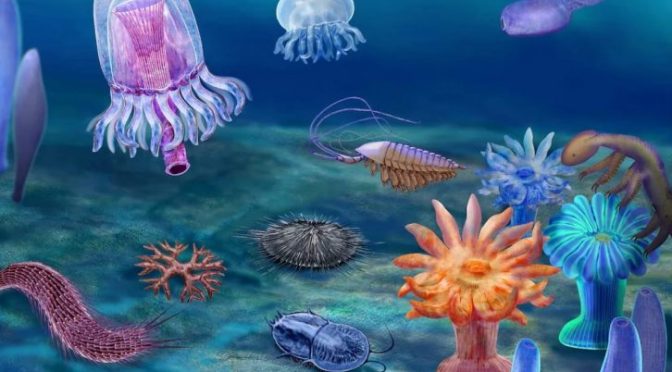
Stephen C. Meyer and Marcus Ross lecture on the Cambrian explosion

Cambrian Explosion
Cambrian Explosion

Access Research Network is a group that produces recordings  of lectures and debates related to intelligent design. I noticed that on their Youtube channel they are releasing some of their older lectures and debates for FREE. So I decided to write a summary of one that I really like on the Cambrian explosion. This lecture features Dr. Stephen C. Meyer and Dr. Marcus Ross.

The lecture is about two hours. There are really nice slides with lots of illustrations to help you understand what the speakers are saying, even if you are not a scientist.

Here is a summary of the lecture from ARN:

The Cambrian explosion is a term often heard in origins debates, but seldom completely understood by the non-specialist. This lecture by Meyer and Ross is one of the best overviews available on the topic and clearly presents in verbal and pictorial summary the latest fossil data (including the recent finds from Chengjiang China). This lecture is based on a paper recently published by Meyer, Ross, Nelson and Chien “The Cambrian Explosion: Biology’s Big Bang” in Darwinism, Design and Public Education(2003, Michigan State University Press). This 80-page article includes 127 references and the book includes two additional appendices with 63 references documenting the current state of knowledge on the Cambrian explosion data.

The term Cambrian explosion describes the geologically sudden appearance of animals in the fossil record during the Cambrian period of geologic time. During this event, at least nineteen, and perhaps as many as thirty-five (of forty total) phyla made their first appearance on earth. Phyla constitute the highest biological categories in the animal kingdom, with each phylum exhibiting a unique architecture, blueprint, or structural body plan. The word explosion is used to communicate that fact that these life forms appear in an exceedingly narrow window of geologic time (no more than 5 million years). If the standard earth’s history is represented as a 100 yard football field, the Cambrian explosion would represent a four inch section of that field.

For a majority of earth’s life forms to appear so abruptly is completely contrary to the predictions of Neo-Darwinian and Punctuated Equilibrium evolutionary theory, including:

  • the gradual emergence of biological complexity and the existence of numerous transitional forms leading to new phylum-level body plans;
  • small-scale morphological diversity preceding the emergence of large-scale morphological disparity; and
  • a steady increase in the morphological distance between organic forms over time and, consequently, an overall steady increase in the number of phyla over time (taking into account factors such as extinction).

After reviewing how the evidence is completely contrary to evolutionary predictions, Meyer and Ross address three common objections: 1) the artifact hypothesis: Is the Cambrian explosion real?; 2) The Vendian Radiation (a late pre-Cambrian multicellular organism); and 3) the deep divergence hypothesis.

Finally Meyer and Ross argue why design is a better scientific explanation for the Cambrian explosion. They argue that this is not an argument from ignorance, but rather the best explanation of the evidence from our knowledge base of the world. We find in the fossil record distinctive features or hallmarks of designed systems, including:

  • a quantum or discontinuous increase in specified complexity or information
  • a top-down pattern of scale diversity
  • the persistence of structural (or “morphological”) disparities between separate organizational systems; and
  • the discrete or novel organizational body plans

When we encounter objects that manifest any of these several features and we know how they arose, we invariably find that a purposeful agent or intelligent designer played a causal role in their origin.

Recorded April 24, 2004. Approximately 2 hours including audience Q&A.

I learned a lot by watching great lectures from Access Research Network. Their YouTube channel is here. I recommend their origin of life lectures – I have watched the ones with Dean Kenyon and Charles Thaxton probably a dozen times each. Speaking as an engineer, you never get tired of seeing engineering principles applied to questions like the origin of life.

If you’d like to see Dr. Meyer defend his views in a debate with someone who reviewed his book about the Cambrian explosion, you can find that in this previous post.

Further study

The Cambrian explosion lecture above is a great intermediate-level lecture and will prepare you to be able to understand Dr. Meyer’s new book “Darwin’s Doubt: The Explosive Origin of Animal Life and the Case for Intelligent Design“. The Michigan State University book that Dr. Meyer mentions is called “Darwin, Design and Public Education“. That book is one of the two good collections on intelligent design published by academic university presses, the other one being from Cambridge University Press, and titled “Debating Design: From Darwin to DNA“. If you think this lecture is above your level of understanding, then be sure and check out the shorter and more up-to-date DVD “Darwin’s Dilemma“.

Are the Galapagos finch beaks evidence of Darwinian evolution?

Were you taught in biology class that the changing lengths of finch beaks was a good proof of Darwinian evolution? Many students were… but is it true?

Jonathan Wells has an article about it at Evolution News.

It says:

When Charles Darwin visited the Galápagos Islands in 1835, he collected specimens of the local wildlife. These included some finches that he threw into bags, many of them mislabeled. Although the Galápagos finches had little impact on Darwin’s thinking (he doesn’t even mention them in The Origin of Species), biologists who studied them a century later called them “Darwin’s finches” and invented the myth that Darwin had correlated differences in the finches’ beaks with different food sources (he hadn’t). According to the myth, Darwin was inspired by the finches to formulate his theory of evolution, thoughaccording to historian of science Frank Sulloway “nothing could be further from the truth.”

In the 1970s, biologists studied a population of medium ground finches on one of the islands in great detail. When a severe drought left only large, hard-to-crack seeds, 85 percent of the birds perished. The survivors had beaks that were about 5 percent larger than the average beak size in the original population. The biologists estimated that if similar droughts occurred once every ten years, the population could become a new species in only 200 years. In a 1999 booklet defending evolution, the U.S. National Academy of Sciences called the finches “a particularly compelling example” of the origin of species.

But after the drought, birds with smaller beaks flourished again, and the average beak size of the population returned to normal. No net evolution had occurred. No matter; Darwin’s finches became an icon of evolution that is still featured in most biology textbooks.

In the 1980s, a population of large ground finches, with larger beaks than the medium ground finches, migrated to the island. When a drought in 2004-2005 again reduced the food supply, the medium and large ground finch populations both declined. But since even the largest beaks among the medium ground finches were no match for the beaks of the large ground finches, the latter pretty much monopolized the larger seeds and the former had to make do with smaller seeds. This time, the medium ground finches that survived the drought had beaks that were smaller than the average size in the original population. Biologists studying the finches argued that birds with smaller beaks were better able to eat the tiny seeds that were left after the large ground finches ate the big ones, and they concluded that this was again an example of “evolutionary change.”

[…]Wait a minute. Average beak size increased slightly during one drought, only to return to normal after the rains return. Then average beak size decreased slightly during another drought. A region of DNA is correlated with beak size. And somehow that tells us how finches evolved in the first place?

There is an important distinction to make between micro-evolution and macro-evolution. Changes within a type is micro-evolution. Evolving a new organ type or body plan is macro-evolution. There is plenty of evidence for micro-evolution, but no evidence for macro-evolution.

What needs to be proven by the Darwinists is that the same process that results in different average beak size in a population of finches after a drought can create the finches in the first place. I think that Darwinists are credulous – they believe what they want to believe because they want to believe it, even if the evidence is incredibly weak. Darwinists must demonstrate that heritable variations can result in the generation of new organ types and body plans. Changes in average beak size is not interesting. What is needed is to show how the beaks, much less the wings, evolved in the first place.

Icons of Evolution

Jonathan has actually written about a number of  misleading things that you may mind in Biology textbooks.

Here are the sections in his book “Icons of Evolution“:

  • The Miller-Urey Experiment
  • Darwin’s Tree of Life
  • Homology in Vertebrate Limbs
  • Haeckel’s Embroys
  • Archaeopteryx–The Missing Link
  • Peppered Moths
  • Darwin’s Finches
  • Four-Winged Fruit Flies
  • Fossil Horses and Directed Evolution
  • From Ape to Human: The Ultimate Icon

Dr. Wells holds a Ph.D in Molecular and Cell Biology from the University of California at Berkeley.