Tag Archives: Darwinism

Information Enigma: 21-minute video explains intelligent design

Can random mutation and natural selection create new functional information?

The video is here:

I have read and listened and watched a lot of material on intelligent design, but I have never seen so much value packed into such a short lecture. I really hope you’ll watch this and that it’s helpful to you.

Summary:

  • the big question when discussing the origin of life: where did the information in living systems come from?
  • Until 530 million years ago, the oceans were largely devoid of life
  • In a 10 million year period, many new forms of animal life emerged
  • New biological forms of life require new information
  • the discovery of DNA shows that living systems work because cells have information that allows them to build the components of molecular machines: cell types, proteins, etc.
  • can random mutation and natural selection create new functional information?
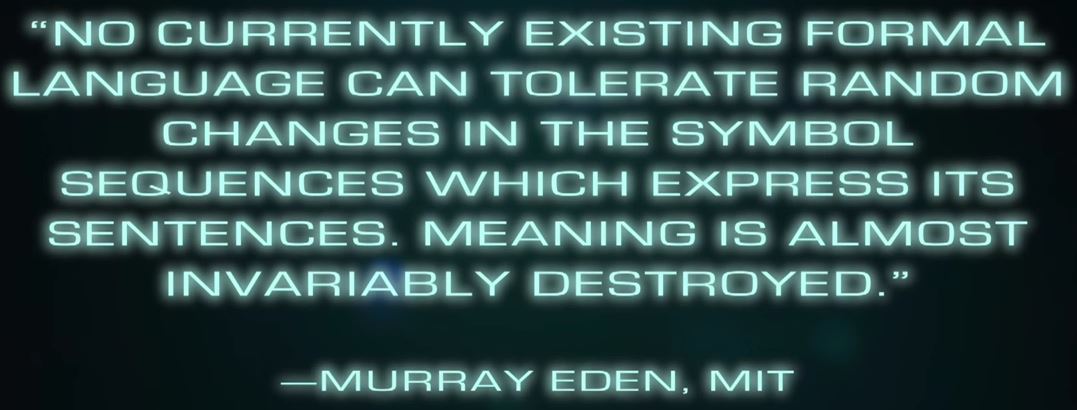
  • normally, random mutations tend to degrade the functionality of information, e.g. – randomly changing symbols in an applications code does not usually introduce useful new functions, it usually renders what is there non-functional
  • the majority of possible sequences will NOT have functions, so random mutations will more likely give you non-functional code, rather than functional code
  • example: a bicycle lock  with 4 numbers has many possible sequences for the 4 numbers, and only one of them has unlock functionality, the rest have no functionality
  • if you have lots of time, then you might be able to guess the combination, but if the lock as has 10 billion numbers, and only one combination that unlocks, you can spend your whole life trying to unlock it and won’t succeed
  • how likely is it to arrive at a functional protein or gene by chance? Is it more like the 4-dial lock (can be done with lots of time) or the 10 billion dial lock (amount of time required exceeds the time available)?
  • the probability is LOW because there is only one sequence of numbers that has unlock function
  • consider a short protein of 150 amino acids has 10 to the 195th power possible sequences
  • if many of these sequences of amino acides had biological function, then it might be easier to get to one by random mutation and selection than it is with a lock that only unlocks for ONE sequence
  • how many of the possible sequences have biological function?
  • Thanks to research done by Douglas Axe, we now know that the number of functional amino acid sequences for even a short protein is incredibly small…
  • Axe found that the odds of getting a functional sequence of amino acids that will fold and have biological function is 1 in 10 to the 77th power
  • Is that number too improbable to reach by chance? well, there are 10 to 65th atoms in the entire Milky Way galaxy… so yes, this is a very improbable outcome
  • can random genetic mutations search through all the sequences in order to find the one in 10 to the 77th power one that has biological function? It depends on how much guessers we have and how many guesses we get in the time available
  • even with the entire 3.5 billion year history of life on Earth, only about 10 to the 40th organisms have ever lived, which far smaller fraction of the 10 to the 77th total sequences
  • even with a very fast mutation rate, you would not be able to reach a functional protein even with all that time, and even with all those organisms

I was once having a discussion with a woman about the research that Axe did at the Cambridge University lab. He published four articles in the Journal of Molecular Biology. I held out one of the papers to her and showed her the numbers. She said over and over “I hate the Discovery Institute! I hate the Discovery Institute!” Well, yeah, but you can’t make the Journal of Molecular Biology go away with hating the Discovery Institute. JMB is peer-reviewed, and this was experimental evidence – not a theory, not a hypothesis.

We have been blessed by the Creator and Designer of the universe in this time and place with overwhelming evidence – an abundance of riches. For those who have an open mind, this is what you’ve been waiting for to make your decision. For the naturalists who struggle so mightily to block out the progress of experimental science, they’ll need to shout louder and shut their eyes tighter and push harder to block their ears. Maybe if they keep screaming “Star Trek” and “Star Wars” over and over to themselves, they will be able to ignore the real science a little longer.

Study: biological convergence found in human and squid eye genes

Christianity and the progress of science

We have to start this post with the definition of convergence in biology.

In evolutionary biology, convergent evolution is the process whereby organisms not closely related (not monophyletic), independently evolve similar traits as a result of having to adapt to similar environments or ecological niches.

It is the opposite of divergent evolution, where related species evolve different traits.

On a molecular level, this can happen due to random mutation unrelated to adaptive changes; see long branch attraction. In cultural evolution, convergent evolution is the development of similar cultural adaptations to similar environmental conditions by different peoples with different ancestral cultures. An example of convergent evolution is the similar nature of the flight/wings of insects, birds, pterosaurs, and bats.

All four serve the same function and are similar in structure, but each evolved independently.

With that being said, here is an article from Real Clear Science with me.

Eyes and wings are among the most stunning innovations evolution has created. Remarkably these features have evolved multiple times in different lineages of animals. For instance, the avian ancestors of birds and the mammalian ancestors of bats both evolved wings independently, in an example of convergent evolution. The same happened for the eyes of squid and humans. Exactly how such convergent evolution arises is not always clear.

In a new study, published in Nature Scientific Reports, researchers have found that, despite belonging to completely different lineages, humans and squid evolved through tweaks to the same gene.

Like all organs, the eye is the product of many genes working together. The majority of those genes provide information about how to make part of the eye. For example, one gene provides information to construct a light-sensitive pigment. Another gene provides information to make a lens.

Most of the genes involved in making the eye read like a parts list – this gene makes this, and that gene makes that. But some genes orchestrate the construction of the eye. Rather than providing instructions to make an eye part, these genes provide information about where and when parts need to be constructed and assembled. In keeping with their role in controlling the process of eye formation, these genes are called “master control genes”.

The most important of master control genes implicated in making eyes is called Pax6. The ancestral Pax6 gene probably orchestrated the formation of a very simple eye – merely a collection of light-sensing cells working together to inform a primitive organism of when it was out in the open versus in the dark, or in the shade.

Today the legacy of that early Pax6 gene lives on in an incredible diversity of organisms, from birds and bees, to shellfish and whales, from squid to you and me. This means the Pax6 gene predates the evolutionary diversification of these lineages – during the Cambrian period, some 500m years ago.

This is an example of convergence because the same gene is present in animals that DO NOT SHARE A RECENT COMMON ANCESTOR. In short, this is exactly identical to the case where a computer programmer reuses the same library of functions in two completely different programs. Software engineers re-use libraries all the time in different programs. It makes sense in an software engineering paradigm.

But this example of convergence makes no sense on naturalistic evolution – random mutation and selection does not create the same design in two animals with no common ancestry. It screams out design.

Related posts

New book on intelligent design by molecular biologist Douglas Axe

Undeniable: How Biology Confirms Our Intuition That Life Is Designed

It’s not out yet, but the Kindle edition is only $12.99, so I pre-ordered it. That helps to get the book up in the bestseller lists. I’ll add it to my list of books that I am reading for the third quarter later, and maybe feature it in the coveted spot in the right column of the blog.

Anyway, here is the description:

Throughout his distinguished and unconventional career, engineer-turned-molecular-biologist Douglas Axe has been asking the questions that much of the scientific community would rather silence. Now, he presents his conclusions in this brave and pioneering book. Axe argues that the key to understanding our origin is the “design intuition”—the innate belief held by all humans that tasks we would need knowledge to accomplish can only be accomplished by someone who has that knowledge. For the ingenious task of inventing life, this knower can only be God.

Starting with the hallowed halls of academic science, Axe dismantles the widespread belief that Darwin’s theory of evolution is indisputably true, showing instead that a gaping hole has been at its center from the beginning. He then explains in plain English the science that proves our design intuition scientifically valid. Lastly, he uses everyday experience to empower ordinary people to defend their design intuition, giving them the confidence and courage to explain why it has to be true and the vision to imagine what biology will become when people stand up for this truth.

Armed with that confidence, readers will affirm what once seemed obvious to all of us—that living creatures, from single-celled cyanobacteria to orca whales and human beings, are brilliantly conceived, utterly beyond the reach of accident.

Our intuition was right all along.

Trailer is here:

Evolution News has a deal for those who pre-order:

A remarkable thing about evolutionary theory is the way it demands that we deny our intuition at almost every step. Evolutionists then assure us that the science is all figured out, so we needn’t trouble our silly heads about the relevant biology.

In a new book, Douglas Axe of Biologic Institute turns this standard assurance on its head. In Undeniable: How Biology Confirms Our Intuition That Life Is Designed, Dr. Axe restores the place of intuition alongside intellect in considering the question of life’s origins.

Undeniable will be published on July 12 by HarperOne, but you can pre-order before then and participate in an exclusive, private conference call with Dr. Axe and talk- show host Michael Medved. You’ll also receive digital versions of three complete books from Discovery Institute Press: Debating Darwin’s Doubt, The Unofficial Guide to Cosmos, and Science & Human Origins. See here for easy instructions.

And now, I have a secret story to tell you. I met Doug Axe face to face way back in the late 1990s. He told me and some other people about the post-doctoral work he was doing at Cambridge University on the probabilities of getting a functional protein by chance. He made me promise not to tell anyone, and I never did. It was from conversations like that with the intelligent design scholars that I decided to start using an alias.

From his research at Cambrudge, Dr. Axe found that the number of functional amino acid sequences is tiny:

Doug Axe’s research likewise studies genes that it turns out show great evidence of design. Axe studied the sensitivities of protein function to mutations. In these “mutational sensitivity” tests, Dr. Axe mutated certain amino acids in various proteins, or studied the differences between similar proteins, to see how mutations or changes affected their ability to function properly. He found that protein function was highly sensitive to mutation, and that proteins are not very tolerant to changes in their amino acid sequences. In other words, when you mutate, tweak, or change these proteins slightly, they stopped working. In one of his papers, he thus concludes that “functional folds require highly extraordinary sequences,” and that functional protein folds “may be as low as 1 in 10^77.”

The problem of forming DNA by sequencing nucleotides faces similar difficulties. And remember, mutation and selection cannot explain the origin of the first sequence, because mutation and selection require replication, which does not exist until that first living cell is already in place.

He published his findings in four separate publications with the prestigious Journal of Molecular Biology, and got his PhD with it. To get a PhD from Caltech, and then do post-doctoral work at Cambridge, you have to be good. And Dr. Axe is very, very good.

I have used the papers he wrote in many, many conversations with engineers in different companies where I have worked. He hit a home run with that research. You could never look at the evidence for intelligent design the same way again. Christian parents, if you have any children, be sure that you tell them about Doug Axe’s story.