

Tag Archives: Darwinism

Is the presupposition of naturalism in science good for the pursuit of truth?

I have a key that will unlock a puzzling mystery

This topic came up recently in a discussion, and I wanted to be sure that all my readers were aware of how to think about the work that the presupposition of naturalism does in supporting naturalistic views of science. When I was little, way back in the 1990s, Phillip E. Johnson’s work on the definitions of science, evolution and creation were very important stuff. He was everywhere, doing lectures on university campuses and debates on the radio with Eugenie Scott. I was able to get a bunch of this audio from Access Research Network on AUDIO CASSETTES, but now that’s all obsolete.

Thankfully, I was able to find an old column written by Johnson in the Wall Street Journal, and preserved by Access Research Network.

Excerpt:

A Chinese paleontologist lectures around the world saying that recent fossil finds in his country are inconsistent with the Darwinian theory of evolution. His reason: The major animal groups appear abruptly in the rocks over a relatively short time, rather than evolving gradually from a common ancestor as Darwin’s theory predicts. When this conclusion upsets American scientists, he wryly comments: “In China we can criticize Darwin but not the government. In America you can criticize the government but not Darwin.”

That point was illustrated last week by the media firestorm that followed the Kansas Board of Education’s vote to omit macro-evolution from the list of science topics which all students are expected to master. Frantic scientists and educators warned that Kansas students would no longer be able to succeed in college or graduate school, and that the future of science itself was in danger. The New York Times called for a vigorous counteroffensive, and the lawyers prepared their lawsuits. Obviously, the cognitive elites are worried about something a lot more important to themselves than the career prospects of Kansas high school graduates.

The root of the problem is that “science” has two distinct definitions in our culture. On the one hand, science refers to a method of investigation involving things like careful measurements, repeatable experiments, and especially a skeptical, open-minded attitude that insists that all claims be carefully tested. Science also has become identified with a philosophy known as materialism or scientific naturalism. This philosophy insists that nature is all there is, or at least the only thing about which we can have any knowledge. It follows that nature had to do its own creating, and that the means of creation must not have included any role for God. Students are not supposed to approach this philosophy with open-minded skepticism, but to believe it on faith.

[…]All the most prominent Darwinists proclaim naturalistic philosophy when they think it safe to do so. Carl Sagan had nothing but contempt for those who deny that humans and all other species “arose by blind physical and chemical forces over eons from slime.” Richard Dawkins exults that Darwin “made it possible to be an intellectually fulfilled atheist,” and Richard Lewontin has written that scientists must stick to philosophical materialism regardless of the evidence, because “we cannot allow a Divine Foot in the door.”

So, if you’re having a discussion with a person who believes in naturalism – that everything in nature can be explained by material forces alone – then they will give you a stock response to all of your evidence for something outside of nature.

  • Origin of the universe? That’s not science
  • Cosmic fine-tuning? That’s not science
  • Origin of life? That’s not science
  • Cambrian explosion? That’s not science
  • Habitability-discoverability? That’s not science

It’s not that the people who did the science around these discoveries invoked God, and that’s why it’s not science. On the contrary, the mainstream scientists who made these discoveries scrupulously left God out of their microscopes and telescopes. These discoveries – which have only gotten worse for the naturalists as more details emerge – do not have easy naturalistic explanations. If you ask the naturalist for an explanation, they will resort to various sorts of speculations:

  • future science will undermine all our current knowledge
  • we are in an unobservable multiverse that exists eternally
  • aliens seeded the Earth with life, and THEY evolved
  • there are lots of fossils we haven’t discovered yet
  • there are lots of stars and planets we haven’t discovered yet

What’s the answer to this arguing from ignorance?

I think ridicule is best. You need to start by telling the full story about how these discoveries were made. Name the scientists, state the dates. Tell the whole story of how the science was done. Do this for each discovery. Then, at the end, ask them which of these scientific discoveries they deny. Ask them for naturalistic explanations of the ones they accept. Pretend to be confused, then concerned about their sanity. Finally, you should be as condescending as possible, and just explain that we can’t believe in fairies and unicorns. Explain things to them as if they were a child: we have to base our worldview on what science has revealed. We can’t hold out for Santa Claus to come down the chimney with new science that undermines all we have discovered. We have to go with the science we have today, and the science we have today says Creator and Designer. That is the best explanation of the what we know right now. And the trend is that these discoveries are becoming even MORE difficult for naturalism to account for. I guarantee you that the average rank-and-file atheist knows more about Star Wars and Star Trek lore than they do about actual scientific discoveries that threaten their beloved religion of naturalism.

Try to make your face look like Tucker Carlson:
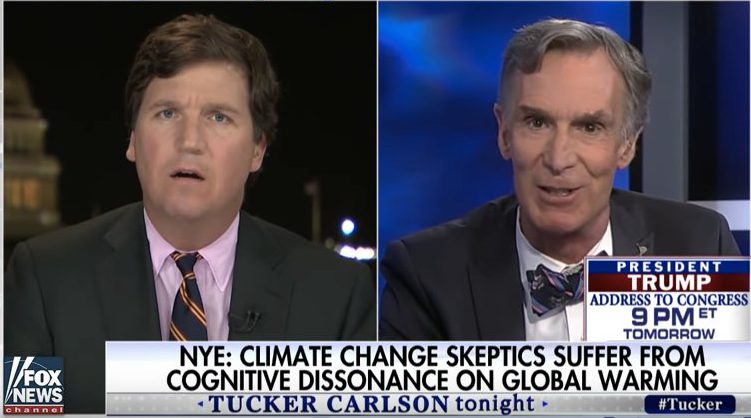
When dealing with a naturalist fundamentalist, make the Tucker Carlson face
The Tucker Carlson face conveys a mix of confusion, disappointment and horror

For God’s sake, even Richard Dawkins admitted in his debate with John Lennox that a good case can be made for a deistic God from the science we have now. If Dawkins can admit this, then you need to be extremely harsh to the village atheists.

If the word “naturalism” is all new to you, you should probably read the whole article and this longer article as well. The longer article really explains the different definitions of the words that are used in these debates. Johnson’s an excellent writer, and you will learn a lot.

Are the Galapagos finch beaks evidence of Darwinian evolution?

I have a key that will unlock a puzzling mystery

Jonathan Wells has an article about it at Evolution News.

It says:

When Charles Darwin visited the Galápagos Islands in 1835, he collected specimens of the local wildlife. These included some finches that he threw into bags, many of them mislabeled. Although the Galápagos finches had little impact on Darwin’s thinking (he doesn’t even mention them in The Origin of Species), biologists who studied them a century later called them “Darwin’s finches” and invented the myth that Darwin had correlated differences in the finches’ beaks with different food sources (he hadn’t). According to the myth, Darwin was inspired by the finches to formulate his theory of evolution, thoughaccording to historian of science Frank Sulloway “nothing could be further from the truth.”

In the 1970s, biologists studied a population of medium ground finches on one of the islands in great detail. When a severe drought left only large, hard-to-crack seeds, 85 percent of the birds perished. The survivors had beaks that were about 5 percent larger than the average beak size in the original population. The biologists estimated that if similar droughts occurred once every ten years, the population could become a new species in only 200 years. In a 1999 booklet defending evolution, the U.S. National Academy of Sciences called the finches “a particularly compelling example” of the origin of species.

But after the drought, birds with smaller beaks flourished again, and the average beak size of the population returned to normal. No net evolution had occurred. No matter; Darwin’s finches became an icon of evolution that is still featured in most biology textbooks.

In the 1980s, a population of large ground finches, with larger beaks than the medium ground finches, migrated to the island. When a drought in 2004-2005 again reduced the food supply, the medium and large ground finch populations both declined. But since even the largest beaks among the medium ground finches were no match for the beaks of the large ground finches, the latter pretty much monopolized the larger seeds and the former had to make do with smaller seeds. This time, the medium ground finches that survived the drought had beaks that were smaller than the average size in the original population. Biologists studying the finches argued that birds with smaller beaks were better able to eat the tiny seeds that were left after the large ground finches ate the big ones, and they concluded that this was again an example of “evolutionary change.”

[…]Wait a minute. Average beak size increased slightly during one drought, only to return to normal after the rains return. Then average beak size decreased slightly during another drought. A region of DNA is correlated with beak size. And somehow that tells us how finches evolved in the first place?

There is an important distinction to make between micro-evolution and macro-evolution. Changes within a type is micro-evolution. Evolving a new organ type or body plan is macro-evolution. There is plenty of evidence for micro-evolution, but no evidence for macro-evolution.

What needs to be proven by the Darwinists is that the same process that results in different average beak size in a population of finches after a drought can create the finches in the first place. I think that Darwinists are credulous – they believe what they want to believe because they want to believe it, even if the evidence is incredibly weak. Darwinists must demonstrate that heritable variations can result in the generation of new organ types and body plans. Changes in average beak size is not interesting. What is needed is to show how the beaks, much less the wings, evolved in the first place.

Icons of Evolution

Jonathan has actually written about a number of  misleading things that you may mind in Biology textbooks.

Here are the sections in his book “Icons of Evolution“:

  • The Miller-Urey Experiment
  • Darwin’s Tree of Life
  • Homology in Vertebrate Limbs
  • Haeckel’s Embroys
  • Archaeopteryx–The Missing Link
  • Peppered Moths
  • Darwin’s Finches
  • Four-Winged Fruit Flies
  • Fossil Horses and Directed Evolution
  • From Ape to Human: The Ultimate Icon

Dr. Wells holds a Ph.D in Molecular and Cell Biology from the University of California at Berkeley.

Are human bodies poorly designed? Is the human retina a bad design?

Christianity and the progress of science

I think this “sub-optimal” argument against a Designer is stupid, because designs are always trade-offs between different quality goals, but just to put this one to bed, here is Evolution News.

Excerpt:

Now a new paper in Nature Communications, “Müller cells separate between wavelengths to improve day vision with minimal effect upon night vision,” has expanded upon this research, further showing the eye’s optimal design. According to the paper, Müller cells not only act as optical fibers to direct incoming light through the optic nerve, but are fine-tuned to specific wavelengths to ensure that light reaches the proper retinal cells. From the Abstract:

Vision starts with the absorption of light by the retinal photoreceptors — cones and rods. However, due to the ‘inverted’ structure of the retina, the incident light must propagate through reflecting and scattering cellular layers before reaching the photoreceptors. It has been recently suggested that Müller cells function as optical fibres in the retina, transferring light illuminating the retinal surface onto the cone photoreceptors. Here we show that Müller cells are wavelength-dependent wave-guides, concentrating the green-red part of the visible spectrum onto cones and allowing the blue-purple part to leak onto nearby rods. This phenomenon is observed in the isolated retina and explained by a computational model, for the guinea pig and the human parafoveal retina. Therefore, light propagation by Müller cells through the retina can be considered as an integral part of the first step in the visual process, increasing photon absorption by cones while minimally affecting rod-mediated vision.

(Amichai M. Labin, Shadi K. Safuri, Erez N. Ribak, and Ido Perlman, “Müller cells separate between wavelengths to improve day vision with minimal effect upon night vision,” Nature Communications, DOI: 10.1038/ncomms5319 (July 8, 2014).)

The paper presents Müller cells as a direct answer to the view that the vertebrate eye has a suboptimal wiring:

[T]he mammalian retina and the peripheral retina of humans and primates are organized in a seemingly reverse order with respect to the light path. This arrangement places the photoreceptors, responsible for light absorption, as the last cells in the path of light, rather than the first. Therefore, the incident light must propagate through five reflecting and scattering layers of cell bodies and neural processes before reaching the photoreceptors. This ‘inverted’ retinal structure is expected to cause blurring of the image and reduction in the photon flux reaching the photoreceptors, thus reducing their sensitivity. It has been recently reported that retinal Müller cells act as light guides serving to transfer light across the retina, from the vitreo-retinal border towards the photoreceptors.

I just had someone push this idea that human beings are badly designed as a response to the cosmic fine-tuning argument of all things. Her list of objections was all speculations (multiverse, aliense, design of humans could be better).

This argument that humans are poorly designed strikes me as literally insane. But since this argument is still in use, I guess I had better say something.

First, the argument assumes that the designer of human beings has to design for our comfort and pleasure. Apparently, God – if he were to exist – would be obligated to design creatures who never got sick, never grew old, and never suffered at all. This makes sense to atheists, for some reason – that the God of the universe has to create creatures that last forever and never suffer. There is this perception out there among atheists and very small narcissistic children (but I repeat myself) that God should be our cosmic butler, waiting at our beck and call to do whatever makes us happiest. From the Christian perspective, this is nonsense. Human beings only think about ultimate questions because, as C.S. Lewis wrote, we suffer pain and have limited lifespans. If were designed to be happy and live forever, we would never think about a relationship with God. By nature, humans want to avoid God, because we don’t want to be accountable to him for our rebellion against him and the harm we cause by disobeying the moral law.

The second problem with the argument from imperfection is that it has no understanding of how engineers work in practice. Engineers are used to trading off non-functional requirements against each other. If the laptop has a fast processor, then it runs hotter. If the laptop has great battery life, it’s heavier because of the larger battery. If the laptop has lots of memory, it costs more to buy. There is no way to get every design goal met because they conflict with each other.

Sometimes, I think that atheists are just little children who have stopped growing in maturity and wisdom. I once heard one particularly stupid atheist in a debate claim that his belief in God had ended when he asked God to help him find his cricket bat, and God had not cosmic butlered to his satisfaction. This happened when the atheist was a child, of course. And this is when most atheists become atheists. It’s not a conclusion that is reached for intellectual reasons. It’s just multiverse, aliens, science fiction, and sexual immorality all the way down. Give me what I want when I want it, and don’t judge me for being self-centered and immoral.