Tag Archives: Darwin

Stephen C. Meyer and Marcus Ross lecture on the Cambrian explosion

Cambrian Explosion
Cambrian Explosion

Access Research Network is a group that produces recordings  of lectures and debates related to intelligent design. I noticed that on their Youtube channel they are releasing some of their older lectures and debates for FREE. So I decided to write a summary of one that I really like on the Cambrian explosion. This lecture features Dr. Stephen C. Meyer and Dr. Marcus Ross.

The lecture is about two hours. There are really nice slides with lots of illustrations to help you understand what the speakers are saying, even if you are not a scientist.

Here is a summary of the lecture from ARN:

The Cambrian explosion is a term often heard in origins debates, but seldom completely understood by the non-specialist. This lecture by Meyer and Ross is one of the best overviews available on the topic and clearly presents in verbal and pictorial summary the latest fossil data (including the recent finds from Chengjiang China). This lecture is based on a paper recently published by Meyer, Ross, Nelson and Chien “The Cambrian Explosion: Biology’s Big Bang” in Darwinism, Design and Public Education(2003, Michigan State University Press). This 80-page article includes 127 references and the book includes two additional appendices with 63 references documenting the current state of knowledge on the Cambrian explosion data.

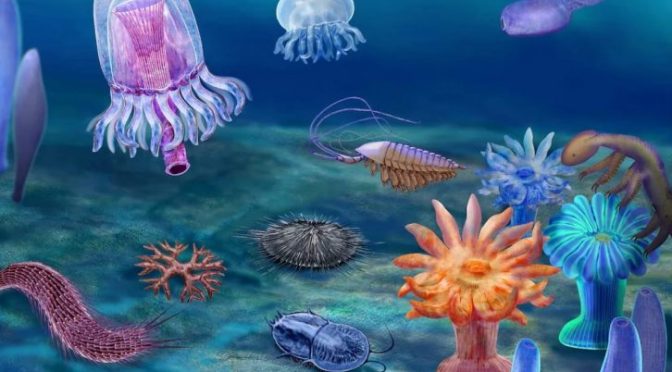
The term Cambrian explosion describes the geologically sudden appearance of animals in the fossil record during the Cambrian period of geologic time. During this event, at least nineteen, and perhaps as many as thirty-five (of forty total) phyla made their first appearance on earth. Phyla constitute the highest biological categories in the animal kingdom, with each phylum exhibiting a unique architecture, blueprint, or structural body plan. The word explosion is used to communicate that fact that these life forms appear in an exceedingly narrow window of geologic time (no more than 5 million years). If the standard earth’s history is represented as a 100 yard football field, the Cambrian explosion would represent a four inch section of that field.

For a majority of earth’s life forms to appear so abruptly is completely contrary to the predictions of Neo-Darwinian and Punctuated Equilibrium evolutionary theory, including:

  • the gradual emergence of biological complexity and the existence of numerous transitional forms leading to new phylum-level body plans;
  • small-scale morphological diversity preceding the emergence of large-scale morphological disparity; and
  • a steady increase in the morphological distance between organic forms over time and, consequently, an overall steady increase in the number of phyla over time (taking into account factors such as extinction).

After reviewing how the evidence is completely contrary to evolutionary predictions, Meyer and Ross address three common objections: 1) the artifact hypothesis: Is the Cambrian explosion real?; 2) The Vendian Radiation (a late pre-Cambrian multicellular organism); and 3) the deep divergence hypothesis.

Finally Meyer and Ross argue why design is a better scientific explanation for the Cambrian explosion. They argue that this is not an argument from ignorance, but rather the best explanation of the evidence from our knowledge base of the world. We find in the fossil record distinctive features or hallmarks of designed systems, including:

  • a quantum or discontinuous increase in specified complexity or information
  • a top-down pattern of scale diversity
  • the persistence of structural (or “morphological”) disparities between separate organizational systems; and
  • the discrete or novel organizational body plans

When we encounter objects that manifest any of these several features and we know how they arose, we invariably find that a purposeful agent or intelligent designer played a causal role in their origin.

Recorded April 24, 2004. Approximately 2 hours including audience Q&A.

I learned a lot by watching great lectures from Access Research Network. Their YouTube channel is here. I recommend their origin of life lectures – I have watched the ones with Dean Kenyon and Charles Thaxton probably a dozen times each. Speaking as an engineer, you never get tired of seeing engineering principles applied to questions like the origin of life.

If you’d like to see Dr. Meyer defend his views in a debate with someone who reviewed his book about the Cambrian explosion, you can find that in this previous post.

Further study

The Cambrian explosion lecture above is a great intermediate-level lecture and will prepare you to be able to understand Dr. Meyer’s new book “Darwin’s Doubt: The Explosive Origin of Animal Life and the Case for Intelligent Design“. The Michigan State University book that Dr. Meyer mentions is called “Darwin, Design and Public Education“. That book is one of the two good collections on intelligent design published by academic university presses, the other one being from Cambridge University Press, and titled “Debating Design: From Darwin to DNA“. If you think this lecture is above your level of understanding, then be sure and check out the shorter and more up-to-date DVD “Darwin’s Dilemma“.

Mark D. Linville: does Darwinian evolution make morality rational?

Have you ever heard an atheist tell you that naturalistic evolution is an answer to the moral argument? I have. And I found a good reply to this challenge in the book “Contending With Christianity’s Critics“. The chapter that responds to the challenge is authored by Dr. Mark D. Linville. It is only 13 pages long. I have a link to the PDF at the bottom of this post.

First, a bit about the author:

Blog: The Tavern at the End of the World
Current positions:

  • PhD Research Fellow
  • Tutoring Fellow in Philosophy

Education:

  • PhD in Philosophy with a minor in South Asian Studies and a specialization in Philosophy of Religion, University of Wisconsin-Madison
  • MA in Philosophy, University of Wisconsin-Madison
  • MA in Philosophy of Religion, Trinity Evangelical Divinity School
  • MA in Theology, Cincinnati Christian Seminary
  • BA in Biblical Studies, Florida Christian College

Here is his thesis of the essay:

Darwin’s account of the origins of human morality is at once elegant, ingenious, and, I shall argue, woefully inadequate. In particular, that account, on its standard interpretation, does not explain morality, but, rather, explains it away . We learn from Darwin not how there could be objective moral facts, but how we could have come to believe—perhaps erroneously—that there are.

Further, the naturalist, who does not believe that there is such a personal being as God, is in principle committed to Darwinism, including a Darwinian account of the basic contours of human moral psychology. I’ll use the term evolutionary naturalism to refer to this combination of naturalism and Darwinism. And so the naturalist is saddled with a view that explains morality away. Whatever reason we have for believing in moral facts is also a reason for thinking naturalism is false. I conclude the essay with a brief account of a theistic conception of morality, and argue that the theist is in a better position to affirm the objectivity of morality.

And here’s a sample to get your attention:

But even if we are assured that a “normal” person will be prompted by the social instincts and that those instincts are typically flanked and reinforced by a set of moral emotions, we still do not have a truly normative account of moral obligation. There is nothing in Darwin’s own account to indicate that the ensuing sense of guilt—a guilty feeling—is indicative of actual moral guilt resulting from the violation of an objective moral law. The revenge taken by one’s own conscience amounts to a sort of second-order propensity to feel a certain way given one’s past relation to conflicting first-order propensities (e.g., the father’s impulse to save his child versus his impulse to save himself). Unless we import normative considerations from some other source, it seems that, whether it is a first or second-order inclination,one’s being prompted by it is more readily understood as a descriptive feature of one’s own psychology than material for a normative assessment of one’s behavior or character. And, assuming that there is anything to this observation, an ascent into even higher levels of propensities (“I feel guilty for not having felt guilty for not being remorseful over not obeying my social instincts…”) introduces nothing of normative import. Suppose you encounter a man who neither feels the pull of social, paternal or familial instincts nor is in the least bit concerned over his apparent lack of conscience. What, from a strictly Darwinian perspective, can one say to him that is of any serious moral import? “You are not moved to action by the impulses that move most of us.” Right. So?

The problem afflicts contemporary construals of an evolutionary account of human morality. Consider Michael Shermer’s explanation for the evolution of a moral sense—the “science of good and evil.” He explains,

By a moral sense, I mean a moral feeling or emotion generated by actions. For example, positive emotions such as righteousness and pride are experienced as the psychological feeling of doing “good.” These moral emotions likely evolved out of behaviors that were reinforced as being good either for the individual or for the group.2

Shermer goes on to compare such moral emotions to other emotions and sensations that are universally experienced, such as hunger and the sexual urge. He then addresses the question of moral motivation.

In this evolutionary theory of morality, asking “Why should we be moral?” is like asking “Why should we be hungry?” or “Why should we be horny?” For that matter, we could ask, “Why should we be jealous?” or “Why should we fall in love?” The answer is that it is as much a part of human nature to be moral as it is to be hungry, horny, jealous, and in love.3

Thus, according to Shermer, given an evolutionary account, such a question is simply a non-starter. Moral motivation is a given as it is wired in as one of our basic drives. Of course, one might point out that Shermer’s “moral emotions” often do need encouragement in a way that, say, “horniness,” does not. More importantly, Shermer apparently fails to notice that if asking “Why should I be moral?” is like asking, “Why should I be horny?” then asserting, “You ought to be moral” is like asserting, “You ought to be horny.” As goes the interrogative, so goes the imperative. But if the latter seems out of place, then, on Shermer’s view, so is the former.

One might thus observe that if morality is anything at all, it is irreducibly normative in nature. But the Darwinian account winds up reducing morality to descriptive features of human psychology. Like the libido, either the moral sense is present and active or it is not. If it is, then we might expect one to behave accordingly. If not, why, then, as a famous blues man once put it, “the boogie woogie just ain’t in me.” And so the resulting “morality” is that in name only.

In light of such considerations, it is tempting to conclude with C. S. Lewis that, if the naturalist remembered his philosophy out of school, he would recognize that any claim to the effect that “I ought” is on a par with “I itch,” in that it is nothing more than a descriptive piece of autobiography with no essential reference to any actual obligations.

When it comes to morality, we are not interested in mere descriptions of behavior. We want to know about prescriptions of behavior, and whether why we should care about following those prescriptions. We are interested in what grounds our sense of moral obligation in reality. What underwrites our sense of moral obligation? If it is just rooted in feelings, then why should we obey our moral sense when obeying it goes against out self-interest? Feelings are subjective things, and doing the right thing in a real objective state of affairs requires more than just feelings. There has to be a real objective state of affairs that makes it rational for us to do the right thing, even when the right thing is against our own self-interest. That’s what morality is – objective moral obligations overriding subjective feelings. I wouldn’t trust someone to be moral if it were just based on their feelings.

Theistic evolutionists and the two-platoon strategy

What should we make of theistic evolutionists telling us that you can believe in God, while still knowing that matter, law and chance explain the full development of all of life?

Consider this quotation from from famous intelligent design Phillip E. Johnson.

Quote:

The National Academy’s way of dealing with the religious implications of evolution is akin to the two-platoon system in American football. When the leading figures of evolutionary science feel free to say what they really believe, writers such as Edward O. Wilson, Richard Dawkins, Daniel Dennett, Carl Sagan, Steven Pinker, Stephen Jay Gould, Richard Lewontin and others state the “God is dead” thesis aggressively, invoking the authority of science to silence any theistic protest. That is the offensive platoon, and the National Academy never raises any objection to its promoting this worldview.

At other times, however, the scientific elite has to protect the teaching of the “fact of evolution” from objections by religious conservatives who know what the offensive platoon is saying and who argue that the science educators are insinuating a worldview that goes far beyond the data. When the objectors are too numerous or influential to be ignored, the defensive platoon takes the field. That is when we read those spin-doctored reassurances saying that many scientists are religious (in some sense), that science does not claim to have proved that God does not exist (but merely that he does not affect the natural world), and that science and religion are separate realms which should never be mixed (unless it is the materialists who are doing the mixing). Once the defensive platoon has done its job it leaves the field, and the offensive platoon goes right back to telling the public that science has shown that “God” is permanently out of business. (The Wedge of Truth, IVP 2000, pp. 88-89).

So what naturalistic scientists believe is that God didn’t do anything to create the diversity of life – that nature does all of its own creating. In fact, it doesn’t matter if the best naturalistic explanation is improbable or implausible – scientists must bitterly cling to materialistic explanations of natural phenomena.

The problem for these scientists is that they are taxpayer-funded, and religious people don’t like paying to have scientists shoehorn reality into a pre-supposed naturalistic framework. Sometimes, religious people get annoyed about being told that sparking gases can create functional proteins. And sometimes, religious people get annoyed about being told that the universe oscillates eternally despite observations that falsify that speculative theory. And sometimes, religious people get annoyed about being told that there are as yet undiscovered fossilized precusors to the Cambrian era fossils.

Naturalists think that opposition to these lame naturalistic theories only ever be religiously-motivated. They cannot accept that people might question their naturalistic just-so stories on scientific grounds. So what do the naturalists do when faced with scientifically-motivated dissent that they think is religiously motivated? Well, they trot out “religious” scientists. These “religious” scientists claim to have a deep personal faith in God, and a belief in miracles. But these religious scientists believe that what actually happened is that law, matter and chance did all the creating of life. This is the “second platoon”. They are sent out to mislead the public by talking about their personal faith, and what God could and couldn’t do, and how evolutionists can believe in God without any evidence of intelligent causes in the history of life. The one question they most want to avoid is whether science, done in the ordinary naturalistic way, can discover evidence of intelligent agency in the history of the development of life.

So what is theistic evolution? Theistic evolutionists believe no intelligent causes are detectable in nature by science, and that no intelligent causes are needed to explain life. They like to say phrases like “God could” and “God might” and “I believe” and “I attend this church” and “I received a Christian award” and “I believe in miracles too”. But atheists and theistic evolutionists agree on what science shows about the diversity of life – intelligent causes didn’t do anything.

The quickest way to disarm a theistic evolutionist is to refuse to talk about religion or God, and to ask them to show you the naturalistic explanation of the Big Bang. And the naturalistic explanation of the fine-tuning. And the naturalistic explanation of the origin of life. And the naturalistic explanation of the Cambrian explosion. And so on. Focus on the science – don’t let them turn the conversation to their personal beliefs, or to the Bible, or to religion, or to philosophy. Ask them what they can show in the lab. If naturalistic mechanisms can do all the creating they say it can do, let’s see the demonstration in the lab.