
Tag Archives: Creation

Alexander Vilenkin: “All the evidence we have says that the universe had a beginning”

I’ve decided to explain why physicists believe that there was a creation event in this post. That is to say, I’ve decided to let famous cosmologist Alexander Vilenkin do it.

From Uncommon Descent.

Excerpt:

Did the cosmos have a beginning? The Big Bang theory seems to suggest it did, but in recent decades, cosmologists have concocted elaborate theories – for example, an eternally inflating universe or a cyclic universe – which claim to avoid the need for a beginning of the cosmos. Now it appears that the universe really had a beginning after all, even if it wasn’t necessarily the Big Bang.

At a meeting of scientists – titled “State of the Universe” – convened last week at Cambridge University to honor Stephen Hawking’s 70th birthday, cosmologist Alexander Vilenkin of Tufts University in Boston presented evidence that the universe is not eternal after all, leaving scientists at a loss to explain how the cosmos got started without a supernatural creator. The meeting was reported in New Scientist magazine (Why physicists can’t avoid a creation event, 11 January 2012).

[…]In his presentation, Professor Vilenkin discussed three theories which claim to avoid the need for a beginning of the cosmos.

The three theories are chaotic inflationary model, the oscillating model and quantum gravity model. Regular readers will know that those have all been addressed in William Lane Craig’s peer-reviewed paper that evaluates alternatives to the standard Big Bang cosmology.

But let’s see what Vilenkin said.

More:

One popular theory is eternal inflation. Most readers will be familiar with the theory of inflation, which says that the universe increased in volume by a factor of at least 10^78 in its very early stages (from 10^−36 seconds after the Big Bang to sometime between 10^−33 and 10^−32 seconds), before settling into the slower rate of expansion that we see today. The theory of eternal inflation goes further, and holds that the universe is constantly giving birth to smaller “bubble” universes within an ever-expanding multiverse. Each bubble universe undergoes its own initial period of inflation. In some versions of the theory, the bubbles go both backwards and forwards in time, allowing the possibility of an infinite past. Trouble is, the value of one particular cosmic parameter rules out that possibility:

But in 2003, a team including Vilenkin and Guth considered what eternal inflation would mean for the Hubble constant, which describes mathematically the expansion of the universe. They found that the equations didn’t work (Physical Review Letters, DOI: 10.1103/physrevlett.90.151301). “You can’t construct a space-time with this property,” says Vilenkin. It turns out that the constant has a lower limit that prevents inflation in both time directions. “It can’t possibly be eternal in the past,” says Vilenkin. “There must be some kind of boundary.”

A second option explored by Vilenkin was that of a cyclic universe, where the universe goes through an infinite series of big bangs and crunches, with no specific beginning. It was even claimed that a cyclic universe could explain the low observed value of the cosmological constant. But as Vilenkin found, there’s a problem if you look at the disorder in the universe:

Disorder increases with time. So following each cycle, the universe must get more and more disordered. But if there has already been an infinite number of cycles, the universe we inhabit now should be in a state of maximum disorder. Such a universe would be uniformly lukewarm and featureless, and definitely lacking such complicated beings as stars, planets and physicists – nothing like the one we see around us.

One way around that is to propose that the universe just gets bigger with every cycle. Then the amount of disorder per volume doesn’t increase, so needn’t reach the maximum. But Vilenkin found that this scenario falls prey to the same mathematical argument as eternal inflation: if your universe keeps getting bigger, it must have started somewhere.

However, Vilenkin’s options were not exhausted yet. There was another possibility: that the universe had sprung from an eternal cosmic egg:

Vilenkin’s final strike is an attack on a third, lesser-known proposal that the cosmos existed eternally in a static state called the cosmic egg. This finally “cracked” to create the big bang, leading to the expanding universe we see today. Late last year Vilenkin and graduate student Audrey Mithani showed that the egg could not have existed forever after all, as quantum instabilities would force it to collapse after a finite amount of time (arxiv.org/abs/1110.4096). If it cracked instead, leading to the big bang, then this must have happened before it collapsed – and therefore also after a finite amount of time.

“This is also not a good candidate for a beginningless universe,” Vilenkin concludes.

So at the end of the day, what is Vilenkin’s verdict?

“All the evidence we have says that the universe had a beginning.”

This is consistent with the Borde-Guth-Vilenkin Theorem, which I blogged about before, and which William Lane Craig leveraged to his advantage in his debate with Peter Millican.

The Borde-Guth-Vilenkin (BGV) proof shows that every universe that expands must have a space-time boundary in the past. That means that no expanding universe, no matter what the model, can be eternal into the past. No one denies the expansion of space in our universe, and so we are left with a cosmic beginning. Even speculative alternative cosmologies do not escape the need for a beginning.

Conclusion

If the universe came into being out of nothing, which seems to be the case from science, then the universe has a cause. Things do not pop into being, uncaused, out of nothing. The cause of the universe must be transcendent and supernatural. It must be uncaused, because there cannot be an infinite regress of causes. It must be eternal, because it created time. It must be non-physical, because it created space. There are only two possibilities for such a cause. It could be an abstract object or an agent. Abstract objects cannot cause effects. Therefore, the cause is an agent.

Now, let’s have a discussion about this science in our churches, and see if we can’t train Christians to engage with non-Christians about the evidence so that everyone accepts what science tells us about the origin of the universe.
Michael Strauss lectures on scientific evidence for a Creator at UT Dallas

Apologetics and the progress of science

The lecture: (from 2013)

Note: there is a period of 19 minutes of Q&A at the end of the lecture.

About the speaker:

His full biography is here.

Summary:

  • It used to be true that most of the great scientists were believers in God
  • But now science has advanced and we have better instruments – is it still true?
  • Today, many people believe that science has shows that the universe and Earth are not special
  • We used to believe that the Earth was the center of the universe, and Darwin showed we are not designed
  • The problem with this view is that it is based on old science, not modern science
  • Three topics: origin of the universe, fine-tuning of the universe, the Rare Earth hypothesis

Experimental evidence for the origin of the universe:

  • #1: Hubble discovered that the universe expands because of redshifting of light from distant galaxies
  • #2: Measurements of the cosmic microwave background radiation show the universe had a beginnning
  • #3: Measurements of the light element (hydrogen and helium) abundances confirm an origin of the universe
  • The best explanation for an absolute origin of space, time, matter and energy is a supernatural cause

Experimental evidence for the design of the universe:

  • #1: The amount of matter: a bit less = no stars and galaxies, a bit more = universe recollapses
  • #2: The strong force: a bit more = only hydrogen, a bit more = little or no hydrogen
  • #3: Carbon resonance level: a bit higher = no carbon, a bit lower = no carbon

Experimental evidence for galactic, stellar and planetary habitability:

  • #1: Galaxy: produces high number of heavy elements and low radiation
  • #2: Star: long stable lifetime, burns bright, bachelor star, third generation star (10 billion years must elapsed),
  • #3: Planet: mass of planet, stable orbit, liquid water, tectonic activity, tilt, moon

Naturalistic explanations:

  • Humans evolve to the point where they reach back in time and create finely-tuned universe
  • Eternally existing multiverse

Hawking and Mlodinow response to Rare Earth:

  • There are lots of planets so one must support life
  • Odds of a planet that supports life are low even with 10^22 planets

Hawking and Mlodinow proposal of M-theory multiverse:

  • There is no experimental evidence for M-theory being true
  • M-theory is not testable now and is not likely to be testable in the future
  • But science is about making testable predictions, not about blind speculation

Hawking and Mlodinow no-boundary proposal:

  • This theory requires the laws of physics to exist prior to the universe
  • But where do you get laws of physics before there is any physical world?
  • There is no experimental evidence for no-boundary proposal
  • All the evidence we have now (redshift, CMBR, H-He abundances) is for Big Bang

What science has revealed provide abundant evidence for a transcendent Creator and Designer

Related posts

How do atheists try to accommodate the Big Bang in their worldview?

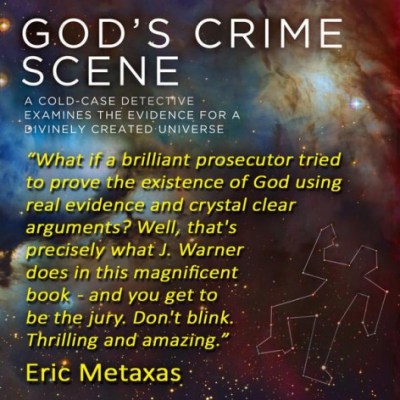
J. Warner Wallace: God's Crime Scene
J. Warner Wallace: God’s Crime Scene

OK, so J. Warner Wallace has a new book out and it’s about science and God. I know, because I saw pictures of his reading list, that he has read tons and tons of atheists like Carl Sagan, Lawrence Krauss and so on.

He’s writing about some of the things he learned from all this reading on his blog, and I wanted to link to something about Lawrence Krauss trying to accommodate the Big Bang within his worldview of atheism.

Wallace writes:

One of the key pieces of evidence in the universe is simply it’s origin. If our universe began to exist, what could have caused it’s beginning? How did everything (all space, time and matter) come into existence from nothing? One way atheist physicists have navigated this dilemma has simply been to redefine the terms they have been using. What do we mean when we say “everything” or “nothing”? At first these two terms might seem rather self-explanatory, but it’s important for us to take the time to define the words. As I’ve already stated, by “everything” we mean all space, time and matter. That’s right, space is “something”; empty space is part of “everything” not part of “nothing”. For some of us, that’s an interesting concept that might be hard to grasp, but it’s an important distinction that must be understood. When we say “nothing”, we mean the complete absence of everything; the thorough non-existence of anything at all (including all space time and matter). These two terms, when defined in this way, are consistent with the principles of the Standard Cosmological Model, but demonstrate the dilemma. If everything came from nothing, what caused this to occur? What is the non-spatial, atemporal, immaterial, uncaused, first cause of the universe? A cause of this sort sounds a lot like a supernatural Being, and that’s why I think many naturalists have begun to redefine the terms.

Lawrence Krauss, Arizona State University Professor (School of Earth and Space Exploration and Director of the Origins Initiative) wrote a book entitled, “A Universe from Nothing: Why There Is Something Rather than Nothing”. As part of the promotion for the book, Krauss appeared on the Colbert Report where he was interviewed by comedian Stephen Colbert. During the interview, Krauss tried to redefine “nothing” to avoid the need for a supernatural first cause:

“Physics has changed what we mean by nothing… Empty space is a boiling, bubbling brew of virtual particles popping in and out of existence… if you wait long enough, that kind of nothing will always produce particles.” (Colbert Nation, June 21st, 2012)

Now if you’re not careful, you might miss Krauss’ subtle redefinition. In describing the sudden appearance of matter (“particles”), Krauss assumes the prior existence of space (“empty space”) and time (“if you wait long enough”). If you’ve got some empty space and wait long enough, matter appears. For Krauss, the “nothing” from which the universe comes includes two common features of “everything” (space and time), and something more (virtual particles). This leaves us with the real question: “Where did the space, time and virtual particles come from (given all our evidence points to their origination at the beginning of our universe)?” Krauss avoids this inquiry by moving space and time from the category of “something” to the category of “nothing”.

If you’ve got a teenager in your house, you might recognize Krauss’ approach to language. I bet you’ve seen your teenager open the refrigerator door, gaze at all the nutritious fruits and vegetables on the shelves, then lament that there is “nothing to eat.”

I used to say that when I was a teenager, but I grew out of it. I didn’t go on the Comedy Channel and try to convince everyone that what I was saying about the refrigerator was scientific.

Anyway, here is a debate between William Lane Craig and Lawrence Krauss, if you want to see how Krauss defends his “refrigerator has nothing to eat” view of cosmology. I know everybody and even many Christians all think that we have something to hide when it comes to science, but if you would just watch these debates, you would see that there is nothing to fear from science at all. We own it.

Meanwhile, I want to show you that this is not at all rare among atheists.

Look, here is Peter Atkins explaining how he makes the Big Bang reconcile with his atheism – and notice that it’s a completely different view than Krauss:

So, just who is this Peter Atkins, and why is he a good spokesman for atheism?

From his Wikipedia bio.

Peter William Atkins (born August 10, 1940) is an English chemist and a fellow and professor of chemistry at Lincoln College of the University of Oxford. He is a prolific writer of popular chemistry textbooks, including Physical Chemistry, 8th ed. (with Julio de Paula of Haverford College), Inorganic Chemistry, and Molecular Quantum Mechanics, 4th ed. Atkins is also the author of a number of science books for the general public, including Atkins’ Molecules and Galileo’s Finger: The Ten Great Ideas of Science.

[…]Atkins is a well-known atheist and supporter of many of Richard Dawkins’ ideas. He has written and spoken on issues of humanism, atheism, and what he sees as the incompatibility between science and religion. According to Atkins, whereas religion scorns the power of human comprehension, science respects it.

[…]He was the first Senior Member for the Oxford Secular Society and an Honorary Associate of the National Secular Society. He is also a member of the Advisory Board of The Reason Project, a US-based charitable foundation devoted to spreading scientific knowledge and secular values in society. The organisation is led by fellow atheist and author Sam Harris.

Now watch that 6-minute video above. Peter Atkins thinks that nothing exists. He thinks he doesn’t exist. He thinks that you don’t exist. This is how atheism adapts to a world where the Big Bang creation event is fact.

I think Peter Atkins should join Lawrence Krauss on the Comedy Channel and present that view. I would laugh. Wouldn’t you?