Tag Archives: Creation

New study: cameras capture wild crows using tools they made to hunt for insects

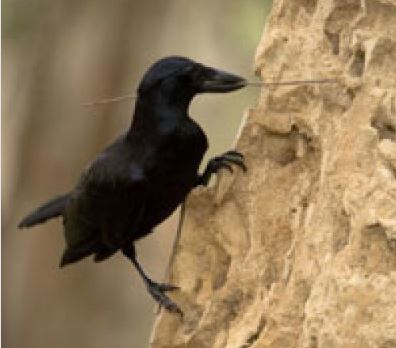
Crow using a tool he made to hunt for bugs

By now regular readers know that birds are my favorite creatures of all, especially parrots. Pretty much any new study about how great birds are will be blogged about here. Partly to bolster the argument for design in nature, and partly just because I think that birds are so awesome!

Here is the latest bird news from Science Daily.

Excerpt:

Scientists have been given an extraordinary glimpse into how wild New Caledonian crows make and use ‘hooked stick tools’ to hunt for insect prey.

Dr Jolyon Troscianko, from the University of Exeter, and Dr Christian Rutz, from the University of St Andrews, have captured first video recordings documenting how these tropical corvids fashion these particularly complex tools in the wild.

The pair developed tiny video ‘spy-cameras’ which were attached to the crows, to observe their natural foraging behaviour.

They discovered two instances of hooked stick tool making on the footage they recorded, with one crow spending a minute making the tool, before using it to probe for food in tree crevices and even in leaf litter on the ground.

The findings are reported in the Royal Society’s journal Biology Letters on Wednesday, December 23.

[…]”In one scene, a crow drops its tool, and then recovers it from the ground shortly afterwards, suggesting they value their tools and don’t simply discard them after a single use.” According to Rutz, this observation agrees with recent aviary experiments conducted by his group: “Crows really hate losing their tools, and will use all sorts of tricks to keep them safe. We even observed them storing tools temporarily in tree holes, the same way a human would put a treasured pen into a pen holder.”

New Caledonian crows (Corvus moneduloides) are found on the South Pacific island of New Caledonia.

They can use their bills to whittle twigs and leaves into bug-grabbing implements; some believe their tool-use is so advanced that it rivals that of some primates.

OK, that is pretty cool, but on crows are not the most cuddly birds. However, Goffin cockatoos are pretty cuddly, and there was a related story about them.
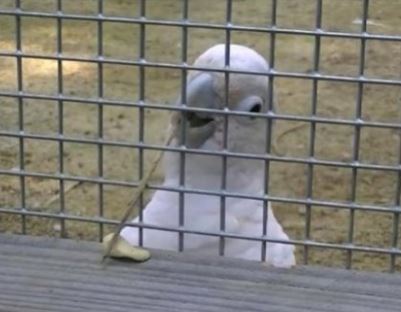
Goffin cockatoo using a tool he made to scoop up food through cage bars

First, this one from November 2012: (Science Daily)

A cockatoo from a species not known to use tools in the wild has been observed spontaneously making and using tools for reaching food and other objects.

A Goffin’s cockatoo called ‘Figaro’, that has been reared in captivity and lives near Vienna, used his powerful beak to cut long splinters out of wooden beams in its aviary, or twigs out of a branch, to reach and rake in objects out of its reach. Researchers from the Universities of Oxford and Vienna filmed Figaro making and using these tools.

How the bird discovered how to make and use tools is unclear but shows how much we still don’t understand about the evolution of innovative behaviour and intelligence.

A report of the research is published this week in Current Biology…

And then an update to the story – a new study showing that the cockatoo is actually able to teach other birds how to make tools as well: (Science Daily)

Goffin’s cockatoos can learn how to make and use wooden tools from each other, a new study has found.

The discovery, made by scientists from Oxford University, the University of Vienna, and the Max Planck Institute at Seewiesen, is thought to be the first controlled experimental evidence for the social transmission of tool use in any bird species.

Goffin’s cockatoo (Cacatua goffini) is a curious species of Indonesian parrot not known to use tools in the wild. At a laboratory in Austria the researchers had observed a captive adult male Goffin’s cockatoo named ‘Figaro’ spontaneously start to sculpt stick tools out of wooden aviary beams to use them for raking in nuts out of his reach. To investigate if such individual invention could be passed on to other cockatoos the team used Figaro as a ‘role model’, exposing other birds to tool use demonstrations, some with Figaro as ‘teacher’ and others without his ‘students’ seeing him at work.

In the experiments one cockatoo group was allowed to observe Figaro skilfully employing a ready-made stick tool, while another could see what researchers called ‘ghost demonstrations’ — either seeing the tools displacing the nuts by themselves, while being controlled by magnets hidden under a table, or seeing the nuts moving towards Figaro without his intervention, again using magnets to displace the food. The birds were all then placed in front of an identical problem, with a ready-made tool lying on the ground nearby.

Three males and three females that saw Figaro’s complete demonstration interacted much more with potential tools and other components of the problem than those seeing ghost demos. They picked up sticks more than the ghost demo control groups and generally seemed more interested in achieving the result. Remarkably, all three males in this group acquired proficient tool use, while neither the females in the same group nor males and females in the ghost demo groups did.

A report of the research is published in the journal Proceedings of the Royal Society B.

During the Christmas holidays, I’ve been working on a technical project that is now deployed and functioning on a cloud service, backed by a data store. One of the reasons I have been able to keep at it despite all the festivities going on, is because my pet bird has been flying and landing on top the computer monitor and urging me to get cracking on the next feature in the feature list. He is very bossy.

Related posts

New study: parrots capable of using and sharing tools

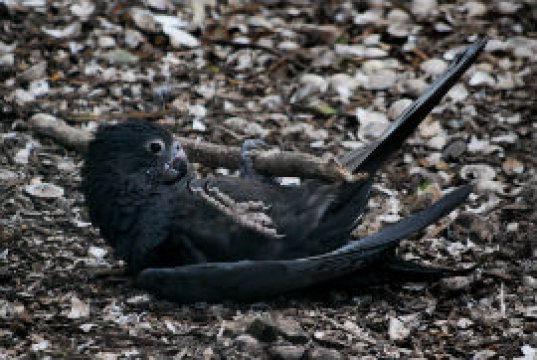
Greater vasa parrot using a tool to extract calcium
Greater vasa parrot using a tool

All right, well, awareness of my tremendous affection for all things bird-related has spread to all my friends, and now whenever there is an interesting bird study, (or funny video of owls blinking), I can expect to be informed about it.

My friend Melissa, who is doing a degree in STEM, and just got all As, sent me this new study from Science Daily.

It says:

Psychologists at the University of York and University of St Andrews have uncovered the first evidence of tool use by greater vasa parrots (Coracopsis vasa).

Studying ten captive parrots, researchers in the Department of Psychology at York observed the birds adopt a novel tool-using technique to acquire calcium from seashells and also the active sharing of tools among themselves.

The birds used small pebbles or date pits to grind calcium powder from the shells or to break off small pieces of shell to ingest. This behaviour, never before seen in this species, is the first evidence of a nonhuman using tools for grinding, and one of the few reports of nonhuman animals sharing tools directly.

Observing and filming the parrots over an eight month period (March to October), researchers documented their interactions with cockle shells on the floor of their aviary. Shells are a known source of calcium for birds.

Five out of ten birds were documented using tools, placing either pebbles or date pits inside shells to grind against the shell, or using them as a we

Yes, this is actually really important if you are a bird owner, as I am. Male parrots tend to have problems that are specific to their breed, but female parrots of any breed seem to run into this egg-laying problem where they law so many eggs, that they run out of calcium to make the eggshells. This is called “egg binding” and it can kill your bird if it’s not caught early.

Now, what do you think that a ambitious and chivalrous male parrot would do about egg binding when courting a delightful female parrot?

This:

Interest in the shells was greatest from March to mid-April, just before the breeding season — this may be due to calcium supplementation being critical for egg-laying. Researchers were therefore initially surprised to find that it was the males, not the females who showed the greatest interest in shells.

However, observation of the parrots’ breeding behaviour showed that males often engaged in regurgitative feeding of females before copulating with them, thus potentially passing on the calcium benefits.

Megan Lambert, PhD student in York’s Department of Psychology and lead author on the study, said: “The use of tools by nonhuman animals remains an exceedingly rare phenomenon. These observations provide new insights into the tool-using capabilities of parrots and give rise to further questions as to why this species uses tools.

“Tool use could reflect an innate predisposition in the parrots, or it could be the result of individual trial and error learning or some form of social learning. Whether these birds also use tools in the wild remains to be explored, but ultimately these observations highlight the greater vasa parrot as a species of interest for further studies of physical cognition.”

That’s right!

Here is a video linked in the article:

Now, do you know what this reminds me of? It reminds me of that post on love that I wrote a while back. When a man loves a woman, he tries to take away her trouble, or to take trouble for her, so that she is protected and her life is easier. He does things that will help her because he cares about her. It would be nice if more men acted like these birds, and tried to show that they cared by protecting and providing. And it would be nice if more women looked for protecting and providing, and were attracted by them.

Lawrence Krauss debates “A Universe From Nothing” with an astrophysicist

Two horses fight it out, may the best horse win!

Dina sent me news of a cracking good episode of Unbelievable, which features Lawrence Krauss, who debated William Lane Craig. Krauss’ book was also reviewed in the New York Times.

The MP3 file is here.

Details:

Lawrence Krauss is a Cosmologist at Arizona State University who describes himself as an “anti-theist”. His latest book “A Universe From Nothing” has received both acclaim and criticism for its attempt to answer the question “Why is there something rather than nothing?” Debating the issue with Krauss is Rodney Holder, Course director at the Faraday Institute, Cambridge. An astrophysicist and priest by background. In a lively exchange they debate whether Krauss’ “nothing” is “nothing”, fine tuning and multiverses, scientific knowledge, miracles and the usefulness of theology and philosophy.

This debate is quite entertaining, and do not be intimidated if your don’t understand science. You can understand pretty easily who is arguing based on facts and who is speculating about unobservable, untestable entities. At one point, Krauss actually denies that there is any fine-tuning in the universe, so please see this link to refute that claim as well as this podcast which explains some examples of fine-tuning. Krauss gets a bit angry at the beginning, but calms down.

Quotation marks are for direct quotes, italics is for made-up snark. See below the summary for more posts that are related to this one.

Summary of the discussion: (picked up at 9:30 when they start talking about the book)

Brierley:

  • explain your theory of how the universe can come into being from nothing

Krauss:

  • the nothing that preceded the universe is “no space, no time, no universe”
  • theists say that God is responsible for creating the universe out of this nothing
  • but the laws of nature can create the universe uncaused out of nothing

Holder:

  • Krauss sometimes writes that the nothing is really a quantum vacuum, but that is not nothing
  • He even acknowledges in his book that a quantum vacuum is not nothing
  • He thinks that the nothing has properties, even though it has no being
  • It has the property of being unstable
  • It has the property of being acted on by quantum fields
  • It has the property of being acted on by gravity

Krauss:

  • But nothing can have the potential to do things inside it
  • For example suppose you have an electron, which is not nothing
  • If it jumps from one level to another, it emits light
  • There was no potential for the light in the electron, but it was there as part of atomic structure

Holder:

  • But in cases like that, there is something physical that has the potential
Krauss:
  • Well, how did God makes the universe then if it had no potential?

Holder:

  • God existed, and the potential for creating the universe in himself

Brierley:

Krauss:
  • It was written by a philosopher, so I dismissed it

Brierley:

Krauss:
  • These book reviewers have not even read my book!

Krauss:

  • Science will be able to figure out how to make something from nothing in the future
  • We are even now speculating about interesting questions, like is there a multiverse?

Brierley:

  • Consider the critical review of your book in the New York Times
  • The author of the review claims that you equivocate on the term “nothing”
  • In order to get things to pop into being, you have to make “nothing” mean “something”
  • Reviewer: none of Krauss’ theories explain how something can come from actual nothingness

Krauss:

  • In physics, something and nothing are not that different
  • The reviewer doesn’t understand the physics
  • He doesn’t understand quantum field theory
  • You could call a quantum vacuum “nothing”, (this is the vacuum fluctuation model, refuted by William Lane Craig in a peer-reviewed publication in an astrophysics journal – get the full text of the article here)
  • Maybe there is an eternally existing multiverse that we can’t observe or test scientifically
  • Maybe it has laws that we don’t know about which allow our universe to pop into being
  • Maybe this popping into being is uncaused
  • (alarmed) Who made God? Who made God?

Holder:

  • God is eternal and necessary

Krauss:

  • (interrupting, angry) What does it mean for something to be necessary?

Holder:

  • Basically, you have to decide whether there is more evidence that the necessary being God or a multiverse

Brierley:

  • So Dr. Krauss are you willing to say that the universe is a brute fact, in some sense, and requires no explanation

Krauss:

  • (angry) Religious people are stupid because they just assume brute facts, not like me and my unobservable, untestable multiverse
  • (angry) Religious people are against the progress of science, they don’t want to figure out how things work

Brierley:

  • But isn’t it possible that naturalists can be opposed to the progress of science?
  • What about the way the Fred Hoyle opposed the Big Bang because he wanted an eternal universe

Krauss:

  • (angry) But naturalists like me let the facts determine our beliefs, like the facts about the eternal unobservable, untestable multiverse
  • (angry, shouting) Philosophers are stupid, they know nothing!

=== Break ===

Brierley:

  • Do you see any evidence of purpose in the universe?

Krauss:

  • Well maybe I would believe if the stars lined up to spell out a message from God

Brierley:

  • Actually no, that wouldn’t be evidence for God on your multiverse view
  • if there an infinite number of universes existing for an infinite amount of time, then anything can happen no matter how unlikely it is
  • therefore, no evidence could convince you that God exists, since the unobservable, untestable, eternal multiverse can make anything it wants

Krauss:

  • That’s a true statement, and very convenient for atheists who don’t want to be accountable to God, don’t you think?
Brierley:
  • Back to the multiverse, how does it solve the fine-tuning?

Krauss:

  • “We have no idea if the universe is fine-tuned for life”, even though the atheist Martin Rees who endorsed Krauss’ book wrote his own book about the fine-tuning of the universe called “Just Six Numbers”
  • Inflationary theory does suggest a way to create multiple universes, (this is the chaotic inflationary model, refuted by William Lane Craig in a peer-reviewed publication in an astrophysics journal – get the full text of the article here)

Brierley:

  • But this theory is still very much a hypothesis, isn’t it? We can’t observe or test this hypothesis can we?

Krauss:

  • “No, and that is really important to state”
  • “I’m an empiricist, so if you can’t falsify it and if you can’t test it then it’s not science”
  • In my book, I speculate about a way that we could test the multiverse theory

Holder:

  • Yes, in principle, the multiverse would be scientific if you could test it through other theories like inflationary theory
  • There are a lot of speculations about multiverse theory, but no evidence from predictions that were validated in the lab

Krauss:

  • “I agree completely with everything you just said”

Brierley:

  • Roger Penrose agrees with Holder that the multiverse theory is too speculative
  • (To Holder) Isn’t the multiverse theory better than positing a completely different kind of being, which is God?

Holder:

  • The multiverse theory is extremely speculative
  • Even if the multiverse were true, you would still need to explain the multiverse

Krauss:

  • People don’t oppose my book because it’s full of self-contradictory speculations
  • People oppose my book because they are stupid and ignorant

Holder:

  • There are things that exist that science cannot measure, like objective morality
  • It’s possible to give explanations for moral behavior by appealing to evolution
  • But that does not ground self-sacrificial morality, such as what occurs in the Christian life

Brierley:

  • Dawkins says there is no purpose or morality in in the universe, do you agree?

Krauss:

  • “There is certainly no evidence of any of that”

Brierley:

  • In the book, you talk about how we live in a special time in the universe’s history to be able to do science, (i.e. – The Privileged Planet hypothesis)
  • You also write about how all the discoveries were are making will not be communicated to anyone in other places in the universe
  • So what is the meaning of doing science on your view? And why are you sad at the knowledge that will not be available to people in the future?
  • Are you longing for some kind of purpose?

Krauss:

  • No, I just get enjoyment from studying the universe with science to gain understanding

Holder:

  • What do you make of Einstein’s statement about the unexpected comprehensibility of the universe
  • Theists would say that this is because God wanted us to study and understand and gain knowledge

Krauss:

  • “It is remarkable that the universe is comprehensible”

Brierley:

  • Why is the universe comprehensible?

Krauss:

  • Well, maybe the universe just has to be that way

Brierley:

  • What do you make of the heat death of the universe, when all life in the universe will die out?

Krauss:

  • That’s the way the universe is
=== BREAK ===

Krauss:

  • I wouldn’t want to live in a universe where there was a God
  • God is a cosmic Saddam Hussein
  • “Religious people turn their minds off” and believe in God for consolation

Holder:

  • First, Jesus is the revelation of God and he is no Saddam Hussein
  • Second, the Christian life is anything but easy, we are facing some persecution already in the UK
  • Third, there is also the problem of being accountable to God when we die
  • It’s very much like science – Christianity is the way it is, not the way we want it to be

Krauss:

  • “If you don’t believe in him, you don’t get any of the benefits, so you have to believe”
  • “And then if you’ve done something wrong, you’re going to be judged for it”
  • “So I don’t want to be judged by God, I want to be… that’s the bottom line”

Holder:

  • Well, Jesus has died to pay the price for those things we’ve done wrong
  • Although we will have to face the charges for what we’ve done, believers will ultimately be forgiven

UPDATE: Peter Sean Bradley note that Krauss is now walking back his rhetoric in response to criticisms from people like atheist John Horgan.

Related posts