Tag Archives: Cosmology

Sean Carroll debates William Lane Craig on cosmology and God’s existence

Here’s the video of the debate:

Carroll was as good of a speaker as Craig in terms of style. Very easy to listen to, very quick on his feet, very civil. There was no clear winner on style.

It was difficult to assess the truth value of scientific points being made, especially for the layperson. I explained a few of them in my posts earlier this week, but I think laypeople might struggle with them if they are hearing about these things for the first time.

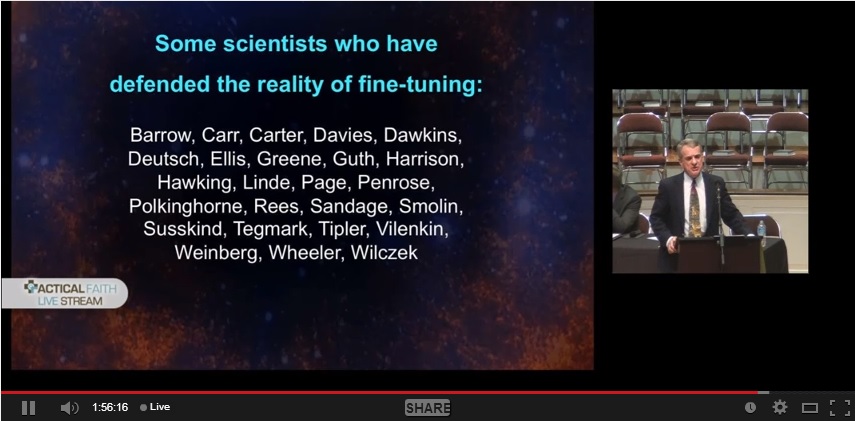
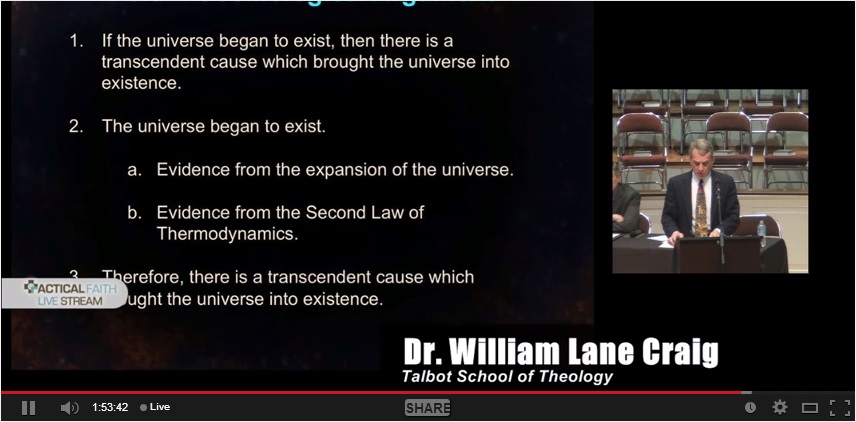
A couple of Craig’s slides: (click for larger images)

Slide 1 of 2:
Dr. Craig slide #1 of 2

Slide 2 of 2:

Dr. Craig slide #2 of 2

Quick summary: (this is not complete, because I couldn’t get everything they were saying noted)

Dr. Craig defended two arguments: 1) the kalam cosmological argument and the fine-tuning argument.

Dr. Craig supported the origin of the universe with 1) the expansion of the universe and 2) the second law of thermodynamics.

Dr. Craig said that the BGV theorem supports a beginning for the universe.

Dr. Craig said that the consensus of scientists did not accept Carroll’s naturalistic cosmology, quoting Stephen Hawking in support.

Dr. Craig said that multiverse models fall victim to the Boltzmann brain problem, where we should observe Boltzmann brains coming into existence and then phasing out again far more probably than embodied minds. But we observe embodied minds, and no Boltzmann brains.

Dr. Carroll said that science cannot study metaphysical questions.

Dr. Carroll said that science is about making models that may or may not be consistent with the experimental data.

Dr. Carroll said that the BGV theorem does not support a beginning for the universe.

Dr. Carroll proposed 17 alternative cosmologies, but did not provide a shred of scientific evidence for any of them, the way that Craig did for the standard model.

Dr. Carroll refuted Dr. Craig’s citation of Stephen Hawking, and Craig yielded the point.

Dr. Carroll speculated that science might progress to the point where the fine-tuning can be explained without an intelligent cause, and he gave an example of where that happened (inflation).

Dr. Craig argued that all 17 of the models suggested by Carroll either conflicted with evidence, had serious problems or did require a beginning.

Dr. Craig argued that Carroll’s own model required a beginning.

Dr. Craig argued that Carroll’s own model fell victim to the Boltzmann brain problem.

Dr. Craig argued that Carroll’s own model violated the second law of thermodynamics.

Dr. Craig re-stated his point that the baby universe spawning in Carroll’s model was speculative and incomplete, and cited Christopher Weaver’s work.

Dr. Carroll denied that things that pop into being out of nothing require a transcendent cause.

Dr. Carroll reiterated that science can only make naturalistic models, and that he did not have to answer questions about ultimate causes.

Dr. Carroll showed a photo of Alan Guth expressing his opinion that the universe is “probably” eternal. No evidence was given for this assertion.

Dr. Carroll said that the fine-tuning was not done in an optimal way, because one fine-tuned value was lower than it needed to be, and it should be exactly what it needed to be if God did it.

Dr. Carroll said that a finely-tuned universe is more probably in naturalism than in theism, because God can do anything he wants and doesn’t need a fine-tuned universe.

Dr. Carroll said he would stop defending his model now, and would instead defend Aguirre-Gratton.

Dr. Craig gave three reasons why the universe popping into being out of nothing requires a transcendent cause.

First, he said that nothing cannot cause anything to happen, because nothing is nothing.

Second, he said that if things pop into being out of nothing, then why don’t we see it happening all the time with other things.

Third, he said that we have no reason to dismiss the causal principle, especially when it is the basis of scientific inquiry and has been so fruitful in the progress of science.

Dr. Craig reiterated that baby universes in Carroll’s model would be dominated by Boltzmann brains, and we don’t observe that.

Dr. Craig said that even on the quantum gravity models that Carroll mentioned, there would still be a beginning.

Dr. Carroll said that Craig mustn’t say “popped into being” but instead that “there was a first moment of time”.

Dr. Carroll said that his model does indeed violate the second law of thermodynamics “YES!”.

At this point Carroll stopped talking about the topic of the debate and started expressing personal opinions about religion. It’s funny how often atheists do this in debates.

Dr. Carroll said that most theists don’t believe in God because of cosmology, but because of community and feelings.

Dr. Carroll said that science had learned a lot in the last 2000 years, so theism was false.

Dr. Carroll said that most philosophers don’t think that God exists, so theism was false.

Dr. Carroll said microscopes and telescopes were absent 2000 years ago, so theism was false.

Dr. Carroll said that religion should be about community and feelings, not about what is true.

Conclusion:

My conclusion was that Carroll lost because he is just satisfied to throw theories out and not to argue that they are true by citing evidence. Carroll never seemed to be interested in finding out what is true, but instead he just wanted to tell a story that didn’t include God, and assert that by Occam’s Razor, his story was a better explanation. I am not impressed with theoretical speculations, although the layperson might be. I kept waiting for him to respond to Craig’s points about how his model was falsified by experimental evidence and observations, e.g. – the Boltzmann brains or the baby universe generation, and he never cited the evidence I wanted him to cite. Craig did have some evidence for his views, but he could have been stronger in making his case. He could have shown the e-mail from Vilenkin that stated that he had understood the BGV theorem, and was using it correctly, for example.

For me the winning side comes down to evidence. The standard model is the standard model because of scientific evidence. Until that evidence is overturned, then speculative models are of no interest to anyone who is evidence-driven. Speculations are not science. A philosophical presupposition of metaphysical naturalism is not science.

If you want to see a good lecture on scientific evidence related to cosmology, then there is the particle physicist Michael Strauss lecture on cosmology and fine-tuning at Stanford University and his more recent lecture at the University of Texas. Note that Strauss is an experimental physicist, not a theoretical physicist like Carroll.

Here’s another review of the debate by Randy Everist of Possible Worlds blog. He explains the back-and-forth over Boltzmann brains and the BGV theorem in more detail.


Five reasons why the multiverse is not a good explanation for cosmic fine-tuning

Apologetics and the progress of science

This post by J. Warner Wallace appeared at his Cold Case Christianity blog. It features 5 reasons why the multiverse hypothesis is not a good explanation for the astonishing degree of fine-tuning we find in the cosmic constants and quantities in the universe that allow complex, embodied intelligent life of any conceivable kind.

Here is the list:

  1. This Explanation Lacks Evidential Confirmation
  2. This Explanation Requires Fine-Tuning
  3. This Explanation Relies on Speculative Notions of Time
  4. This Explanation Results in Absurdities Common to “Infinites”
  5. This Explanation Acknowledges an “External” Creative Cause

Let’s take a closer look at numbers two and three:

This Explanation Requires Fine-Tuning
If there is a multiverse vacuum capable of such creative activity, it would be reasonable for us to askhow the physics of such an environment could be so fine-tuned to create a life-permitting universe. As Oxford philosopher Richard Swinburne observes, any proposed multiverse mechanism “needs to have a certain form rather than innumerable possible other forms, and probably constants too that need fine-tuning in the narrow sense . . . if that diversity of universes is to result.” Theoretical physicist, Stephen Hawking, when assessing “eternal inflation” models as a source for the multiverse, admits the same problem of fine-tuning: “The problem is, for our theoretical models of inflation to work, the initial state of the universe had to be set up in a very special and highly improbable way. Thus traditional inflation theory resolves one set of issues but creates another—the need for a very special initial state.”

This Explanation Relies on Speculative Notions of Time
Theorists who propose a pre-existing vacuum must account for the nature of time in this setting. All descriptions of this vacuum describe it as temporal (with bubble universes emerging or quantum events occurring over time). But the Standard Cosmological Model indicates time, as we know it,began with our universe. Physicist Alexander Vilenkin describes the dilemma this way: “There is no matter and no space in this very peculiar state. Also, there is no time . . . In the absence of space and matter, time is impossible to define. And yet, the state of ‘nothing’ cannot be identified with absolute nothingness.” Multiverse explanations must provide an account for the temporal nature of the vacuum lying at the core of their theory.

Regarding  Wallace’s first point, here is MIT physicist Alan Lightman talking about the multiverse’s evidential problems in Harper’s Magazine.

He writes:

The… conjecture that there are many other worlds… [T]here is no way they can prove this conjecture. That same uncertainty disturbs many physicists who are adjusting to the idea of the multiverse. Not only must we accept that basic properties of our universe are accidental and uncalculable. In addition, we must believe in the existence of many other universes. But we have no conceivable way of observing these other universes and cannot prove their existence. Thus, to explain what we see in the world and in our mental deductions, we must believe in what we cannot prove.

Sound familiar? Theologians are accustomed to taking some beliefs on faith. Scientists are not. All we can do is hope that the same theories that predict the multiverse also produce many other predictions that we can test here in our own universe. But the other universes themselves will almost certainly remain a conjecture.

It’s not a good explanation of the data, it’s just desperate speculation. Don’t be one of these people that finds a way to believe what you want to believe. Look through the telescope for yourself. Believe what you can see with your own eyes – that’s the right way to get to the truth.

Why is the universe so big, and why is so much of it hostile to life?

Chris Kyle, Navy SEAL
Chris Kyle, Navy SEAL, can hit a very small target from a mile away – very improbable

Review: In case you need a refresher on the cosmological and fine-tuning arguments, as presented by a professor of particle physics at Stanford University, then click this link and watch the lecture.

If you already know about the standard arguments for theism from cosmology, then take a look at this post on Uncommon Descent.

Summary:

In my previous post, I highlighted three common atheistic objections to to the cosmological fine-tuning argument. In that post, I made no attempt to answer these objections. My aim was simply to show that the objections were weak and inconclusive.

Let’s go back to the original three objections:

1. If the universe was designed to support life, then why does it have to be so BIG, and why is it nearly everywhere hostile to life? Why are there so many stars, and why are so few orbited by life-bearing planets? (Let’s call this the size problem.)

2. If the universe was designed to support life, then why does it have to be so OLD, and why was it devoid of life throughout most of its history? For instance, why did life on Earth only appear after 70% of the cosmos’s 13.7-billion-year history had already elapsed? And Why did human beings (genus Homo) only appear after 99.98% of the cosmos’s 13.7-billion-year history had already elapsed? (Let’s call this the age problem.)

3. If the universe was designed to support life, then why does Nature have to be so CRUEL? Why did so many animals have to die – and why did so many species of animals have to go extinct (99% is the commonly quoted figure), in order to generate the world as we see it today? What a waste! And what about predation, parasitism, and animals that engage in practices such as serial murder and infant cannibalism? (Let’s call this the death and suffering problem.)

In today’s post, I’m going to try to provide some positive answers to the first two questions: the size problem and the age problem.

Here’s an excerpt for the size argument:

(a) The main reason why the universe is as big as it currently is that in the first place, the universe had to contain sufficient matter to form galaxies and stars, without which life would not have appeared; and in the second place, the density of matter in the cosmos is incredibly fine-tuned, due to the fine-tuning of gravity. To appreciate this point, let’s go back to the earliest time in the history of the cosmos that we can meaningfully talk about: the Planck time, when the universe was 10^-43 seconds old. If the density of matter at the Planck time had differed from the critical density by as little as one part in 10^60, the universe would have either exploded so rapidly that galaxies wouldn’t have formed, or collapsed so quickly that life would never have appeared. In practical terms: if our universe, which contains 10^80 protons and neutrons, had even one more grain of sand in it – or one grain less – we wouldn’t be here.

If you mess with the size of the universe, you screw up the mass density fine-tuning. We need that to have a universe that expands at the right speed in order to form galaxies, stars and planets. You need planets to have a place to form life – a place with liquid water at the surface.

And an excerpt for the age argument:

(a) One reason why we need an old universe is that billions of years were required for Population I stars (such as our sun) to evolve. These stars are more likely to harbor planets such as our Earth, because they contain lots of “metals” (astronomer-speak for elements heavier than helium), produced by the supernovae of the previous generation of Population II stars. According to currently accepted models of Big Bang nucleosynthesis, this whole process was absolutely vital, because the Big Bang doesn’t make enough “metals”, including those necessary for life: carbon, nitrogen, oxygen, phosphorus and so on.

Basically, you need heavy elements to make stars that burn slow and steady, as well as to make PEOPLE! And heavy elements have to be built up slowly through several iterations of the stellar lifecycle, including the right kinds of stellar death: supernovae.

Read the rest! These arguments come up all the time in debates with village atheists like Christopher Hitchens and Richard Dawkins. It’s a smokescreen they put up, but you’ve got to be able to answer it using the scientific evidence we have today. They always want to dismiss God with their personal preferences about what God should or should not do. But the real issue is the design of the cosmological constants that allow life to anywhere. That’s the part that’s designed. And that’s not a matter of personal preference, it’s a matter of mathematics and experimental science.

One last parting shot. If God made the universe have life everywhere, the first thing atheists would say is “See? Life evolves fine by itself without any God!” The only way to recognize a marksman is when he hits a narrow target (not hostile to life) from a wide range of possibilities that have no value (hostile to life). We don’t credit Chris Kyle for hitting the wall above an Islamic terrorist from a mile away, we credit Chris Kyle for hitting an Islamic terrorist a mile away. The design is not how much of the universe is hospitable to life versus how much is hostile to life. The design is in the cosmological constants – where we are in the narrow band that is hospitable to life and not in the huge regions that are hostile to life.

You can read the best explanation of the design argument in this lecture featuring Robin Collins. That link goes to my post which has a summary of the lecture. He has a new lecture that I also blogged about where he extends the fine-tuning argument down to the level of particle physics. I have a summary of that one as well.