
Tag Archives: Cosmological Argument

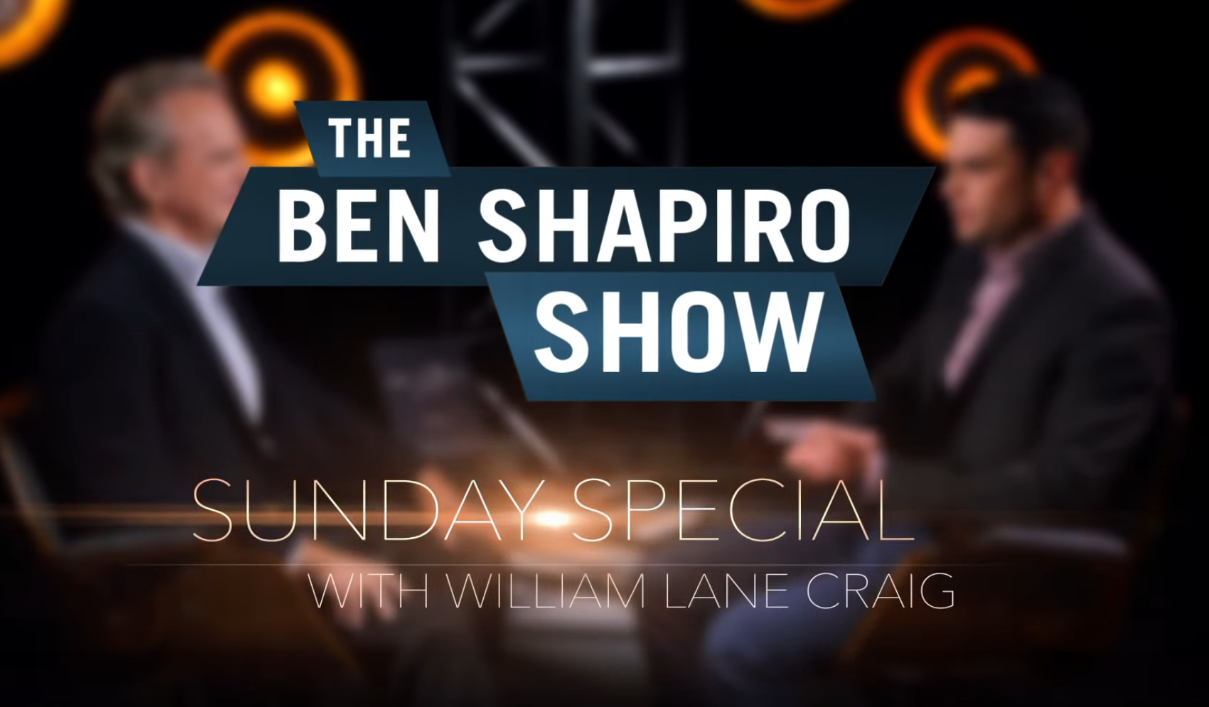
Dr. William Lane Craig interviewed on the Ben Shapiro Show Sunday Special

Dr. William Lane Craig on the Ben Shapiro Sunday special

I’m re-posting this old episode of the Ben Shapiro show.  They discuss arguments for God’s existence in the first 25 minutes. The spend the first 26 minutes on arguments for God,and  the next 16 minutes on Christian distinctives. They spend a bunch more time responding to common arguments for atheism, and finally Ben asks Dr. Craig how he became a Christian.

Summary:

William Lane Craig, philosopher, theologian, and best selling author of numerous books including “On Guard: Defending Your Faith With Reason And Precision,” joins Ben to discuss the hard sciences vs. philosophy, the cosmological and ontological arguments, Jesus, slavery, gay marriage, and much more.

Video:

The MP3 file is here.

Topics:

  • Why are we seeing such a decline in religious belief in America?
  • Why are mainline denominations in Christianity and Judaism emptying out?
  • What was the driver behind the move away from religion starting in the 1960s?
  • Why is their a gap in the university and in the broader culture between reason and religious belief?
  • What is the strongest argument for God’s existence?
  • What is the most compelling argument for God’s existence for this culture?
  • Respond to Richard Dawkins’ challenge that God needs a cause.
  • Why does the universe have to have a cause?
  • Does Darwinian evolution provide grounds for our awareness of objective moral values and duties?
  • What is the strongest objection to the cosmological argument?
  • What is the strongest objection to the moral argument?
  • What about the objection that the existence of the universe is just a “brute fact” and doesn’t need an explanation for it’s existence?
  • What about David Hume’s objection to the law of causality?
  • What about objections to the cause of the universe from apparently uncaused events in quantum mechanics?
  • What is the ontological argument, and why is it frequently dismissed?
  • How do we get from an unmoved mover to a moral God?
  • Which arguments show that God is a mind?
  • How do you show that God is present and active in time now?
  • How do you move from God as Creator, Designer and moral lawgiver to a God who has revealed himself to human beings?
  • Who does Jesus claim to be in the gospels, and what is the evidence that his claims were correct?
  • From the Jewish perspective, this narrative has some  problems. First, merely declaring yourself as the Messiah is not seen as a punishable offense.
  • Second, the real problem is that Jesus vision of himself as the Messiah is completely different than how Jews have understood the Messiah. The Messiah in Judaism has always been a political figure who is destined to restore the Kingdom of Israel, bringing more Jews back to Israel, etc.  Claiming to be God, though would be blasphemy and a punishable offense.
  • Why is resurrection proof of divinity? Wasn’t Lazarus also raised from the dead?
  • The gospels were written decades after the events they claim to describe. Should we still see them as reliable enough to infer that the resurrection really happened?
  • Couldn’t legends have been introduced in the gap between the events and the time that the events were recorded?
  • Is it enough for us to have a Creator God, or is there a reason for God to reveal himself to us?
  • Tell us about your experience debating atheist scholars on university campuses.
  • Has any an atheist ever caused you to doubt your arguments?
  • The problem of human evil is easy to respond to, but how do you respond to the problem of natural evil, i.e. – suffering from events in the natural world, such as birth defects or natural disasters.
  • Atheists like to bring up specific disagreements they have with the Bible, e.g. – same-sex marriage, abortion, slavery, genocide. How would you respond to those?
  • Regarding slavery in the Bible, isn’t it the case that people sometimes do things that are not prescribed by God, and the Bible merely records that?
  • How would you respond then to people who push for same-sex marriage by arguing that this is a case where God wanted same-sex marriage, but couldn’t press for it because the people were not capable at that time and in that culture?
  • When discussing specific issues of morality, do you try to argue from a natural law perspective or from the morality in the Bible?
  • How would you respond to someone like Jordan Peterson who approaches religion teachings pragmatically, focusing on behaviors rather than the rational grounding of those behaviors?
  • How do you speak to young people about God without them losing interest?
  • How did you become a Christian?
  • As the influence of Judeo-Christian religion recedes, what do you see filling the void, and how do you see that affecting Western civilization going forward?

Physicist Michael Strauss discusses Christianity and science at Stanford University

Christianity and the progress of science

This is one of my favorite lectures.

The lecture:

Dr. Strauss delivered this lecture at Stanford University in 1999. It is fairly easy to understand, and it even includes useful dating tips.

Here is a clip:

The full video can be watched on Vimeo:

Summary:

What does science tell us about God?
– the discoveries of Copernicus made humans less significant in the universe
– the discoveries of Darwin should that humans are an accident
– but this all pre-modern science
– what do the latest findings of science say about God?

Evidence #1: the origin of the universe
– the steady state model supports atheism, but was disproved by the latest discoveries
– the oscillating model supports atheism, but was disproved by the latest discoveries
– the big bang model supports theism, and it is supported by multiple recent discoveries
– the quantum gravity model supports atheism, but it pure theory and has never been tested or confirmed by experiment and observation

Evidence #2: the fine-tuning of physical constants for life
– there are over 100 examples of constants that must be selected within a narrow range in order for the universe to support the minimal requirements for life
– example: mass density
– example: strong nuclear force (what he studies)
– example: carbon formation

Evidence #3: the fine-tuning of our planet for habitability
– the type of galaxy and our location in it
– our solar system and our star
– our planet
– our moon

It’s a good lecture explaining a couple of basic arguments for a cosmic Creator and Designer. If you add the origin of life and the Cambrian explosion (Stephen C. Meyer’s arguments), then you will be solid on the basic scientific arguments for a Creator and Designer of the universe.

Positive arguments for Christian theism

The kalam cosmological argument defended in a peer-reviewed science journal

Christianity and the progress of science

Here’s the peer-reviewed article. It appears in a scientific journal focused on astrophysics.

Here’s the abstract:

Both cosmology and philosophy trace their roots to the wonder felt by the ancient Greeks as they contemplated the universe. The ultimate question remains why the universe exists rather than nothing. This question led Leibniz to postulate the existence of a metaphysically necessary being, which he identified as God. Leibniz’s critics, however, disputed this identification, claiming that the space-time universe itself may be the metaphysically necessary being. The discovery during this century that the universe began to exist, however, calls into question the universe’s status as metaphysically necessary, since any necessary being must be eternal in its existence. Although various cosmogonic models claiming to avert the beginning of the universe predicted by the standard model have been and continue to be offered, no model involving an eternal universe has proved as plausible as the standard model. Unless we are to assert that the universe simply sprang into being uncaused out of nothing, we are thus led to Leibniz’s conclusion. Several objections to inferring a supernatural cause of the origin of the universe are considered and found to be unsound.

The whole text of the article is posted online here.

Here’s an excerpt in which the author, Dr. William Lane Craig, explains the Big Bang cosmology:

The monumental significance of the Friedman-Lemaitre model lay in its historization of the universe. As one commentator has remarked, up to this time the idea of the expansion of the universe “was absolutely beyond comprehension. Throughout all of human history the universe was regarded as fixed and immutable and the idea that it might actually be changing was inconceivable.”{8} But if the Friedman-Lemaitre model were correct, the universe could no longer be adequately treated as a static entity existing, in effect, timelessly. Rather the universe has a history, and time will not be matter of indifference for our investigation of the cosmos. In 1929 Edwin Hubble’s measurements of the red-shift in the optical spectra of light from distant galaxies,{9} which was taken to indicate a universal recessional motion of the light sources in the line of sight, provided a dramatic verification of the Friedman-Lemaitre model. Incredibly, what Hubble had discovered was the isotropic expansion of the universe predicted by Friedman and Lemaitre. It marked a veritable turning point in the history of science. “Of all the great predictions that science has ever made over the centuries,” exclaims John Wheeler, “was there ever one greater than this, to predict, and predict correctly, and predict against all expectation a phenomenon so fantastic as the expansion of the universe?”{10}

As a GTR-based theory, the Friedman-Lemaitre model does not describe the expansion of the material content of the universe into a pre-existing, empty, Newtonian space, but rather the expansion of space itself. This has the astonishing implication that as one reverses the expansion and extrapolates back in time, space-time curvature becomes progressively greater until one finally arrives at a singular state at which space-time curvature becomes infinite. This state therefore constitutes an edge or boundary to space-time itself. P. C. W. Davies comments,

An initial cosmological singularity . . . forms a past temporal extremity to the universe. We cannot continue physical reasoning, or even the concept of spacetime, through such an extremity. . . . On this view the big bang represents the creation event; the creation not only of all the matter and energy in the universe, but also of spacetime itself.{11}

The popular expression “Big Bang,” originally a derisive term coined by Fred Hoyle to characterize the beginning of the universe predicted by the Friedman-Lemaitre model, is thus potentially misleading, since the expansion cannot be visualized from the outside (there being no “outside,” just as there is no “before” with respect to the Big Bang).{12}

The standard Big Bang model thus describes a universe which is not eternal in the past, but which came into being a finite time ago. Moreover,–and this deserves underscoring–the origin it posits is an absolute origin ex nihilo. For not only all matter and energy, but space and time themselves come into being at the initial cosmological singularity. As Barrow and Tipler emphasize, “At this singularity, space and time came into existence; literally nothing existed before the singularity, so, if the Universe originated at such a singularity, we would truly have a creation ex nihilo.“{13}

[…]On such a model the universe originates ex nihilo in the sense that at the initial singularity it is true that There is no earlier space-time point or it is false that Something existed prior to the singularity.

Every theist should be able to understand and defend this argument. It is a scientific refutation of materialism, and it is supported by six lines of scientific evidence – all of which emerged as science has progressed.

Scientific evidence:

  1. Einstein’s theory of general relativity (GTR)
  2. the red-shifting of light from distant galaxies implies an expanding universe
  3. the cosmic background radiation (which also disproves the oscillating model of the universe)
  4. the second law of thermodynamics applied to star formation theory
  5. hydrogen-helium abundance predictions
  6. radioactive element abundance predictions

Those are the scientific discoveries that have led us to the beginning of the universe, which support’s Dr. Craig’s argument.

This is the kind of evidence I expect all Christian theists to be using when discussing the question of whether God exists. Scientific evidence. When talking to non-Christians, we first need to show that we understand science, because science is a reliable and respected way of getting knowledge about the universe. Non-Christians do not accept the Bible, but they do accept science, so we begin evangelism with science. Science (experimental, testable, repeatable science) should set limits on what anyone can believe – including non-Christians, who might otherwise not be inclined to listen to Bible verses and theology. Important: it’s not a good idea to discuss the resurrection of Jesus with a person who does not accept the scientific evidence for a Creator of the universe.

A helpful short video:

The Big Bang is not compatible with atheism

According to the Secular Humanist Manifesto, atheism is committed to an eternally existing universe, (See the first item: “Religious humanists regard the universe as self-existing and not created.”). If something non-material brought all existing matter into being, that would be a supernatural cause, and atheists deny that anything supernatural exists. The standard Big Bang theory requires that all the matter in the universe come into being out of nothing. This falsifies eternal models of the universe, which are required by the atheistic worldview.