
Tag Archives: Conservative Party

A look at redistribution of wealth from the workers to the non-workers in Canada

Canada election 2011: Conservatives in Blue, Socialists in Red, Communists in Orange
Election 2011: Conservatives in Blue, Socialists in Red, Communists in Orange

I found two examples of policies that promote the redistribution of wealth from producers to non-producers in Canada. I think it’s worth taking a look at their policies so that we understand more about our own redistribution policies.

The first example of redistribution has to do with unemployment insurance, where productive taxpayers who choose low-risk, high-pay jobs must subsidize other citizens who get high-risk, low-pay jobs. Their program is called “Employment Insurance”. Canadians who work have to pay into the system, and when any of them loses their jobs, then they get to take money out of it. Those who work more pay more, those who work less pay less. Those with safe jobs collect nothing, and those with risky jobs collect more.

Is this program fair? In this article from Brian Lilley’s Lilley Pad blog, Canadian columnist Lorne Gunter explains what’s wrong with this program.

Excerpt:

Employment Insurance is a lot of things, but an insurance plan to encourage employment it is not.

For one thing, the premiums aren’t based on the risk of making a claim.

Young drivers pay higher auto insurance premiums because they are much more likely to get in an accident. Yet Canadians in high-unemployment industries and high-unemployment regions make no higher EI contributions than those who live where they are never likely to be without work.

Indeed, those most likely to make EI claims will make far lower lifetime contributions than those who are unlikely ever to claim. That makes EI a welfare program underwritten by a tax on employment, rather than an insurance plan.

In the 1990s, I interviewed a Statistics Canada researcher who had made the study of EI his life’s work. He told me that he had discovered one New Brunswick town of 3,000 people where every adult had made at least one EI claim. Most had claimed three or more times.

In some areas, EI is an accepted part of the culture. It’s that entitlement mentality the Tories’ changes are aimed at breaking.

In the CBC’s fawning 1994 biography of Pierre Trudeau, St. Pierre admitted that one of the goals of his government’s ’70s-era reforms to Unemployment Insurance (as it was more accurately known then) was to enable Canadians to stay in their home regions if they wanted to, even if they were never likely to find steady work there.

So the scheme is also an interregional transfer of wealth — from have to have-not provinces.

Of course, every year thousands of Canadians move from have-not regions to more prosperous areas in search of better jobs and higher pay. So it is not as though everyone who could collects EI to stay put.

But the question is why should hard-working Canadians be compelled to subsidize anyone who refuses to move or turns down locally available work?

It’s very similar to their health care programs, which transfers wealth from producers to health care users – and remember that not all health care is from stuff like car accidents. Abortions, IVF and sex changes are entirely voluntary – based on lifestyle choices.

But this is not the only program that transfers wealth from workers to non-workers. It turns out that there is an entire province of Canada that has a majority of secular socialist slackers who can’t pay their own way, but must instead depend on the rest of Canada to support them.

Eric Duhaime explains in this article on the Lilley Pad.

Excerpt:

Although we live in the same house, we certainly don’t sleep in the same room anymore. Our romantic days are long gone. Quebec and the rest of Canada have grown apart. Young Quebecers have no appetite for constitutional quarrels, although they define themselves more and more as Quebecois and less and less as Canadians. They have even invented the word “decanadianization.”

Conversely, English-Canadians are becoming more and more fed up with paying for Quebec, which receives more than half the money given through the so-called equalization program, the equivalent of $8 billion a year.

The solution might not be to ask Quebec to become an independent nation but to become less dependent on its neighbours and more fiscally autonomous. To calm English Canada down, the equalization formula — which will be reviewed before 2014 anyway — could be modernized.

Canada has evolved over the years. The need for interprovincial welfare is not as necessary as it used to be. The principle of redistribution is part of our Constitution but could focus exclusively on funding very essential social programs, which wouldn’t include $7-a-day daycare or a fully subsidized year of parental leave after the birth of each child.

I think it would be an excellent idea to cut Quebec loose. Whatever goods and services they produce could still be bought by the rest of Canada – if there are any such things. Let them pay for their own exorbitant abortion and day care costs, for a start.

Why am I posting about Canada? I think it’s important for us to look at other countries so that we understand how public policies that are sold to us as “compassionate” actually punish hard work, thrift and risk-taking while at the same time rewarding ignorance, wastefulness and sloth. In fact, one could argue that Obamacare itself is nothing more than a way to transfer wealth from those who are take care of their health and work hard for their money, to those who are unemployed and want free contraceptives, abortions and sex changes. You can get all three of those things in the Canadian province of Ontario, and in the UK as well. But the UK goes even further and provides taxpayer-funded IVF and breast implants. This is what liberal compassion really means: pillaging those who sacrifice their leisure to work, in order to buy votes from unproductive, reckless and lazy special interest groups.

Canadian government to limit environmentalist obstruction of energy development

From Fox Business: the Canadians embrace federalism.

Excerpt:

The Canadian government released details Tuesday of its plan to dramatically streamline reviews for big energy and mining projects, capping the timeline for federal reviews and ceding more regulatory oversight to the country’s provinces.

The Conservative government of Prime Minister Stephen Harper has said for months it would move to speed up the regulatory review of big energy, mining and infrastructure projects. It has expressed frustration at the sometimes-lengthy review timelines for big projects.

Mr. Harper’s government said in its annual budget announcement last month that it would cap federal reviews. Resources Minister Joe Oliver released details Tuesday, saying that federally-led hearings would be applied only to major initiatives that risk some environmental harm.

Further, the government said it was prepared to hand over more responsibility for the review to Canadian provinces, so long as their regulations meet or exceed federal standards. Canadian provinces already enjoy considerable regulatory oversight.

“It is counterproductive to have the federal and provincial governments completing separate reviews of the same project,” Oliver said in a speech in Toronto.

[…]The government had previewed in its budget last month that reviews for major projects would be limited to 24 months. Meanwhile, regular inter-provincial pipeline reviews, as conducted by the National Energy Board, would be limited to 18 months.

Oliver said Tuesday that Enbridge Inc.’s (ENB) proposed Northern Gateway pipeline – which envisions shipping oil from Alberta to Canada’s West Coast — would benefit from the quicker review. The line has been mired in stiff opposition from native groups in British Columbia, and the government has accused foreign-funded environmental groups of tying up the project in regulatory hearings. Government officials said the new rules would also limit who could participate as intervenors in the review process.

[…]In Toronto, Oliver said the current process is unworkable, with over 40 federal departments involved in reviews. He said he would pare that back to only three federal agencies: the Canadian Environmental Assessment Agency; the National Energy Board; and the Canadian Nuclear Safety Commission.

The Canadian process, as it stands, forces investors to go “through hoops and hurdles as far as the eye can see,” Oliver said. “We simply have to turn that around.”

Canadians don’t want to scare businesses away from Canada – they want the jobs to come to Canada. That’s the exact opposite of what Obama’s socialist “Environmental Protection Agency” does – they regulate energy development, in order to block it or slow it down.

And Canada lowered corporate taxes to 15% compared to our 35% – and their revenues held steady.

Canada: Corporate tax cuts, not stimulus spending

They cut their corporate tax rate, but then businesses saw the lower rate and just kept on expanding in order to make more money. As businesses grow, they pay more in taxes. So government revenues from taxes haven’t dropped at all, even with the lower corporate tax rates! More businesses moved in to Canada to capitalize on the lower tax rates, generating revenue for the government. More workers moved off of unemployment and welfare as demand for labor grew, and they started paying income taxes and sales taxes, generating even more revenue for the government. Do you know what makes consumers more confident, so that they spend more? Having a job.  Not being dependent on government.

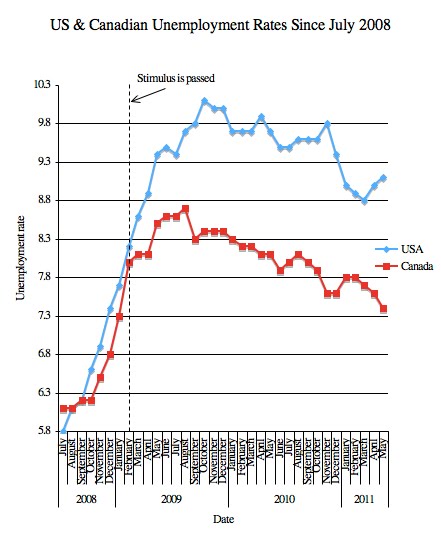
Look at their unemployment rate:

Canada and US unemployment rates

When we embraced “stimulus” spending, they went for the corporate tax cuts. Our unemployment rate used to be LOWER than theirs, before Pelosi and Reid took over Congress in January 2007. Now we are HIGHER than they are. That’s not rhetoric – that’s data. Even though Canada’s economy is linked to ours, and has suffered as a result of that, they have been signing free trade deals left, right and center. They did this in order to decouple themselves from our collapsing economy, massive debt and devalued currency. Barack Obama, of course, opposes free trade. He has to – he’s in the back pocket of the socialist labor unions.

Free trade empire: (click for larger image)

Canada: Free Trade Empire

What a contrast Canada’s energy policy makes with Obama’s politicized “Cash for Cronies” energy policy. But then again, Canada hired a conservative right-wing capitalist economist to run their country. We could have just done the same and put in economists like Thomas Sowell or Walter Williams to run our economy, but we put in an unqualified community organizer instead.

Iain Duncan Smith’s defense of traditional marriage in the UK

Dina sent me this article from the UK Telegraph.

Excerpt:

Iain Duncan Smith will make the Coalition’s most explicit official statement in favour of parents marrying and staying together.

He will say that children from such homes are most likely to end up with a good education and a job.

The Work and Pensions Secretary will make the declaration as he announces an Early Intervention Foundation to raise millions of pounds from private investors to help disadvantaged children.

The Social Justice Strategy Paper will set out plans to tackle the causes of poverty and disadvantage.

It makes clear that the stability of parents’ relationships is a key factor in children’s prospects.

Marriage is particularly good for children, the paper says. The Government is “concerned” by the long-term trend away from marriage, it says.

Mr Duncan Smith will say the strategy marks a change in the approach to marriage. Successive governments have done too little to promote stable families, he will say.

Mr Duncan Smith has had a long personal interest in family issues but the main paper he will publish today constitutes a government commitment to promote marriage.

The command paper quotes evidence showing that “children tend to enjoy better life outcomes when the same two parents give them support and protection”.

Children who have experienced the breakdown of their parents’ relationship are “more likely to have poor cognitive development and education and employment outcomes than those who have lived with both birth parents”.

“Outcomes” are better for children when parents stay together, the paper says. Research shows that about one in three cohabiting couples splits up before a child’s fifth birthday, compared with one in 10 married couples.

“This Government believes marriage often provides an excellent environment in which to bring up children,” it says. “The Government is clear that marriage should be supported.”

Mr Duncan Smith said he was not “lecturing” parents on how to live, merely setting out the facts on the advantages of marriage and commitment.

I keep expecting to hear more statements like this from thoughtful conservatives here and abroad. There are so many conservatives, but very few of them are willing to make a case for marriage using the evidence.