Tag Archives: Coercion

Who cut federal spending more, Bush or Obama?

The Heritage Foundation is my favorite think tank, just like the Investors Business Daily podcast is my favorite podcast.  These two news sources are heads and shoulders over anything else. Except for Commenter ECM, but that goes without saying.

Let’s see what they have for us today!

First, let’s get an answer to the question of who cut spending more, Bush (in his last year budget) or Obama (in his first budget)?

The graphic, from Keith Hennesey, tells all:
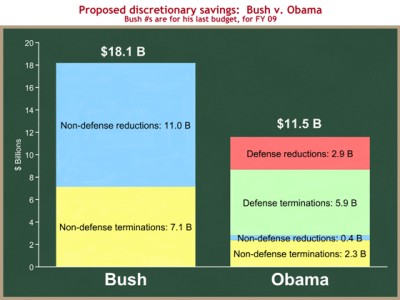
Who cut spending more? Bush or Obama?

Oh, that reminds me of a video I saw on the Maritime Sentry of the lovely Michele Bachmann trying desperately to persuade the silly people in Congress not to give more money to organizations like ACORN who are facing charges of voter fraud. But there’s only one Michele and so many other unqualified people.

Well, let’s see her speak anyway:

She’s addressing Barney Frank, who is one of the people responsible for the recession in my opinion.

I don’t know why they won’t listen to her and do what she wants. When I see Michele speaking, I just want to give her whatever she wants. She seems so passionate, moral and competent, much more so than the other people who haven’t actually run a business or home-schooled 5 children and 23 foster children.

Representative Michele Bachmann

She had a post on her blog about her amendment to block giving money to ACORN, too.

Excerpt:

On Monday of this week, charges were brought in Nevada against ACORN and two of its former employees for voter registration violations, and  today, the Allegheny County District Attorney in Pennsylvania charged seven employees of ACORN with forgery and election law violations, saying they filed hundreds of fraudulent voter registrations during last year’s general election.

It really could not be more timely as Chairman Barney Frank was just on the House floor trying to justify his amendment to the Mortgage Reform and Anti-Predatory Lending Act that will allow groups such as ACORN that have been indicted, or have employees who have been indicted, of voter fraud to receive millions in taxpayer funding.

Last week, the House Financial Services Committee unanimously passed my amendment to prohibit the flow of your money to such groups, but Chairman Frank feels it necessary to take back his support for that commonsense language and raise the bar so that organizations would have to be convicted before their access to tax dollars would be cut off.

While I realize that we are all innocent until proven guilty, ACORN has established a pattern of voter registration violations that seems to pop up election after election and in state after state.  The courts are the appropriate place to try guilt and innocence.  Congress has a fiduciary obligation to spend tax dollars wisely.

Your taxpayer money must be held to the highest standard, and not used to engage in a proven pattern of voter registration violations.

Here’s another story from the Heritage Foundation about Obama’s interventions into the free market. The more he meddles, the fewer people will want to run businesses in the USA, and the more unemployment there will be. You’ll remember that Obama tried to force the banks to stiff creditors for pennies on the dollar, while giving his union supporters a much better bankruptcy deal than they deserved.

“…I am indeed fearful writing this. It’s really a bad idea to speak out. Angering the President is a mistake…” What country would you expect to hear a citizen make this statement? Venezuela? Cuba? Russia? Nope, those are the words of prominent hedge fund manager Clifford Asness, who wrote a now-famous and widely circulated open letter this week describing the intimidation techniques used by President Obama and his administration.

Why did the President have to resort to such enhanced techniques of intimidation? Mainly because he was asking financial lenders to engage in the same unscrupulous acts his administration has been engaging in since January, i.e. picking winners and losers without concern for free market principles. The President wanted hedge funds to force a loss on investment onto their unknowing clients, so he could reward supportive union bosses in a “controlled” (i.e. Obama controlled) bankruptcy.

The rest of the post documents the ways in which government intervention and intimidation of private business hurts the economy. And they summarize Tom Lauria’s testimony that I blogged about before:

Tom Lauria, a prominent bankruptcy judge, and Democratic Party contributor, recently told WJR in Detroit: “One of my clients was directly threatened by the White House and in essence compelled to withdraw its opposition to the deal under threat that the full force of the White House press corps would destroy its reputation if it continued to fight.” Certainly the White House press corps considers themselves independent of any revenge scheme the President may cook up, but then why has their silence on these issues been so loud?

And here is the big picture lesson:

While the left and the right can agree to disagree on certain matters of this bailout, every American should be on one side of this intimidation debate, against what Michael Barone labeled “Gangster Government“. Whether trying to strong arm the dissolution of a company to benefit its union bosses, or trying to use selective declassification of national security memos to prove a policy point, the White House needs to be held to the highest (not higher) standard. The best way to end this cycle of government intimidation is to get government out of these businesses to begin with. Without an end, there shall be no means.

Attack the free market and you attack all of our liberties, especially our precious freedom of religious expression. If I cannot earn an income and make purchases without government approval, then I am not free. We have to keep talking about this story until Obama understands.

My next story is from Victor Davis Hanson, writing in Investor’s Business Daily. He makes the case that America is strong, secure and prosperous for specific reasons. Mess with the design of the country and we will lose our liberty, security and prosperity.

His first example is environmental regulation in California:

Now in California — the nation’s richest farm state — the population is skyrocketing toward 40 million. Yet hundreds of thousands of acres of farmland this year are going out of production, and with them thousands of jobs.

Why? In times of chronic water shortages, environmentalists have sued to stop irrigation deliveries in order to save threatened two-inch-long delta fish that need infusions of fresh water diverted from agricultural use. And for environmental and financial reasons, we long ago stopped building canals and dams in the Sierra Nevada to find sources of replacement irrigation water.

And what about domestic energy production?

Developing such traditional sources of energy responsibly would save us trillions of dollars in imported fuels, keep jobs at home and allow the nation a precious window of energy autonomy as we steadily transfer to more wind, solar and renewable energy.

If we exploit our own energy carefully offshore and in Alaska, it will mean less sloppy foreign drilling off places like Nigeria or in the fragile Russian tundra to feed American cars and trucks.

And what about being able to project military power abroad?

Democrats and Republicans have also taken for granted having enough military power to intervene overseas to remove tyrants like Saddam Hussein, Slobodan Milosevic, Manuel Noriega and the Taliban — and to stop atrocities whenever we can. But such power takes hundreds of billions of dollars in expensive hardware and military personnel.

He also wants to keep the defense budget static, or even cut it in some places.

In our have-it-both-ways generation, we want to keep our involvements abroad while not worrying as much about the practical means to meet them.

And his last example, massive deficits… and expanded entitlement programs?

Then there is the question of national debt. We are projected to run a record $1.7 trillion deficit — and may add $9 trillion to our existing $11 trillion in aggregate debt over the next eight years.

Meanwhile, the president has outlined vast new entitlement programs in health care, education, environmental programs and infrastructure.

It’s like we think that the USA is a magic place that will somehow keep running smoothly if we stop believing everything that got us the top spot in the first place. Shouldn’t we send Obama to North Korea or something where his policies might actually be welcomed? Democrats can’t handle any of these issues. Let’s put Michele Bachmann in charge in 2012.

How childhood experiences shape our view of religion

I have a very good friend named Rick Heller who blogs at several places, including Transparent Eye. Rick is not a Christian, but he is fairly familiar with the relevant evidence pro and con, except on the resurrection of Jesus. I was browsing on Transparent Eye the other day and I found this post about a childhood experience that turned Rick away from religion.

Excerpt:

Even when I was religious, I always found the glorification of God to be a lesser form of spirituality. As an Orthodox Jew, I disliked the text of the Yishtabach prayer (though I liked the tune)

May your Name be praised, our King, the God, the great and holy King, in heaven and on Earth. Because, our God and God of our forefathers, you deserve song and praise, lauding and hymns, power and dominion, triumph, greatness and strength, praise and splendor, holiness and kingship, blessing and thanksgivings now and forever.

It seemed to me that the Rabbis thought that God had a self-esteem problem, and His ego needed massaging. Even as a religious person, I thought these prayers were inferior to the Psalms, which often expressed delight and gratitude rather than the obsequious praise of the courtier.

In life, I can think of two reasons why you might flatter someone. First, the person might be insecure, and out of compassion you might say a little white lie that makes them feel better. Second, the person might have power over you, and you tell a lie in order to elevate them in the hopes of reciprocity, that they will elevate you, or at least not punish you.

This sucking up to God seems to me like the flattery of the poweful. The extravagent praise of the Yishtabach prayer strikes me as something done to propitiate a powerful and potentially dangerous Being that could destroy you.

Does God need our glorification? A mature person does not need constant praise (though a heartfelt thank-you every once in a while is appreciated).

Let’s take a look at his concern and see if we can find a solution.

The problem of forcing religion on children

Now, I have a different view of worship than many Christians. I think it’s better to worship God in the public square, not just in church. I believe in worshiping with theological truths and with publicly available knowledge, such as describing the scientific discoveries that led to our knowledge of God’s role in creating the universe. And I believe in talking about God’s worth to non-Christians, not just Christians.

Surprising as it may be to many Christians, as someone who was not raised in a Christian home, I really struggle with the church. Unlike Rick, I enjoy ascribing worth to God. I think that voluntary worship is best, because you make your own case based on what you know about God from your own study. But I also think a prayer like Rick’s may be appropriate, but only after you convince yourself it is true.

I want to go on to make a general point about the way religion is presented to young people.

A lot of people who have religion crammed down their throats at a young age end up either rebelling or just going through the motions until they leave home. What I noticed about Rick’s post is that sounds like he was being made to do things that he didn’t want to do. Can you imagine what would have happened if he told the church elders or his parents that he was uncomfortable mouthing these parrot-praises?

This is the problem. Church elders and parents are long on ordering people around, and short on answering questions. They don’t try to convince you of anything, they just demand visible behaviors. Rick might be willing to say that prayer, but first he deserves to be convinced. It is not enough to just pressure him into mouthing the words. He needs to persuade himself that the words are true, by studying the facts!

The problem is that parents and the church won’t lift a finger to present religious truth claims the same way as truth is presented in the classroom, the lab or the workplace. Children know when they are being told fairy tales. We need to give them public knowledge! Show them some debates! We need to put in the same effort into persuading people about religion as we do about any other area of knowledge.

I once exchanged e-mails with a fundamentalist Christian who explained to me how her approach to atheist’s questions was to quote the Bible to them. I asked her whether it might not be better to appeal to scientific or historical evidence, instead, since atheists don’t believe the Bible. Naturally she cited a Bible verse to me, in order to justify her not having to answer anyone’s questions.

A wicked and adulterous generation looks for a miraculous sign, but none will be given it except the sign of Jonah.” Jesus then left them and went away. (Matthew 16:4)

Now the thing is, this woman had no idea what this verse was saying. She was just trying to justify being lazy. But every serious Christian knows that Jesus is predicting his own resurrection in that verse! That is what the sign of Jonah is: 3 days in the tomb and then out of it. So Jesus is saying, you guys are going to get a historical event, and it’s going to be done right in front of you as a sign to prove my claims.

This is exactly how the early church presented the resurrection (e.g. Peter in Acts 2:14-41). Non-Christians were supposed to form their opinion of whether Jesus was the long-awaited Messiah, or not, based on a historical event. The whole Bible is chock-full of examples of faith founded on fact! But you would never, ever know that by watching parents and churches present religion to children.

I hereby apologize to sincere atheists, agnostics and deists for these experiences. But guess what? Authentic Christians like William Wilberforce agree with me on this.

What would William Wilberforce think?

Well, take a look for yourself, from his own writings:

Look at the facts. Do cultural Christians view Christian faith as important enough to make it a priority when teaching their children what they believe and why they believe it? Or do they place greater emphasis on their children getting a good education than on learning about the things of God? Would they be embarrassed if their children did not possess the former while basically being indifferent about the latter? If their children have any understanding of Christian faith at all, they probably have acquired it on their own. If the children view themselves as Christians, it is probably not because they have studied the facts and come to a point of intellectual conviction but because their family is Christian, so they believe they must be Christians also.

The problem with this way of thinking is that authentic faith cannot be inherited. When Christianity is viewed in this way, intelligent and energetic young men and women will undoubtedly reach a point where they question the truth of Christianity and, when challenged, will abandon this “inherited” faith that they cannot defend. They might begin to associate with peers who are unbelievers. In this company, they will find themselves unable to intelligently respond to objections to Christianity with which they are confronted. Had they really known what they believe and why they believe it, these kinds of encounters would not shake their faith one bit.

I fear for the future of authentic faith in our country. We live in a time when the common man in our country is thoroughly influenced by the current climate in which the cultural and educational elite propagates an anti-Christian message. We should take a look at what has happened in France and learn a lesson from it. In that country, Christianity has been successfully attacked and marginalized by these same groups because those who professed belief were unable to defend the faith from attack, even though its attackers’ arguments were deeply flawed. We should be alarmed that instruction in authentic faith has been neglected, if not altogether eliminated, in our schools and universities.

Is it any wonder then that the spiritual condition of our country is of little concern to those who don’t even educate their own children about true Christianity?  Their conduct reflects their absence of concern, not only for the state of Christianity in our own country, but also for the need to communicate the message of Christ to those in other parts of the world who have not heard this truth.

This is the guy who stopped slavery in the UK, folks. My advice: let’s do whatever Wilber says.

In a forthcoming post, I’ll look at another childhood experience that causes problems for people. It turns out that bad views of economics can be traced to childhood experiences, just like bad views of religion.