
Tag Archives: CHZ

What conditions support the minimum requirements for complex life?

The Circumstellar Habitable Zone (CHZ)

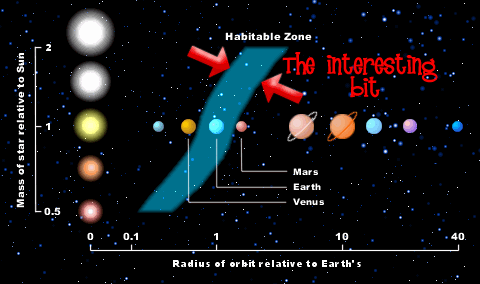
What do you need in order to have a planet that supports complex life? First, you need liquid water at the surface of the planet. But there is only a narrow range of temperatures that can support liquid water. It turns out that the size of the star that your planet orbits around has a lot to do with whether you get liquid water or not. A heavy, metal-rich star allows you to have a habitable planet far enough from the star so  the planet can support liquid water on the planet’s surface while still being able to spin on its axis. The zone where a planet can have liquid water at the surface is called the circumstellar habitable zone (CHZ). A metal-rich star like our Sun is very massive, which moves the habitable zone out further away from the star. If our star were smaller, we would have to orbit much closer to the star in order to have liquid water at the surface. Unfortunately, if you go too close to the star, then your planet becomes tidally locked, like the moon is tidally locked to Earth. Tidally locked planets are inhospitable to life.

Circumstellar Habitable Zone

Here, watch a clip from The Privileged Planet: (Clip 4 of 12, full playlist here)

But there’s more.

The Galactic Habitable Zone (GHZ)

So, where do you get the heavy elements you need for your heavy metal-rich star?

You have to get the heavy elements for your star from supernova explosions – explosions that occur when certain types of stars die. That’s where heavy elements come from. But you can’t be TOO CLOSE to the dying stars, because you will get hit by nasty radiation and explosions. So to get the heavy elements from the dying stars, your solar system needs to be in the galactic habitable zone (GHZ) – the zone where you can pickup the heavy elements you need but not get hit by radiation and explosions. The GHZ lies between the spiral arms of a spiral galaxy. Not only do you have to be in between the arms of the spiral galaxy, but you also cannot be too close to the center of the galaxy. The center of the galaxy is too dense and you will get hit with massive radiation that will break down your life chemistry. But you also can’t be too far from the center, because you won’t get enough heavy elements because there are fewer dying stars the further out you go. You need to be in between the spiral arms, a medium distance from the center of the galaxy.

Like this:

Galactic Habitable Zone
Galactic Habitable Zone and Solar Habitable Zone

Here, watch a clip from The Privileged Planet: (Clip 10 of 12, full playlist here)

The GHZ is based on a discovery made by astronomer Guillermo Gonzalez, which made the front cover of Scientific American in 2001. That’s right, the cover of Scientific American. I actually stole the image above of the GHZ and CHZ (aka solar habitable zone) from his Scientific American article (linked above).

These are just a few of the things you need in order to get a planet that supports life.

Here are a few of the more well-known ones:

  • a solar system with a single massive Sun than can serve as a long-lived, stable source of energy
  • a terrestrial planet (non-gaseous)
  • the planet must be the right distance from the sun in order to preserve liquid water at the surface – if it’s too close, the water is burnt off in a runaway greenhouse effect, if it’s too far, the water is permanently frozen in a runaway glaciation
  • the solar system must be placed at the right place in the galaxy – not too near dangerous radiation, but close enough to other stars to be able to absorb heavy elements after neighboring stars die
  • a moon of sufficient mass to stabilize the tilt of the planet’s rotation
  • plate tectonics
  • an oxygen-rich atmosphere
  • a sweeper planet to deflect comets, etc.
  • planetary neighbors must have non-eccentric orbits

By the way, you can watch a lecture with Guillermo Gonzalez explaining his ideas further. This lecture was delivered at UC Davis in 2007. That link has a link to the playlist of the lecture, a bio of the speaker, and a summary of all the topics he discussed in the lecture. An excellent place to learn the requirements for a suitable habitat for life.
Guillermo Gonzalez lectures at UC Davis on the requirements for life

The 5 video clips that make up the full lecture.

The playlist for all 5 clips is here.

About the speaker

Guillermo Gonzalez is an Associate Professor of Physics at Grove City College. He received his Ph.D. in Astronomy in 1993 from the University of Washington. He has done post-doctoral work at the University of Texas, Austin and at the University of Washington and has received fellowships, grants and awards from such institutions as NASA, the University of Washington, the Templeton Foundation, Sigma Xi (scientific research society) and the National Science Foundation.

Learn more about the speaker here.

The lecture

Here’s part 1 of 5:

Habitability topics:

  • What is the Copernican Principle?
  • Is the Earth’s suitability for hosting life rare in the universe?
  • Does the Earth have to be the center of the universe to be special?
  • How similar to the Earth does a planet have to be to support life?
  • What is the definition of life?
  • What are the three minimal requirements for life of any kind?
  • Requirement 1: A molecule that can store information (carbon)
  • Requirement 2: A medium in which chemicals can interact (liquid water)
  • Requirement 3: A diverse set of chemical elements
  • What is the best environment for life to exist?
  • Our place in the solar system: the circumstellar habitable zone
  • Our place in the galaxy: the galactic habitable zones
  • Our time in the universe’s history: the cosmic habitable age
  • Other habitability requirements (e.g. – metal-rich star, massive moon, etc.)
  • The orchestration needed to create a habitable planet
  • How different factors depend on one another through time
  • How tweaking one factor can adversely affect other factors
  • How many possible places are there in the universe where life could emerge?
  • Given these probabilistic resources, should we expect that there is life elsewhere?
  • How to calculate probabilities using the “Product Rule”
  • Can we infer that there is a Designer just because life is rare? Or do we need more?

The corelation between habitability and measurability.

  • Are the habitable places in the universe also the best places to do science?
  • Do the factors that make Earth habitable also make it good for doing science?
  • Some places and times in the history of the universe are more habitable than others
  • Those exact places and times also allow us to make scientific discoveries
  • Observing solar eclipses and structure of our star, the Sun
  • Observing stars and galaxies
  • Observing the cosmic microwave background radiation
  • Observing the acceleration of the universe caused by dark matter and energy
  • Observing the abundances of light elements like helium of hydrogen
  • These observations support the big bang and fine-tuning arguments for God’s existence
  • It is exactly like placing observatories on the tops of mountains
  • There are observers existing in the best places to observe things
  • This is EXACTLY how the universe has been designed for making scientific discoveries

This lecture was delivered by Guillermo Gonzalez in 2007 at the University of California at Davis.

What is intelligent design?

Dr. Stephen C. Meyer explains the concept of intelligent design in a lecture, with lots of visual aids.

He is also the author of “Signature in the Cell“, the best book on intelligent design. (A Times Literary Supplement Book of the Year selection)

Related DVDs

Illustra also made two other great DVDs on intelligent design. The first two DVDs “Unlocking the Mystery of Life” and “The Privileged Planet” are must-buys, but you can watch them on youtube if you want, for free.

Here are the 2 playlists:

I also recommend “Darwin’s Dilemma”. All three of these are on sale from Amazon.com.

New study on tidal heating strengthens stellar habitability argument

Circumstellar Habitable Zone

Note: If you need a refresher on the habitability argument, click here.

Here’s an article entitled “Tidal heating shrinks the ‘goldilocks zone’: Overlooked factor suggests fewer habitable planets than thought”. It appeared in Nature, the most prestigious peer-reviewed science journal.

The gist of it is that tidal forces can alter orbits so that planets don’t spend all of their orbit in the habitable zone. If planets go outside the habitable zone, it damages their supply of liquid water, and any life chemistry going on in there is disrupted.

Excerpt:

A previously little-considered heating effect could shrink estimates of the habitable zone of the Milky Way’s most numerous class of stars — ‘M’ or red dwarfs — by up to one half, says Rory Barnes, an astrobiologist at the University of Washington in Seattle. That factor — gravitational heating via tides — suggests a menagerie of previously undreamt-of planets, on which tidal heating is a major source of internal heat. Barnes presented the work yesterday at a meeting of the American Astronomical Society’s Division on Dynamical Astronomy in Timberline Lodge, Oregon.

The habitable zone is the orbital region close enough to a star for a planet to have liquid water, but not so close that all of the water evaporates. For our Sun, the zone extends roughly from the inner edge of the orbit of Mars to the outer edge of that of Venus. For smaller, cooler stars, such as M-class dwarfs, the zone can be considerably closer to the star than Mercury is to the Sun. And because close-in planets are easier to spot than more distant ones, such stars have been a major target for planet hunters seeking Earth-like worlds.

There’s just one problem with finding habitable planets around such stars, says Barnes. Because tidal forces vary dramatically with the distance between a planet and its star, closer orbits also result in massively larger tidal forces.

Since planets do not have perfectly circular orbits, these tidal forces cause the planet to flex and unflex each time it moves closer to or further from its star; kneading its interior to produce massive quantities of frictional heat. Substantial heat can be produced, he added, with even slight deviations from a perfectly circular orbit. And, Barnes notes, other factors — such as the rate of the planet’s rotation and its axial tilt — can also influence heat production.

A similar tidal process makes Jupiter’s moon Io the most volcanic body in the Solar System. “I’m just scaling that Io–Jupiter system up by a factor of 1,000 in mass,” Barnes said at the meeting. “It’s the same process, on steroids.”

So, stars that are smaller and cooler will have a habitable zone that is closer to the star, exposing them to more tidal forces. More tidal forces makes their orbits less likely to stay circular – within the habitable zone around the star. These variations cause an increase in heat production on the planet. Too much heat means that the planet is unable to support liquid water on the surface, making it inhospitable for life. Therefore, solar systems with less massive stars can be ruled out as possible sites for life, because of these tidal forces.