Tag Archives: Church

New study: intact heterosexual married home still critical for children’s academic success

Sometimes, when you’re discussing reality with progressives, it helps to have a study. Because although you might think that conservatism is common sense, they think that their feelings are common sense. So you will have to give them evidence, and then call them stupid, until they either accept your evidence or run away screaming back to the New York Times building.

Anyway, here’s the research from the Institute for Family Studies:

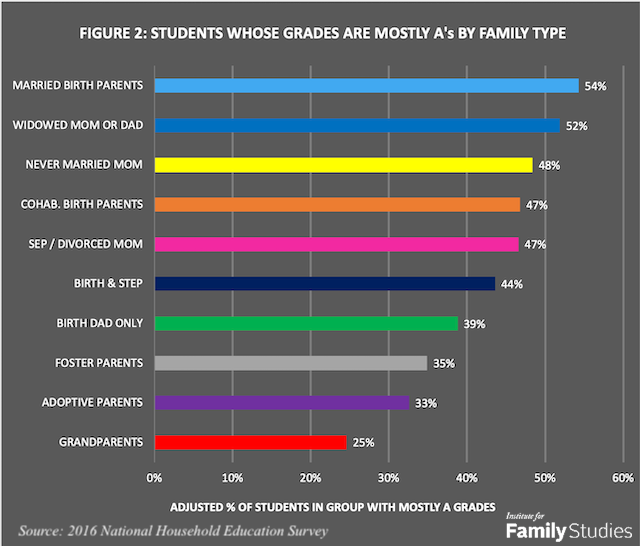
Beginning with the 1966 Coleman Report, a long line of studies have found that students from intact, married families do better in school than those from disrupted or unmarried families.5 My own analysis of data from a longitudinal study conducted by the U.S. Department of Education (the ECLS-K) demonstrated the impact that family transitions, such as parental divorce and remarriage, have on students’ task persistence and eagerness to learn, emotional distress, and misbehavior resulting in school disciplinary actions such as suspension.6 IFS studies of trends in Arizona, Florida, and Ohio indicate that school districts tend to be more successful and safer when more of their families are headed by married parents.7

And there’s a graph to go with it. Actually, several, but I just chose this one.

Why can't non-STEM sociologists use apostrophes properly?
Why can’t non-STEM sociologists use apostrophes properly? It’s As not A’s

And here’s the conclusion:

The analyses showed that schoolchildren who live with both married parents do better on each of the three educational progress indicators. Children from married-couple families did better even after controlling for socioeconomic and demographic correlates of family structure.

They’ve also got graphs for student misbehavior by family type, and student disciplined by family type. Naturally, the traditionally family far outperforms the alternatives.

Now the first thing that a progressive will tell you is that adding more money from government social programs will solve the problem, so we just need to have more communism, and give the children to strangers at earlier ages. But the study corrects for socioeconomic factors. And demographic factors, too. So that deflection isn’t going to work.

Are all sins equally bad? Or are there degrees of severity for different sins?

This question came up recently so I did some digging on theology web sites to find what Bible verses applied to the question.

Here’s what Ligonier said:

It’s clear that we have different degrees of sin when we consider the warnings of Scripture. There are at least twenty-two references in the New Testament to degrees of rewards that are given to the saints in heaven. There are different levels, different rewards, and different roles in heaven. The Bible warns us against adding to the severity of our judgment. Jesus said to Pontius Pilate, “He who delivered me over to you has the greater sin” (John 19:11). Jesus measures and evaluates guilt, and with the greater guilt and greater responsibility comes the greater judgment. It’s a motif that permeates the New Testament.

The idea of gradation of sin and reward is based upon God’s justice. If I commit twice as many sins as another person, justice demands that the punishment fits the crime. If I’ve been twice as virtuous as another person, justice demands that I get more of a reward. God tells us that entrance into heaven will be only on the basis of the merit of Christ, but once we get to heaven, rewards will be dispensed according to works. Those who have been abundant in good works will receive an abundant reward. Those who have been derelict and negligent in good works will have a small reward in heaven. By the same token, those who have been grievous enemies of God will have severe torments in hell. Those who have been less hostile will have a lesser punishment at the hands of God. He is perfectly just, and when He judges, He will take into account all of the extenuating circumstances. Jesus said, “I tell you, on the day of judgment people will give account for every careless word they speak” (Matt. 12:36).

A while back, my friend Dina sent me a sermon where that exact passage (John 19) was brought up by the pastor.

I think the correct position is that any sin is enough to separate you from God, but some sins are more severe than others in God’s objective standard of right and wrong.

OK, that was fine and good, but then I noticed a few days later that Michael Krueger had also blogged about this “all sin are equal” view, too.

Krueger says this:

First, to say all sins are the same is to confuse the effect of sin with the heinousness of sin.  While all sins are equal in their effect (they separate us from God), they are not all equally heinous.

Second, the Bible differentiates between sins. Some sins are more severe in terms of impact (1 Cor 6:18), in terms of culpability (Rom 1:21-32), and in terms of the judgment warranted (2 Pet 2:17;  Mark 9:42; James 3:1).

Even more Bible references, so we’re not on the wrong track.

So then why do some people insist that all sins are equal? It turns out that it is coming from the secular ideal of non-judgmentalism.

Krueger explains:

We should begin by observing that this phrase does not come from Scripture.  People do not use it because it appears in the Bible. Why then do they use it?

One reason, as noted above, is that some Christians use this phrase to uphold the seriousness of sin. It is viewed as a way to remind people not to be dismissive about their sin or regard it is a triviality.

Others use this phrase as way to “flatten out” all sins so that they are not distinguishable from each other.  Or, to put it another way, this phrase is used to portray all human beings as precisely the same.  If all sins are equal, and all people sin, then no one is more holy than anyone else.

In a world fascinated with “equality,” this usage of the phrase is particularly attractive to folks. It allows everyone to be lumped together into a single undifferentiated mass.

Such a move is also useful as a way to prevent particular behaviors from being condemned.  If all sins are equal, and everyone is a sinner, then you are not allowed to highlight any particular sin (or sinner).

Needless to say, this usage of the phrase has featured largely in the recent cultural debates over issues like homosexuality.  Yes, homosexuality is a sin, some Christians reluctantly concede.  But, they argue, all sins are equal in God’s sight and therefore it is no different than anything else.  Therefore, Christians ought to stop talking about homosexuality unless they are also willing to talk about impatience, anger, gluttony, and so on.

Krueger also posted this fascinating follow up post, where he looks at how the phrase is being used by people on Twitter.

Look at these tweets:

  • All sins are equal. People tend to forget that. There is no bigger or smaller sin. Being gay and lying, very equal.

  • all sins are equal in God’s eyes. whatever you’re doing, is no better than what someone else is doing.

  • If you have sex before marriage please don’t come on social media preaching about the wrongs of homosexuality. All sins are equal

  • Need people to realize that all sins are equal… don’t try to look down on me or question my faith just cuz you sin differently than I do.

  • Don’t understand why you’re so quick to judge me, when all sins are equal. So much for family..

  • if you think being gay is a sin, let me ask you something, have you not done anything wrong in your life? all sins are equal. we’re sinners

  • Nope no difference at all. All sins are equal no matter what you’re running for. The bible says do not judge lest ye be judged

  • A huge problem I have with religion is the notion that all sins are equal. Like pre-martial sex and murder are the same amount t of bad.

  • people do bad things because they believe that all sins are equal and ~god~ loves y’all equally so he’s going to forgive you naman ha ha ha

  • It a sin to condemn another sinner and their actions. All sins are equal. So what makes you better than the person you’re condemning?

  • I think so b/c having sex before marriage doesn’t make you less of a women then if you waited until marriage.. all sins are equal soo

  • friendly reminder, all sins are equal in gods eyes so you’re not better than I am in any way. please worry about your own sins before mine.

  • People don’t like when I suggest abortion as an option. This is a free country and all sins are equal so mind your business!!!

  • What I do is no worse than wat you do… all sins are equal no matter what it is… a sin is a sin

  • to god all sins are equal so you have no right to compare your sins to someone else’s bc in the end it doesn’t matter

The first thing that I noticed is that premarital sex and homosexuality are the most popular sins. I would think that divorce and abortion would be up there in the rankings, as well.

Something strange has happened in our society such that more and more people want to be led by their feelings, rather than be bounded by rules or standards. When people get caught breaking moral rules, rather than be accountable, they attack the person judging them. They would rather escape the judgment of their peers than admit fault and try to fix the mistake, and do better next time.

It’s so bad now, that the people who have morals and who make moral judgments are seen as the real bad people. The immoral people are on the offense, and even trying to ban people from being able to disagree with them. We’re seeing that with people who are being attacked for defending natural marriage against divorce and redefinition of marriage. In France, they want to make speech critical of abortion a criminal offense. And in Canada, they’ve now made speech critical of the gay agenda a criminal offense. (It’s already a human rights tribunal offense)

What is even more interesting is when the people who push the “don’t judge me” line try to justify it from the Bible. Very strange, but we seem to have forgotten the value of setting moral boundaries. Now moral boundaries are “evil”. Instead, having compassion for people who break the moral boundaries and harm themselves and others is “good”.

How does church appear to someone raised in a non-Christian home?

My friend Wes posted an article about how communication is set up in the church, and why it’s not effective at equipping Christians to defend their worldview in hostile environments. The article describes what I encountered in church, after I was raised in a non-Christian home and become a Christian on my own by reading the New Testament. The view presented in the essay is how I viewed the church, and is probably how most outsiders view church. I think it explains why young people leave the church in droves once they move out of their parents’ houses.

The author writes:

On the Internet, one soon discovers that many respected church leaders are quite unable to deal directly with opposing viewpoints. In fact, many of them can’t even manage meaningful engagement with other voices. Their tweets may be entirely one-way conversations. They talk at their audiences. They can talk about other voices, but fail to talk to them, let alone with them. Their representations of opposing viewpoints reveal little direct exposure to the viewpoints in question.

[…]Around this point, it can start to dawn on one that many church leaders have only been trained in forms of discourse such as the sermon and, to a much lesser extent, the essay. Both forms privilege a single voice—their voice—and don’t provide a natural space for response, questioning, and challenge. Their opinions have been assumed to be superior to opposing viewpoints, but have never been demonstrated to be so. While they may have spoken or written about opposing voices, they are quite unaccustomed to speaking or writing to them (not to mention listening to or being cross-examined by them). There are benefits to the fact that the sermon is a form of discourse that doesn’t invite interruption or talking back, but not when this is the only form of discourse its practitioners are adept in.

Many church leaders have been raised and trained in ideologically homogenous cultures or contexts that discouraged oppositional discourse. Many have been protected from hostile perspectives that might unsettle their faith. Throughout, their theological opinions and voices have been given a privileged status, immune from challenge. Nominal challenges could be brushed off by a reassertion of the monologue. They were safe to speak about and habitually misrepresent other voices to their hearers and readers, without needing to worry about those voices ever enjoying the power to answer them back. Many of the more widely read members of their congregations may have had an inkling of the weakness of their positions in the past: the Internet just makes it more apparent.

One of my friends who comments here as “Wintery’s Friend” actually did his M. Div, and I think it was he who told me that his seminary had dropped the lone course in apologetics that had been part of the curriculum. Now seminary grads don’t learn any opposing views. They just pre-suppose that the Bible is true in the same way that Mormons pre-suppose their Bible is true, or Muslims pre-suppose their Bible is true, etc.

More:

If one’s opinion has never been subjected to and tried by rigorous cross-examination, it probably isn’t worth much. If one lacks the capacity to keep a level head when one’s views are challenged, one’s voice will be of limited use in most real world situations, where dialogue and dispute is the norm and where we have to think in conversation with people who disagree with us.

The teachers of the Church provide the members of the Church with a model for their own thinking. The teacher of the Church does not just teach others what to believe, but also how to believe, and the process by which one arrives at a theological position. This is one reason why it is crucial that teachers ‘show their working’ on a regular basis. When teaching from a biblical text, for instance, the teacher isn’t just teaching the meaning of that particular text, but how Scripture should be approached and interpreted more generally. An essential part of the teaching that the members of any church need is that of dealing with opposing viewpoints. One way or another, every church provides such teaching. However, the lesson conveyed in all too many churches is that opposing voices are to be dismissed, ignored, or ‘answered’ with a reactive reassertion of the dogmatic line, rather than a reasoned response.

You can imagine that the first questions that you’ll be asked by a non-Christian co-worker would be things like “why think God exists?” and “why think the Bible is history rather than legend?”. In order to answer those questions, you would have to know how to counter what a non-Christian believes. You would have to show them the reasons for your view.

Unfortunately, many of the conservative Christian leaders we trust think that the best way to be convincing is not to show your work, but just to speak Bible verses at people who don’t accept the Bible as an authority. Some people attend church for 20 years, and they never meet a single person who didn’t just assume that the Bible is trustworthy without doing an investigation first.

What’s most surprising is that this fideistic view of Christianity is not even Biblical. The Biblical view of faith is that faith is trust in God, based on evidence. This is why Jesus offered his own resurrection as evidence to a generation of unbelievers. His miracles were also evidence offered to unbelievers. And the Old Testament is filled with examples of people like Isaiah presenting evidence to unbelievers. The fideist view sounds more like the Mormon “burning of the bosom” view. We can do better than that!

Look:

That debate has over 6 million views on YouTube. That’s a debate with Christopher Hitchens, one of the most famous atheists of the last 100 years. In the post-debate comments, the atheist admitted he lost. Watch it. You won’t find it in most churches, so you’re going to have to learn it on your own. Without anyone’s help. Don’t be a spectator. Don’t settle for youth pastor Christianity.