Tag Archives: Christianity

Don Johnson: six reasons why people reject Christianity

Here’s a post on practical evangelism by Christian scholar Don Johnson.

His list of reasons why people often reject Christianity:

  1. Christians behaving badly
  2. Disappointment with God
  3. Weak or absent father
  4. Social pressure
  5. Cost of discipleship
  6. Immorality (especially sexual immorality)

And here’s the detail on #6:

Of all the motivations and reasons for skepticism that I encounter, immorality is easily the most common. In particular, sexual sin seems to be the largest single factor driving disbelief in our culture. Brant Hanson calls sex “The Big But” because he so often hears this from unbelievers: “’I like Jesus, BUT…’ and the ‘but’ is usually followed, one way or the other, with an objection about the Bible and… sex. People think something’s deeply messed-up with a belief system that says two consenting, unmarried adults should refrain from sex.” In other words, people simply do not want to follow the Christian teaching that sexual intercourse should take place only between and man and woman who are married, so they throw the whole religion out.

The easiest way to justify sin is to deny that there is a creator to provide reality with a nature, thereby denying that there is any inherent order and purpose in the universe.

Aldous Huxley admitted that this is a common reason for skepticism:

I had motives for not wanting the world to have a meaning; consequently I assumed that it had none and was able without any difficulty to find satisfying reasons for this assumption…. Those who detect no meaning in the world generally do so because, for one reason or another, it suits their books that the world should be meaningless. …

For myself as, no doubt, for most of my contemporaries, the philosophy of meaninglessness was essentially an instrument of liberation. The liberation we desired was …liberation from … a certain system of morality.  We objected to the morality because it interfered with our sexual freedom…. There was one admirably simple method in our political and erotic revolt: We could deny that the world had any meaning whatsoever. Similar tactics had been adopted during the eighteenth century and for the same reasons. (Ends and Means, 270-273)

Indeed, similar tactics have been used extensively up to the present day. If you are looking for two great resources that document the extent to which the work of the world’s “great” atheistic thinkers has been “calculated to justify or minimize the shame of their own debauchery,” (Spiegel, 72) I recommend Intellectuals by Paul Johnson and Degenerate Moderns: Modernity as Rationalized Sexual Misbehavior by E. Michael Jones. The bottom line is that these skeptical scholars didn’t reach their conclusions by following the evidence where it led. They didn’t “discover” that the world was meaningless and then proceed to live accordingly. They lived sinful lives (usually involving some type of sexual deviancy) and then produced theories that justified their actions.

It’s important to understand that an atheist is not identical to a Christian, except not religious. There is something else going on in their minds when they reject very obvious evidences like the origin of the universe, the cosmic fine-tuning, the origin of life, the Cambrian explosion, the habitability arguments, etc. The something else that is going on is hinted at when you look at atheist attitudes to abortion. According to a recent survey of atheists, 97% of them were pro-abortion!

What kind of person likes abortion? The kind of person who wants to be sexually active with no consequences, even if it means taking someone else’s life. The desire to do as they please and retreat from obligations to others is the key. Now dispensing with God and his obligations is not an unreasonable view if there is no evidence for God, but it does provide a motive for people to not look for that evidence if happiness is their main goal. When I discuss these issues with atheists, I find that no work has been done to read anything. Not even debates, where there are two sides. They don’t want to hear the case for Christian theism, and they work hard to avoid stumbling across it by accident, too.

God and the cosmic authority problem

Tough Questions Answered has a quote from Christian philosopher Paul Moser that I think is relevant:

It would be a strange, defective God who didn’t pose a serious cosmic authority problem for humans.  Part of the status of being God, after all, is that God has a unique authority, or lordship, over humans.  Since we humans aren’t God, the true God would have authority over us and would seek to correct our profoundly selfish ways.

So we’re not dealing with unbiased truth-seekers here. The goal might not always be sex, but let’s be honest. Who wants to have to spend time reading the Bible, praying, going to church and reading thick books by Stephen C. Meyer, Michael Licona and Hugh Ross so that we can answer questions? No one. Who wants to give up premarital sex so that we can create a stable marriage for children so they can grow up in a safe place where knowing God is natural and easy? No one. We just don’t want to have to do stuff for God, even if it’s good stuff. We don’t want to have build a life that is a testament to God’s existence and character, especially if it means that other people will think that we are weird and maybe even a bit mean. We want to do what we want to do instead, and be liked by other people.

That’s the real challenge of Christianity: setting aside what you wanted to do, and letting God be your customer, instead. You’d be surprised how many Christians aren’t comfortable with the idea of serving God and being viewed in a bad way by non-Christians. They aren’t OK with the self-sacrifice, and they are really not OK with the social disapproval. It’s hard to be chaste, and to be known to be chaste by your peers, for example. Much easier to just give in and do what everyone else is doing.

Let’s illustrate with C.S. Lewis

And here’s a relevant quote from C.S. Lewis’ “The Screwtape Letters” to illustrate:

You must have often wondered why the enemy [God] does not make more use of his power to be sensibly present to human souls in any degree he chooses and at any moment. But you now see that the irresistible and the indisputable are the two weapons which the very nature of his scheme forbids him to use. Merely to over-ride a human will (as his felt presence in any but the faintest and most mitigated degree would certainly do) would be for him useless. He cannot ravish. He can only woo. For his ignoble idea is to eat the cake and have it; the creatures are to be one with him, but yet themselves; merely to cancel them, or assimilate them, will not serve…. Sooner or later he withdraws, if not in fact, at least from their conscious experience, all supports and incentives. He leaves the creature to stand up on its own legs—to carry out from the will alone duties which have lost all relish…. He cannot “tempt” to virtue as we do to vice. He wants them to learn to walk and must therefore take away his hand…. Our cause is never more in danger than when a human, no longer desiring, but still intending, to do our enemy’s will, looks round upon a universe from which every trace of him seems to have vanished, and asks why he has been forsaken, and still obeys.

— Uncle Screwtape, in The Screwtape Letters

I’m not a big fan of Lewis, but I think he is onto something there. That’s really what the Christian life is like, and no wonder more people don’t choose it. Who wants to do your duty for God, as part of a relationship with him, in a universe that seems so unfair? It’s a tall order, and most people prefer to do their own thing instead of building something nice for God with their lives.
Finding God’s will for our lives

I’m stealing from Amy Hall, who blogged at Stand to Reason.

Excerpt:

Chandler Vannoy wrote about “What We Get Wrong about ‘Finding God’s Will,’” and it’s always a good time to be reminded of this:

The phrase we have all heard…is we need to find God’s will for our life. And for the past 21 years, I thought I had to keep praying for God to open my eyes to the will he had laid out for me. That if I just kept searching long enough and hard enough, I would know exactly what I was supposed to do in the future.

But Kevin DeYoung blew up this idea for me while I was reading his book Just Do Something….

In the beginning of the book, DeYoung says, “We should stop thinking of God’s will like a corn maze, or a tight-rope, or a bull’s eye, or a choose-your-own-adventure novel.” This rocked my world. I always thought that if I made a wrong decision or took a wrong turn, I would be removed from God’s plan.

But what he is saying here is that we are free from the burden of trying to discover God’s will ahead of time. It is not a maze for us to perfectly navigate in order to reach our end goal, but instead, God desires for us to trust Him with all of the twists and turns.

Yes, God is sovereign over my life. Yes, He has specific plans for my future, but He does not expect me to find out the details of His plan before I get there. So this whole idea of finding God’s will for my life has been me searching for something God does not want to reveal.

The answer for making good decisions is to learn wisdom from the words God has already given us, and to rest in the knowledge that God has guaranteed that all things work together for the good of making us more like Christ (Romans 8:28-29). Even if a wise decision leads to unforeseen difficulties, that doesn’t mean it was the “wrong” one. In fact, difficulties are the most powerful tool God regularly uses to shape us.

I think this is good advice for everyone.

Here’s a wonderful post on decision making and the will of God posted on Neil’s blog. Neil links to another post where someone is trying to figure out what God wants him to do.

Excerpt:

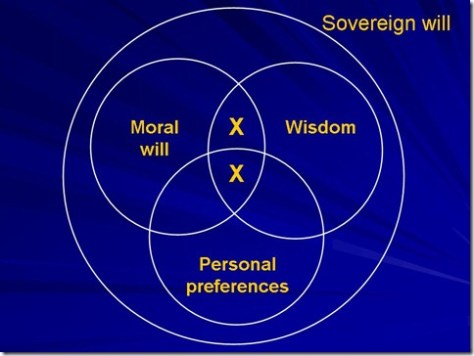
Really short version: Aside from direct and clear personal revelation from God, you don’t have access to his sovereign will when making decisions.  Therefore you must look at other factors.  If it isn’t moral, don’t do it.  If it is moral but not wise, don’t do it.  If it is moral and wise, then use your personal preferences.

Using this model you can end up with a wise and biblical decision, but you have avoided the traps of the “God told me to ____” routine.  People who run around saying that God told them this and that convey a super-spirituality that can leave less mature believers wondering if they really have a relationship with God (i.e., “God doesn’t tell me every little thing to do, so maybe I don’t really know him.”).

He has a helpful picture posted as well:

This is actually a very important topic for me, because I like making plans and making good decisions. I like being the quarterback or squad leader of my own life. I like to pick objectives and then make plans to achieve them. (Nothing too exotic, just simple stuff like saving money or reading more books)

Actually, I really oppose the idea that God has a magical fairy tale will for each person that will make them happy and fulfilled. For me, life isn’t like that. I don’t expect God to lead me along like a child at a scavenger hunt. I expect to survey the battlefield where I am and then do something to make a difference. There are lots of things you can do that will please God. Should you focus on your career and sponsor apologetics conferences? Or should you use your spare time preparing Sunday school lessons? There are lots of good things you could do to please God. Your job is to pick the one that will be the most effective. It doesn’t matter if it makes you happy, it only matters if it’s effective and if you are good at it.

Who is Rifleman Dodd?

A while back, I was busily working my way through the U.S. Marine Corps Official Reading List, and I came across a book by C.S. Forester called Rifleman Dodd, or alternatively titled Death to the French. It’s a work of historical fiction that takes place during the Napoleonic wars. The story is about a British marksman named Dodd, who is cut off from his own lines during a withdrawal maneuver. He is subsequently left to fend for himself behind enemy lines. An ordinary man might be full of despair and forget about his mission entirely. But Dodd is no ordinary man. Not only does he find a way to survive by finding food to eat, water to drink and places to sleep, but he also tries to remember his orders and to think about what he can do to advance the cause of his General, the Duke of Wellington.

Here’s an excerpt from a gritty book review:

It’s about a green-coated British infantry rifleman in the Napoleonic Wars, an age when rifles were a novelty and most of the army was red-coated and carried muskets. Private Matthew Dodd gets separated from his regiment during a retreat and finds himself stranded behind enemy (French) lines in Portugal. With the occasional aid of some natives, but mostly on his own, he harasses the French with his rifle and tries to prevent them from building a bridge across the Tagus River. It’s a remarkable tale of survival and solitary achievement, of a rank-and-file soldier who lives by his wits and slowly learns to make plans without orders, and shows leadership qualities and a knowledge of warfare.

I think we’re in the same situation as Dodd.

There is no point in us looking for breadcrumb trails to happiness at this point. That’s not the point of Christianity. The point of Christianity is friendship with God, imitation of Christ, honoring moral obligations, self-sacrificial love for your neighbor (and even your enemies!), and dedication to the truth – whether anyone else likes you or not. It’s not supposed to make you happy, and it’s not necessarily going to be a normal life like everyone else has. Things may not work out the way you’d like them to.

We seem to be making such a big deal about compassion and forgiveness in the Christian life these days – such a big emphasis on our feelings. Almost like we have forgotten that we have obligations to our friend – and his objectives. A relationship doesn’t mean that one person completely disregards the character and goals of the other person and then is automatically granted forgiveness whenever they want it. That’s not a friendship – that’s using someone else for your own ends. Maybe it’s time to remember what this is all about.

Ohio State University core class teaches that atheists are smarter than Christians

From Campus Reform.

Excerpt:

Ohio State University (OSU) class has apparently determined another fundamental difference between Christians and atheists: their IQ points.

An online quiz from the school’s Psychology 1100 class, provided to Campus Reform via tip, asked students to pick which scenario they found most likely given that “Theo has an IQ of 100 and Aine has an IQ of 125.”

The correct answer? “Aine is an atheist, while Theo is a Christian.”

According to a student in the class who wished to remain anonymous, the question was a part of an online homework quiz. Students were required to complete a certain amount of quizzes throughout the course but were encouraged to finish all of them in order to prep for the final exam.

“I understand that colleges have a liberal spin on things so it didn’t surprise me to see the question, which is a sad thing,” the student told Campus Reform in a phone interview. “But how can you really measure which religion has a higher IQ?”

Psychology 1100 is a general education requirement class which can primarily be taught by an undergraduate teacher’s assistant.

[…]Dr. Mike Adams, an outspoken conservative Christian professor at the University of North Carolina, said “every group is protected from offensive speech on campus except for conservative Christians.”

The university is a challenging problem for Christians who want to make a difference. On the one hand, it’s definitely a center of influence where many young people come to learn how the world works. On the other hand, if you are a conservative Christian, you will be attacked there. It would be nice if Christians could somehow influence the university, helping young people to find or keep their relationship with God in Christ. But I don’t think it’s a priority for most Christians. Ratio Christi does a good job, and I like to sponsor their events. We lose a lot of young people who are raised in Christian homes at the university.