Tag Archives: Christian Apologetics

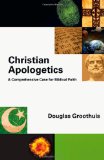
Douglas Groothuis’ 752-page Christian apologetics book is now under $22

Christian Apologetics

Looking for a good textbook on apologetics that covers everything you need to know? Check out Dr. Groothuis’ book. It’s now under $22 on Amazon.

Here are the chapters:

Part I: Apologetic Preliminaries
1 Introduction: Hope, Despair and Knowing Reality
2 The Biblical Basis for Apologetics
3 Apologetic Method: Evaluating Worldviews
4 The Christian Worldview
5 Distortions of the Christian Worldview–or the God I Don’t Believe In
6 Truth Defined and Defended
7 Why Truth Matters Most: Searching for Truth in Postmodern Times
8 Faith, Risk and Rationality: The Prudential Incentives to Christian Faith

Part II: The Case for Christian Theism
9 In Defense of Theistic Arguments
10 The Ontological Argument
11 Cosmological Arguments: A Cause for the Cosmos
12 The Design Argument: Cosmic Fine-Tuning
13 Origins, Design and Darwinism
14 Evidence for Intelligent Design
15 The Moral Argument for God
16 The Argument from Religious Experience
17 The Uniqueness of Humanity: Consciousness and Cognition
18 Deposed Royalty: Pascal’s Anthropological Argument
19 Jesus of Nazareth: How Historians Can Know Him and Why It Matters by Craig L. Bloomberg
20 The Claims, Credentials and Achievements of Jesus Christ
21 Defending the Incarnation
22 The Resurrection of Jesus

Part III: Objections to Christian Theism
23 Religious Pluralism: Many Religions, One Truth
24 Apologetics and the Challenge of Islam
25 The Problem of Evil: Dead Ends and the Christian Answer
26 Conclusion: Take It to the Streets

Appendix 1 Hell on Trial
Appendix 2 Apologetic Issues in the Old Testament by Richard S. Hess

Here’s a review of the book by Michael D. Stark.

Introduction:

Contemporary Christians interested in apologetics can now turn to another text that is bound to become one of the most-used textbooks in apologetics. Douglas Groothuis’ Christian Apologetics: A Comprehensive Case for the Biblical Faith (InterVarsity, 2011) may have more breadth both in content and wisdom than any apologetics text to date. The subtitle is justified as the book, over 700 pages and 26 chapters long (not including two appendixes), presents the need for apologetics and explores the main philosophical arguments for the existence of God. Unlike other apologetics texts, Groothuis includes chapters examining truth in postmodern society, religious pluralism, and a tactful approach to dealing with Islam. Furthermore, biblical scholars (and Denver Seminary colleagues) Richard Hess and Craig Blomberg build on an already strong text by writing chapters on apologetics in the Old Testament (Appendix 2) and a historical approach to the person of Christ and the gospels, respectively.

Here’s a snip from the review:

The chapter on cosmological arguments is superb and only further qualifies Groothuis as a proficient thinker. This chapter without question is the chapter I learned the most from. Groothuis engages very difficult scientific and philosophical concepts and communicates them in a way that even the beginner will be able to grasp. Though there are many different versions of the cosmological argument, the chapter hones in on the kalam cosmological argument as put forth by William Lane Craig. The kalam argument is superior to other cosmological arguments in that it supposedly secures the theistic doctrine of ex nihilo if the arguments proves successful (note: a minor quibble of this chapter is that Groothuis purports that the Thomistic cosmological argument does not endorse ex nihilo. I believe this to be false). This specific chapter was sensational – however I was left disappointed that no time was given to addressing the cosmological argument posited by Aquinas. In some respects, the Thomistic cosmological argument is the simplest form for people new to apologetics. The Thomistic version does not get into the technical issues of the metaphysics of time and Big Bang cosmology that the kalam version uses, nor does it require knowledge of the principle of sufficient reason that the Leibnizian version necessitates. While the kalam and Leibnizian versions are logical and sound arguments, they may confusing to people new to apologetics. Because of this, beginners ought to take the time to read this chapter slowly and more than once because of the finer technical details.

Chapters 12-14 are devoted to the design argument and issues relating to it. Groothuis opposes macroevolution and thus goes to great extent to battle Darwinism. Those interested in the philosophy of science will be drawn to these chapters. The chapter focused on intelligent design relies heavily on the work of William Dembski and Michael Behe. These chapters serve as a valuable introduction for those new to discussion between Christian and naturalistic sciences.

Chapter 15 is perhaps the most successful chapter of the entire book as it deals with the moral argument. It is my belief that the moral argument is the most successful argument for the existence of God as it appeals to everyone, Christian, atheist, and non-Christian religious persons. Ethical theory may perhaps be the most widely debated philosophical topic throughout history and thus Groothuis could have taken many approaches when discussing the moral argument. The way he structured his chapter, however, is nearly flawless. Building off his chapter examining truth in the postmodern culture (chapter 7), Groothuis correlates the denial of objective truth to the ridding of objective moral value. He unmercifully attacks moral relativism and brilliantly shows its dangers. He states that cultural relativism reduces to individual relativism, which, in turn, ultimately rests on nihilism. The setup of this reductio ad absurdum points the reader to a moral system that does not reduce to nihilism. Thus, a worldview that embraces objective moral truths must be embraced. Groothuis makes the claim that the source of objective moral truths is found in the absolute Being – God. Groothuis puts for the notion that God is the source of all perfect moral code because he himself is incapable of an evil act as it would be a contradiction of God’s Being.

I think that the big advantage you get from Doug Groothuis is his worldview. He has the most fully-integrated worldview of any Christian scholar I know.

I bought one copy of Dr. Groothuis’ book, but I gave it away. So I got myself another one. It’s a must have. My favorite four apologetics books are this one, “Philosophical Foundations for a Christian Worldview” by William Lane Craig and J.P. Moreland, Michael Licona’s “The Resurrection of Jesus” and Stephen C. Meyer’s “Signature in the Cell”. I think that if you add Wayne Grudem’s “Politics According to the Bible” to that list, then that’s a very practical set of tools.

Richard Dawkins defends the moral goodness of infanticide and adultery

Here’s the latest moral wisdom from atheist Richard Dawkins, courtesy of Uncommon Descent.

Excerpt:

I want to raise another question that interests me. Why are we so obsessed with monogamous fidelity in the first place?

[…]The underlying presumption — that a human being has some kind of property rights over another human being’s body — is unspoken because it is assumed to be obvious. But with what justification?

In one of the most disgusting stories to hit the British newspapers last year, the wife of a well-known television personality, Chris Tarrant, hired a private detective to spy on him. The detective reported evidence of adultery and Tarrant’s wife divorced him, in unusually vicious style. But what shocked me was the way public opinion sided with Tarrant’s horrible wife. Far from despising, as I do, anybody who would stoop so low as to hire a detective for such a purpose, large numbers of people, including even Mr. Tarrant himself, seemed to think she was fully justified. Far from concluding, as I would, that he was well rid of her, he was covered with contrition and his unfortunate mistress was ejected, covered with odium. The explanation of all these anomalous behavior patterns is the ingrained assumption of the deep rightness and appropriateness of sexual jealousy. It is manifest all the way from Othello to the French “crime passionnel” law, down to the “love rat” language of tabloid newspapers.

[…]Why should you deny your loved one the pleasure of sexual encounters with others, if he or she is that way inclined?

I, for one, feel drawn to the idea that there is something noble and virtuous in rising above nature in this way.

[…]And why don’t we all admire — as I increasingly do — those rare free spirits confident enough to rise above jealousy, stop fretting about who is “cheating on” whom,

Here’s a little snippet about Richard Dawkins’ ability to stay married:

In 1984, Dawkins divorced his wife of 17 years, Marian Stamp; later that same year, he married Eve Barham. Dawkins also divorced Barham, though the precise circumstances of this divorce are unclear. He married science fiction actress Lalla Ward in 1992; at present, the two are still married.

I have been advised that the full article featuring Dawkins’ views is far, far worse that what was excerpted by UD.

What does atheist morality amount to, in practice? It amounts to the strong acting selfishly and allowing the weak to suffer for it. That’s why atheists are almost entirely for abortion and sexual permissiveness – the children are the first to be screwed by the moral relativism of the adults. That’s where abortion, no-fault divorce, fatherlessness, etc. come from – they are crimes committed by selfish adults against vulnerable children – because they can. It’s the strong abusing the weak, exactly as Darwinism would have them do. There are no human rights on atheism, and there is no reason for self-sacrificial moral behavior, either. Do what you want, and don’t get caught. Get them, before they can get you. Don’t let anyone diminish your happiness with their moral rules. That’s “atheist morality”.

This isn’t the first time that we’ve caught a glimpse of Dawkins’ atheist perspective on morality, either.

Morality according to atheist Richard Dawkins

Rev. George Pitcher writes about an interview of Christopher Hitchens conducted by Richard Dawkins. (H/T Thinking Christian)

Excerpt:

But the centrepiece of this Christmas edition is the main coup for the New Statesman – an interview by Prof. Dawkins with Christopher Hitchens, the great polymath who today lost his fight against cancer. It’s a fascinating read over three double-page spreads. Not least because Prof. Dawkins reveals a charming humility, allowing Hitchens to show his intellectual superiority at his own expense. Hitchens is thoughtful about CS Lewis and Christianity and rather leaves Prof. Dawkins floundering in his wake, occasionally interjecting little assents to show that he’s still there, as he struggles to keep up.

But one of these interjections is most revealing. About half-way through, the Prof gets this in edgeways: ‘Do you ever worry that if we win and, so to speak, destroy Christianity, that vacuum would be filled by Islam?’

So, ‘if we win…and destroy Christianity’. True, there’s a ‘so to speak’ in there, but it doesn’t do much. Try ‘If we win and, so to speak, kill all the Jews’ as an alternative. Doesn’t really work, does it? And Prof Dawkins can hardly claim that he was misquoted or taken out of context. He was editing the magazine, after all – there’s even a picture of him doing so, pen poised masterfully over page proofs.

Now you might think that Dawkins intends to destroy Christianity in debates, and not in the wars and purges of atheism that occurred last century in North Korea, Cambodia, China, the Soviet Union, and so on. Those atheist regimes caused the deaths of 100 million people, according to Harvard University Press. But Dawkins has refused to debate William Lane Craig on more than one occasion. So whatever he means by “destroy Christianity”, he doesn’t mean “defeat them in rational debate, using superior arguments and evidence”. He had his chance to do that, and he passed on it. So, he must mean something else by “destroying Christianity” other than persuasion.

Let’s find out what Richard Dawkins thinks about morality. Dawkins has previously written this:

The total amount of suffering per year in the natural world is beyond all decent contemplation. During the minute that it takes me to compose this sentence, thousands of animals are being eaten alive, many others are running for their lives, whimpering with fear, others are slowly being devoured from within by rasping parasites, thousands of all kinds are dying of starvation, thirst, and disease. It must be so. If there ever is a time of plenty, this very fact will automatically lead to an increase in the population until the natural state of starvation and misery is restored. In a universe of electrons and selfish genes, blind physical forces and genetic replication, some people are going to get hurt, other people are going to get lucky, and you won’t find any rhyme or reason in it, nor any justice. The universe that we observe has precisely the properties we should expect if there is, at bottom, no design, no purpose, no evil, no good, nothing but pitiless indifference.

(“God’s Utility Function,” Scientific American, November, 1995, p. 85)

Dawkins’ view is that nothing is really good or bad objectively. Cultures just evolve certain conventions, and those conventions vary arbitrarily by time and place. I think we need to interpret his goal of destroying Christianity against the backdrop of his nihilism. 50 million unborn children have been killed in the United States since 1973 alone. That’s 50 million people with distinct genetic codes different from their mothers or their fathers, who will never grow up to achieve their potential.

Dawkins himself is in favor of infanticide:

So what might destroying Christianity look like to an atheist?

Here it what destroying Christianity means in North Korea, the most atheistic country on the planet.

Excerpt:

A Christian woman accused of distributing the Bible, a book banned in communist North Korea, was publicly executed last month for the crime, South Korean activists said Friday.

The 33-year-old mother of three, Ri Hyon Ok, also was accused of spying for South Korea and the United States, and of organizing dissidents, a rights group said in Seoul, citing documents obtained from the North.

The Investigative Commission on Crime Against Humanity report included a copy of Ri’s government-issued photo ID and said her husband, children and parents were sent to a political prison the day after her June 16 execution.

That’s what Kim Jong Il means by “destroy Christianity”. What does Dawkins mean by it?

FLASHBACK: American Atheists calls for the eradication of Christianity.

Are claims about religion and morality objective or subjective?

Here’s an article from J. Warner Wallace, the host of the Please Convince Me podcast. He starts the article by explaining the difference between objective truth claims and subjective truth claims.

He writes:

As an example, we offer the proposition, “Jim’s car is a Hyundai”. Is this an objective claim or a subjective claim? It is clearly objective. My car is either a Hyundai or it is not, and my personal opinion will not change this fact. The truth is rooted in the nature of the object, the Hyundai automobile, and it is not dependent upon my subjective opinion. Now let’s examine another claim: “Hyundai’s are the coolest (hippest) cars”. This second claim is highly personal depending on what each of us considers “hip” or “cool”. Our opinion about this is rooted in each of us as subjects who hold varying opinions about “hipness” or “coolness”. See the difference? “1+1=2” is an objective truth statement; “Math is fun” is a subjective claim.

Then he asks the question: are claims about God’s existence and character objective truth claims or subjective truth claims? What about moral claims? You might be surprised what answers you get from Christians who have attended church all their lives.

He writes:

But it seems to get trickier for people when they begin to move away from physical realities or math facts. Consider the following claim: “God exists”. Surprisingly, many Christian groups I work with struggle to define this statement as objective. But the existence of God is either a true reality or it is not, and our personal opinion is not going to change this reality. It is something we can either acknowledge or reject, but doing so does not change the reality of God’s existence. Does that make sense? Spiritual truth claims about the existence of God are objective, they are rooted in the object under consideration: God. He either exists or He does not; my opinion won’t change that fact.

At some point toward the end of our “Truth Test,” Brett and I will begin to post moral claims such as, “Premarital sex is morally wrong.” Now things usually get interesting as the Christians in our groups struggle to decide if there are such things as objective moral claims. Some are very uncomfortable identifying this statement as an objective truth claim. It’s one thing to say that we, as Christians, might believe this statement to be true, but some Christians hesitate to say this is a truth claim that transcends those who don’t accept our Christian values. The culture has effectively eroded our confidence in objective moral truth claims. The new cultural definition of “tolerance” obliges us to embrace all truth claims as equally valid or true. This is an important re-definition, because classic “tolerance” acknowledges disagreement and allows each person to hold an opposing view without having to embrace the other view as equally true. Classic tolerance requires us to endure and respect the people who hold opposing views, even as we resist these views themselves.

If you’d like to listen to Jim talk about this essay, I noticed that it was the topic of his opening monologue in his most recent Please Convince Me podcast. I think this post is interesting, because we just had a commenter who didn’t think that statements about God and morality were objective, but that these statements were true for the person making them. That would mean that if a person said “I believe that the Earth is flat”, then that statement would be true for that person. Or, if a person said “It’s wrong to murder people just for the fun of it”, then that statement would be true for them. I think it’s pretty clear that as Christians, we defend statements about God and statements about morality as objective statements. These statements are not just true for us, they are true, period.