
Tag Archives: Chastity

Is it the man’s responsibility to pursue the woman, or the other way around?

Telling a woman how to make wise decisions protects her

If you ask this question theoretically, most people will probably say that it’s the man’s responsibility, especially in the church. Is this because women don’t like the idea of having to plan out and achieve something? Maybe. But what is interesting is that the man-pursues view is very popular in the church, even though it’s not very common in the Bible. Dalrock posted something about this.

He writes:

One comment I see from fathers with surprising regularity is that their unmarried daughter is in a great position to find a husband because she’s not remotely interested in the kind of men who express interest in her.

I… think this is tied into the erroneous idea that the Bible teaches that men should pursue and women should judge the performance. But it isn’t the Bible that teaches this ethic, it is the religion of Courtly Love that teaches this. Think of the only two women to have books of the Bible named after them. Both Ruth and Esther pursued their eventual husbands. Ruth’s pursuit of Boaz resulted in her being the grandmother of King David, which meant that Christ would come from her line. Esther’s pursuit of Ahasuerus allowed her to save the Jews.

Cane Caldo was actually the first to write about this on his blog:

According to traditionalists (and others): Men are supposed to chase, and women are supposed to be caught. Or they might say: Men are to initiate, and women are to respond.

[…]If you fancy yourself a traditionalist… [s]earch your Bible for a story about a man who woos a woman directly.

So, just consider that for a minute. Ruth is probably the best example of a woman who just makes decisions to get on with life, and happens across a wealthy single man. Then she consults with Naomi and takes action to pursue that man. It works out for her. Where in the Bible does the man pursue the woman?

Derek Ramsey was able to come up with two examples, and he commented on Dalrock’s blog:

You can find examples of all cases in the Bible: fully arranged marriages (for Isaac), where the man pursued the woman (Jacob; Hosea), where the woman pursued the man (Ruth; Esther), and where both pursued each other or it wasn’t clearly stated one way or the other (Samson; Solomon). I would argue that pursuit (by either sex) is neither condemned nor encouraged. Each situation is different and there is no rule one way or the other.

I think that Derek wins the argument, here. But I still think that practically speaking, in such a time (of feminism) as this, it’s much much wiser for women to take action to “pursue” men she is interested in. That doesn’t mean asking men out, though.

thedeti explains in a comment:

A man setting his sights on one or two or three women and then pursuing them really hard trying to get on their radar isn’t the best way to find a woman who’s interested in him and who is the best match.

Instead, he should be his best version of himself, and then see which women are tossing subtle signs of interest at him. Which women just kind of show up where he is, which ones make a point to say hi to him, which ones reach out to him, which ones contact him, which ones strike up conversations with him. And then from THOSE women he should select a few he is interested in and then pursue them.

That certainly isn’t what most Christians are teaching their children. I certainly wasn’t taught this.

And a bit later, thedeti says:

In the current #MeToo climate, false rape allegations, and sexual harassment’s current definition as “any conduct or words uttered by any man anywhere that any woman within sight or earshot didn’t like”, this model can be downright dangerous for men.

A man can no longer just pick a few girls he’s interested in and pursue them. If he selects some girls who dont’ like him, he’s in for a world of hurt by trying to “perform” for them. If he selects one who kind of likes him, but he makes even one wrong move or says one remotely mildly offensive thing, he’s done. Not only will she know about it, all her friends will know too.

When a woman is very interested and shows it, she’ll be much more forgiving of his expected missteps. That gives him room to run, and gives a budding relationship the space it needs to germinate and grow.

Deti advises women to just show up in places where men they are interested in are, and not actively discourage them. Maybe ask him questions about what he is doing as a Christian, and ask for his advice about something he knows about, etc. And deti warns women to consider that in a culture where false accusations and frivolous no-fault divorces are everywhere, men with good educations, degrees and finances will be very careful about pursuing women.

My thoughts

I was speaking to someone who thinks that she wants to be pursued by a man. I suggested that she read the book of Ruth to counter her view. The first and most important piece of advice I gave her was to “cross the room” for any man she is interested in. Stand up, walk directly at him, and speak right in his face. Maintain eye contact and speak directly to him about things he is interested in. On another day, I told her that the most important thing you can ask a man about is his vision to serve God.

As women age and lose their beauty, the only thing that remains is the man’s passion – his plan – and the place of the woman within it. Men stay in love with women who have invested in the plan they made to serve God. Naturally, it’s POINTLESS to choose any man unless he has a plan to serve God effectively that he has demonstrated his willingness to sacrifice for. In my case, writing this blog is a sacrifice, and giving money to Christian apologists and pro-life debaters is a sacrifice. A woman should be skeptical about anything a man says – look at what he has already done for his vision, and whether he is actually practical and determined enough to achieve anything. That’s where you’ll find your place. And that’s what you need to investigate in a husband candidate. Standing back and remaining passive, waiting to be pursued, is just going to attract a lot of non-Christian men who are pursuing you for sex. If the man is pursuing you, and he hasn’t told you his vision (why he needs you as his wife anyway), then he wants sex.

The pursuit of women by non-Christian alpha male bad boys seems to be welcomed, surprisingly, by a lot of passive Christian women who kind of lie back and expect to just acquiesce to experiences that feel good. Women today don’t like to think about marriage in a structured way. And they especially don’t want to be asked by men about past decisions, demonstrated abilities, future wife responsibilities and obligations, etc. (How dare men evaluate them for a marriage plan!) They don’t want marriage, defined as self-sacrificial commitment. They want marriage as constant tingles, supplied by an alpha male bad boy who exists solely to generate feelings of happiness in them, and feelings of envy in their girlfriends. Think about marriage as a plan? That’s boring. Let’s get drunk and hook up with an alpha male bad boy, and see if he calls back after the abortion.

Alpha male bad boys feel good (for a while) and this is how women get trapped into relationships with men who have no reason to commit to them. A much better strategy is to stop being attracted to alpha male bad boys, and deliberately engage in conversations with marriage-ready men. As my friend Lindsay says, you need to learn to become attracted to men who have a vision that will survive the loss of your youth and beauty.

In my own case, I’ll be able to retire at 50 with a net worth well north of 7 figures. Because of this, it would be stupid for me to waste my time pursuing Christian women whose criteria for men has nothing to do with the marriage enterprise, and is INDISTINGUISHABLE from the criteria used by non-Christian women. The ONLY thing that would catch my eye at this point is a woman who is equal to me (chaste, no tattoos, STEM degree(s), debt-free, married parents, house or savings, into apologetics, conservative politics, and between the ages of 23-28). And that’s a minimum. And she can forget about being pursued by me. She’ll have to approach me, and question me about what my plan is, and where she would fit into it.

I’ve often been told by wise female Christian advisors that I need to do a better job of showing off my situation to women. But if I spent the money on sparkly things and fun, I wouldn’t be financially secure, would I? It’s up to women to stop being so shallow and emotional. They need to look beyond appearances and fun. They need to have a marriage focus, and they need to choose men, show up and start investigating and investing. I simply don’t have the time to flail around in a feminist culture where women, including Christian women, are woefully unqualified for the marriage enterprise. It’s not my job, after having made thousands of good decisions, to risk my fortune by pursuing women who have made thousands of bad decisions (promiscuity, debt, useless degrees, etc). The entitled attitudes of women today, including Christian women, is nothing short of astonishing to men like me who have spent a lifetime being careful about being chaste, sober, practical, frugal and effective.

Alistair Begg has a great sermon series on Ruth that emphasizes Ruth’s agency, and her willingness to make decisions that were practical without any sort of being led by feelings or being nudged by God. Christian women, if you want to get married, then get to work on finding a man and making it easy for him to choose you.

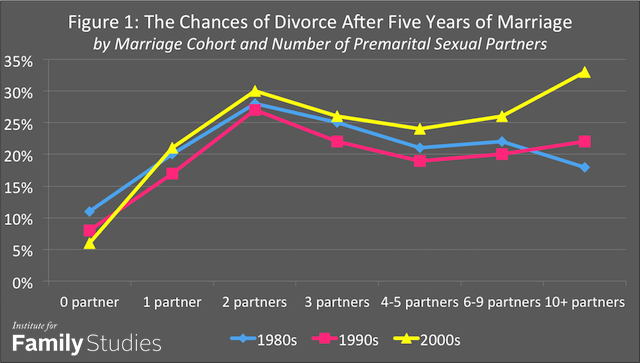
Lori Alexander is right: serious Christian men prefer debt-free virgins without tattoos

Marriage stability vs sexual partners,(Teachman et al. JAMF, August 2010)

Christian writer Lori Alexander recently wrote a blog post (H/T Lindsay) urging Christian women to do 3 things:

  1. be a virgin before marriage
  2. be debt-free before marriage
  3. don’t get any tattoos

She also urged women to be cautious about college, because it often gets them into debt. I disagree with her a little here. I always urge young women to earn a STEM degree in college, then work a few years to pay off their loans (if any) before marrying. This is because women, like men, need to have the experience of doing something hard that they don’t “feel” like doing, in order to grow. STEM degrees teach young people that the world doesn’t revolve around them, and that their feelings don’t matter when trying to solve a problem in the real world. It’s a very useful way for women and men to break themselves out of the desire for free and easy happiness that is so common in our time.

Lori’s article drew enormous opposition from both secular and Christian sources. So far, the only people defending her are men’s rights sites, like Dalrock (Christian) and Spawny (non-Christian). Every other “Christian” blog or news site that I read disagreed her article, and argued that premarital sex was no big deal, that having debt was no big deal, and that having tattoos was no big deal.

Let’s take a look at her three points, then I’ll explain why her article is largely correct, and why she is correct about what she asserts about the criteria that godly men have for women.

Even one non-husband premarital sex partner raises risk of divorce

Virginity

Regarding her first point, virginity is commanded by the Bible, it’s in line with peer-reviewed studies on marriage quality and stability. The reason that people find this difficult is that they want the freedom to give in to sexual desires without feeling shame. They want to believe that there is no permanent effect. It doesn’t help that parents and pastors are terrified of telling young people, and young women in particular, that promiscuity harms marital stability. Right now, the culture is drowning in feminism. Feminism tells women that the traditional male roles of provider, protector, and spiritual leader are “sexist”. The “best” men are good-looking pro-abortion bad boys. If a Christian woman is not able to think through the meaning of sex with respect to marriage enough to control herself, it seriously harms the stability of her future marriage.

Starting and Mid-Career salaries by profession (click for larger image)

Debt-free

Regarding her second point, almost everything a serious Christian man might plan to do for Christ with his marriage is impacted by finances. From education, to marriage timing, to number of children, to home ownership, early investment, to the success of children. to age of retirement. Less money means fewer choices, and less ability to counter challenges. Think of how important money for legal defense is to Christian-owned businesses who are being persecuted, for example. The reason that many people find the Bible’s teaching on stewardship difficult is that they don’t want to exercise self-control with money if they don’t feel like it. They want to waste money seeking fun and thrills, and then act like their poverty could not be avoided. Being debt-free is an indicator of practical wisdom and self-control in a woman.

Hugh Hewitt's "In, But Not Of", Chapter 9: Tattoos, Don't
Chapter 9 of Hugh Hewitt’s “In, But Not Of: A Guide to Christian Ambition”

Tattoos

Tattoos are a problem for serious Christian men for several reasons. First, they cost money and for no gain, and can even cause you losses in your career. Second, most people get them because of low self-esteem or vanity or to look rebellious or to look dangerous. None of these motivations should be acted upon by someone with a robust Christian worldview. The money could be better used on charity, or investments, etc. Women show what their priorities really are by how they spend their money and time. Show me a woman’s bookshelf, and I’ll tell you how seriously she has thought about what it means to be a Christian in all areas of life. Instead of showing me your tattoos to demonstrate your “spirituality”, show me your apologetics books, to demonstrate your intellectual engagement. And tell me how you used that information to engage in conversations with educated non-Christians to answer their challenges to your faith. That way I’ll know that you use your money to train do hard things in order to have an influence for Christ in serious, practical, effective ways. A woman who can defend her faith and discuss Christianity with non-Christians is demonstrating her ability to raise Christian children in a secular society.

A family praying and reading the Bible

The goal of marriage is to serve God

Today, young people have been taught to follow their hearts, and to deny that there is any authority or practical wisdom that should govern their decisions. They always imagine themselves to be exempt from moral rules, statistics, cause and effect, etc. They think they know better than everyone else – even though they do almost no research on their own. Every adviser who tells them to study computer science instead of creative writing is wrong. Their same-age friends know more about what causes divorces than peer-reviewed research papers. And money should be spent on skydiving and zip-lining, regardless of what financial experts like Dave Ramsey might say.

A woman who has made many mistakes cannot fix those mistakes with words. Rationalizations, evasions, and blame-shifting do not work to show that there has been real repentance. The man can only assess whether grace has caused any real re-prioritization of goals by evaluating her outward actions over a long period of time. Furthermore, if a woman who has made mistakes attacks those who correct her from Bible’s teachings on chastity, stewardship, etc., then it’s a sign that there is no real repentance.

Choosing a wife wisely doesn’t mean that Christian men treat OTHER Christian women poorly. Christian men love all the Christian women. We care for them and support them. But when a man chooses a wife, he is choosing someone who will have more influence on his ability to serve God than anyone else. In my case, the goals for my marriage involve making a difference with apologetics in the church, having many children who will receive the educations and careers they need to have an influence, influencing government to promote Christian-friendly policies, charitable giving, mentoring young Christians, modeling a good marriage to others, and having a home that can serve to host discussions about issues that matter. These things are not free – they take careful planning and execution to achieve.

Lori’s advice is  intended for men who are serious about making their marriage produce a return for God. Men who are chaste themselves. Men who accept the Bible as an authority. Men who earned STEM degrees, instead of easy nonsense degrees that don’t lead to good careers. Men who earn 6-figure salaries, who buy houses for cash, and who are on track have a 7-figure net worth by age 50. Men who made good decisions cannot risk marrying someone who hasn’t prepared for marriage. The wrong woman in the home could ruin the man’s effort to produce a marriage that gives glory to God.

Not every man intends to achieve something for God with his marriage, but those who do need to choose a woman who has demonstrated ability at doing the job. For example, if the job requires marital fidelity, then chastity is a good indicator that the woman has the necessary self-control. If the job requires frugality, and practicality, then being debt-free, having a STEM degree, and having some private sector work experience are good indicators that she’s qualified for the role. Nothing valuable in life is ever been achieved by being lazy, wild and irresponsible. Serious Christian men look for wives who have applied themselves to difficult tasks that they didn’t feel like doing, who achieved success by remaining committed to the plan, in spite of their unhappy feelings and unmet desires.

We have a problem in the church such that we aren’t serious about teaching young people to develop marriage-ready character and to make serious plans for marriage. We are teaching them to follow their hearts, and that their feelings and desires are clues about God’s will for their happiness. We are teaching them to be uncomfortable with responsibilities, expectations and obligations to others. We are teaching them not to do their own research. We are teaching them not to make practical, wise plans. We are teaching them to ATTACK those who try to get them to be serious about doing what is likely to work. This approach is not working.

My own criteria for a wife are more demanding than Lori’s. My advice there is only for serious Christian men who want their marriage to serve God.

More and more women are asking why they can’t find a good man to marry

Do young women understand how to get to a stable marriage?

In the last few months, I’ve met 5 different Christian women in their 30s who all asked me the same question: where are all the good men who want to marry me?

Christian men’s rights blogger Dalrock had two different posts where he described the answer to this question.

Here is the first post from Dalrock that concisely illustrates the problem:

As I wrote in A very long season, feminists don’t want to waste a day more of their youth and fertility on their husbands than absolutely necessary. As if to prove this very point, 30 year old Mona Chalabi writes in the NY Times* I Want My 2.3 Bonus Years:

If I could prolong my time as a young adult by, say, 2.3 years, here is a list of things I would like to do:

• Go to more parties. Preferably wild parties that I can think about, years later, at mild parties.

[…]• Have more romantic partners.

[…]• Get a bit higher up the career ladder a bit earlier on. That would probably boost my earnings, giving me more financial security. I could use that money to go to more parties, get a membership to a fancy gym and maybe even meet a romantic partner on the ab machines.

To drive the message home, the image at the top of the article is a cartoon of a resentful Chalabi giving her future husband the side eye for her lost years of sampling penises!

Surely, this must be an isolated case just for New York Times feminists, right? It’s not widespread, is it?

Second post from Dalrock:

Margaret Wente at the Globe and Mail* asks where all the good men have gone.  Wente comes to the conclusion that women need a sex cartel:

…it’s up to us to make the rules. “Why buy the cow when you can get the milk for free?” my father used to say. It drove me crazy when he said that. Now, it’s dawned on me that he was right.

Since the women’s cartel collapsed, women’s bargaining power has seriously eroded. That’s why so many single women hate Tinder, which has further commodified sex for the benefit of men. Women are just another consumer good in the shop window.

The apex fallacy aside, Wente is partially right.  Women (as a group) have signaled to men that what they really want are exciting sexy badboys, not boring loyal dudes. It isn’t that women no longer want to marry beta providers, they just don’t want to waste a day more of their youth and fertility on their husband than absolutely necessary.

As a result, some up and coming boring loyal dudes aren’t knocking themselves out in their twenties while they wait for their future wife to tire of having sex with other men.

If you wonder why men are no longer performing in school, and exchanging careers for video games, the answer is simple. Men have realized that young women today, under the influence of feminism, are not interested in traditional husbands during their late teens and 20s. During these years, women are interested in travel, fun, drinking, hook-ups and cohabitation with amoral atheists. This is what I have personally observed. In the minds of young women, the highest value men are good-looking men who have no religion, and make no moral judgments, and are left of center politically – especially on abortion. There are many good men who are romantic about women from their youth, and want to get married. But when they see what young women really want, they just give up on school and work, since doing the traditional male roles has no value to young women. Many good men even give up on morality and Christianity because they want a relationship with a woman so badly.

More from second post:

What Wente doesn’t understand is that timing is everything.  From an economic point of view, women are dividing up sexual access that traditionally would have been reserved only for their husband into two blocks.  The first block contains their most attractive and fertile years, and it is dedicated to no strings sex with exciting badboys.  Then, once women reach what Rollo calls the epiphany phase, they want to bargain sexual access in their remaining (older and less fertile) years for maximum beta bucks.

The problem with this strategy is (generally speaking) not that the previously overlooked beta men will refuse to marry the suddenly reformed party girls.  The problem is that young men now look at the men 3-5 (and even 5-10) years older than them and don’t see an indication that signaling provider status will make them attractive to women.  They also see a society that holds married fathers in contempt**.  Most of these men are still working hard in their late teens and twenties to prepare to signal provider status in their 30s.  But a growing minority of young men are no longer doing so.  These men are instead working like women.  Once the reformed party girls are ready to find Mr. Beta Bucks, there is a shortage of 30 something men who fit the bill.  Even worse, no amount of complaining or shaming will cause the missing beta providers to go back in time and spend the prior decade preparing for this moment.

I’m one of the last men who followed the marriage-preparedness script for traditional men who wanted to marry and have four children and have a stay-at-home homeschooling mom to raise them from birth to graduate school. I find myself now in my early 40s, with a 6-figure income and a nearly 7-figure net worth. I declined to use those assets to play the field with hot bad girls, preferring instead to keep my sexual past completely clean for my eventual wife. However, what I observed in my late teens and 20s and even early 30s was a complete lack of interest in marriage ability, from non-Christian women and Christian women alike. Christian women aren’t learning to value early marriage from their married parents or their evangelical churches. None of the traditional husband skills are valued by young women, i.e. – chastity, gapless resume, alcohol abstinence, undergraduate and graduate STEM degrees, experience nurturing and mentoring others, stewardship of earned income.

I recently caused an uproar on my Facebook page by saying that even if the perfect woman showed up right now to marry me, I would not pursue her because the critical time where the woman could have applied maximum youth, beauty and fertility as a wife to make an impact on my education, early career, health, and finances has passed. A younger woman develops value to her husband precisely by applying herself to him and to her family in these critical early years. Men who have experienced this self-sacrificial love and support are loyal to their wives even after their wives lose their youth and beauty. Why? Because the men know that they are much better than they could have been, having enjoyed that early investment of value made by their young wives.

Young women very supportive of premarital sex

As Christian writer Matt Walsh notes in a recent article at the Daily Wire, this “follow your heart” focus on happiness in women is lethal to marital stability, and men know it.

Excerpt:

There was an article in Cosmo this week with a title that summarizes all that’s wrong with Cosmo and modern society as a whole: “I eloped at 25, divorced at 26, and dated my way across Europe all summer.” Of course, by “dated my way across Europe” she means that she slept with half the continent.

The author, Elise, says she “started fighting” with her husband and within a few months they both decided that their differences were irreconcilable. Despite counseling, she says, “neither of us was happy.” So, exhausted from 12 whole months of marriage, Elise embarked on a voyage of self-discovery and STD cultivation. She met random dudes in half a dozen countries and had sex with them, learning quite a lot as she went, though she can’t really explain what exactly she learned or why sex was a necessary component in learning it. Finally, she came home and started dating some other guy. The end.

Well, not really the end. 20 years from now I’m sure we’ll get the follow up article: “I’m alone and miserable and it’s everyone’s fault but mine.” After all, you may be able to fill the emptiness in your soul with frivolous sex when you’re young and physically desirable, but that phase is fleeting. People who don’t want to “waste” their beauty and youth on a spouse, so they waste it instead on strangers who don’t love them or even care what happens to them tomorrow, will be shocked when a tomorrow comes where even strangers aren’t interested anymore. This is where the single-minded, utterly selfish pursuit of “happiness” at all costs inevitably leads: to rejection, despair, and a quiet, unnoticed death on a lonely hospital bed.

As Elise helpfully demonstrated, “do what makes you happy” is poison in a marriage. Many a vow has been broken because one or both partners decide to chase “happiness” instead of commitment, fidelity, and love. “I deserve to be happy,” reports the legion of serial divorcees, as they drift on to the next spouse, and the next, and the next, and the next, looking for the one — the one, finally — who might cure the misery they’ve inflicted on themselves. Increasingly unhappy, yet increasingly convinced that they deserve to be.

And this follow your heart to happiness situation is alive and well in the church today. Marriage-minded Christian men who have prepared for husband roles are surprised to find that there is often little or no difference between Elise and the Christian women the church produces. Christian men who desire to invest in a marriage that is stable, productive and influential have nowhere to turn for a wife who is able and willing to help. In my experience, the problem with happiness-focused women who delay marriage is never discussed in churches from the pulpit. The “good men to marry” that today’s 30-something women are looking for were plentiful back when those same women were in their early-to-mid 20s.