
Tag Archives: Chastity

New study: As Christianity declines, so do stable relationships and marriage

Man and woman working on a computer upgrade
Man and woman working on a computer upgrade together

Mark Regnerus is a sociologist at the University of Texas, Austin. He publishes a lot of his books with Oxford University Press. So, his research methods are generally seen as reliable. I noticed that he had done a survey of views on religion, sexuality and marriage in 2018, and he published a popular level article about it earlier this week. I think it’s worth taking a look at his findings.

He writes:

Let me offer a word about the survey. I call it the American Political and Social Behavior survey, which interviewed 5,285 Americans in November 2018, just days after the midterm election. The data collection was conducted by Ipsos… a research firm with a very strong record of generating high-quality data for academic projects.

Here are his findings:
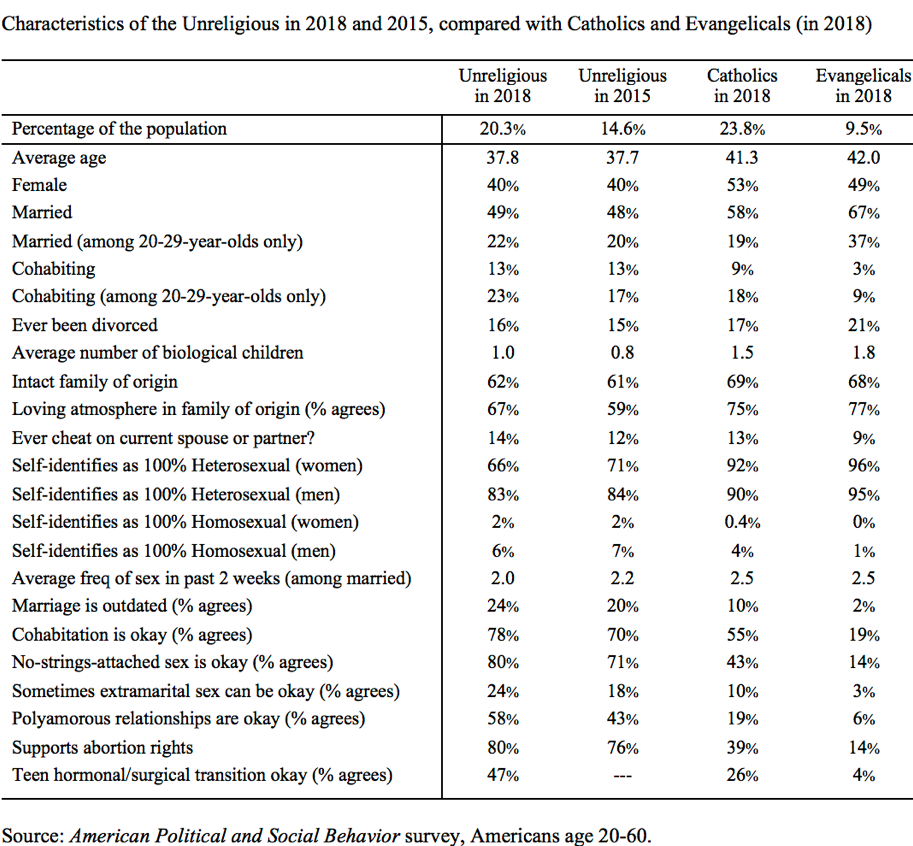
Views of unreligious, Catholic and evangelical Americans
Views of unreligious, Catholic and evangelical Americans (click to expand)

This is interesting:

Even when I limit the group to respondents below age thirty—which is just north of the median age at marriage in the United States—it is notable that 22 percent of the unreligious are married and 23 percent are currently cohabiting, not radically different from the 19 and 18 percent of Catholics that are married and cohabiting, respectively. For comparison, 37 and 9 percent of younger evangelicals are married and cohabiting, respectively. The cohabiting habits of the unreligious, however, have shifted—note the uptick in cohabitation—six percentage points in just under four years. That amounts to a 35 percent increase. Since it’s unlikely that the unreligious have recently changed their minds about the morality or pragmatics of living together, my bet is in the other direction: cohabiting leads many to no longer identify as religious at all.

Got that part in bold? Their attitudes are changing because of their sexual behaviors. So, if you want to reverse the decline of Christianity, we’re going to need to come up with some arguments and evidence to counter the sexual revolution. And on this blog, we’ve done that many times, looking at studies showing the future instability of marriages that occur after cohabitation. I’ve never heard a church preach on that, though. And it’s not something that even many Christian apologists focus on. Most Christian apologists, particularly the women, tend to focus on soft arguments,. They stay away from arguments about morality, because it’s divisive and abrasive to their desired audience. However, if the goal is persuading people that Christianity is a viable worldview, then we need to focus more on sexuality.

More Regnerus:

[O]n each of seven attitude measures I examined, the unreligious are notably more permissive than even the spiritual-but-not-religious (not shown). Nearly 80 percent of unreligious Americans agree (or strongly agree) that cohabitation is okay, no-strings-attached sex is okay, and abortion should be a legal right. This is all unsurprising. But even some of the more radically “progressive” attitudes demonstrate strong support among the unreligious: 24 percent agree that it is “sometimes permissible for a married person to have sex with someone other than his/her spouse.” (I thought perhaps women would differ from men here, but they didn’t—or at least not by much.) Although few Americans are actually in polyamorous living arrangements, the unreligious would support them should someone choose such an arrangement; 58 percent of them agreed that “it is okay for three or more consenting adults to live together in a sexual/romantic relationship,” a percentage that is far more supportive than Catholics or evangelicals. Among the latter, only 6 percent thinks polyamory could be okay.

A more interesting theme, however, is the surge in support for such alternatives. On each statement, note the rise in agreement that has occurred in just under four years. Polyamory tops the list—a 35-percent leap in the share of unreligious who now endorse polyamorous arrangements (from 43 to 58 percent). Even support for extramarital affairs grew by one-third (from 18 to 24 percent). The unreligious aren’t alone here. Catholics, too, have witnessed liberalization in attitudes. Evangelical numbers display a more modest uptick, and from lower starting points.

The non-religious people in my office who were raised Christian like to tell me that the existence of the Christian God isn’t important to them, because they can achieve marriage via cohabitation, and behave like good people without the need for any sort of framework to rationally ground it. They think that you can just pull out God, and the marriage will stay the same. They expect the people they start relationships with to act on Christian morality, even if the worldview was rejected as superstitious nonsense. But as you can see from the data, removing God has an enormous effect on the person’s ability to be stable and faithful.  The truth is that when you take out the vertical relationships with God, then the blueprint for the relationship becomes completely different. Relationships used to be seen as an enterprise where each person’s primary commitment was to lead and protect their spouse before delivering them to God with faith intact. Now, relationships are contingent on continuous happiness.

More Regnerus:

Only 66 percent of unreligious women say they are “100% Despite the permissive reputation of the unreligious, their actual marital sexual frequency is lower than that of Catholic and evangelical couples—at two instances in the past two weeks. As has been documented extensively in the past few years, the frequency of sex among American couples—whether cohabiting or married—has been declining at statistically significant rates. This pattern has not spared the godless.

I think this is interesting. I believe that men are facing an epidemic of sex-withholding from their wives, and I have an idea why that is. Today, women most commonly use sex to “jump start” a relationship with men who they perceive as “high value”, but who refuse to commit to them. This behavior is not focused on men who have commitment abilities, e.g. – provider, moral leader, spiritual leader, accurate worldview rooted in logic and evidence. Instead, most women use sex to get men who have the appearance of high value, e.g. – tall, tattoos, piercings, violent tendencies, exciting, fun, etc. Having established that pattern over and over with no-commitment bad boys, they marry someone who they see as beneath them, and then withhold sex. Commitment isn’t worthy of sex. It’s the man’s appearance and entertainment value that makes him worthy of sex. The comparison of this low-quality man to previous partners makes women more likely to initiate divorce for “unhappiness” later on.
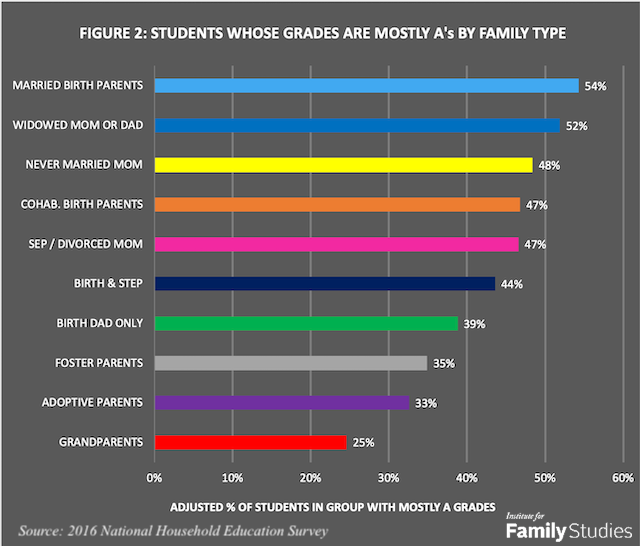

New study: intact heterosexual married home still critical for children’s academic success

Sometimes, when you’re discussing reality with progressives, it helps to have a study. Because although you might think that conservatism is common sense, they think that their feelings are common sense. So you will have to give them evidence, and then call them stupid, until they either accept your evidence or run away screaming back to the New York Times building.

Anyway, here’s the research from the Institute for Family Studies:

Beginning with the 1966 Coleman Report, a long line of studies have found that students from intact, married families do better in school than those from disrupted or unmarried families.5 My own analysis of data from a longitudinal study conducted by the U.S. Department of Education (the ECLS-K) demonstrated the impact that family transitions, such as parental divorce and remarriage, have on students’ task persistence and eagerness to learn, emotional distress, and misbehavior resulting in school disciplinary actions such as suspension.6 IFS studies of trends in Arizona, Florida, and Ohio indicate that school districts tend to be more successful and safer when more of their families are headed by married parents.7

And there’s a graph to go with it. Actually, several, but I just chose this one.

Why can't non-STEM sociologists use apostrophes properly?
Why can’t non-STEM sociologists use apostrophes properly? It’s As not A’s

And here’s the conclusion:

The analyses showed that schoolchildren who live with both married parents do better on each of the three educational progress indicators. Children from married-couple families did better even after controlling for socioeconomic and demographic correlates of family structure.

They’ve also got graphs for student misbehavior by family type, and student disciplined by family type. Naturally, the traditionally family far outperforms the alternatives.

Now the first thing that a progressive will tell you is that adding more money from government social programs will solve the problem, so we just need to have more communism, and give the children to strangers at earlier ages. But the study corrects for socioeconomic factors. And demographic factors, too. So that deflection isn’t going to work.

In previous posts on this blog, I have cited many other studies that show the unique importance of biological mothers and fathers to children’s development. Normally, progressives snatch the blog post out of my hands, tear it into little pieces, throw the little pieces into the air, and then stomp on them. While screaming “hate speech” continuously throughout. But I don’t really know of any other way to argue than to cite evidence. So we’re stuck, I guess. We’re stuck until we outlaw non-STEM degrees so that the only way to graduate college is by learning something useful like nursing or computer science. Then this crazy crying of “racism” and “sexism” and “homophobia” etc. at every piece of evidence will stop.

Yes, Karen, the rules of relationships really do apply to you. And speaking to the manager is not going to get you a “get out of the consequences of my reckless choices free” card. In point of fact, there is no such thing as a get out of the consequences of my reckless choices free card. You will just have to learn to make better decisions about who to have relationships with, and when to have sex with them. That is, if you care about your future children. My recommendation? Don’t choose tall hawt atheist bad boys with tattoos, piercings, violent tempers, and criminal records. Do choose men with STEM degrees who don’t drink, but who do read their Bibles and go to church. Things aren’t really complicated, as long as you make decisions with your brain instead of your intuitions.

Unmarried 35-year-old woman reflects on her adventurous life of fun, travel and serial cohabitation

Telling a woman how to make wise decisions protects her

I found an interesting article featuring a 35-year-old woman who is alarmed that her approach to life has left her in debt and single, with a gap-filled resume of short-term jobs. I thought it might be useful for young women to read this, and consider whether making “rash” decisions and being “adventurous” works out.

She writes:

I feel like a ghost. I’m a 35-year-old woman, and I have nothing to show for it. My 20s and early 30s have been a twisting crisscross of moves all over the West Coast, a couple of brief stints abroad, multiple jobs in a mediocre role with no real upward track. I was also the poster child for serial monogamy. My most hopeful and longest lasting relationship (three and a half years, whoopee) ended two years ago. We moved to a new town (my fourth new city), created a home together, and then nose-dived into a traumatic breakup that launched me to my fifth and current city and who-knows-what-number job.

Rash decisions, adventure, exploring…. and lots of debt:

For all these years of quick changes and rash decisions, which I once rationalized as adventurous, exploratory, and living an “original life,” I have nothing to show for it. I have no wealth, and I’m now saddled with enough debt from all of my moves, poor decisions, and lack of career drive that I may never be able to retire. I have no career milestones and don’t care for my line of work all that much anyway, but now it’s my lifeline, as I only have enough savings to buy a hotel room for two nights.

No STEM degree, which means she doesn’t like to study hard things that can be tested against the real world for correctness:

I used to consider myself creative — a good writer, poetic, passionate, curious. Now, after many years of demanding yet uninspiring jobs, multiple heartbreaks, move after move, financial woes, I’m quite frankly exhausted.

Surprised by aging and poor health:

Also, within the past year I’ve had a breast-cancer scare and required surgery on my uterus due to a fertility issue. On top of that, I’m 35 and every gyno and women’s-health website this side of the Mississippi is telling me my fertility is dropping faster than a piano falling out of the sky. Now I’m looking into freezing my eggs, adding to my never-ending financial burden, in hopes of possibly making something of this haunted house and having a family someday with a no-named man.

She’s still trying to be the sexpot 25-year-old she used to be:

I’m dating. I’m working out and working hard. Listening to music I enjoy and loving my cat. Calling my mom…. I’m drinking too much… And with men I date, I feel pressure to make something of the relationship too soon (move in, get married, “I have to have kids in a couple of years”; fun times!). All the while still trying to be the sexpot 25-year-old I thought I was until what seemed like a moment ago.

But her plan hasn’t worked out:

I used to think I was the one who had it all figured out. Adventurous life in the city! Traveling the world! Making memories! Now I feel incredibly hollow. And foolish. How can I make a future for myself that I can get excited about out of these wasted years?  What reserves or identity can I draw from when I feel like I’ve accrued nothing up to this point with my life choices?

Well, I’ve known women like this, and I think we’re going to see more and more women like this as the society becomes more secular and feminist. I want to say something about whether she is sincere about wanting to get married and have children, and what women should do to avoid ending up like her.

Do women today understand male nature and marriage?

This woman’s demonstrated life plan is that she chose whatever made her feel good from age 18-35+, and now wants to enter into a marriage some time after age 35. And what does marriage mean to her? Has she prioritized entering the traditional roles of wife and mother? Don’t listen to her words. Look at her actions. Her actions show that marriage and children were of NO importance to her. And her current approach to getting married and having kids is the same as ever – work out in order to look hot, and try to coerce a man who signs up for recreational sex with no commitment into becoming a man who makes a life-long commitment to provide for her and her children (which is the opposite of what he signed up for). She wants marriage now for the same reason that she’s wanted anything: for fun, thrills, adventure and to keep up with her girlfriends who are already married.

What kind of man should she have been pursuing from age 18 to 35, if she really wanted marriage and children? Well, the first thing to realize is that not all men want marriage. And the next thing to realize is that women who are serious about marriage need to focus ONLY on men who want to marry. All the men that the women quoted above wanted in her youth didn’t want to marry. They wanted premarital recreational sex with her, and that was fine with her – she chose them, and disregarded the men who were interested in marriage.

A man who was interested in marrying her would have:

  • ….told her no to sex before marriage (because the more sexual partners a woman has, the less happy she will be in marriage, and the more unstable her marriage will be).
  • …led her to become better at being a wife and mother, by discouraging her thrill-seeking, traveling and wasteful spending, and instead encouraging her focus on a STEM education, career and getting debt-free.
  • …led her to develop a Christian worldview in which she would understand the importance of marriage and children, and learn to sacrifice her own interests to love and care for others.

Was she interested in getting ready for marriage? No. She never chose those marriage-minded men. She didn’t want to be a wife. The men she chose were chosen for fun, for thrills, and to show off their outward appearance to her girlfriends.

So, who are the men in this group of marriage-minded men? How do you recognize them? Marriage-minded men are interested in marriage because they want to lead a home. They will have invested a lot of time learning how to protect others, how to provide, and how to debate and lead on moral and spiritual issues. Marriage-minded men see the marriage enterprise as a way of advancing the causes that they care about most. Women who really want to get married will recognize those men, and pursue those men. And they’ll do it early, so that they can invest in their husbands early and be young enough to have children.