Tag Archives: Career

What do college students achieve by participating in the hook-up culture?

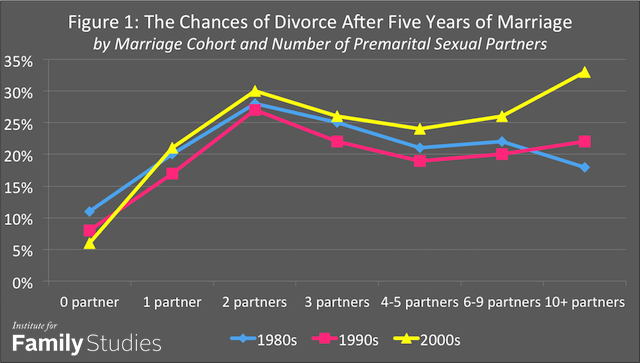
Even one non-husband premarital sex partner raises risk of divorce

Stuart Schneiderman linked to a balanced article from the New York Times Magazine which offers scary insights into the hook-up culture at one of our elite universities.

First, feminism is definitely a driver of the hook-up culture, and women are voluntarily choosing it:

At 11 on a weeknight earlier this year, her work finished, a slim, pretty junior at the University of Pennsylvania did what she often does when she has a little free time. She texted her regular hookup — the guy she is sleeping with but not dating. What was he up to? He texted back: Come over. So she did. They watched a little TV, had sex and went to sleep.

Their relationship, she noted, is not about the meeting of two souls.

“We don’t really like each other in person, sober,” she said, adding that “we literally can’t sit down and have coffee.”

Ask her why she hasn’t had a relationship at Penn, and she won’t complain about the death of courtship or men who won’t commit. Instead, she’ll talk about “cost-benefit” analyses and the “low risk and low investment costs” of hooking up.

“I positioned myself in college in such a way that I can’t have a meaningful romantic relationship, because I’m always busy and the people that I am interested in are always busy, too,” she said.

“And I know everyone says, ‘Make time, make time,’ ” said the woman, who spoke on the condition of anonymity but agreed to be identified by her middle initial, which is A. “But there are so many other things going on in my life that I find so important that I just, like, can’t make time, and I don’t want to make time.”

It is by now pretty well understood that traditional dating in college has mostly gone the way of the landline, replaced by “hooking up” — an ambiguous term that can signify anything from making out to oral sex to intercourse — without the emotional entanglement of a relationship.

Until recently, those who studied the rise of hookup culture had generally assumed that it was driven by men, and that women were reluctant participants, more interested in romance than in casual sexual encounters. But there is an increasing realization that young women are propelling it, too.

Hanna Rosin, in her recent book, “The End of Men,” argues that hooking up is a functional strategy for today’s hard-charging and ambitious young women, allowing them to have enjoyable sex lives while focusing most of their energy on academic and professional goals.

And a bit more about “A”:

For A., college is an endless series of competitions: to get into student clubs, some of which demand multiple rounds of interviews; to be selected for special research projects and the choicest internships; and, in the end, to land the most elite job offers.

As A. explained her schedule, “If I’m sober, I’m working.”

In such an overburdened college life, she said, it was rare for her and her friends to find a relationship worth investing time in, and many people avoided commitment because they assumed that someone better would always come along.

“We are very aware of cost-benefit issues and trading up and trading down, so no one wants to be too tied to someone that, you know, may not be the person they want to be with in a couple of months,” she said.

Instead, she enjoyed casual sex on her terms — often late at night, after a few drinks, and never at her place, she noted, because then she would have to wash the sheets.

[…]“‘I’ve always heard this phrase, ‘Oh, marriage is great, or relationships are great — you get to go on this journey of change together,’ ” she said. “That sounds terrible.

“I don’t want to go through those changes with you. I want you to have changed and become enough of your own person so that when you meet me, we can have a stable life and be very happy.”

In the meantime, from A.’s perspective, she was in charge of her own sexuality.

“I definitely wouldn’t say I’ve regretted any of my one-night stands,” she said.

“I’m a true feminist,” she added. “I’m a strong woman. I know what I want.”

At the same time, she didn’t want the number of people she had slept with printed, and she said it was important to her to keep her sexual life separate from her image as a leader at Penn.

“Ten years from now, no one will remember — I will not remember — who I have slept with,” A. said. “But I will remember, like, my transcript, because it’s still there. I will remember what I did. I will remember my accomplishments and places my name is hung on campus.”

These high-powered feminist students are having sex with strangers because they are “hot”, not because they have made the man prove his intention and ability to commit by waiting until marriage.

I think the key point about this is that these women think that they are actually on a path to marriage by focusing on themselves and their careers. Their alcohol abuse is a path to marriage. Their promiscuity with bad boy men who have no interest in marriage is a path to marriage. Their career and selfishness is a path to marriage. This despite the fact that research clearly shows that the number of sexual partners that a woman has before marrying directly impacts her ability to perform in a relationship. Premarital sex with bad boys raises her estimation of her own value in relationships. When she is older and has to settle for what she can get, she will be dissatisfied and ungrateful. This is where divorce comes from.

Nothing that these women are doing is preparation for actual commitment and support. They can’t even converse with men, much less do the duties of a wife. Their ability to choose a man who can perform actual husband/father duties is not being formed by study or courtship. There is no wisdom. There is no self-sacrifice. There is no chastity. There is no support. There is no communication. These women are pro-abortion – that’s their view of  the rights and dignity of children. They are pro-gay marriage – that’s their view of providing for children’s relationship needs. These are literally the worst women in the world to marry. Their ignorance of what they must do to be good wives and mothers, and their messed up criteria for choosing men who can be husband and fathers makes them the worst women in the world to marry.

Read this carefully:

Some women went to college wanting a relationship, but when that seemed unlikely, they embraced hooking up as the best alternative. M., an athletic freshman with long legs and a button nose, arrived at college a virgin and planned to wait to have sex until she had her first boyfriend, something she expected to happen in college. But over the course of the fall, as she saw very few students forming relationships, she began to lose hope about finding a boyfriend and to see her virginity as a hindrance.

“I could be here for four years and not date anyone,” she said she realized. “Sometimes you are out, and there’s a guy you really are attracted to, and you kind of want to go back home with him, but you kind of have that underlying, ‘I can’t, because I can’t just lose my V-card to some random guy.’ ”

At a party in the spring semester, she was taking a break from dancing when she ran into a guy she had had a class with in the fall. They started talking, then danced until the party was over. M. went back to his room, where they talked some more and then started making out.

By this time, she said, “I wasn’t very drunk — I was close to sober,” which made her believe she could make a considered decision.

“I’m like, ‘O.K., I could do this now,’ ” she recalled thinking. “ ‘He’s superhot, I like him, he’s nice. But I’m not going to expect anything out of it, either.’ ”

The alternative, she said, was that “I could take the chance that one night I get really drunk and sleep with someone that I don’t want to sleep with, which probably is what would have ended up happening.”

So she had sex with him. In the morning, he walked her home.

“Honestly, all of my friends, they’re super envious, because I came back with the biggest smile on my face,” M. said. As she had expected, she and the guy remained friendly but nothing more. Yet she was still happy with her decision.

“All of my friends are jealous, because I had such a great first experience,” she added. Over spring break, she slept with someone else.

In general, she said, she thought that guys at Penn controlled the hookup culture. But women played a role as well.

“It’s kind of like a spiral,” she said. “The girls adapt a little bit, because they stop expecting that they’re going to get a boyfriend — because if that’s all you’re trying to do, you’re going to be miserable. But at the same time, they want to, like, have contact with guys.” So they hook up and “try not to get attached.”

Now, she said, she and her best friend had changed their romantic goals, from finding boyfriends to finding “hookup buddies,” which she described as “a guy that we don’t actually really like his personality, but we think is really attractive and hot and good in bed.”

I think I would really like everyone reading this to just read that last part over a few times, and let that sink in. You have a minority of good looking athletic men having sex with most of the women on campus, while the majority of men who opt-out of the hook-up culture and want to court and marry are left wondering where all the women went. And many of those will reinvent themselves as “bad boys” in order to at least get some contact with women, so that there are even fewer chaste, marriage-enabled men.

I really recommend reading some of Dr. Schneiderman’s comments on this article. He is really not happy about it, and he puts the blame squarely on feminists. As do I. Radical feminism is the ideology that gave us abortion, fatherlessness and divorce. We should call it what it is: selfish and destructive.

Maggie Gallagher does not like the message of the movie “La La Land”

Marriage and family
Marriage and family

I own a couple of books written by Maggie Gallagher, (“The Abolition of Marriage” and “The Case for Marriage”).

Here is an excerpt from her review of La-La Land, posted at The Stream: (excerpt contains spoilers)

The story begins as a classic story of two beautiful young people who meet in L.A. — a “city of magic, city of stars,” as the haunting lyric puts it, but clearly no longer City of Angels. Together they pursue their dreams both of love and success. Sebastian wants to become a jazz club singer. Mia wants to be a famous actress. The dramatic climax of the film comes after Sebastian at some personal sacrifice has given Mia the shot at her dreams, dreams she had given up on. And she chooses those dreams over him.

[…]In La La Land, [the director] chose to sharpen the clash between love and ambition. He does so in three ways:

  1. By making the choice to leave love behind the woman’s choice, rather than the man’s, brilliantly (in the commercial sense) situating the film among the emerging and popular female empowerment dramas in which women learn they do not need a man to be happy and fulfilled.
  2. By making the man a genuine hero — how else do you describe a guy who, after a woman has broken up with him and run home to Ohio to hide in the safety of her parents’ house, drives all night to deliver to her the message that she has a callback audition to a major movie? (She didn’t leave a forwarding address so he can’t just call her and let her know.)
  3. By portraying the obstacle to love as so feeble that it’s hard to imagine why it should destroy true love: Mia has to go to Paris for 6 months to make her movie. It’s her big break. Of course she has to go. But what is a love that cannot survive a few months in Paris? Is there no Skype? Are there no intercontinental flights?

One young online commentator described this twist on the iconic musical narrative, this “bittersweet ending,” as being more realistic, more grounded. I find it difficult to get into that young man’s head. How one can believe that however hard it is to find true love these days, becoming a famous Hollywood actress is a more “realistic” dream? Mia is not the loser for making this choice. She becomes famous and finds a new love, who seem a nice man, and they have a baby. She has it all, and has chosen correctly, because dreams are not transferable, but people can be replaced.

The message of the movie is clear: a good man is easier to find than a good career – especially a career that is fun, thrills and popularity. Follow your heart, and all these things will be added unto you.

She concludes with this:

[…]La La Land is a strange postmodern exercise in nostalgia, which tried to give us all the romantic feelings of the classic Hollywood musicals before ripping them away from us and substituting the idea that it is work alone on which we can rely.

If you Google La La Land, this synopsis pops up: “With modern day Los Angeles as the backdrop, this musical about everyday life explores what is more important: a once-in-a-lifetime love or the spotlight.”

I know a lot of Christian women who delay marriage because they want the spotlight.

Don’t give your money to Hollywood leftists

I don’t go to movie theaters except once every 1-3 years, because I don’t want to give Hollywood my money. If I like a movie, I buy it later on DVD for less than $10. The last movie I saw in the theater was “13 Hours”. I rarely see anything in the themes of popular movies (or popular music) that is true, good or beautiful. This movie does nothing to make me question my stewardship of my dollars. What I end up spending my money on these days is World War 2 and Korean War history audio books. Nothing in those books hurts my character. Reading military history helps me to be thankful and humble.

Consider Romans 12:1-2:

Therefore I urge you, brethren, by the mercies of God, to present your bodies a living and holy sacrifice, acceptable to God, which is your spiritual service of worship.

And do not be conformed to this world, but be transformed by the renewing of your mind, so that you may prove what the will of God is, that which is good and acceptable and perfect.

And Phil 4:8:

Finally, brethren, whatever is true, whatever is honorable, whatever is right, whatever is pure, whatever is lovely, whatever is of good repute, if there is any excellence and if anything worthy of praise, dwell on these things.

I don’t want to explain to God later why I gave the money he entrusted to me to radical leftists. What is frustrating to me about movies, (and entertainment in general, including far-left ESPN), is that all too often, my friends seem to think that my choice of entertainment is not something that God cares about.

If you’re going to be a Christian, you need to be as smart as you can be

C.S. Lewis has some words to live by for you

I guess I will start this post by linking to something a friend of mine named Joel Furches wrote about an atheist engineer. (link is dead)

He writes:

As an Aerospace Engineer for the U.S. Navy, Jason Pratt is not inaccurate when he describes himself as a rocket scientist for the government. He has flown F-14 Tomcats and the F/A-18F Super Hornet. He was a test pilot of the FA-18B and D Hornet, the FA-18F Super Hornet, and the T-45 Goshawk. His pedigree with all things aeronautical is well established. As was his atheism.

Pratt grew up in a single parent home. He and his sister were raised by their mother, who felt it was her duty to introduce them to church in their teenage years. The church Pratt attended was a religious shell: a ritualistic facade with little reference to actual scriptural teachings. He went through the ceremonial steps as a matter of form, and the moment he was confirmed by the church, he confirmed himself an atheist, and left the church in his dust. His family took this with barely a nod, and as soon as she was confirmed, his sister followed his example.

After High School, Pratt entered college to study engineering. Academically, he proved himself quite brilliant, and flaunted that brilliance at every opportunity. He describes himself as very much a “self-righteous atheist” in college.

He found his atheism very freeing, morally, living by the code of “do whatever you want as long as nobody gets hurt.”

Says Pratt:

“I started to meet other students, and some of them were claiming to be Christians. I even had some of them as roommates. Having had some church background, I knew the type. They were hypocrites, deluded by the silly book that they claimed they believed in. And so I frequently took pleasure in ridiculing them. I would mock them. I would look for any reason to bring out things that they would claim they believe and I would just make fun of them, and mock their God and the Bible that supposedly guided them.

“I generally enjoyed playing the intellectual superior, and I enjoyed challenging what they believed.”

Not much surprise to Pratt, most of the Christians he met had no ability to defend their faith against his ridicule.

[…]One day, however, Pratt met a fellow engineering student named John Thatcher. Thatcher had a perfect GPA, which was somewhat intimidating to someone like Pratt, who took such pride in his own intellect. Thatcher was a very likable guy. He was also a Christian. This made things difficult for Pratt.

At the same time, Pratt discovered that his Academic Adviser – a leading authority in the field of Thermodynamics – was a Christian. This discovery was made when Pratt went to his adviser’s office one day in order to request some help from the brilliant man. As Pratt approached his office, he was shocked to find a scientific article, arguing Thermodynamics from a Christian perspective, hanging from his office door. Pratt was so infuriated, he stormed away and never spoke to his adviser again.

Confused and upset that these two very intelligent men would believe in superstitious nonsense, Pratt made it his goal to truly examine the claims of Christianity for the first time.

This reminded me of a quote from atheist philosopher Thomas Nagel.

He says this:

“In speaking of the fear of religion, I don’t mean to refer to the entirely reasonable hostility toward certain established religions and religious institutions, in virtue of their objectionable moral doctrines, social policies, and political influence. Nor am I referring to the association of many religious beliefs with superstition and the acceptance of evident empirical falsehoods. I am talking about something much deeper–namely, the fear of religion itself. I speak from experience, being strongly subject to this fear myself: I want atheism to be true and am made uneasy by the fact that some of the most intelligent and well-informed people I know are religious believers.

I want atheism to be true and am made uneasy by the fact that some of the most intelligent and well-informed people I know are religious believers. It isn’t just that I don’t believe in God and, naturally, hope that I’m right in my belief. It’s that I hope there is no God! I don’t want there to be a God; I don’t want the universe to be like that.”

(”The Last Word” by Thomas Nagel, Oxford University Press: 1997)

I think in general, it’s a good thing when Christians strive to be different from the culture around them. Obviously, that means having different moral values and different goals than what’s popular and acceptable for non-Christians. It means not openly engaging in activities that are forbidden to Christians, like not getting drunk, not having premarital/extra-marital sex, etc. And I think it also means being as smart as you can possibly be about about areas that touch on your Christian worldview. Why? Because like the story above says, being informed and having the answers is attractive to people who are searching.

It doesn’t help God for you to be wild and stupid

In my life, I have sometimes tried to lead other Christians to study harder things and to get better jobs. Most of the time, this works. I can get young Christians to not study English or Drama or Art History, and instead get them to study Engineering or Computer Science or Nursing. And if they already are studying hard things, then I encourage them, I buy them books, I play games with them and ask them how things are going. Once they have the degrees, I encourage them to get jobs, to work in the summers, to open investment accounts, and pay off their loans.

The point is this – what you study and what you do for work and how good you are at your job plays a massive role in whether you will get into conversations with non-Christians at all. It is not good service to God to bungle your education and career because you were more interested in feeling good, having fun and seeking thrills. You will lose opportunities to make a difference in the lives of others that way.

Managing your money – paying off debts and investing early and often – is part of that signal of maturity that you send to others. And don’t underestimate the importance of marriage and children – something I don’t have. If I had a successful marriage, and lots of well-behaved children, that would help a lot as well. Especially if people could come over to a warm and happy home. It sends a message. However, if you’re going to stay single, then keep your self-control and be content with it. That sends a message, too.

Life is short. Don’t do what feels good. Do what works.