David Evans consulted full-time for the Australian Greenhouse Office (now the Department of Climate Change) from 1999 to 2005, and part-time 2008 to 2010, modelling Australia’s carbon in plants, debris, mulch, soils, and forestry and agricultural products. And then he stopped working for them. Now that he is no longer obligated to toe the party line, he explains what global warming really is about. (H/T Neil Simpson)
Excerpt:
The debate about global warming has reached ridiculous proportions and is full of micro-thin half-truths and misunderstandings. I am a scientist who was on the carbon gravy train, understands the evidence, was once an alarmist, but am now a skeptic. Watching this issue unfold has been amusing but, lately, worrying. This issue is tearing society apart, making fools out of our politicians.
Let’s set a few things straight.
The whole idea that carbon dioxide is the main cause of the recent global warming is based on a guess that was proved false by empirical evidence during the 1990s. But the gravy train was too big, with too many jobs, industries, trading profits, political careers, and the possibility of world government and total control riding on the outcome. So rather than admit they were wrong, the governments, and their tame climate scientists, now outrageously maintain the fiction that carbon dioxide is a dangerous pollutant.
The evidence that was ignored by the global warming alarmists:
Most scientists, on both sides, also agree on how much a given increase in the level of carbon dioxide raises the planet’s temperature, if just the extra carbon dioxide is considered. These calculations come from laboratory experiments; the basic physics have been well known for a century.
The disagreement comes about what happens next.
The planet reacts to that extra carbon dioxide, which changes everything. Most critically, the extra warmth causes more water to evaporate from the oceans. But does the water hang around and increase the height of moist air in the atmosphere, or does it simply create more clouds and rain? Back in 1980, when the carbon dioxide theory started, no one knew. The alarmists guessed that it would increase the height of moist air around the planet, which would warm the planet even further, because the moist air is also a greenhouse gas.
This is the core idea of every official climate model: For each bit of warming due to carbon dioxide, they claim it ends up causing three bits of warming due to the extra moist air. The climate models amplify the carbon dioxide warming by a factor of three — so two-thirds of their projected warming is due to extra moist air (and other factors); only one-third is due to extra carbon dioxide.
That’s the core of the issue. All the disagreements and misunderstandings spring from this. The alarmist case is based on this guess about moisture in the atmosphere, and there is simply no evidence for the amplification that is at the core of their alarmism.
Weather balloons had been measuring the atmosphere since the 1960s, many thousands of them every year. The climate models all predict that as the planet warms, a hot spot of moist air will develop over the tropics about 10 kilometres up, as the layer of moist air expands upwards into the cool dry air above. During the warming of the late 1970s, ’80s and ’90s, the weather balloons found no hot spot. None at all. Not even a small one. This evidence proves that the climate models are fundamentally flawed, that they greatly overestimate the temperature increases due to carbon dioxide.
This evidence first became clear around the mid-1990s.
At this point, official “climate science” stopped being a science. In science, empirical evidence always trumps theory, no matter how much you are in love with the theory. If theory and evidence disagree, real scientists scrap the theory. But official climate science ignored the crucial weather balloon evidence, and other subsequent evidence that backs it up, and instead clung to their carbon dioxide theory — that just happens to keep them in well-paying jobs with lavish research grants, and gives great political power to their government masters.
The Blog Prof also linked this useful video in which a Physics professor from the University of California at Berkeley explains the Climategate scandal.
These revelations should mark the end of global warming alarmism, but they won’t, because global warming is such a useful fiction for so many people. As the article noted, it’s a source of endless research grants and prestigious travel budgets for researchers in academia who must apply for government money before they can prove what the governments wants them t0 prove – namely, that government needs to control individuals and corporations. It provides those who reject traditional morality with a way of feeling better about themselves by being “moral” about recycling, turning of their lights and not having any children. It gives people a feeling of pride, because they are better than those greedy oil companies that pay a 40% tax rate, much higher than the 0% paid by companies that are favored by the Democrat Party, like GE. It also provides a useful fiction for the socialists to mislead the public into voting for them to “solve” the “crisis” with bigger government, higher taxes and less individual liberty.
Last time we saw how the progress of science in the last 30 years has proved that the environment of the early Earth would not have allowed the emergence of the basic building blocks of life. This time, let’s allow the atheist to assume the building blocks were created by the noodly appendage of the Flying Spaghetti Monster, (peas be upon him), and see whether it’s possible for the blocks to chain themselves together to make a living cell withinin a reasonable amount of time (400 million years, say).
For this post, I will be referencing an article by Stephen C. Meyer, which he published in the Catholic journal “First Things”. I chose this article deliberately because it was written at the level of an ordinary layman, so we could all understand everything well enough to feel confident explaining it to our neighbors. All unattributed quotes are from this article.
The combatants
The contest over origins features two opposing points of view:
A Creator and Designer is responsible for the origin of life
Matter, chance and long periods of time are sufficient to explain the origin of life
What’s at stake?
Atheistic Cornell University professor Will Provine explains what logically follows from naturalistic evolution:
There are no gods, no purposes, and no goal-directed forces of any kind. There is no life after death. When I die, I am absolutely certain that I am going to be dead. That’s the end of me. There is no ultimate foundation for ethics, no ultimate meaning in life, and no free will for humans, either. What an unintelligible idea.
So, the stakes are high.
Why doubt the apparent design in nature?
There are two main reasons why atheists doubt the appearance of design in nature:
In order for a living organism to support life, it must be able to perform minimal functions:
store information
transmit information
edit information
use that information to regulate metabolic processes
There must be sufficient information inside the cells of that organism to support those functions. How does this information exist in the cell, and where did it come from?
Atheism is a pre-scientific worldview
Meyer describes the primitive superstitions of tribes of atheists living in primitive, pre-scientific cultures:
…in the 1870s and 1880s scientists assumed that devising an explanation for the origin of life would be fairly easy….they assumed that life was essentially a rather simple substance called protoplasm that could be easily constructed by combining and recombining simple chemicals such as carbon dioxide, oxygen, and nitrogen. …just as salt could be produced spontaneously by adding sodium to chloride, so… could a living cell be produced by adding together several chemical constituents and then allowing spontaneous chemical reactions to produce the simple protoplasmic substance that they assumed to be the essence of life.
Atheists believe in all kinds of primitive pre-scientific myths, like the eternal universe, etc., which the progress of science has falsified. Can the progress of science falsify the atheistic superstitions about the origin of life?
The Oparin-Haldane hypothesis
Atheists began to panic in the early 20th century as discoveries began to pile up confirming the that the entire physical universe, and time itself, was created by a supernatural force that existed transcendentally, independent of matter, energy, space and time. (See here for a listing of 6 of these discoveries from the progress of science). Atheists decided that they’d better get involved in this “science” thing that the Christians had started.
Meyer reports on one of their first groundless speculations:
During the 1920s and 1930s a more sophisticated version of this so–called “chemical evolutionary theory” was proposed by a Russian biochemist named Alexander I. Oparin…. Oparin, like his nineteenth–century predecessors, suggested that life could have first evolved as the result of a series of chemical reactions.
It was hoped that that the Flying Spaghetti Monster would appear to his true believers and ground this blind speculation, allowing atheists to continue in their flight from rationality and moral obligations.
The Miller-Urey experiment
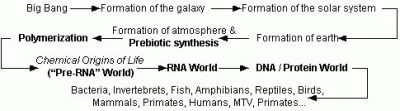
Pre-biotic synthesis (see below) produces amino acids, which are the first step in explaining the origin of the simplest life, on atheism:
How did life begin?
As we saw last time, the Miller-Urey experiments that were designed to produce the building blocks of life (amino acids) were horribly flawed and did not reflect the conditions that would have existed on the early Earth.
I’ll summarize the problems with the experiment:
the gasses were used in the experiment were not those present on the early Earth
molecular oxygen was excluded from the experiment
Harmful UV radiation was filtered out by the experimenter intervention
interfering cross-reactions were prevented by experimenter intervention
Other problems:
extinction events, such as meteorite impacts, were excluded not considered
the chirality problem (left-handed amino acids, right-handed sugars) was not considered
the problem of getting all peptide bonds was not considered
This experiment, though flawed, still exists in biology textbooks today, along side faked photographs of peppered moths and doctored drawings of embryos. All must praise the Flying Spaghetti Monster, and at taxpayer expense!
The problem of biological information
To create life, you need to sequence amino acids into proteins, and sequence the nucleotides on DNA strands.
Meyer explains:
To form a protein, amino acids must link together to form a chain. Yet amino acids form functioning proteins only when they adopt very specific sequential arrangements, rather like properly sequenced letters in an English sentence. Thus, amino acids alone do not make proteins, any more than letters alone make words, sentences, or poetry. In both cases, the sequencing of the constituent parts determines the function (or lack of function) of the whole.
…As it turns out, specific regions of the DNA molecule called coding regions have the same property of “sequence specificity” or “specified complexity” that characterizes written codes, linguistic texts, and protein molecules. Just as the letters in the alphabet of a written language may convey a particular message depending on their arrangement, so too do the sequences of nucleotide bases (the A’s, T’s, G’s, and C’s) inscribed along the spine of a DNA molecule convey a precise set of instructions for building proteins within the cell. The nucleotide bases in DNA function in precisely the same way as symbols in a machine code. In each case, the arrangement of the characters determines the function of the sequence as a whole…. In the case of DNA, the complex but precise sequencing of the four nucleotide bases (A, T, G, and C) stores and transmits the information necessary to build proteins.
…As Bernd–Olaf Kuppers recently stated, “The problem of the origin of life is clearly basically equivalent to the problem of the origin of biological information.”
How do atheists account for this biological information?
Atheistic superstitions about the biological information
Le’s take a look at the atheist’s faith-based explanations of the origin of life: chance, law and self-organization.
For the first one, let’s calculate the odds of building a protein composed of a functional chain of 100 amino acids, by chance. (Think of a meaningful English sentence built with 100 scrabble letters, held together with glue)
1. Chance:
BONDING: You need 99 peptide bonds between the 100 amino acids. The odds of getting a peptide bond is 50%. The probability of building a chain of one hundred amino acids in which all linkages involve peptide bonds is roughly (1/2)^99 or 1 chance in 10^30.
CHIRALITY: You need 100 left-handed amino acids. The odds of getting a left-handed amino acid is 50%. The probability of attaining at random only L–amino acids in a hypothetical peptide chain one hundred amino acids long is (1/2)^100or again roughly 1 chance in 10^30.
SEQUENCE: You need to choose the correct amino acid for each of the 100 links. The odds of getting the right one are 1 in 20. Even if you allow for some variation, the odds of getting a functional sequence is (1/20)^100 or 1 in 10^65.
The final probability of getting a functional protein composed of 100 amino acids is 1 in 10^125. Even if you fill the universe with pre-biotic soup, and react amino acids at Planck time (very fast!) for 14 billion years, you are probably not going to get even 1 such protein. And you need at least 100 of them for minimal life functions, plus DNA and RNA.
Research performed by Doug Axe at Cambridge University, and published in the peer-reviewed Journal of Molecular Biology, has shown that the number of functional amino acid sequences is tiny:
Doug Axe’s research likewise studies genes that it turns out show great evidence of design. Axe studied the sensitivities of protein function to mutations. In these “mutational sensitivity” tests, Dr. Axe mutated certain amino acids in various proteins, or studied the differences between similar proteins, to see how mutations or changes affected their ability to function properly. He found that protein function was highly sensitive to mutation, and that proteins are not very tolerant to changes in their amino acid sequences. In other words, when you mutate, tweak, or change these proteins slightly, they stopped working. In one of his papers, he thus concludes that “functional folds require highly extraordinary sequences,” and that functional protein folds “may be as low as 1 in 10^77.”
The problem of forming DNA by sequencing nucleotides faces similar difficulties. And remember, mutation and selection cannot explain the origin of the first sequence, because mutation and selection require replication, which does not exist until that first living cell is already in place.
2. Law:
The idea here is that components, such as nucleotides, might have special bonding affinities that might cause them to bond together spontaneously into functional sequences. Like if certain SCRABBLE tiles had an affinity for certain other tiles that caused them to bond together whenever they met.
Meyer writes:
Consider what would happen if the individual nucleotide “letters” in a DNA molecule did interact by chemical necessity with each other. Every time adenine (A) occurred in a growing genetic sequence, it would likely drag thymine (T) along with it. Every time cytosine (C) appeared, guanine (G) would follow. As a result, the DNA message text would be peppered with repeating sequences of A’s followed by T’s and C’s followed by G’s.
3. Self-organization:
The idea here is that some spontaneous order might arise due to some physical force, just like rocks sort themselves by size in a rock agitator because of gravity.
Meyer writes:
…just as magnetic letters can be combined and recombined in any way to form various sequences on a metal surface, so too can each of the four bases A, T, G, and C attach to any site on the DNA backbone with equal facility, making all sequences equally probable (or improbable). The same type of chemical bond occurs between the bases and the backbone regardless of which base attaches. All four bases are acceptable; none is preferred. In other words, differential bonding affinities do not account for the sequencing of the bases. Because these same facts hold for RNA molecules, researchers who speculate that life began in an “RNA world” have also failed to solve the sequencing problem…
Understanding what creates information
The bottom line is that in order for software code, or even English letters, to be functional, it needs to defy ordering mechanisms. Biological sequences are functional for the same reason that software code or English text is functional – because some intelligent agent chose an irregular sequence of characters in order to achieve a specific purpose. Look at the letters in this post – they are not ORDERED by physical laws. They are SELECTED by an intelligent agent.
Meyer writes:
To see the distinction between order and information, compare the sequence “ABABABABAB ABAB” to the sequence “Time and tide wait for no man.” The first sequence is repetitive and ordered, but not complex or informative.
What causes specified, complex sequences?
…the information contained in an English sentence or computer software does not derive from the chemistry of the ink or the physics of magnetism, but from a source extrinsic to physics and chemistry altogether. Indeed, in both cases, the message transcends the properties of the medium… Our experience with information–intensive systems (especially codes and languages) indicates that such systems always come from an intelligent source…
And this is what everybody means by “intelligent design”. This design inference came from the progress of science. The more we discovered about the cell, the more nature pointed towards a creative, designing intelligence. The only option left to atheists now is blind faith that the Flying Spaghetti Monster will swoop in and undo the progress of science over the last 100 years. Good luck with that, atheists!
Further study
One of my favorite resources on the origin of life is this interview from the University of California with former atheist and origin of life researcher Dean Kenyon. Kenyon, a professor of Biology at San Francisco State University, wrote the textbook on “chemical evolution”, which is the view that chemicals can arrange themselves in order to create the first living cell, without intervention.
This interview from the University of California with another origin of life researcher, Charles Thaxton, is also one of my favorites.
You’ll need Quicktime to see the videos, or buy the videos from ARN. (Kenyon, Thaxton) I have both of them – they rock!
There are two problems related to the origin of the first living cell, on atheism:
The problem of getting the building blocks needed to create life – i.e. the amino acids
The problem of creating the functional sequences of amino acids and proteins that can support the minimal operations of a simple living cell
Normally, I concede the first problem and grant the atheist all the building blocks he needs. This is because step 2 is impossible. There is no way, on atheism, to form the sequences of amino acids that will fold up into proteins, and then to form the sequences of proteins that can be used to form everything else in the cell, including the DNA itself. But that’s tomorrow’s topic.
Today, let’s take a look at the problems with step 1.
The problem of getting the building blocks of life
Now you may have heard that some scientists managed to spark some gasses to generate most of the 20 amino acids found in living systems. These experiments are called the “Miller-Urey” experiments.
Miller’s experiment requires a reducing methane and ammonia atmosphere,11, 12 however geochemical evidence says the atmosphere was hydrogen, water, and carbon dioxide (non-reducing).15, 16 The only amino acid produced in a such an atmosphere is glycine (and only when the hydrogen content is unreasonably high), and could not form the necessary building blocks of life.11
Miller and Urey didn’t account for UV of molecular instability:
Not only would UV radiation destroy any molecules that were made, but their own short lifespans would also greatly limit their numbers. For example, at 100ºC (boiling point of water), the half lives of the nucleic acids Adenine and Guanine are 1 year, uracil is 12 years, and cytozine is 19 days20 (nucleic acids and other important proteins such as chlorophyll and hemoglobin have never been synthesized in origin-of-life type experiments19).
Miller and Urey didn’t account for molecular oxygen:
We all have know ozone in the upper atmosphere protects life from harmful UV radiation. However, ozone is composed of oxygen which is the very gas that Stanley Miller-type experiments avoided, for it prevents the synthesis of organic molecules like the ones obtained from the experiments! Pre-biotic synthesis is in a “damned if you do, damned if you don’t” scenario. The chemistry does not work if there is oxygen because the atmosphere would be non-reducing, but if there is no UV-light-blocking oxygen (i.e. ozone – O3) in the atmosphere, the amino acids would be quickly destroyed by extremely high amounts of UV light (which would have been 100 times stronger than today on the early earth).20, 21, 22 This radiation could destroy methane within a few tens of years,23 and atmospheric ammonia within 30,000 years.15
And there were three other problems too:
At best the processes would likely create a dilute “thin soup,”24 destroyed by meteorite impacts every 10 million years.20, 25 This severely limits the time available to create pre-biotic chemicals and allow for the OOL.
Chemically speaking, life uses only “left-handed” (“L”) amino acids and “right-handed” (“R)” genetic molecules. This is called “chirality,” and any account of the origin of life must somehow explain the origin of chirality. Nearly all chemical reactions produce “racemic” mixtures–mixtures with products that are 50% L and 50% R.
Two more problems are not mentioned in the article. A non-peptide bond anywhere in the chain will ruin the chain. You need around 200 amino acids to make a protein. If any of the bonds is not a peptide bond, the chain will not work in a living system. Additionally, the article does not mention the need for the experimenter to intervene in order to prevent interfering cross-reactions that would prevent the amino acids from forming.
The progress of science
As science has progressed, the discoveries have proved out the need for a Creator and Designer in every area – the big bang, cosmic, galactic and stellar fine-tuning, the Cambrian explosion, etc…. and even the origin of life.
“More than 30 years of experimentation on the origin of life in the fields of chemical and molecular evolution have led to a better perception of the immensity of the problem of the origin of life on Earth rather than to its solution. At present all discussions on principal theories and experiments in the field either end in stalemate or in a confession of ignorance. New lines of thinking and experimentation must be tried.”
(Dose, Klaus, “The Origin of Life: More Questions Than Answers,” Interdisciplinary Science Reviews, Vol. 13, No. 4, 1988, p.348.)
Meanwhile, atheists are left to have blind faith that the progress scientists have made during decades of research will be miraculously overturned by new evidence that their beloved unobservable Flying Spaghetti Monster, (peas be upon him), did it. Hey! Don’t blaspheme against the non-supernatural powers of his noodly appendage! (Two Ph.Ds in biology will not save you from the wrath of the Darwoid cultists!)
To see how bad this gets for atheists, watch this video where Dawkins says that unobservable aliens evolved somewhere else and then seeded the Earth with life. He has no evidence that these aliens did evolve (no fossil record), and even worse, he does not know whether they even exist. Nevertheless, that is the state of atheism today – an unobservable Flying Spaghetti Monster evolved somewhere else and seeded the Earth with life.
What else could have happened?
Further study
One of my favorite resources on the origin of life is this interview from the University of California with former atheist and origin of life researcher Dean Kenyon. Kenyon, a professor of Biology at San Francisco State University, wrote the textbook on “chemical evolution”, which is the view that chemicals can arrange themselves in order to create the first living cell, without intervention.
This interview from the University of California with another origin of life researcher, Charles Thaxton, is also one of my favorites.
You’ll need Quicktime to see the videos, or buy the videos from ARN. (Kenyon, Thaxton) I have both of them – they rock!

 WINTERY KNIGHT