
Tag Archives: Capitalism

Video, audio and summary: Jay Richards and Jim Wallis debate Christianity and the common good

Note: if you are having trouble liking this page on Facebook or sharing it on Twitter, please click here for an updated one that is shareable. Something went wrong in Facebook and they’ve marked this post as spam! But the new one is fine for sharing.

The video recording:

  • The organizers of the debate tell me that the video will be posted shortly after the debate, and I will link to it in this very post.

The audio recording:

The debaters

Jay Richards:

Jay Richards, Ph.D., is a Senior Fellow of the Discovery Institute where he directs the Center on Wealth, Poverty and Morality, and is a Visiting Scholar at the Institute for Faith, Work & Economics. Most recently he is the co-author with James Robison of the best-selling Indivisible: Restoring Faith, Family, and Freedom Before It’s Too Late”.

In addition to writing many academic articles, books, and popular essays on a wide variety of subjects, he recently edited the new award winning anthology, God & Evolution: Protestants, Catholics and Jews Explore Darwin’s Challenge to Faith . His previous book was Money, Greed, and God: Why Capitalism Is the Solution and Not the Problem (HarperOne, May 2009), for which he received a Templeton Enterprise Award in 2010.

[…]In recent years, he has been a Contributing Editor of The American at the American Enterprise Institute, a Visiting Fellow at the Heritage Foundation, and a Research Fellow and Director of Acton Media at the Acton Institute. Richards has a B.A. with majors in Political Science and Religion, an M.Div. (Master of Divinity) and a Th.M. (Master of Theology), and a Ph.D. (with honors) in philosophy and theology from Princeton Theological Seminary.

Jim Wallis:

Jim Wallis (born June 4, 1948) is a Christian writer and political activist. He is best known as the founder and editor of Sojourners magazine and as the founder of the Washington, D.C.-based Christian community of the same name. Wallis is well known for his advocacy on issues of peace and social justice. Although Wallis actively eschews political labels, he describes himself as an evangelical and is often associated with the evangelical left and the wider Christian left. He works as a spiritual advisor to President Barack Obama. He is married to the Rev. Joy Carroll, who was one of the first female priests in the Church of England. He is also a leader in the Red-Letter Christian movement.

[…]In 2010, Wallis admitted to accepting money for Sojourners from philanthropist George Soros after initially denying having done so. When conservative writer Marvin Olasky pointed this out, and that Soros also financed groups supporting abortion, atheism, and same-sex marriage, in a WORLD magazine column, Wallis said Olasky “lies for a living”; he subsequently apologized to Olasky for the comments. In 2011, Wallis acknowledged that Sojourners had received another $150,000.00 from Soros’ Open Society Foundation.

[…]In regard to the 2011 United States budget proposal, Wallis described Congressman Paul Ryan and his congressional allies as “bullies” and “hypocrites.”

Wallis just came out this month in favor of gay marriage. He is also a strong supporter of Barack Obama, who is radically pro-abortion, according to Planned Parenthood. Some pro-lifers have argued that Barack Obama has the same views on abortion as Kermit Gosnell, who is currently on trial for murdering born babies.

The format of the debate

  • 20 minute opening speeches
  • 10 minute rebuttals
  • 10 minutes of discussion
  • Q&A for the remainder

SUMMARY

I use italics below to denote my own observations.

Jim Wallis’ opening speech:

My goal is to spark a national conversation on the “common good”.

A story about my son who plays baseball.

The central goal of Christianity is to promote the “common good”.

Quotes “Catholic social teaching” which values “human flourishing”.

The “common good” is “human flourishing”.

Is the purpose of Christianity is to make sure that everyone has enough material stuff or to preach the gospel?

When Christians go on mission trips, it’s good that they focus on things like human trafficking.

Democrat John Lewis is the “conscience of the U.S. Congress”.

John Lewis gets a 0% rating from the American Conservative Union in 2012.

John Lewis gets a 8% rating from the American Conservative Union in 2011.

John Lewis gets a 2.29% lifetime rating from the American Conservative Union.

Nothing is going well in Washington right now except comprehensive immigration reform.

Does he think that Christianity means giving 12-20 million illegal immigrants a path to citizenship, while skilled engineers cannot even get green cards, even though there is a shortage of them? Does he think that the other people in society who earn more than they receive from the government ought to be taxed more in order to provide more services and benefits to those who earn less than they take from the government?

Jay Richards’ opening speech:

Two topics: 1) what is the common good? 2) what should Christians do to promote the common good?

Catholicism defines the “common good” as “Indeed, the common good embraces the sum of those conditions of the social life whereby men, families and associations more adequately and readily may attain their own perfection.” (Source)

We have natural ends that we are supposed to be achieving and some places, like South Korea, are better for allowing that to happen.

The common good is broader and prior to any sort of political specification.

It’s not the political good or what the state is supposed to do.

It’s not about the communal good, as in Soviet Russia, where the communal good was above individual and familial good.

The common good is the social conditions that promote the things that we humans have in common as individuals and members of family.

The common good takes account of who we are as individuals and in associations with other individuals, e.g. – families.

Christians don’t have to be doing the same things to promote the common good, e.g. – pastors, entrepreneurs, etc.

The church, as the church, has as its primary goal making disciples of all nations.

But even in that capacity, the church should be interested in more than just conversions and saving souls.

We also have to care about God’s created reality including things like physics, education, etc.

How should Christians promote the common good in politics?

Question: when is coercion warranted?

In Romans 13, Paul says that the state does have power to coerce to achieve certain ends, like justice.

Most Christians think that there are some things where the state can use coercion, for example, to prevent/punish murder.

It is OK for the police to use coercive force to maintain public order and the rule of law.

But we need to ask whether other things are legitimate areas for the state to use coercive force.

We should only give the state power to coerce when there is no other way to achieve a goal.

We need to leverage the science of economics in order to know how to achieve the common good.
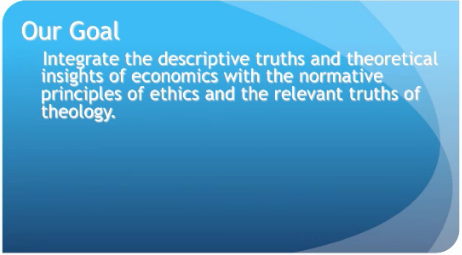
Jay Richards' main point in the debate
Jay Richards’ main point in the debate

Henry Hazlitt: “The art of economics consists in looking not merely at the immediate but at the longer effects of any act or policy; it consists in tracing the consequences of that policy not merely for one group but for all groups.”

For example, what happens if we raise the federal minimum wage to $50. What happens next for all groups? That’s what we need to ask in order to know which policies achieve the common good.

When it comes to economics a lot of things have been tried in other places and times.

We can know what works and doesn’t work by studying what was tried before and in other places.

Many things are counter-intuitive – things that sound good don’t work, things that sound bad do work.

Principle: “We are our brother’s keeper”. Christians have an obligation to care for their neighbors.

We all agree on the goal. But how do we do things that will achieve that goal?

We have to distinguish aspirations from principles and prudential judgment.

Principle: We should provide for the material needs of the poor.

Prudence: Seeing the world as it is, and acting accordingly.

Example policies: which minimum wage is best? None? $10? $20?

We decide based on seeing how different economic policies achieve the goal of helping the poor.

Jim Wallis’ first rebuttal:

Jesus commanded us to “care for the poor and help to end poverty”.

Actually, Jesus thought that acknowledging him and giving him sacrificial worship was more important than giving money to the poor, see Matthew 26:6-13:

While Jesus was in Bethany in the home of Simon the Leper, 

a woman came to him with an alabaster jar of very expensive perfume, which she poured on his head as he was reclining at the table.

When the disciples saw this, they were indignant. “Why this waste?” they asked. 

“This perfume could have been sold at a high price and the money given to the poor.”

10 Aware of this, Jesus said to them, “Why are you bothering this woman? She has done a beautiful thing to me. 

11 The poor you will always have with you, but you will not always have me. 

12 When she poured this perfume on my body, she did it to prepare me for burial. 

13 Truly I tell you, wherever this gospel is preached throughout the world, what she has done will also be told, in memory of her.”

It’s not clear to me whether Jim Wallis thinks that preaching is more important than redistributing wealth to address material inequality.

I like what Jesus said in a TV series, even though it’s not in the Bible when an actor playing Jesus said to “change the world”.

Jesus never said to “change the world” in the Bible. Should we be concerned that he is quoting a TV actor playing Jesus instead of Jesus.

Here is a terrific story about Bill Bright.

I love Catholic social teaching.

Quote: “All are responsible for all”.

I go to the World Economic Forum at Davos, Switzerland every year. I spoke once at 7 AM on the 4th floor.

It’s a funny place for a Christian to be if they care about the poor – rubbing shoulders with leftist elites. He must have named a dozen high-profile people that he spoke with during the debate, as if he could win the debate by some sort of argument from name-dropping. He mentioned the Davos thing several times!

The greatest beneficiary of government actions to deal with the economic crisis was Wall Street banks.

And Wall Street bankers are huge supporters of Barack Obama for exactly that reason.

I’m going to tell you a story about what a Washington lawyer says to Jesus.

I’ve had conversations with business leaders where I tell them to integrate moral truths.

I talk about the Good Samaritan parable.

Quote: “Do you love your undocumented neighbor?”

Quote: “Do you love your Muslim neighbor?”

Jay Richards’ first rebuttal:

Who is responsible for your own children? Who knows the most about them?

Parents should have more discretion over their children because they have more knowledge about their child and what’s best for them.

The Good Samaritan doesn’t show that government should confiscate wealth through taxation and redistribute it.

The Good Samaritan emphasizes voluntarily charity to help people who are not necessarily your immediate neighbor.

Some of the things we do should be for the good of other people in other countries.

But then we are back to leveraging economics to know what policies are good for those other people in other countries.

The principle of subsidiarity: if a problem can be addressed by a lower level of society (family) then we shouldn’t make higher levels (government) address it.

The best place to take care of children is within the family.

Only if the family fails should wider and wider spheres get involved.

Although we want to think of the common good in a global sense, we don’t want to lose sight of the fact

The financial crisis: we need to integrate moral truths, but also economic truths.

We don’t want to assume policies based on intuitions, we want to check our intuitions using economic principles.

Why did we have a financial crisis in mortgages, but not in commodities futures or technology, etc.?

Greed is a contributing factor in all areas of business.

Something more was going on in the mortgage markets than just greed.

There were specific policies that caused the mortgage lending crisis.

The root cause of the problem were “affordable housing policies” that lowered lending restrictions on low income people.

The policy ended up degrading the underwriting standards on loans.

Government intruded into the market and undermined the normal ways of

People were getting massive loans with no income, no jobs, no assets and no down payment.

The federal government created a market for risk loans by guaranteeing

There was a government imposed quota on mortgage lenders such that 50% of their loans had to be given to high-risk borrowers.

That is what led to the financial crisis. Not the free market, but intrusions into the free market.

These policies were well-meaning and implemented by people from both parties. But they had bad effects.

How Margaret Thatcher, the Iron Lady, saved Britain

Here’s an article from the UK Daily Mail with some more details about her.

Margaret Thatcher stood almost alone in driving through the tough policies now credited with saving the economy, secret papers reveal.

The Tory Premier had to take on her predecessor Harold Macmillan, Bank of England governor Gordon Richardson and even her own Chancellor Geoffrey Howe to push through the policies which pulled Britain back from the brink of economic chaos.

Documents released by the National Archives under the 30-year rule show the pressure Mrs Thatcher faced from the Establishment behind the scenes – and the extent to which she was isolated.

In 1980, the year after becoming Britain’s first female Prime Minister, Margaret Thatcher embarked on a controversial programme to revive the moribund economy through deep public spending cuts and strict control of the money supply, intended to stamp out inflation.

He warned that while her programme of cuts might give a ‘sense of exhilaration’ to her supporters, the country was heading for industrial collapse and ‘dangerous’ levels of unemployment.

Macmillan, then 86, sent the letter following a meeting with the Prime Minister at Chequers in August 1980.

He criticised her for abandoning ‘consensus politics’ to pursue radical reforms and ‘divisive politics’, which he said went against the ‘essence of Tory democracy’.

It was Macmillan who coined the phrase ‘you’ve never had it so good’ in 1957 during the long post-war economic boom.

His brand of consensus politics is now credited with contributing to the economic malaise that brought Britain to its knees in the late 1970s.

Years later, in her memoirs, Mrs Thatcher poured scorn on consensus politics, writing: ‘What great cause would have been fought and won under the banner “I stand for consensus”?.’

[…]In 1981, 365 economists wrote to The Times urging Mrs Thatcher to change course and limit the damage caused by the recession.

But she was unmoved, and her tough stance succeeded in reducing inflation from 27 per cent to four per cent in four years, putting Britain on the road to recovery.

Mrs Thatcher’s economic views were heavily influenced by the right-wing Cabinet minister Sir Keith Joseph, with whom she set up the free market think tank the Centre for Policy Studies in 1974.

Both drew on the work of the influential American economist Milton Friedman whose monetary theories challenged the post-war consensus on economic thinking.

I recommend reading the whole article for some more articles where Lady Thatcher had to stand against everyone and hold onto her convictions in the teeth of the majority.

Here’s an article from Forbes magazine that summarizes her effort to turn Britain around.

Excerpt:

It’s hard to appreciate today how desperate Britain’s condition was before Thatcher took office.  Its economy was a laughing stock, the perennial sick man of Europe.  Strikes were endemic and union bosses effectively governed the country.  Her Conservative Party had long ago made its peace with the welfare state and the ethos of high spending and high taxes. While the previous Tory Prime Minister, Edward Heath, wanted to revive Britain, he hadn’t a clue how to do it. In a make-or-break showdown with the coal miner’s union, Heath called a special election under the banner “Who Governs Britain?”  Heath lost and unions’ dominance in Britain seemed secure.

Great leaders have an astute sense of taking advantage of circumstances. Even though Heath had lost two elections, none of the senior party officials would challenge him.  At the time, Thatcher was not regarded as one of the party’s major figures.  But she was the only Tory who firmly believed in free markets and in Britain’s ability to become again a proud nation based on the principles of liberty. She was a devotee of Friedrich von Hayek and Milton Friedman and of the idea of paring back big government and giving free enterprise room to flourish. Astonishingly she beat Heath in a leadership fight in 1975 and led the Tories to victory in 1979.

Immediately she began slashing income tax rates and reining in galloping spending and fighting inflation.  She also exhibited that critical sense of timing. When she took office, she was faced with a potential strike of nurses whose union was demanding huge pay increases. Thatcher compromised in a way that some thought she didn’t have the backbone to turn Britain around.  Instead she was exhibiting a great politician’s sense of knowing when to pick a fight.  Thatcher eventually pushed through major labor union reforms and made it clear she would not tolerate any union riots or violence.  Shortly after Thatcher won reelection, the coal miners union, which had destroyed Heath, decided to take her on. But unlike Heath Thatcher was fully prepared.  The big showdown ensued and Thatcher beat the coal miner’s union resoundingly. It never recovered from that defeat.

Thatcher knew the deadweight on the economy of excessive taxation. She cut the top income tax rate from 98% to 40%. She cut the corporate income tax rate from 52% to 35%.

One of Thatcher’s greatest innovations was the systematic selling off of the government’s business assets, dubbed privatization.  After World War II Britain nationalized enormous swaths of the economy which actions subsequent Conservative governments left largely untouched.  Thatcher sold government companies off and her example has been followed by countless nations around the world.

In the area of privatizations, she did two remarkable things. She sold off much of Britain’s public housing.  An enormous number of Britons, far more than in the U.S., lived in these government-owned buildings. Thatcher pushed the sale of these apartments to occupants at low prices and on very advantageous terms. The purpose was to begin to shift the mentality of people and their dependence on government. Her other smart move was in the privatization of government-owned companies:  offering a significant number of shares to workers at very low prices.  Union leaders hated privatization but their opposition was undermined as their members realized that they could do very well buying cheap shares in these newly-privatized entities.  Here again she was changing peoples’ thinking:  pro-big government workers now saw themselves as share owners, taking on more of a capitalist mentality.

Before Thatcher, many social observers thought that Britain had an ingrained, unchangeable, anti-commercial culture that would forever stand in the way of the country becoming an economic success. Yet within a decade of her taking office, Britain had the most vibrant, large economy in Europe, one even more dynamic, innovative than that of Germany’s.  London became a magnet for entrepreneurs from France, Sweden and elsewhere.

One unchangeable characteristic of a great leader is courage and that means taking career-breaking risks.  Thatcher demonstrated her mettle in the Falkland Islands crisis.  When the Argentinean military dictatorship seized Britain’s Falkland Islands, most military experts felt the Sceptred Isle simply did not possess the military means to take them back. Defying almost the entire political establishment which was haunted by both Britain’s current weakness and the memory of the Suez Canal debacle in 1956, Thatcher declared that the seizure would not stand and that Britain would go to war to take the Islands back. Thankfully she received critical help from the U.S. thanks to in large part the unrelenting efforts of Defense Secretary Caspar Weinberger (who years later became Publisher and Chairman of Forbes). To the surprise of experts, Britain’s military expedition succeeded. The Argentinean military dictatorship fell and democracy was restored in that country.  For Britain the Falklands war was a huge boost to a demoralized nation. To the world it meant that once again tyranny would be resisted.

I recommend reading that whole article. It’s hard not to smile at a woman who clearly loved her country and worked to save it from poverty.

Why good men love Maggie

And now I must offend everyone. See, I have a theory about women. I think that women generally tend to be more beholden to the opinions and fashions of the crowd than men are. It’s not absolute, but it’s maybe two-thirds to one-third, in my experience. I think that it is generally hard for them to hold to their convictions in the face of peer pressure. That’s why so few young, unmarried women are conservative after graduating from college. As soon as they reach college, they are swayed towards liberal views by their need to feel good about themselves and their need to be liked by others. Their views at home were not rooted in real knowledge, they were just fitting in with their families and churches and saying whatever words they were expected to say. And then they go off to college and learn other words to say from another community that uses praise and blame to replace their former convictions with new convictions.

But Maggie Thatcher wasn’t like that. And here’s why:

John Ranelagh writes of Margaret Thatcher’s remark at a Conservative Party  policy meeting in the late 1970’s, “Another colleague had also prepared a paper arguing that the middle way was the pragmatic path for the Conservative party to take .. Before he had finished speaking to his paper, the new Party Leader [Margaret Thatcher] reached into her briefcase and took out a book.  It was Friedrich von Hayek’s The Constitution of Liberty.  Interrupting [the speaker], she held the book up for all of us to see.  ‘This’, she said sternly, ‘is what we believe’, and banged Hayek down on the table.”  (John Ranelagh, Thatcher’s People:  An Insider’s Account of the Politics, the Power, and the Personalities.  London:  Harper Collins, 1991.)

Policies like unilateral disarmament, wealth redistribution and redefining marriage sound good to many women – especially in college, and especially when only one side is presented and the other side is demonized. The only way to resist ideas that feel good and ideas that get you peer-approval is to have formed your own views through independent study. Lady Thatcher’s economic policies were formed through a study of real economists like Nobel-prize-winning economist F.A. Hayek and Nobel-prize-winning economist Milton Friedman. The reason why she was able to hold to her principles is because she knew what she was talking about, and her opponents did not. She didn’t care about feeling good. She didn’t care about what other people thought of her. She knew was right, and that was enough to sustain her in trying times. She had the knowledge, and her opponents couldn’t change her core convictions by trying to shame her. It didn’t work.

Hope: California set to offer college credit for online courses

There are forces in motion that could turn the tide against the secular left, and one of them is online education.

Excerpt:

A bill in California’s Legislature would force public colleges to award students credit for taking some outside online courses. It looks likely to pass, and its implications for higher education are vast.

A successful monopoly has an impregnable wall around some much-desired good, such as education, and controls the only door.

The higher education establishment in America has always operated this way. But cracks are starting to appear in its wall. A significant one opened this week.

On Wednesday, a bill was introduced in California’s state Senate to require public colleges to give students credit for online courses from outside providers.

If students can’t take an introductory or remedial class in the traditional way, they can turn to offerings from businesses such as Coursera, Udacity and StraighterLine, or the nonprofit EdX, a joint project of Harvard and MIT.

The bill looks likely to pass in some form.

[…]For the first time, colleges would have to offer credit for courses outside the academic establishment. As StraighterLine founder Burck Smith told the New York Times, “This would be a big change, acknowledging that colleges aren’t the only ones who can offer college courses.”

Up to now, online teaching could offer plenty of knowledge but not the credits leading to degrees.

Colleges could refuse to recognize the courses, and most did. That balance of power would shift if Steinberg’s bill becomes law.

That would be the start of real competition.

If online courses can teach more students just as well and cost the public less, the professors behind the walls will have to change their hidebound ways or lose more business to outsiders.

Either way, the public would be well served.

The faster we can disrupt the current higher education monopoly and focus students back on getting marketable skills at a reasonable price, the better off we’ll be. The financial crisis actually helps with this, because young people now have to be more serious about what they are choosing to study and how much they are paying to study. We have a chance here to turn the tide. It’s good news!