
Tag Archives: Canada

Should Christians who vote for socialism expect to keep their religious liberty?

Four white Canadian police officers arrest black pastor

I saw two interesting news stories about how Catholic hospitals were targeted by the secular left government and courts. The first story comes from progressive state of California, where the courts wanted to force the Catholics to perform sex-reassignment surgeries on transgender people. The second story comes from Canada, where the state wanted the hospital to perform euthanasia.

Here’s Evolution News reporting on the first story:

A Catholic hospital chain known as Dignity Health refused to perform a hysterectomy on a transgendered male, as against Catholic moral teaching. The patient sued for discrimination, but the case was dismissed on the basis that the hospital was legally following its faith principles. Alas, a Court of Appeals reversed the decision, reinstating the case to the active docket.

Here’s the court’s decision – they said it was illegal discrimination on the basis of “gender identity”:

The pleading alleges that Mercy allows doctors to perform hysterectomies as treatment for other conditions but refused to allow Dr. Dawson to perform the same procedure as treatment for Minton’s gender dysphoria, a condition that is unique to transgender individuals. Denying a procedure as treatment for a condition that affects only transgender persons supports an inference that Dignity Health discriminated against Minton based on his gender identity.

So, the secular courts, which are filled with government employees whose salaries are paid by Catholic taxpayers, decided that Catholics don’t have a right to act like Catholics. In California, Christians must be forced to act like atheists.  Or else be punished by the legal system.

Here’s the second story out of Canada, from Global News:

Under the threat of a possible court challenge, Nova Scotia has quietly changed its policy on medically assisted dying at a Catholic hospital in the province.

In a statement to Global News, the Nova Scotia Health Authority (NSHA) says: “Assessments and provision of MAiD [medical assistance in dying] will be available in a section of St. Martha’s Regional Hospital complex at the Antigonish Health and Wellness Centre.”

St. Martha’s Regional Hospital was exempt from assisted dying services as the result of a 1996 agreement between the Nova Scotia government and the Sisters of St. Martha that gave control of the hospital to the Nova Scotia government.

The agreement made medical assistance in dying forbidden at the hospital in Antigonish, N.S. The Sisters of St. Martha say they believe in protecting life until the end.

Because Canada has a “Medicare for All”, single-payer health care system, all payment for medical services is performed by the secular left government. Christian nurses, doctors, hospitals, etc. thought that it was “compassionate” for government to take over the provision of health care, so they allowed the government to come in and take control of their hospitals. Today, Christians have a choice. They can either perform abortions, sex-changes, IVF (which usually involves discarding embryos), breast enlargements, etc. OR they can stop practicing medicine.

American Christians in non-SOGI-states should take note of how the secular left treats Christians in health care. This is how they want to treat Christians in every area – public, and private. It’s already happening in Canada. Teachers, police, lawyers, judges can come into your home, and tell you how to live, and how to raise your children according to secular leftist values. And Christians in Canada are paying the atheist progressives to rule.

Remember: the government that is big enough to give you everything you want – free schools, free health care, free education, etc. – is big enough to take everything you have.

It would be nice if Christian parents and Christian churches had taught young people about the critical importance for smaller government as a requirement for a society that allows religious liberty. I see a lot of concern from Christians about global warming, illegal immigrants, refugees, etc. But not much about which policies allow Christians act like Christians in public.

I know that Christian parents are so busy, and Christian churches are not really places where young people can develop a Christian worldview. If you learn anything from a Christian upbringing, you learn how to color pictures, memorize Bible verses, say “the Bible says so”, and sing praise hymns. Is all that good protection against the policies of the secular left? How many young people today who were raised in the church think that “medicare for all”, “green new deal”, etc. won’t affect their religious liberty? How many of them know what it’s like to be a Christian in atheist socialist states like North Korea – or even in less communist countries like Canada?
New study: Angus Reid Institute analyzes Canada’s single payer healthcare system

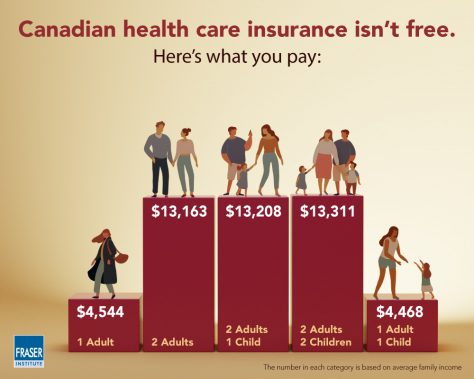
Price of healthcare per Canadian household (Source: Fraser Institute)
The cost of healthcare for average Canadian households

I found two interesting studies from Canada’s Angus Reid Institute describing single payer health care in Canada. I’m very interested in find out what things are like in countries that have true government-run health care. A typical Canadian family pays $13,000+ per year per household for healthcare, or about $585,000 over their working lives. What are they getting for all that money?

Here is the first Angus Reid article:

The study finds more than 2 million Canadians aged 55 and older face significant barriers when accessing the health care system in their province, such as being unable to find a family doctor or experiencing lengthy wait-times for surgery, diagnostic tests, or specialist visits.

Moreover, most Canadians in this age group have at least some difficulty getting the care they want or need in a timely manner.

The study focuses on the health care experiences of older Canadians, as well as their assessments of the quality of care they receive.

According to the article, 31% of respondents (aged 55 and older) rated access to the government’s healthcare system as “easy”. 48% had “moderate” problems with access, and 21% had “major” problems with access.

Remember: in the Canadian system, you pay your money up front in taxes, and then they decide how much healthcare you will get later – and how soon you will get it. If you worked from ages 20 to age 65, then your household will have paid 45 x $13,000 = $585,000 into the system, in order to get “moderate” problems with accessing healthcare after you’re aged 55.

And the Canadian system DOES NOT cover prescription drugs.

The second Angus Reid article explains:

This second part of the study finds one-in-six Canadians (17%) in the 55-plus age group – a figure that represents upwards of 1.8 million people – say that they or someone else in their household have taken prescription drugs in a way other than prescribed because of cost.

One-in-ten (10%) have decided to simply not fill a prescription because it was too expensive, and a similar number (9%) have decided not to renew one for the same reason. One-in-eight (12%) have taken steps to stretch their prescriptions, such as cutting pills or skipping doses.

Some 17 per cent of Canadians 55 and older have done at least one of these things, and that proportion rises among those who have greater difficulty accessing other aspects of the health care system.

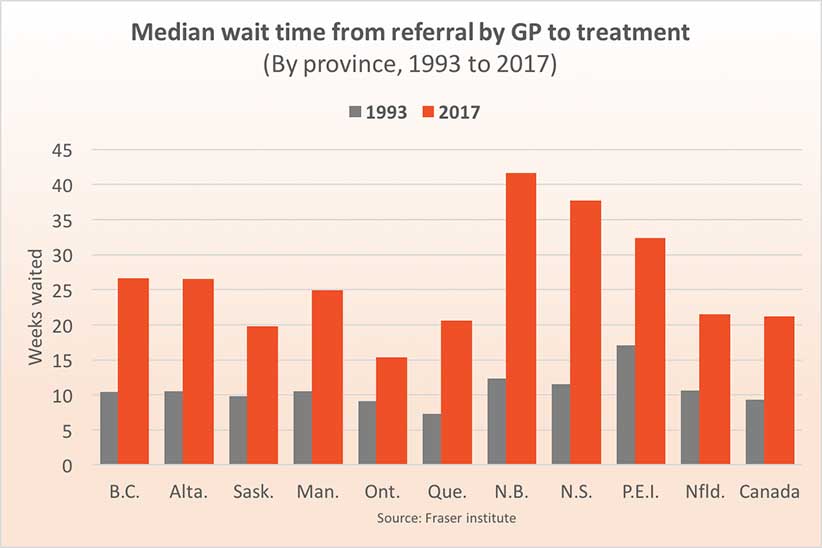
In a previous blog post, I reported on how Canadians have to wait in order to see their GP doctor. If that doctor refers them to a specialist, then they have to wait to see the specialist. And if that specialist schedules surgery, then they have to wait for their surgery appointment. The delays can easily go from weeks to months and even years. The MEDIAN delay from GP referral to treatment is 19.5 weeks.

But remember – they paid into the system FIRST. The decisions about when and if they will be treated are made later, by experts in the government. This is what it means for a government monopoly to run health care. There are no free exchanges of money for service in a competitive free market. Costs are controlled by delaying and withholding treatment. And no one knows this better than elderly Canadians themselves. But by the time they realize how badly they’ve been swindled, it’s too late to get their money back out. You can’t pull your tax money out of government if you are disappointed with the service you receive. There are no refunds. There are no returns.

How well is Canada’s “Medicare for All” health care working for patients?

Wait times in weeks (Source: Maclean's magazine)
Wait times for health care treatment in Canada (Source: Fraser institute)

I get into conversations about politics with my co-workers about who they like in the 2020 election. And I also ask them which particular policies of the candidates they like best. The one they like most is Medicare for All, with “for All” including illegal immigrants. When I ask them which country has got Medicare for All working, they say “Canada”. Let’s take a look at Canada’s health care system.

Here’s a nice article from Mona Charen, posted in TownHall.

She writes:

It’s true that all Canadian citizens and legal residents (though not immigrants there illegally) get “free” health care, but only in the sense that you don’t get a bill after seeing a doctor or visiting a hospital. Medical care is subsidized by taxes, but the price comes in another form as well — rationing. A 2018 report from the Fraser Institute, a Canadian think tank, found that wait times between seeing a general practitioner and a specialist average 19.8 weeks. That’s the average. There are variations among specialties. Those hoping to see an orthopedist wait an average of 39 weeks in Nova Scotia, while those seeking an oncologist wait about 3.8 weeks.

[…]Imagine the anxiety of learning that you need an MRI to find out whether the mass in your breast is anything to worry about and then being told that the next available appointment is in 10 weeks. In addition to the psychic price, Canadians who had to wait for treatment expended an average of $1,822 out of pocket last year, due to lost wages and other costs. The Fraser Institute also calculated the value of the lost productivity of those waiting for treatment — nearly $5,600 per patient, totaling $5.8 billion nationally.

[…]When there’s an artificial shortage of a good or service, a black market usually follows. I have heard from several Canadians that paying doctors bribes to jump the line is not uncommon. But Canada has another pressure reliever: Ninety percent of Canadians live within 90 miles of the U.S. border, and medical centers in Buffalo, Chicago, Rochester and elsewhere receive tens of thousands of Canadian patients every year.

Regarding that last point, I’ve written many times about socialist politicians in Canada electing to travel to the United States for care, and that’s because (as you might expect) health care outcomes for Canadians are vastly inferior to health care outcomes for Americans. And keep in mind that the delay from specialist to GP does not take into account the delay to see the GP, or the delay from seeing the specialist to actually getting treatment.

And how much are Canadians spending for the privilege of waiting 19.8 weeks to see a specialist? Well, the average cost of Canadian health care is about $13,000 per household per year, paid through taxes. What that means is that people who work pay for all the health care being provided, including the health care for people who don’t work. But when it’s time to get treatment, those who pay the bills get in line behind those who don’t pay anything.

So how good is American health care? Maybe Canadians are waiting in line because their health care is so much better than ours.

American health care

One of the best health care policy experts writing today is Avik Roy, who writes for Forbes magazine.

Here is a recent column, which I think is useful for helping us all get better at debating health care policy.

Excerpt:

If you really want to measure health outcomes, the best way to do it is at the point of medical intervention. If you have a heart attack, how long do you live in the U.S. vs. another country? If you’re diagnosed with breast cancer? In 2008, a group of investigators conducted a worldwide study of cancer survival rates, called CONCORD. They looked at 5-year survival rates for breast cancer, colon and rectal cancer, and prostate cancer. I compiled their data for the U.S., Canada, Australia, Japan, and western Europe. Guess who came out number one?

The United States came out number one, and you can click here to see the larger graph of the complete results.

Some people like to point out that the United States has a low life expectancy, but there’s a problem with those numbers.

The article continues:

Another point worth making is that people die for other reasons than health. For example, people die because of car accidents and violent crime. A few years back, Robert Ohsfeldt of Texas A&M and John Schneider of the University of Iowa asked the obvious question: what happens if you remove deaths from fatal injuries from the life expectancy tables? Among the 29 members of the OECD, the U.S. vaults from 19th place to…you guessed it…first. Japan, on the same adjustment, drops from first to ninth.

It’s great that the Japanese eat more sushi than we do, and that they settle their arguments more peaceably. But these things don’t have anything to do with socialized medicine.

Finally, U.S. life-expectancy statistics are skewed by the fact that the U.S. doesn’t have one health-care system, but three: Medicaid, Medicare, and private insurance. (A fourth, the Obamacare exchanges, is supposed to go into effect in 2014.) As I have noted in the past, health outcomes for those on government-sponsored insurance are worse than for those on private insurance.

To my knowledge, no one has attempted to segregate U.S. life-expectancy figures by insurance status. But based on the data we have, it’s highly likely that those on private insurance have the best life expectancy, with Medicare patients in the middle, and the uninsured and Medicaid at the bottom.

If we’re going to discuss health care, then let’s discuss facts. We shouldn’t be picking a health care system from the campaign speeches of politicians who tell us that we can keep our doctor, and keep our health plan, and our premiums will go down. We tried electing a charismatic deceiver in 2008, and it didn’t work out. We lost our doctors, lost our health plans, and our premiums went up astronomically. We can do better than single-payer health care. We can do better than socialism.