President Barack Obama celebrated the opening of an advanced battery plant in Michigan on Monday as a critical boost for hybrid and electric cars — and a success for his administration’s economic stimulus program.
But even as mass-produced advanced batteries start rolling off assembly lines, costs are high for consumers, and hurdles remain.
“This is about the birth of an entire new industry in America, an industry that’s going to be central to the next generation of cars,” Obama said Monday in a phone call broadcast at the opening of A123 Systems Inc.’s lithium ion battery plant in Livonia, Mich.
“And it’s going to allow us to start exporting those cars, making them comfortable, convenient, and affordable. …. When folks lift up their hoods on the cars of the future, I want them to see engines and batteries that are stamped: ‘Made in America,’” Obama said, according to a transcript of the call released by the White House…
…Despite the fanfare, the battery industry faces many hurdles. Gas-electric hybrid vehicles represent about 1 percent of new vehicle sales, and many plug-in hybrids and battery electric cars are just entering the market.
Costs are high. The government has estimated that a battery with a 100-mile range costs about $33,000, although stimulus money could bring that down to $10,000 by the end of 2015.
That stimulus money came from job-producing investors and private companies. The government wasted the money, after taking a cut for their unions.
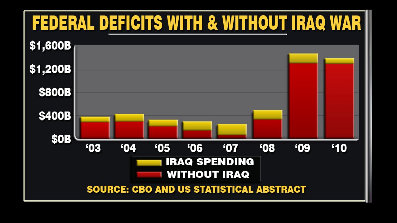
Mr. Obama asserted in his January State of the Union Address that by the time he took office, “we had a one-year deficit of over $1 trillion and projected deficits of $8 trillion over the next decade. Most of this was the result of not paying for two wars, two tax cuts, and an expensive prescription drug program.”
In short, it’s all President Bush’s fault. But Mr. Obama’s assertion fails on three grounds.
First, the wars, tax cuts and the prescription drug program were implemented in the early 2000s, yet by 2007 the deficit stood at only $161 billion. How could these stable policies have suddenly caused trillion-dollar deficits beginning in 2009? (Obviously what happened was collapsing revenues from the recession along with stimulus spending.)
Second, the president’s $8 trillion figure minimizes the problem. Recent CBO data indicate a 10-year baseline deficit closer to $13 trillion if Washington maintains today’s tax-and-spend policies—whereby discretionary spending grows with the economy, war spending winds down, ObamaCare is implemented, and Congress extends all the Bush tax cuts, the Alternative Minimum Tax (AMT) patch, and the Medicare “doc fix” (i.e., no reimbursement cuts).
Under this realistic baseline, the 10-year cost of extending the Bush tax cuts ($3.2 trillion), the Medicare drug entitlement ($1 trillion), and Iraq and Afghanistan spending ($515 billion) add up to $4.7 trillion. That’s approximately one-third of the $13 trillion in baseline deficits—far from the majority the president claims.
Third and most importantly, the White House methodology is arbitrary. With Washington set to tax $33 trillion and spend $46 trillion over the next decade, how does one determine which policies “caused” the $13 trillion deficit? Mr. Obama could have just as easily singled out Social Security ($9.2 trillion over 10 years), antipoverty programs ($7 trillion), other Medicare spending ($5.4 trillion), net interest on the debt ($6.1 trillion), or nondefense discretionary spending ($7.5 trillion).
There’s no legitimate reason to single out the $4.7 trillion in tax cuts, war funding and the Medicare drug entitlement. A better methodology would focus on which programs are expanding and pushing the next decade’s deficit up.
The article notes that the real problem is that Obama is spending money like he has gone mad.
Spending—which has averaged 20.3% of GDP over the past 50 years—won’t remain as stable [as revenue]. Using the budget baseline deficit of $13 trillion for the next decade as described above, CBO figures show spending surging to a peacetime record 26.5% of GDP by 2020 and also rising steeply thereafter.
Putting this together, the budget deficit, historically 2.3% of GDP, is projected to leap to 8.3% of GDP by 2020 under current policies. This will result from Washington taxing at 0.2% of GDP above the historical average but spending 6.2% above its historical average.
Entitlements and other obligations are driving the deficits. Specifically, Social Security, Medicare, Medicaid and net interest costs are projected to rise by 5.4% of GDP between 2008 and 2020. The Bush tax cuts are a convenient scapegoat for past and future budget woes. But it is the dramatic upward arc of federal spending that is the root of the problem.
Spending is the problem, and Obama is spending like a drunken sailor.
And remember, the recession is almost entirely the fault of the Democrats. You can watch videos of them telling the Republicans not to regulate Fannie Mae and Freddie Mac to stop them from making mortgage loans to people who cannot afford them. The only other factor is the decision to keep interest rates low to encourage more and more borrowing – the “boom” in spending that necessarily leads to a “bust”.

 WINTERY KNIGHT