Tag Archives: Budget

New study: “Medicare For All” would cost $32.6 trillion, but it’s actually more

A Christian friend of mine who is divorced with children surprised me by telling me that she favored single payer health-care. I asked her if she realized that people would have to be taxed to pay for all this free health care, and she seemed to be aware of it. But even I didn’t realize how much it would really cost.

Investor’s Business Daily reports on a couple of recent studies – one from the left, and one from the far-left – that both agreed on the price tag for universal health care.

Excerpt:

Last year, 16 Senators, including three presidential hopefuls, co-sponsored Sanders’ “Medicare for all” bill. And earlier this month, more than 70 Democrats signed on to form a “Medicare for all” caucus. Support for the bill is now something of a litmus test for Democratic hopefuls.

Do they have any idea what they’re endorsing?

A new study out Monday from George Mason University’s Mercatus Center finds that Sanders plan would add to federal spending in its first 10 years, with costs steadily rising from there. That closely matches other studies — including one by the liberal Urban Institute — that looked at Sanders’ plan.

To put this in perspective, “Medicare for all” would the size of the already bloated federal government. Doubling corporate and individual income taxes wouldn’t cover the costs.

Even this is wildly optimistic. To get to this number, author Charles Blahous had to make several completely unrealistic assumptions about savings under Sanders’ hugely disruptive plan.

The first is a massive cut in payments to providers. Sanders wants to apply Medicare’s below-market rates across the board, which would amount to a roughly 40% cut in payments to doctors and hospitals. Blahous figures this will save hundreds of billions of dollars a year.

But cuts of that magnitude would drive doctors out of medicine and hospitals out of business, since the only way providers can afford Medicare’s cut-rate reimbursements today is by charging private payers more.

The study also assumes that shoving everyone into a government health care plan would cut administrative costs by $1.6 trillion over the next decade and prescription drug costs by $846 billion. Neither of those are likely, and wouldn’t make much of a difference in overall spending anyway. Private insurance overhead accounts for about 6% of national health spending, and drugs less than 10%.

There’s also the fact that every other federal health program has seen costs explode “unexpectedly” after they were enacted. The per-enrollee cost of ObamaCare’s Medicaid expansion, for example, is almost 49% higher than expected. Medicare itself cost nearly 10 times as much as projected in its first 25 years.

The author of the Mercatus study was nominated Barack Obama to be a member of the Board of Trustees of the Social Security Trust Funds. That might explain his questionable assumptions about costs. And the Urban Institute is even further to the left. There can be no doubt that the true cost of the Sanders health care plan would be much higher than what these two studies calculated it to be.

Now, you might think that we can just tax the people who earn the most money to pay for all this spending.

In 2012, John Stossel wrote this in Forbes:

If the IRS grabbed 100 percent of income over $1 million, the take would be just $616 billion.

In 2011, the Tax Foundation explained that even if you taxed ALL THE DISPOSABLE INCOME from all the people who make $200,000 or more, you would only raise $1.53 trillion dollars:

There’s simply not enough wealth in the community of the rich to erase this country’s problems by waving some magic tax wand.

[…]After everyone making more than $200,000/year has paid taxes, the IRS would need to take every single penny of disposable income they have left. Such an act would raise approximately $1.53 trillion. It may be economically ruinous, but at least this proposal would actually solve the problem.

Taxing the rich isn’t enough to pay for single payer health care. $32.6 trillion over 10 years works out to $3.26 trillion per year. We’re not going to pay that off even with $1.53 trillion a year of additional revenue. And this is assuming that the wealthy would just allow themselves to be made into slaves, and keep working even if the government takes all their money.
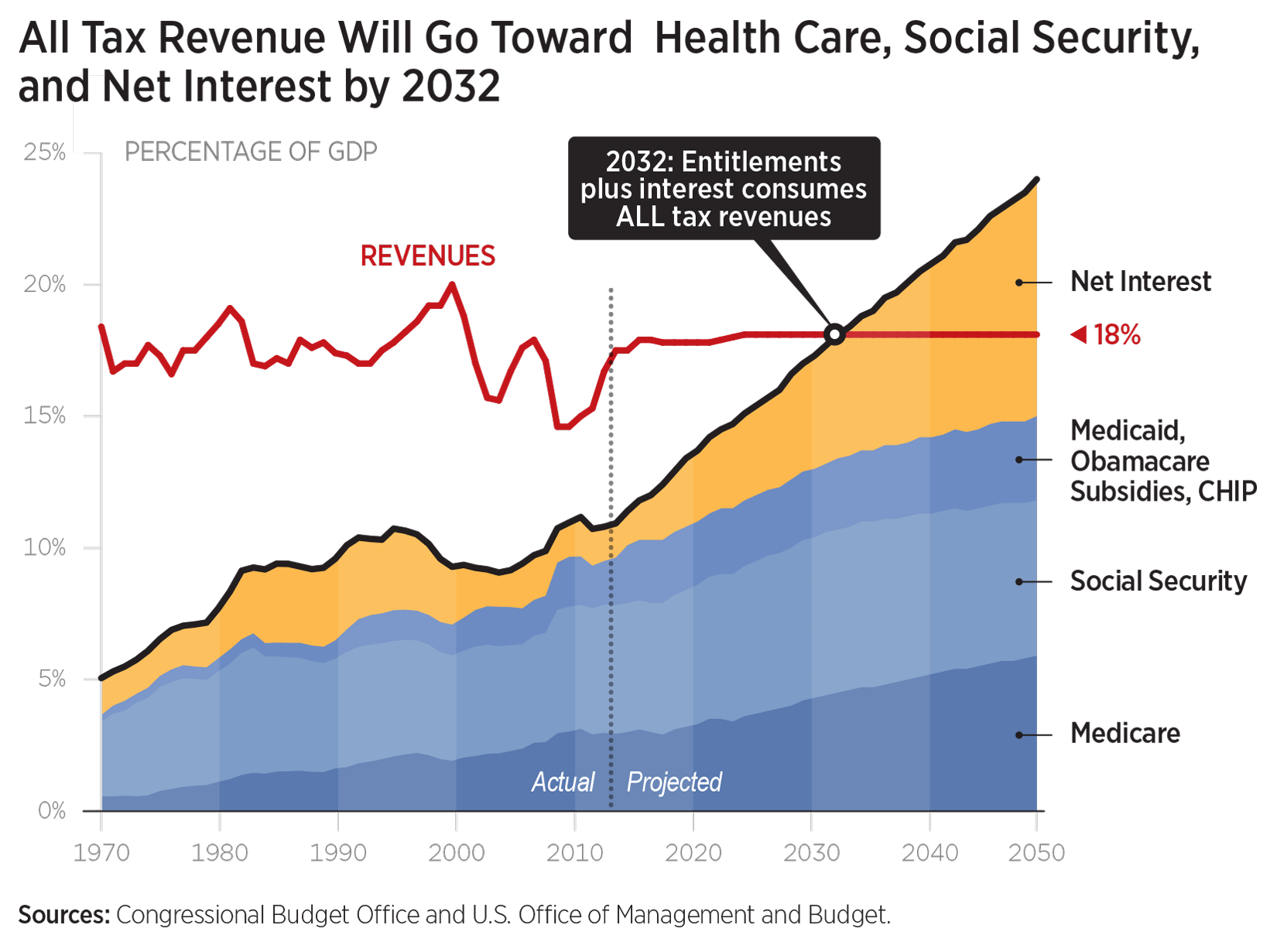
Pretty soon, our mandatory expenses will consume all of our tax revenues

Who is going to pay for all the spending we already have scheduled? As the graph above shows, things are going to get worse in the future as the big entitlement programs pay out more than current tax rates take in. I’m sure glad that I’m going to be retiring before 2032, and I’m not going to be stuck with the bill for this. It’s one thing for me to get out of bed every morning to be paid only 75% of what I earn. I certainly wouldn’t want to be working if the tax rates here were more like Europe, so that I’d be taking home less than half of what I earn. No thank you!

By the way, it might be a good idea to think about whether you want to have children or not before you vote. Children are expensive, and if we keep electing the big spenders like Obama, then there isn’t going to be any money left over to run a family and raise kids. Think about it before you vote with your feelings only.

Young workers are paying Social Security taxes but will they ever collect benefits?

What if we had no money for anything except entitlement spending?
What if we had no money for anything except interest and entitlements?

The way Social Security taxes work is that you pay 12.4% of your salary, and another 2.9% for Medicare. That’s 15.3%, before any federal, state and local taxes. So, what are you getting for this 12.4% contribution to the Social Security welfare program? You’re supposed to be able to withdraw that money when you retire, but that money isn’t being stored in an account with your name on it. It’s being spent right now on people who are already retired. Will there be money available for you to withdraw when you retire?

If you’re a young person who retires in 2035 or later, the answer is absolutely not.

The Daily Signal has the numbers:

The American people need to know the state of finances of the Social Security program so they can better understand why reform is not only necessary, but absolutely essential. Here are five takeaways from the most recent financial report:

  • $66 Billion Cash-Flow Deficit in 2016

Social Security is still considered solvent and able to pay full benefits because it has accumulated a $2.8 trillion trust fund, but since the entirety of its trust fund consists of IOUs, cash-flow deficits must be financed by general revenue taxes or new public borrowing.

Since 2010, the Old-Age and Survivors Insurance program has taken in less money from payroll tax revenues and the taxation of benefits than it pays out in benefits, generating cash-flow deficits.

  • $14.3 Trillion in Unfunded Obligations

However, this figure assumes that the $2.8 trillion in trust fund reserves are available to be spent. The problem is that these reserves represent liabilities for the U.S. taxpayer. The payroll revenues have been spent and the trust fund was credited with U.S. bonds, which represent claims on the American taxpayer. This is why the actual unfunded obligation is $14.3 trillion.

The trustees report that Social Security’s unfunded obligation has reached $11.5 trillion. That is the difference between what the program is expected to receive in income and what is expected to spend over the 75-year horizon the program’s actuaries consider for projections.

  • Insolvent by 2035

Based on current projections, the Social Security Old-Age and Survivors Insurance trust fund will be depleted by 2035, reducing Social Security’s expenditures automatically to what the program will receive in revenues, regardless of benefits due at that time.

Social Security is only legally permitted to spend funds in excess of its revenues until its trust fund is depleted.

  • 25 Percent Automatic Benefit Cut

What this means for beneficiaries is that in the absence of congressional action, benefits could be delayed or indiscriminately reduced across the board by 25 percent.

Once the Social Security trust fund is depleted, the program will only be able to pay 75 percent of scheduled benefits, based on payroll and other Social Security tax revenues projected at that time.

  • High Costs to Delaying Reform

The trustees highlight that if Congress waits until the trust funds become exhausted, the cost of making the program solvent will be as much as 40 percent higher, meaning significantly greater benefit cuts and/or tax increases for workers and beneficiaries.

There are several key reforms Congress could pursue to preserve benefits for the most vulnerable beneficiaries without increasing the tax or debt burden on younger generations. However, the longer Congress waits the act, the larger the changes that will be necessary to address Social Security’s combined financing shortfall.

Young people working today who retire in 2035 or later will never see a dime of their Social Security contributions. What’s more likely is that the taxes on their income will go even higher. Take a good look at your paycheck, and you will see money being deducted for this entitlement program. This is money you will never see again. It is being used now, to buy the votes of elderly people who vote against reform when they vote Democrat.

The only person to try to do something about these Social Security problems was George W. Bush – a Republican. But his effort to set up private savings accounts was stopped by Democrats, who depend on the votes of the people who collect from Social Security.

These problems are even worse when you realize that Social Security is only one of the entitlement programs that is going bankrupt. There are others – as well as interest on the $20 trillion debt. ($10 trillion of which was added by Obama in his 8 years as Welfare President). Young people: you are paying taxes for programs that will not be there for you when you need them. Stop voting Democrat, because money matters!

Ted Cruz’s plan to lower taxes and simplify the process for filing tax returns

How to get kissed: Heidi Cruz helping her husband

Ted Cruz is very upset with the IRS for discriminating against conservative groups and Christian groups in order to get Barack Obama re-elected in 2012. So, he’s come up with a plan to drastically reduce their influence – and their cost to taxpayers.

Here he is talking about the plan with Megyn Kelly on Fox News.

And he has posted something about the plan on his web site:

Under the Simple Flat Tax, the current seven rates of personal income tax will collapse into a single low rate of 10 percent. For a family of four, the first $36,000 will be tax-free. The Child Tax Credit will remain in place, and the Simple Flat Tax Plan expands and modernizes the Earned Income Tax Credit with greater anti-fraud and pro-marriage reforms.

[…]The IRS will cease to exist as we know it, there will be zero targeting of individuals based on their faith or political beliefs, and there will be no way for thousands of agents to manipulate the system.

For businesses, the corporate income tax will be eliminated. It will be replaced by a simple Business Flat Tax at a single 16 percent rate. The current payroll tax system will be abolished, while maintaining full funding for Social Security and Medicare.

The convoluted tax code will be replaced with new rules of the game – so simple, in fact, that individuals and families could file their taxes on a postcard or phone app. The Death Tax will be eliminated. The Alternative Minimum Tax will be eliminated. The tax on profits earned abroad will be eliminated. And of course, the Obamacare taxes will be eliminated. Also gone will be the unending loopholes in the current code, the stacks of depreciation schedules for businesses, and the multi-tiered rates on income and investments. Under the Simple Flat Tax, the Internet remains free from taxes.

Simple.

The Tax Foundation, which is the leading non-partisan think tank that deals with the issue of taxation, scored Cruz’s plan.

They say:

  • Senator Cruz’s plan would cut taxes by $3.6 trillion over the next decade on a static basis. However, the plan would end up reducing tax revenues by $768 billion over the next decade when accounting for economic growth from increases in the supply of labor and capital and the much broader tax base due to the new value-added tax.

  • According to the Tax Foundation’s Taxes and Growth Model, the plan would significantly reduce marginal tax rates and the cost of capital, which would lead to a 13.9 percent higher GDP over the long term, provided that the tax cut could be appropriately financed.

  • The plan would also lead to a 43.9 percent larger capital stock, 12.2 percent higher wages, and 4.8 million more full-time equivalent jobs.

  • On a static basis, the plan would cut taxes by 9.2 percent, on average, for all taxpayers.

  • Accounting for economic growth, all taxpayers would see an increase in after-tax income of at least 14 percent at the end of the decade.

They conclude:

Senator Cruz’s tax plan would significantly alter the federal tax code. It would completely repeal the corporate income tax and all payroll taxes and enact a 10 percent income tax and a 16 percent “business transfer tax” or value-added tax. These changes to the tax code would increase the incentives to work and invest and would greatly increase the U.S. economy’s size in the long run, leading to higher incomes for taxpayers at all income levels. The plan would also be a large tax cut, which would increase the federal government’s deficit by over $3.6 trillion on a static basis. Accounting for the growth caused by the plan, federal revenues would decline by $768 billion over the next decade.

The non-partisan The Hill says that another major think thank for fiscal conservatism also likes Cruz’s plan:

Ted Cruz’s tax plan would cost less and stimulate the economy more than Donald Trump‘s, a recent analysis found.

“Of the two proposals that we have examined so far, those by Trump and Cruz, we find the Cruz proposal to be the better of the two,” said David Tuerck, executive director of the Beacon Hill Institute and senior fellow at the National Center for Policy Analysis. The free-market groups released a report comparing the economic effects of the tax plans from the two Republican presidential candidates.

[…]Cruz’s plan would also increase business investment and personal income more than Trump’s plan would, the report found.

I want a higher personal income, and I want more money invested into the business that employs me – so I can keep my job, or maybe find a better one. It’s very important to my life plan that I be able to earn money, and keep what I earn. I have a use for that money, whether I marry or not. And that use is not to give it to the government so they can buy people condoms and abortions in exchange for their votes. I have a better plan for the money I earn than what a secular government wants to do with it.

Now, Ted Cruz will have to come up with $768 billion in revenue to balance his plan, but that’s why he has promised to abolish or significantly reduce FIVE government departments. Don’t worry, they aren’t the useful ones. We have too much government, and we can get rid of some, and return the money to the people.

Related posts