Tag Archives: Budget

Mitt Romney raised taxes by $740 million while he was governor of Massachusetts

Deroy Murdock explains in this Scripps Howard News Service article.

Excerpt:

Hot on the heels of his eight-vote Iowa-caucus landslide, Willard Mitt Romney is crisscrossing New Hampshire before Tuesday’s key primary. Romney is masquerading as a limited-government, free-market executive from next-door Massachusetts. From the Golden Gate to the Granite State, voters should greet Romney’s impersonation with a quarry full of skepticism.

In fact, Romney increased taxes by $309 million, mainly on corporations. These tax hikes, described by Romney apologists as “loophole closures,” totaled $128 million in 2003, $95.5 in 2004, and $85 million in 2005. That final year, Romney proposed $170 million in higher business taxes, the Boston Globe reports. However, the Bay State’s liberal, Democratic legislature balked and only approved an $85 million increase.

“Tax rates on many corporations almost doubled because of legislation supported by Romney,” Boston Science Corporation chairman Peter Nicholas explained in the January 6, 2008 Boston Herald. Also, Romney raised the tax on subchapter S corporations owned by business trusts from 5.3 percent to 9.9 percent — an 85 percent hike.

“Romney went further than any other governor in trying to wring money out of corporations,” the Council on State Taxation’s Joseph Crosby complained.

Romney also created or increased fees by $432 million. He was not dragooned into this by greedy Democratic lawmakers; Romney himself proposed these items. In 2003 alone, Romney concocted or boosted 88 fees. Romney charged more for marriage licenses (from $6 to $12), gun registrations (from $25 to $75), a used-car sales tax ($10 million), gasoline deliveries ($60 million), real-estate transfers ($175 million), and more. Particularly obnoxious was Romney’s $10 fee per Certificate of Blindness. Romney also billed blind people $15 each for discount-travel ID cards.

While Romney can take credit for a $275 million capital-gains tax rebate, property-tax relief for seniors, and a two-day, tax-free shopping holiday, he also must take responsibility for signing $740.5 million in higher taxes, plus that $85 million in business taxes that he requested and legislators rejected.

“Romney did not even fight higher death-tax rates,” notes former California State Assembly Minority Whip Steve Baldwin, a Romney critic. “When the (Massachusetts) legislature considered this issue, Romney’s official position was ‘no position.’ This echoed Barack Obama’s ‘present’ votes in the Illinois State Senate.”

As Romney drained his constituents’ pockets, the Public Policy Institute of New York’s Cost of Doing Business Index rated Massachusetts in 2006 as America’s fourth costliest state in which to practice free enterprise. The Tax Foundation dropped Massachusetts from America’s 29th most business-friendly state to No. 36. The Tax Foundation also calculated that, under Romney, Massachusetts’ per-capita tax burden increased from 9.3 percent to 9.9 percent. In real dollars, the Romney-era per-capita tax burden grew by $1,175.71.

As if impoverishing his own taxpayers were not bad enough, Romney’s March 5, 2003 signature raised taxes on non-residents retroactive to that January 1. Perpetrating taxation without representation, Romney’s law declared that, “gross income derived from… any trade or business, including any employment,” would be taxable, “regardless of the taxpayer’s residence or domicile in the year it is received.”

Consequently, according to data furnished by the Massachusetts Department of Revenue, between 2002 and 2006, New Hampshire residents who work or do business in the Bay State shipped Massachusetts $95 million above what they paid when Romney arrived. The average tax paid by New Hampshirities to Massachusetts grew by 19.1 percent, from $2,392 in 2002 to $2,850 in 2006.

Romney has a pro-abortion record and pro-gay-marriage record. Not only did he pass Romneycare in Massachusetts, but now we know that he also raised taxes. Why is he running as a Republican? I don’t see anything in his record that would cause me to believe that he is a Republican.

You can see Mitt Romney explaining all of his liberal views in his own words in these videos.
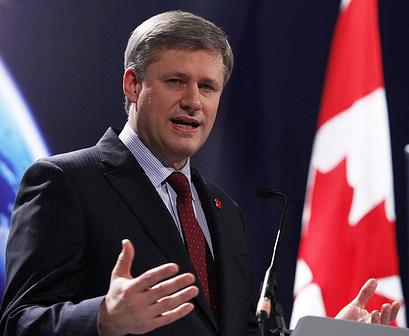
Could Obama have done better? He could learn from Canada’s success

Prime Minister Stephen Harper

Here’s an editorial from Investors Business Daily.

Excerpt:

Away from the low growth and high regulation of an America under Washington’s thumb, our northern neighbor is economically strong. As 2011 ends, Canada has announced yet another tax cut — and will soar even more.

The Obama administration and its economic czars have flailed about for years, baffled about how to get the U.S. economy growing.

In reality, the president need look no further than our neighbor, Canada, whose solid growth is the product of tax cuts, fiscal discipline, free trade, and energy development. That’s made Canada a roaring puma nation, while its supposedly more powerful southern neighbor stands on the outside looking in.

On Thursday, Canadian Prime Minister Stephen Harper announced that he will slash corporate taxes again on Jan. 1 in the final stage of his Economic Action Plan, dropping the federal business tax burden to just 15%.

Along with fresh tax cuts in provinces such as Alberta, total taxes for businesses in Canada will drop to 25%, one of the lowest in the G7, and below the Organization of Economic Cooperation and Development average.

“Creating jobs and growth is our top priority,” said Minister Jim Flaherty. “Through our government low-tax plan … we are continuing to send the message that Canada is open for business and the best place to invest.”

It’s not just that Canada’s conservative government favors makers over takers. Harper’s also wildly popular for shrinking government. “The Harper government has pursued a strategic objective to disembed the federal state from the lives of citizens,” wrote University of Calgary Professor Barry Cooper, in the Calgary Herald.

Harper also has made signing free trade treaties his priority. Canada now has 11 free trade pacts in force, and 14 under active negotiation — including pacts with the European Union and India, among others.

“We believe in free trade in Canada, we’re a free-trading nation. That’s the source of our strength, our quality of life, our economic strength,” Flaherty said last month.

Lastly, Canada has pursued its competitive advantage — oil. And it did so not through top-down “industrial policy,” but by getting government out of the way.

Harper has enacted market-friendly regulations to accomplish big things like the Keystone Pipeline — and urged President Obama to move forward on it or else Canada would sell its oil to China.

These policies have been well-known since the Reagan era. But in a country that’s been institutionally socialist since the 1950s, Harper’s moves represent a dramatic affirmation for free market economics.

For Canada, they’ve had big benefits.

Canada’s incomes are rising, its unemployment is two percentage points below the U.S. rate, its currency is strengthening and it boasts Triple-A or equivalent sovereign ratings across the board from the five top international ratings agencies, lowering its cost of credit.

Is it too much to ask Washington to start paying attention to the Canadian success story?

These sound principles work every time they are tried, and they have led to a transformation in Canada.

Although this article doesn’t mention it, Stephen Harper is also the most solid statesman on foreign policy issues as well.

And here’s a view from up north from Canadian journalist Brian Lilley.

Excerpt:

Prime Minister Stephen Harper has put out his own list of accomplishments for the year that just ended but here are a few of the key conservative minded actions that spring to mind for me.

  • Ending political welfare. The per-vote subsidy that made political parties lazy and unresponsive to the voters of this country and insulated them from angering their core supporters will be gone by 2015-2016. Legislation ending the subsidy has already passed but the parties are slowly being weaned off the money and will get smaller amounts each year until the subsidy is gone.
  • They saw the light of common sense and released the names of those on their wanted list of suspected foreign war criminals. These were people that officials admitted should not be in the country, had been ordered out but that were still in Canada. At first officials would only admit there was a list of suspected war criminals but not say who they were. After much pressure, common sense won the day.
  • Ending the insane rules that would see farmers from certain provinces jailed for daring to sell their wheat to the customer of their choice. The Canadian Wheat Board still exists for those that want to use its centralized system. For those that want freedom, they now have that choice.
  • While much attention has been paid to Bill C-10, the omnibus crime bill, the government has passed C-2 (the mega-trials bill), this bill will make it easier to conduct the mega-trials now associated with organized crime without infringing on the right to a fair trial.
  • While the bill to end the gun registry has not been passed yet, it has been introduced and will pass early this year.
  • Immigration. On this file the Conservatives continue to push for ever higher numbers of newcomers while keeping those skeptical of high immigration onside by cracking down on fraud, cleaning up the system and putting Canada first.

Another thought for those, often myself included, that like to say this government is not conservative enough.

Lilley also notes that electing Harper presented a national day care program (which punishes families with stay-at-home), increasing unemployment benefits (which encourages people not to work), etc.


Barack Obama is the worst President ever

Bill Whittle explains. (7 minutes)

This is not to mention his record on abortion – the most pro-abortion President ever. Or the election of hardline Muslim extremists in Egypt.

The man is a catastrophic failure.