
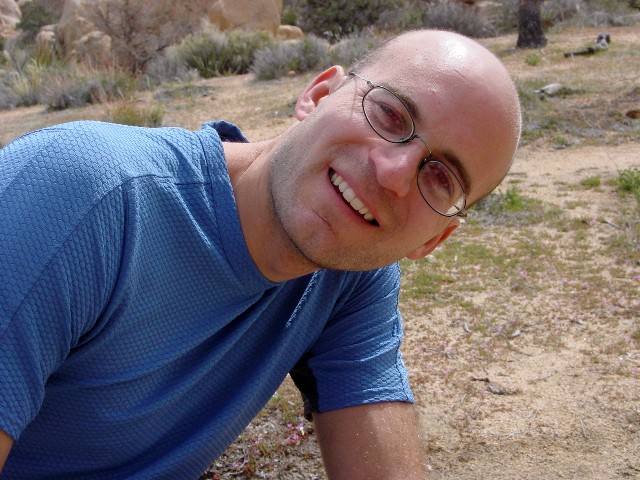
I’m a philosophy professor at the University of Colorado at Boulder. I work in philosophy of time, philosophy of religion, philosophy of science (especially physics), and probabilistic epistemology.
There’s an interview with Dr. Monton in Salvo magazine’s new issue, which is on science and faith.
The interview has more about his credentials:
Bradley Monton • Associate Professor of the Philosophy of Science at the University of Colorado • BA in Physics and Philosophy from Rice University • PhD in Philosophy from Princeton University • Author of Seeking God in Science: An Atheist Defends Intelligent Design
And here are the interview questions:
- What makes you take intelligent design (ID) seriously?
- Why do you think some scientists refuse to take intelligent design seriously?
- You write in your book that you don’t fully endorse intelligent design. In your opinion, what are some of the weaknesses of ID?
- Then why can’t you fully support intelligent design?
- So what are the strengths of intelligent design?
- What do you think about the multiverse theory—this belief that there are actually an infinite number of universes out there, making the complexity of our own universe more likely and less special?
- Do you think intelligent design should be taught in public schools?
- Do you teach your own students about intelligent design?
- Do you think academic freedom is limited for non-tenured proponents of intelligent design?
- How have other academics responded to your writings and statements on intelligent design?
- You’ve written that intelligent-design arguments have made you less certain of your atheism. What would it take to make you abandon it altogether?
- So what sort of scientific evidence would be compelling enough to change your mind?
- Are there other atheist scientists out there who believe that intelligent-design arguments hold some merit?
Here’s my favorite question (#12) and the answer:
So what sort of scientific evidence would be compelling enough to change your mind?
It would be evidence for mind as a fundamental feature of the universe. As far as I’m concerned, God would have to be a purely mental entity, not connected to physical reality in the way that we are through our bodies. So if we could discover some kind of evidence that mind is fundamental, then that would go a long way toward making me a believer. And if we could find evidence that the physical world isn’t causally closed—that not only is mind a fundamental entity, but it likewise plays a causal role in the structure of the world—then that would also be compelling evidence for the existence of God. Now, if it is found that mind plays a role in our brain processes alone, that by itself wouldn’t make me believe in God, though it would certainly make me more open to the idea. But if we were to discover that mind is intervening in other places in the world besides our brain processes, then that would pretty much be the smoking gun.
Yeah, I think there is good evidence for a non-physical mind, both from science and philosophy.
I think a lot of Christians who grew up with young-Earth creationism are startled to find that there are non-theistic, non-Christians scholars who take ID seriously. I think if I were a smart young-Earth creationist like Paul Nelson or Marcus Ross, I would try to create common ground with scholars by discussing intelligent design with them.
 WINTERY KNIGHT