
Tag Archives: Body

N.T. Wright explains seven “mutations” caused by the resurrection

I thought I would just go over a lecture from N.T. Wright, whose multi-volume case for the historicity of the bodily resurrection of Jesus seems to be getting a lot of respect from the other side, (although I strongly disagree with his economic and political views, which are naive at best).Wright has taught at Cambridge, Oxford, Duke, McGill, etc.. He’s published 40 books.

Here is the lecture (that link has PDF transcript, audio and movies) that Wright gave on the resurrection.

N.T. Wright’s historical case for the bodily resurrection of Jesus

Wright basically argues that the resurrection cannot have been a myth invented by the early Christian community, because the idea of the Messiah dying and being bodily resurrected to eternal life was completely unexpected in Jewish theology, and therefore would not have been fabricated.

In Judaism, when people die, they stay dead. At the most, they might re-appear as apparitions, or be resuscitated to life for a while, but then die again later. There was no concept of the bodily resurrection to eternal life of a single person, especially of the Messiah, prior to the general resurrection of all the righteous dead on judgment day.

Wright’s case for the resurrection has 3 parts:

  • The Jewish theological beliefs of the early Christian community underwent 7 mutations that are inexplicable apart from the bodily resurrection of Jesus
  • The empty tomb
  • The post-mortem appearances of Jesus to individuals and groups, friends and foes

Here’s the outline of Wright’s case:

…the foundation of my argument for what happened at Easter is the reflection that this Jewish hope has undergone remarkable modifications or mutations within early Christianity, which can be plotted consistently right across the first two centuries. And these mutations are so striking, in an area of human experience where societies tend to be very conservative, that they force the historian… to ask, Why did they occur?

The mutations occur within a strictly Jewish context. The early Christians held firmly, like most of their Jewish contemporaries, to a two-step belief about the future: first, death and whatever lies immediately beyond; second, a new bodily existence in a newly remade world. ‘Resurrection’ is not a fancy word for ‘life after death’; it denotes life after ‘life after death’.

And here are the 7 mutations:

  1. Christian theology of the afterlife mutates from multiples views (Judaism) to a single view: resurrection (Christianity). When you die, your soul goes off to wait in Sheol. On judgment day, the righteous dead get new resurrection bodies, identical to Jesus’ resurrection body.
  2. The relative importance of the doctrine of resurrection changes from being peripheral (Judaism) to central (Christianity).
  3. The idea of what the resurrection would be like goes from multiple views (Judaism) to a single view: an incorruptible, spiritually-oriented body composed of the material of the previous corruptible body (Christianity).
  4. The timing of the resurrection changes from judgment day (Judaism) to a split between the resurrection of the Messiah right now and the resurrection of the rest of the righteous on judgment day (Christianity).
  5. There is a new view of eschatology as collaboration with God to transform the world.
  6. There is a new metaphorical concept of resurrection, referred to as being “born-again”.
  7. There is a new association of the concept of resurrection to the Messiah. (The Messiah was not even supposed to die, and he certainly wasn’t supposed to rise again from the dead in a resurrected body!)

There are also other historical puzzles that are solved by postulating a bodily resurrection of Jesus.

  1. Jewish people thought that the Messiah was not supposed to die. Although there were lots of (warrior) Messiahs running around at the time, whenever they got killed, their followers would abandon them. Why didn’t Jesus’ followers abandon him when he died?
  2. If the early Christian church wanted to communicate that Jesus was special, despite his shameful death on the cross, they would have made up a story using the existing Jewish concept of exaltation. Applying the concept of bodily resurrection to a dead Messiah would be a radical departure from Jewish theology, when an invented exaltation was already available to do the job.
  3. The early church became extremely reckless about sickness and death, taking care of people with communicable diseases and testifying about their faith in the face of torture and execution. Why did they scorn sickness and death?
  4. The gospels, especially Mark, do not contain any embellishments and “theology historicized”. If they were made-up, there would have been events that had some connection to theological concepts. But the narratives are instead bare-bones: “Guy dies public death. People encounter same guy alive later.” Plain vanilla narrative.
  5. The story of the women who were the first witnesses to the empty tomb cannot have been invented, because the testimony of women was inadmissible under almost all circumstances at that time. If the story were invented, they would have invented male discoverers of the tomb. Female discovers would have hampered conversion efforts.
  6. There are almost no legendary embellishments in the gospels, while there are plenty in the later gnostic forgeries. No crowds of singing angels, no talking crosses, and no booming voices from the clouds.
  7. There is no mention of the future hope of the general resurrection, which I guess they thought was imminent anyway.

To conclude, Wright makes the argument that the best explanation of all of these changes in theology and practice is that God raised Jesus (bodily) from the dead. There is simply no way that this community would have made up the single resurrection of the Messiah – who wasn’t even supposed to die – and then put themselves on the line for that belief.

And remember, the belief in a resurrected Jesus was something that the earliest witnesses could really assess, because they were the ones who saw him killed and then walking around again after his death. They were able to confirm or deny their belief in the resurrection of Jesus based on their own personal experiences with the object of those beliefs.
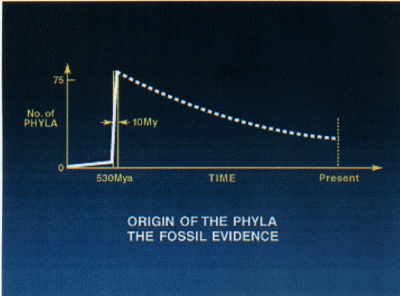
The Cambrian explosion: biology’s Big Bang

Consider this article by Jonathan Wells.

First, let’s re-cap the challenge to evolution from the phenomenon of the Cambrian explosion.

The newly released film “Darwin’s Dilemma” argues that the geologically abrupt appearance of the major groups of animals (the “phyla”) in the Cambrian Explosion posed a serious problem for Charles Darwin’s theory of evolution (as he himself knew), and that subsequent fossil discoveries—far from solving the problem—have made it worse.

Basically, all the major body plans we have today appear in the fossil record in a 2-3 million period about 543 million years ago. There are no precursors in the fossil record showing the gradual evolution of these major body plans.

The Cambrian Explosion: 0 to 60 in a few million years

Darwin expected to discover lots and lots of fossils leading up to the Cambrian explosion period that would show how all these phyla came into existence slowly over time. Unfortunately for the naturalistic evolutionists, the discoveries we’ve been making haven’t shown any hint of precursor fossils leading up the Cambrian explosion.

Since 1859, however, many Precambrian fossils have been found, including microfossils of single-celled bacteria in rocks more than three billion years old. In addition, multicellular Precambrian fossils have been found in the Ediacara Hills of Australia, though there is continuing debate over whether any—or how many—of the Ediacaran fossils were animals, or what relationship—if any—they had to the Cambrian phyla. In 1998, Cambridge University paleobiologist Simon Conway Morris (who is featured in the film “Darwin’s Dilemma”) wrote, “Apart from the few Ediacaran survivors… there seems to be a sharp demarcation between the strange world of Ediacaran life and the relatively familiar Cambrian fossils” (Crucible of Creation, 30).

But wait! Maybe we can’t find the precusor fossils required by Darwinism because they are too small or too soft to have survived for so long?

Since 1859, however, many Precambrian fossils have been found, including microfossils of single-celled bacteria in rocks more than three billion years old. In addition, multicellular Precambrian fossils have been found in the Ediacara Hills of Australia… In 1998, Cambridge University paleobiologist Simon Conway Morris… wrote, “Apart from the few Ediacaran survivors… there seems to be a sharp demarcation between the strange world of Ediacaran life and the relatively familiar Cambrian fossils” (Crucible of Creation, 30).

So there is now no shortage of Precambrian fossils. Not only do we have fossils of bacteria, but we also have many fossils of soft-bodied Multicellular organisms. “In the Ediacaran organisms there is no evidence for any skeletal hard parts,” wrote Conway Morris in 1998. “Ediacaran fossils look as if they were effectively soft-bodied” (Crucible of Creation, 28). The same is true of many of the organisms fossilized in the Cambrian explosion.

But wait! Scientists have discovered lots of exceptionally preserved microbes just before the Cambrian explosion. Don’t microbes count as precursors to the Cambrian explosion phyla?

Richard Callow and Martin Brasier reported in the January 2009 issue of the Journal of the Geological Society, London “a variety of exceptionally preserved microbes” from late Precambrian rocks in England that address “the paradox known as ‘“Darwin’s dilemma’.”

[…]Callow and Brasier didn’t solve Darwin’s dilemma. Instead, they put one more nail in the coffin of Darwin’s attempt to salvage his theory from it. The truth is that “exceptionally preserved microbes” from the late Precambrian actually deepen Darwin’s dilemma, because they suggest that if there had been ancestors to the Cambrian phyla they would have been preserved.

I am willing to believe in evolution. But in order to get me to believe it, I insist on seeing a fossil record that shows the gradual emergence of phyla, one or two at a time, over hundreds of millions of years. That is what Darwinism predicts. We now have a solid record of what came before the Cambrian explosion. So where are the precursors? Where is the record of gradual emergence? Where is my evidence?

What does the peer-reviewed research say?

Story from the Discovery Institute.

A new peer-reviewed paper has been published that concludes that there is no material explanation for the massive amounts of information introduced during the Cambrian explosion, when all of the phyla came into being in the blink of an eye, geologically speaking, with no fossilized precursors.

Excerpt:

Thus, elucidating the materialistic basis of the Cambrian explosion has become more elusive, not less, the more we know about the event itself, and cannot be explained away by coupling extinction of intermediates with long stretches of geologic time, despite the contrary claims of some modern neo-Darwinists.

Once again, the progress of science brings light.

The DI post goes on to cite another passage from the paper:

Beginning some 555 million years ago the Earth’s biota changed in profound and fundamental ways, going from an essentially static system billions of years in existence to the one we find today, a dynamic and awesomely complex system whose origin seems to defy explanation. Part of the intrigue with the Cambrian explosion is that numerous animal phyla with very distinct body plans arrive on the scene in a geological blink of the eye, with little or no warning of what is to come in rocks that predate this interval of time. The abruptness of the transition between the ‘‘Precambrian’’ and the Cambrian was apparent right at the outset of our science with the publication of Murchison’s The Silurian System, a treatise that paradoxically set forth the research agenda for numerous paleontologists — in addition to serving as perennial fodder for creationists. The reasoning is simple — as explained on an intelligent-design t-shirt.

Fact: Forty phyla of complex animals suddenly appear in the fossil record, no forerunners, no transitional forms leading to them; ‘‘a major mystery,’’ a ‘‘challenge.’’ The Theory of Evolution – exploded again (idofcourse.com).

Although we would dispute the numbers, and aside from the last line, there is not much here that we would disagree with. Indeed, many of Darwin’s contemporaries shared these sentiments, and we assume — if Victorian fashion dictated — that they would have worn this same t-shirt with pride.

Here is the reference for the paper:

(Kevin J. Peterson, Michael R. Dietrich and Mark A. McPeek, “MicroRNAs and metazoan macroevolution: insights into canalization, complexity, and the Cambrian explosion,” BioEssays, Vol. 31 (7):736 – 747 (2009).)

I linked before to a bunch of easy-to-understand videos that explain the Cambrian explosion. Here’s another peer-reviewed research paper on the Cambrian explosion written by Stephen C. Meyer, on the Cambrian explosion. This is the paper that got evolutionary biologist Richard Sternberg fired by secular leftists. He has two earned Ph.Ds in biology. I would expect that the people who fired him had never seen the inside of a biology lab. That’s the way it goes – science (intelligent design) vs. religion (materialism).

Videos on intelligent design

Can computers become conscious by increasing processing power?

There is a very famous thought experiment from UC Berkeley philosopher John Searle that all Christian apologists should know about. And now everyone who reads the Wall Street Journal knows about it, because of this article. (H/T Sarah)

Searle is writing about the IBM computer that was programmed to play Jeopardy. His Chinese room example shows why no one should be concerned about computers acting like humans. There is no thinking computer. There never will be a thinking computer. And you cannot build up to a thinking computer my adding more hardware and software.

Excerpt:

Imagine that a person—me, for example—knows no Chinese and is locked in a room with boxes full of Chinese symbols and an instruction book written in English for manipulating the symbols. Unknown to me, the boxes are called “the database” and the instruction book is called “the program.” I am called “the computer.”

People outside the room pass in bunches of Chinese symbols that, unknown to me, are questions. I look up in the instruction book what I am supposed to do and I give back answers in Chinese symbols.

Suppose I get so good at shuffling the symbols and passing out the answers that my answers are indistinguishable from a native Chinese speaker’s. I give every indication of understanding the language despite the fact that I actually don’t understand a word of Chinese.

And if I do not, neither does any digital computer, because no computer, qua computer, has anything I do not have. It has stocks of symbols, rules for manipulating symbols, a system that allows it to rapidly transition from zeros to ones, and the ability to process inputs and outputs. That is it. There is nothing else.

By the way, Searle is a naturalist – not a theist, not a Christian. But he does oppose postmodernism. So he isn’t all bad. But let’s hear from a Christian scholar who can make more sense of this for us.

Here’s an article by Christian philosopher Jay Richards.

Excerpt:

Popular discussions of AI often suggest that if you keep increasing weak AI, at some point, you’ll get strong AI. That is, if you get enough computation, you’ll eventually get consciousness.

The reasoning goes something like this: There will be a moment at which a computer will be indistinguishable from a human intelligent agent in a blind test. At that point, we will have intelligent, conscious machines.

This does not follow. A computer may pass the Turing test, but that doesn’t mean that it will actually be a self-conscious, free agent.

The point seems obvious, but we can easily be beguiled by the way we speak of computers: We talk about computers learning, making mistakes, becoming more intelligent, and so forth. We need to remember that we are speaking metaphorically.

We can also be led astray by unexamined metaphysical assumptions. If we’re just computers made of meat, and we happened to become conscious at some point, what’s to stop computers from doing the same? That makes sense if you accept the premise—as many AI researchers do. If you don’t accept the premise, though, you don’t have to accept the conclusion.

In fact, there’s no good reason to assume that consciousness and agency emerge by accident at some threshold of speed and computational power in computers. We know by introspection that we are conscious, free beings—though we really don’t know how this works. So we naturally attribute consciousness to other humans. We also know generally what’s going on inside a computer, since we build them, and it has nothing to do with consciousness. It’s quite likely that consciousness is qualitatively different from the type of computation that we have developed in computers (as the “Chinese Room” argument, by philosopher John Searle, seems to show). Remember that, and you’ll suffer less anxiety as computers become more powerful.

Even if computer technology provides accelerating returns for the foreseeable future, it doesn’t follow that we’ll be replacing ourselves anytime soon. AI enthusiasts often make highly simplistic assumptions about human nature and biology. Rather than marveling at the ways in which computation illuminates our understanding of the microscopic biological world, many treat biological systems as nothing but clunky, soon-to-be-obsolete conglomerations of hardware and software. Fanciful speculations about uploading ourselves onto the Internet and transcending our biology rest on these simplistic assumptions. This is a common philosophical blind spot in the AI community, but it’s not a danger of AI research itself, which primarily involves programming and computers.

AI researchers often mix topics from different disciplines—biology, physics, computer science, robotics—and this causes critics to do the same. For instance, many critics worry that AI research leads inevitably to tampering with human nature. But different types of research raise different concerns. There are serious ethical questions when we’re dealing with human cloning and research that destroys human embryos. But AI research in itself does not raise these concerns. It normally involves computers, machines, and programming. While all technology raises ethical issues, we should be less worried about AI research—which has many benign applications—than research that treats human life as a means rather than an end.

Jay Richards is my all-round favorite Christian scholar. He has the Ph.D in philosophy from Princeton.

When I am playing a game on the computer, I know exactly why what I am doing is fun – I am conscious of it. But the computer has no idea what I am doing. It is just matter in motion, acting on it’s programming and the inputs I supply to it. And that’s all computers will ever do. Trust me, this is my field. I have the BS and MS in computer science, and I have studied this area. AI has applications for machine learning and search problems, but consciousness is not on the radar. You can’t get there from here.