Recorded temperatures at the Bureau of Meteorology’s Thredbo Top automatic weather station have dropped below -10C in the past week, after action was taken to make the facility “fit for purpose”.
A record of the Thredbo Top station for 3am on Wednesday shows a temperature reading of -10.6C. This compares with the BoM’s monthly highlights for June and July, both showing a low of -9.6C.
The BoM said it had taken immediate action to replace the Thredbo station after concerns were raised that very low temperatures were not making it onto the official record. Controversy has dogged the bureau’s automatic weather station network since Goulburn man Lance Pigeon saw a -10.4C reading on the BoM’s website on July 2 automatically adjust to -10C, then disappear.
Later independent monitoring of the Thredbo Top station by scientist Jennifer Marohasy showed a recording of -10.6C vanish from the record.
BoM initially claimed the adjustments were part of its quality control procedures. But bureau chief executive Andrew Johnson later told Environment Minister Josh Frydenberg that investigations had found a number of cold-weather stations were not “fit for purpose” and would be replaced.
Several other temperature measurement stations are also receiving the fix to stop adjusting the raw data:
An in-house investigation that includes two independent experts has been called. The bureau said it rejected allegations aired in some media outlets that it had sought to tamper with temperature data.
It has been reported online that electronic smart cards were allegedly fitted to the BoM’s automatic weather stations, which put a limit on how low temperatures could be recorded in official weather data. The BoM declined to comment ahead of the internal review.
[…]On her website yesterday, Dr Marohasy said it was not the recording devices that were at fault. “To be clear, the problem is not with the equipment; all that needs to be done is for the smart-card readers to be removed,” Dr Marohasy said.
And this was not a situation where the government, which had been lying, corrected itself. Oh no! Challenges to the faked government data came from outside the government, as Bureau of Meteorology minister explained:
“The first we heard of the problem was in early July after (The Australian) approached the Bureau of Meteorology,” the minister said.
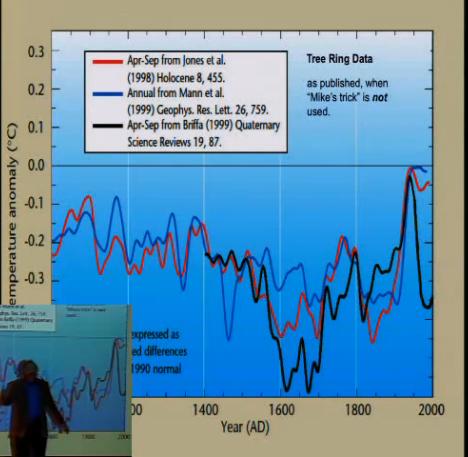
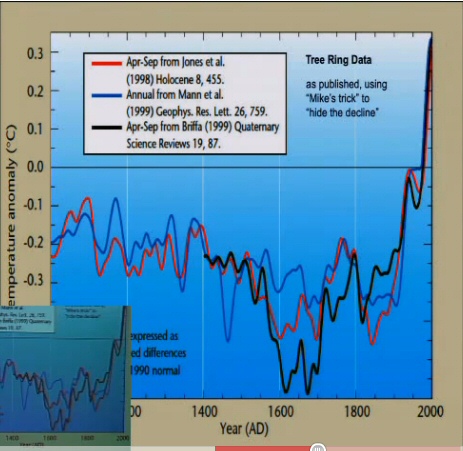
You might remember a recent scandal where it was discovered that scientists in the UK had been adjusting the temperatures to “hide the decline” of temperatures in their simulation code.
Here was the data before hiding the decline:
Raw temperature measurements before hiding the decline
And here was the data after:
Raw temperature measurements after hiding the decline
That second graph, with “Mike’s Nature trick” to “hide the decline” was sent then to the IPCC to influence climate policy. I have no doubt that socialist governments were very grateful for this “evidence”. Just what they needed to get a mandate from the masses to control businesses and consumer spending were grateful for this hiding of the decline, and rewarded the scientists with many research grants. This is why we call global warming alarmists “watermelons”: green on the outside, and red on the inside.
If you’ve never heard of that Climategate story from 2009 before, you should definitely read about it. Here is a good single post that explains what happened.
The Christian life requires a certain degree of mental toughness and non-conformity
Are you interested in knowing how to avoid losing your Christian faith? Well, an episode of the Unbelievable show featuring well-known apostate Ryan Bell will give you some clues.
But before we go to the podcast, I want to recap some reasons why people think that God exists.
I listed these out so that you can see how many of these positive arguments and defenses that Ryan Bell wrestles with in his deconversion testimony.
The podcast
Details:
Ryan J Bell is a former pastor who has decided to try being an atheist for a year. He explains why and interacts with New Zealand apologist Matt Flannagan.
Matt Flanagan and Justin Brierley do a great job in this debate getting the real issues on the table, although you have to wait until about 20 minutes in. Quick note about Bell. He has a BA in Pastoral Ministry, an MDiv, and a doctorate in Missional Organization. Now I have a suspicion of people with a background like that – my view is that they are more likely to be impractical and/or insulated from real life.
I also noticed that his politics are liberal, and that he is featured on the web site of GLAAD, a gay rights organization, for supporting gay marriage. Why do people support same-sex marriage? I think the most common reason is because they care more about the needs of adults than they care about the needs of children for a mother and a father. That’s where this guy is coming from – he is a people-pleaser, not someone who promotes the needs of children over the needs of adults.
Summary:
At the start of the podcast, we learn that Bell was in the Seventh Day Adventist church, which is strongly invested in young-Earth creationism. Depending on how strict his young Earth view was, this closes off many of the best arguments for theism from science, such as the cosmological argument, the cosmic fine-tuning argument, the stellar habitability argument, the galactic habitability argument, the Cambrian explosion argument, and even the origin of life argument (to a degree). These are the arguments that make theism non-negotiable.
When he started his journey to atheism, he says that he was reading a book called “Religion Without God” by Ronald Dworkin.I was curious to see what view of faith was embraced by this book. Would it be the Biblical view of faith, trust based on evidence? Or the atheist view of faith, belief without evidence? I found an excerpt from the book in the New York Times, which said this:
In the special case of value, however, faith means something more, because our convictions about value are emotional commitments as well and, whatever tests of coherence and internal support they survive, they must feel right in an emotional way as well. They must have a grip on one’s whole personality. Theologians often say that religious faith is a sui generis experience of conviction. Rudolf Otto, in his markedly influential book, The Idea of the Holy, called the experience “numinous” and said it was a kind of “faith-knowledge.” I mean to suggest that convictions of value are also complex, sui generis, emotional experiences. As we will see… when scientists confront the unimaginable vastness of space and the astounding complexity of atomic particles they have an emotional reaction that matches Otto’s description surprisingly well. Indeed many of them use the very term “numinous” to describe what they feel. They find the universe awe-inspiring and deserving of a kind of emotional response that at least borders on trembling.
The excerpt quotes William James, who reduces religion to non-rational emotional experiences. I don’t know about you, but I don’t think that view of faith is Biblical at all. Biblical faith is rooted in evidence. So clearly, what is important to this Dworkin is not objective evidence, it’s feelings. And this is what Bell was reading. He was not reading academic books like “Debating Christian Theism” to get the best arguments pro-and-con. He was looking for something that “resonated” with his feelings.
His journey was prompted by a female Episcopal priest friend who was asked by an atheist “what difference does religion make in my life?”. So, the framework of his investigation is set by a question that is not focused on truth, but is instead focused on emotions and life enhancement. Now Christianity might be a real stinker of a worldview for life enhancement, and the Bible warns us not to expect a bed of roses in this life. Christianity is not engineered to make you feel good or to make people like you, especially people like female Episcopal priests and GLAAD.
When talking about atheism, he is not concerned with whether atheism is logically consistent or consistent with objective evidence. He is concerned by whether atheists can have the experience of being moral without God. He sees an atheist who has moral preferences and seems like a good person by our arbitrary social standards, and he finds that as “valid” as religion. He is judging worldviews by whether people have their needs met, not by truth.
He says that as a pastor, his method of evangelizing atheists was to encourage them to “try on faith” “go through the motions” “participate in social justice outreach events”, etc. His goal was that they would “step into the stream of the Christian narrative and discover that it held value and meaning to them, and find that they actually believed it”. So his method of recommending Christianity to others has nothing to do with logic, evidence or truth. He is offering Christianity as life enhancement – not knowledge but a “narrative” – a story. If it makes you feel good, and it makes people like you, then you can “believe” it. He says that he was “a Christian by practice, a Christian by tradition”. Not a Christian by truth. Not a Christian by knowledge. He just picked a flavor of ice cream that tasted right to him, one that pleased his parents, friends and community. And now he has new friends and a new community, and he wants to please them and feel good about himself in this new situation.
He says that the Christian worldview is “a way of approaching reality” and “creating meaning” and “identifying meaning in the experiences we have”. And he says that there are “other ways of experiencing meaning”. He talks a lot about his correspondence with people and reading atheists, but nothing about reading Christian scholars who deal with evidence, like William Lane Craig, Stephen C. Meyer or Mike Licona.
Literal, literal quote: (23:35) “Well I think the only access we have to the question of God’s existence or not is how we feel. I mean there’s no falsifiable data that says God either exists or doesn’t exist. It’s all within the realm of our personal experience”. “If living as though God exists makes you happy and comforts you, then by all means, go for it”. This attitude is so popular in our churches today, and where does it end? In atheism. I had a fundamentalist woman telling me just last night how this feelings mysticism approach was the right approach to faith, and that the head knowledge approach was bad and offensive.
I’m going to cut off my summary there, but the podcast goes on for 45 minutes. Matt Flannagan is brilliant, and went far beyond what I wanted to say to this guy, but in such a winsome way. I recommend listening to the whole thing, and be clear where this fideistic nonsense ends – in atheism.
My thoughts
This podcast is a great warning against two views: 1) faith is belief without evidence and 2) religion not about truth, but about life enhancement. Three other related stories might also help: the story of Dan Barker,the story of Nathan Pratt and the story of Katy Perry. I think the Christian life requires a commitment to truth above all. If you think that you can get by as a Christian relying on hymn singing, church attending, mysticism and emotional experiences, you have another thing coming. This is a different time and a different place than 50 years ago, when that sort of naivete and emotionalism might have been safe. Now we have many challenges – some intellectual and some not. To stand in this environment, it’s going to take a little more than piety and emotions.
People today are very much looking for religion to meet their needs. And this is not just in terms of internal feelings, but also peer approval and mystical coincidences. They expect God to give them happy feelings. They expect God to give them peer approval. They expect God to make every crazy unBiblical, unwise selfish plan they invent “work out” by miracle. They feel very constrained by planning and moral boundaries, believing in a “God of love” who is primarily concerned with their desires and feelings, not with rules and duties. Nothing in the Bible supports the idea that a relationship with God is for the purpose of making us feel happy and comfortable. When people realize that they will be happier in this life without having to care what God thinks, they will drop their faith, and there are plenty of non-Christians to cheer them on when they do it.
I would say to all of you reading that if the opinions of others causes you to stumble then meditate on the following passage: 1 Cor 4:1-4 too. There is only one person’s opinion that matters, ultimately.
A fine article by Aaron, who writes at Apologetics Junkie.
Excerpt:
A self-defeating (or self-refuting) statement is one that fails to meet its own standard. In other words, it is a statement that cannot live up to its own criteria. Imagine if I were to say,
I cannot speak a word in English.
You intuitively see a problem here. I told you in English that I cannot speak a word in English. This statement is self-refuting. It does not meet its own standard or criteria. It self-destructs.
The important thing to remember with self-defeating statements is that they are necessarily false. In other words, there is no possible way for them to be true. This is because they violate a very fundamental law of logic, the law of non-contradiction. This law states that A and non-A cannot both be true at the same time and in the same sense. For example, it is not possible for God to exist and not exist at the same time and in the same sense. This would violate the law of non-contradiction. So if I were to say, “God told me He doesn’t exist” you would see intuitively the obvious self-refuting nature of this statement.
Aaron goes on to explain how to deal with self-refuting statements in the article.



 WINTERY KNIGHT