Tag Archives: Bible

How pro-life apologetics helps strengthen your evangelism

From Scott Klusendorf’s Life Training Institute.

Excerpt:

Beyond the obvious obligation we have as thinking human beings to clarify the status, and defend the value, of innocent, unborn human life, engaging in the pro-life project is also a way to make the case for the truth of Christianity in general. It stands to reason that if the scientific, philosophical, and moral arguments we offer in defense of the humanity of the unborn also happen to align exactly with the biblical notion of what it means to be a human being made “in the image of God,” then the Bible might also have something to say about other things of importance.

This is a point Scott makes repeatedly but it was recently driven home in a very concrete way by, of all people, a hard core atheist in the most recent issue of Salvo magazine. A secular skeptic, law school professor, renowned blogger, and mocker of deluded “Godiots,” the “Raving Atheist” attended a blogger party where he serendipitously sat next to a Catholic blogger named Benjamin. As the “Raving Atheist” explains:

At one point the conversation turned to abortion, and I asked Benjamin’s opinion of the practice. I was stunned. Here was a kind, affable, and cogently reasonable human being who nonetheless believed that abortion was murder. To the limited extent I had previously considered the issue, I believed abortion to be completely acceptable, the mere disposal of a lump of cells, perhaps akin to clipping fingernails.

This unsettling exchange spurred me to further investigate the issue on Benjamin’s blog. I noticed that pro-choice Christians did not employ scientific or rational arguments but relied on a confused set of “spiritual” platitudes. More significantly, the pro-choice atheistic blogosphere also fell short in its analysis of abortion. The supposedly “reality-based” community either dismissed abortion as a “religious issue” or paradoxically claimed that pro-life principles were contrary to religious doctrine. Having formerly equated atheism with reason, I was slowly growing uncertain of the value of godlessness in the search for truth.

Though the “Raving Atheist” continued to rave, there was now a stone in his God-rejecting shoe, placed there by a reasoned defense of the pro-life view. He couldn’t disconnect himself from it and later admitted that the “selfless dedication [of pro-life advocates] to their cause moved [him] deeply.” Later, he met a woman named Ashli whose work in pregnancy care drew him to further consider the pro-life position. Soon thereafter, the “Raving Atheist” became, in part, a pro-life blogsite …

Click here to read the astonishing conclusion. Then come back here.

Back? Ok, so what did we learn from this? Well, the moral of this story is that it is very important for Christians to have a good understanding of moral issues like abortion and same-sex marriage so that they can talk about these issues based on what they know. When someone can stake out a moral position on these kinds of issues, using science and history and other hard evidence – not just the Bible – then it helps non-Christians to take us seriously as thinkers.

Unless we demonstrate the ability to reason out there in the real world – outside the church – then we are not going to be viewed as authoritative on any subject – especially on spiritual subjects. We really need to study up on other issues, and show that we care about the unborn (abortion issue) and children (same-sex marriage issue). We have to show that there is more to us than just doing what feels good. We have to show that we are smart and that we are willing to be unpopular in order to do the right thing. That we didn’t just inherit these views from our parents, or from our culture. That we have actually thought things through more than just reading the Bible, and that it makes a difference in how we view the world, and in how we live. We don’t want people to continue in their perception that Christians are just people who play follow-the-leader – we want to show them how we have worked through these issues on our own.

Ignorance is never a good idea when you are trying to do good – and you can’t know what is really good just by your feelings and intuitions. If you want to do good, you need to be 1) convincing and 2) effective. And that takes study. Don’t choose policies based on what makes you feel good and what sounds good to others. Push for effective policies – what actually does good – and then have your arguments and evidence ready to convince people, using evidence from authorities that they accept as non-Christians. If you have the will to study a little, you can be passionate and convincing. Non-Christians respect passion and knowledge. They don’t respect fideism and mysticism.

Scott Klusendorf is the author of the best introductory book on pro-life apologetics, entitled “The Case for Life“.

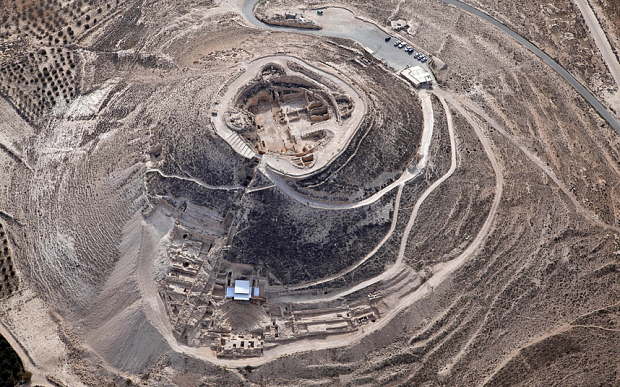
Archaeologists discover entrance to Herod’s palace near Bethlehem

Herod's palace
Herod’s palace

Baptist Press reports on the story.

Full text:

Israeli archeologists have uncovered an impressive entrance to Herod’s palace at Herodium. Located only three miles southeast of Bethlehem, Herodium played an important part in the events surrounding the early life of Christ.

The December announcement by Hebrew University archeologists Roi Porat, Yakov Kalman and Rachel Chachy dovetails well with the seasonal interest in the nativity accounts of Luke and Matthew in the New Testament.

While both Luke and Matthew wrote that King Herod governed Judea during the era of Jesus’ birth at Bethlehem (Luke 1:5, Matthew 2:1), they included nothing concerning Herod’s massive palace/fortress complex at nearby Herodium.

Herodium, like Herod’s other isolated palace/fortress complexes at Masada and Machaerus, was built on a mountain. To enhance its impressive scale, Herod artificially extended the height of the hill to make it the tallest mountain in the Judean desert.

While the site included the usual Herodian luxuries such as a palace, bathhouse, theatre and garden, Herodium was essentially a fortress, a place where Herod could find refuge if his people revolted.

Herod’s fear of a Jewish revolt led him to establish many fortresses in both urban centers (he maintained two in Jerusalem itself) and in isolated rural areas away from the urban centers.

A small community close to the fortress housed the construction teams and, later, the garrison soldiers and palace servants. The servants who waited on the king indeed worked in an impressive palace.

The newly uncovered entranceway apparently was still being constructed near the time of the monarch’s death.

As shown in one of the photographs, the entryway included three levels of arches in a 65-foot corridor that was 19 feet across and 65 feet in height leading to the palace’s courtyard. Curiously enough, the nearly completed entrance was abruptly stopped and backfilled around the time of Herod’s death. The archeologists speculated that the now-aging Herod instead sought to convert the entire palace into a memorial mound for his upcoming burial at the site.

Indeed, Herod’s plans for Herodium unfolded as Jesus was born and as He spent His early life in nearby Bethlehem. When the magi arrived in Jerusalem and announced they had come to worship the “king of the Jews,” Herod sent them to Bethlehem after learning the location of the Messiah’s birthplace from the chief priests and learned scholars. The monarch hoped to ascertain from the magi which of the town’s small children was the designated royal candidate. Then Herod hoped to execute the child (Matthew 2:1-8, 2:16).

When the magi failed to return with this information, Herod ordered his soldiers into Bethlehem to murder all children age 2 and under. Warned to flee to Egypt, the holy family escaped Herod’s plans, but an undisclosed number of children were killed by Herod’s soldiers. Although never stated in the biblical account, the soldiers who carried out the old king’s infamous order were either stationed in Jerusalem (seven miles from Bethlehem) or in the closer post at Herodium. In fact, Herodium overlooked Bethlehem and could have functioned as a convenient headquarters for Herod’s deadly operation.

While the holy family resided in Egypt, another Herodium connection to the early life of Christ took place. After a long and terribly painful illness, Herod died. His surviving eldest son (Herod had murdered his three oldest sons), Archelaus, then buried him in Herodium at a pre-selected tomb and gave his father an elaborate funeral at the site and spared no expense, according to the Jewish historian Josephus (Jewish War, 1,673).

Israeli archeologist Ehud Netzer claimed to have found Herod’s tomb and damaged sarcophagus (stone coffin) in 2007 at Herodium, but in 2013 and 2014 other archeologists have raised doubts about the tomb and the sarcophagus. Israeli archeologists Joseph Patrich and Benjamin Arubas largely based their doubts on the modest tomb site and the unimpressive sarcophagus. They believe that the mega-maniacal Herod would have commissioned a larger tomb and a more elaborate sarcophagus.

With Herod now buried in Herodium and with Archelaus eventually ruling over much of his father’s former kingdom as an “ethnarch” (“ruler of the people”), the New Testament noted the change in political leadership (Matthew 2:19-22). The change prompted Joseph to consider a move back to Judea (perhaps back to Bethlehem itself where the family had lived for about two years), but his misgivings about a Judea under the rule of an already unpopular Archelaus and a warning in a dream led him to reconsider. The decision was a wise one. A return to Bethlehem in the “shadow of Herodium” and the nearby royal city of Jerusalem placed the holy family at potential risk.

Instead, Joseph took his family back to Nazareth in Galilee (Matthew 2:22-23). Galilee was governed by Herod Antipas, the younger brother of Archelaus. At the time, this Herodian ruler, with the title of “tetrarch” (“ruler over a fourth”), was regarded as a milder alternative to the volatile Archelaus. Located far away from the recent unpleasant associations connected to Herodium and the slaughter of the children in Bethlehem, Joseph and Mary would raise Jesus in the peaceful surroundings of Nazareth.

The recent archeological find in Herodium and the continuing dispute concerning Herod’s tomb and sarcophagus calls attention to the background story of the early life of Christ as detailed in the Gospel of Matthew. Perhaps some further archeological discoveries at Herodium will uncover additional information about the familiar nativity narrative.

I liked this article on Baptist Press so much, I pasted it here in full – because of the links between history and the Bible. It’s also reported in secular news sources like NBC News and the UK Telegraph.

When I read stories like this, it really makes me question people who think that the New Testament books were not intended to be history. I think the default view has to be that the authors intended to write history, and then we do the work to see which parts pass historical tests – i.e. – how early, how many sources, how many eyewitnesses, etc. And, do we have archaeological evidence to corroborate the narrative.

Is the story of the woman being stoned for adultery in John 7-8 authentic?

Here’s the leading conservative New Testament scholar Daniel Wallace to explain.

Excerpt:

One hundred and forty years ago, conservative biblical scholar and Dean of Canterbury, Henry Alford, advocated a new translation to replace the King James Bible. One of his reasons was the inferior textual basis of the KJV. Alford argued that “a translator of Holy Scripture must be…ready to sacrifice the choicest text, and the plainest proof of doctrine, if the words are not those of what he is constrained in his conscience to receive as God’s testimony.” He was speaking about the Trinitarian formula found in the KJV rendering of 1 John 5:7–8. Twenty years later, two Cambridge scholars came to the firm conclusion that John 7:53–8:11 also was not part of the original text of scripture. But Westcott and Hort’s view has not had nearly the impact that Alford’s did.

For a long time, biblical scholars have recognized the poor textual credentials of the story of the woman caught in adultery (John 7:53–8:11). The evidence against its authenticity is overwhelming: The earliest manuscripts with substantial portions of John’s Gospel (P66 and P75) lack these verses. They skip from John 7:52to 8:12. The oldest large codices of the Bible also lack these verses: codex Sinaiticus and Vaticanus, both from the fourth century, are normally considered to be the most important biblical manuscripts of the NT extant today. Neither of them has these verses. Codex Alexandrinus, from the fifth century, lacks several leaves in the middle of John. But because of the consistency of the letter size, width of lines, and lines per page, the evidence is conclusive that this manuscript also lacked the pericope adulterae. Codex Ephraemi Rescriptusalso from the fifth century, apparently lacked these verses as well (it is similar to Alexandrinus in that some leaves are missing). The earliest extant manuscript to have these verses is codex Bezae, an eccentric text once in the possession of Theodore Beza. He gave this manuscript to the University of Cambridge in 1581 as a gift, telling the school that he was confident that the scholars there would be able to figure out its significance. He washed his hands of the document. Bezae is indeed the most eccentric NT manuscript extant today, yet it is the chief representative of the Western text-type (the text-form that became dominant in Rome and the Latin West).

When P66, P75, Sinaiticus, and Vaticanus agree, their combined testimony is overwhelmingly strong that a particular reading is not authentic. But it is not only the early Greek manuscripts that lack this text. The great majority of Greek manuscripts through the first eight centuries lack this pericope. And except for Bezae (or codex D), virtually all of the most important Greek witnesses through the first eight centuries do not have the verses. Of the three most important early versions of the New Testament (Coptic, Latin, Syriac), two of them lack the story in their earliest and best witnesses. The Latin alone has the story in its best early witnesses.

Even patristic writers seemed to overlook this text. Bruce Metzger, arguably the greatest textual critic of the twentieth century, argued that “No Greek Church Father prior to Euthymius Zigabenus (twelfth century) comments on the passage, and Euthymius declares that the accurate copies of the Gospel do not contain it” (Textual Commentary, 2nd ed., loc. cit.).

It is an important point to note that although the story of the woman caught in adultery is found in most of our printed Bibles today, the evidence suggests that the majority of Bibles during the first eight centuries of the Christian faith did not contain the story. Externally, most scholars would say that the evidence for it not being an authentic part of John’s Gospel is rock solid.

But textual criticism is not based on external evidence alone; there is also the internal evidence to consider. This is comprised of two parts: intrinsic evidence has to do with what an author is likely to have written;transcriptional evidence has to do with how and why a scribe would have changed the text.

Intrinsically, the vocabulary, syntax, and style look far more like Luke than they do John. There is almost nothing in these twelve verses that has a Johannine flavor. And transcriptionally, scribes were almost always prone to add material rather than omit it—especially a big block of text such as this, rich in its description of Jesus’ mercy. One of the remarkable things about this passage, in fact, is that it is found in multiple locations. Most manuscripts that have it place it in its now traditional location: between John 7:52 and 8:12. But an entire family of manuscripts has the passage at the end of Luke 21, while another family places it at the end of John’s Gospel. Other manuscripts place it at the end of Luke or in various places in John 7.

The pericope adulterae has all the earmarks of a pericope that was looking for a home. It took up permanent residence, in the ninth century, in the middle of the fourth gospel.

Wallace teaches at the ultra-conservative fundamentalist Dallas Theological Seminary, and is the foremost evangelical manuscript expert in the world.

Why is this important? I think it is important because this story is very prominent for a great many Christians, especially Christian women, who use this to justify a variety of positions that are inconsistent with the rest of the Bible. These Christians do not like the idea of anyone being judged and so they are naturally inclined to blow this disputed passage into an entire theology that repudiates making moral judgments on such things as capital punishment. In fact, in another post, I was accused of being the equivalent of one of the people who wanted to stone the woman taken for adultery because I oppose fornication and single motherhood. That’s how far this has gone, where some Christians, especially Christian feminists, have leveraged this passage to redefine the Bible so that women are no longer responsible to the Bible’s moral rules and can never be blamed for acting irresponsibly.