
Tag Archives: Bible

New York church makes space for non-Christians to ask questions

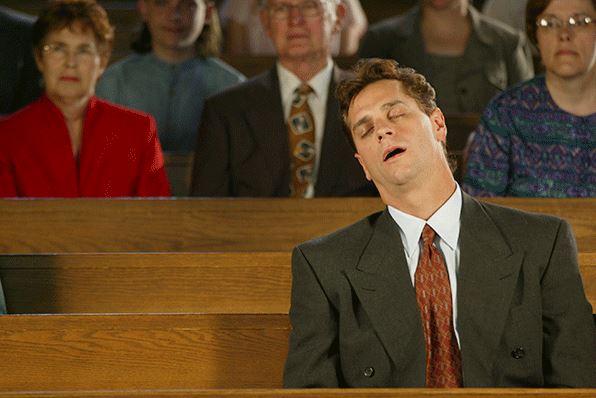
Church sucks, that's why men are bored there
Is church boring? How can you make it more interesting for people?

This is from the radically leftist New York Times, of all places.

It says:

When Craig Ellis was growing up, he picked up the sort of adventure book meant for a boy looking to serve God. The book, “Shadow of the Almighty,” told the story of Jim Elliot, a young American evangelist killed while doing mission work in Ecuador.

The narrative of this Christian martyr did for Mr. Ellis what a superhero comic might have done for his peers: It got him pondering purpose, struggle and sacrifice. The book also provided a model for how a Christian should spread the news of salvation while working in treacherous territory, at great personal risk.

Very little in “Shadow of the Almighty,” however, prepared Mr. Ellis for where he stood on a recent Tuesday, in a room with industrial carpet and a dropped ceiling at Redeemer Presbyterian Church on the Upper West Side of Manhattan, where people lined up on Sunday morning are more likely awaiting a table for brunch than taking communion.

Mr. Ellis, 39, welcomed the dozen men and women seated before him. “This is a space,” he said, “for people who consider themselves non-Christian and are coming in from the outside.”

His weekly sessions, called the WS Café in a reference to the neighborhood, are at a new frontier of evangelism, one that seeks converts among a fervent and growing number of atheists in this country. The sessions started in September as a push by Redeemer Presbyterian’s prominent pastor, the Rev. Tim Keller, to preach the gospel to skeptics.

How are they doing it?

By not quoting the Bible as if it were inerrant to people who don’t think it is. But using evidence from outside the Bible to explain what’s in the Bible.

More:

On that recent Tuesday evening, Mr. Ellis, the pastor’s assistant, was sharing a lectern with the Rev. Bijan Mirtolooi, the assistant pastor for the 83rd Street church. In the chairs around them sat people like Frank Ying, 33, who works for a technology start-up. Brought up in the Dallas area by immigrant parents who had been raised amid the official atheism of the People’s Republic of China, Mr. Ying tried exploring Christianity with his high school classmates, even accompanying them to megachurches, only to be put off by their fundamentalism.

“You have all these questions,” he recalled. “And you have all these long, drawn-out conversations. ‘What do you believe? How much of the Bible do you take literally?’ And these people stop short and say, ‘You’ve just got to have faith.’ But I’ve always been more pragmatic, so that wasn’t good enough.”

Mr. Ying heard about Redeemer Presbyterian from a few acquaintances after moving to Manhattan several years ago. He dipped his toe slowly, watching a YouTube video of Dr. Keller in conversation with a journalist and a historian, emissaries of the secular world. By now, Mr. Ying is a regular at the WS Café, not because he believes, but because his doubts get heard.

Each session has a central topic, and on the recent Tuesday it was about why Jesus needed to be crucified. As part of framing a wide-open conversation, a list of quotations on the subject even included this zinger from Mr. Hitchens: “I find something repulsive about the idea of vicarious redemption.”

Mr. Ellis and Mr. Mirtolooi cited popular culture (movies like “The Revenant,” “Inside Out”) and real-life examples (the way a parent sacrifices free time to raise a child) in order to make palpable the concept of suffering leading to the remission of sin. Very deliberately, they did not lean heavily on Scripture.

“The difference with the Café is what you’re using as your authorities,” Mr. Ellis said later. “Typically, in a Christian class, the Bible is your authenticity. To this group, the Bible is just another book. You can use it, but it’s just one piece of the puzzle. You rely on those your listeners would find credible — scientists, philosophers, authors — and you show how Christianity makes sense.”

[…]The point of their exchange was not winning a soul now as much as keeping a mind open to the possibility someday. “Now I find that I’m very comfortable going to church on a Sunday, listening to the sermons,” Mr. Ying said. “I can explore more and not have religious people put down their foot and say, ‘This is how it is.’ ”

This reminds me of the conversation I had when I went to work for a tech start-up right out of college. You had to have a graduate degree to work in this company. I remember talking to a buy who had a PhD from Northwestern, and my boss who had his undergrad from UIUC and his Masters from Purdue. I had just answered one of their questions, and then apologized for taking the conservative point of view – hoping I hadn’t offended them. I said “I’m a fundamentalist”. And the PhD guy said, “you’re not a fundamentalist. You have your view, but you know all the other views, too”.

I think that in the workplace or in the school, it’s important to know all the other views, too. We don’t want to play into this stereotype that the secular leftists have of us. We should be able to sit still and listen, and put their view forward better than they can themselves. You won’t learn how to do that in church, though. Church teaches you to only be able to talk to people about your faith if they assume that the Bible is the inerrant Word of God (which it is, but non-Christians don’t believe that!) You have to learn how to speak to non-Christians effectively on your own, by reading and watching debates. Sad, but true.

Suppose God had coffee with Donald Trump… how would that go?

The Jesus Seminar and their pre-suppositions
Donald Trump and his evangelical Christian supporters

My friend William shared this post by well-known social conservative Matt Barber. Barber imagines a conversation between Trump and God.

Excerpt:

The following statements attributed to Mr. Trump are not fabricated. The man truly uttered them. Those attributed to God are likewise genuine.

[…]The discussion begins.

Trump: “I am a really smart guy. I’m intelligent. Some people would say I’m very, very, very intelligent. I know what sells, and I know what people want.”

God: “[I] oppose the proud, but give grace to the humble. For everyone who exalts himself will be humbled, and he who humbles himself will be exalted” (James 4:6 and Luke 14:11).

Trump: “Nothing wrong with ego. Show me someone without an ego, and I’ll show you a loser. Sorry losers and haters, but my I.Q. is one of the highest – and you all know it!”

God: “Let not the wise man boast in his wisdom, let not the mighty man boast in his might, let not the rich man boast in his riches. When pride comes, then comes disgrace, but with the humble is wisdom. But as it is, you boast in your arrogance; all such boasting is evil” (Jeremiah 9:23, Proverbs 11:2, James 4:16).

Trump: “If you don’t tell people about your success, they probably won’t know about it.”

“Part of the beauty of me is that I am very rich. I’m really rich. Cash is king, and that’s one of the beauties of the casino business. And while I can’t honestly say I need an 80-foot living room, I do get a kick out of having one.”

God: “For the love of money is a root of all kinds of evil” (1 Timothy 6:10).

Trump: “Fighting for the last penny is a very good philosophy to have. I have black guys counting my money. … I hate it. The only guys I want counting my money are short guys that wear yarmulkes all day. Who the f–k knows? I mean, really, who knows how much the Japs will pay for Manhattan property these days?”

God: “Again I tell you, it is easier for a camel to go through the eye of a needle than for someone who is rich to enter the kingdom of God” (Matthew 19:24).

The conversation moves on to Mr. Trump’s boasting of his many adulterous affairs.

God: “Why should you be intoxicated, my son, with a forbidden woman and embrace the bosom of an adulteress?” (Proverbs 5:20)

Trump: “Nice t-ts, no brains. A person who is very flat-chested is very hard to be a 10. Oftentimes when I was sleeping with one of the top women in the world, I would say to myself, thinking about me as a boy from Queens, ‘Can you believe what I am getting?’”

God: “Likewise, husbands, live with your wives in an understanding way, showing honor to the woman as the weaker vessel, since they are heirs with you of the grace of life, so that your prayers may not be hindered” (1 Peter 3:7).

Trump: “[Women:] You have to treat ’em like s—t.”

“When a man leaves a woman, especially when it was perceived that he has left for a piece of a– – a good one! – there are 50 percent of the population who will love the woman who was left.”

“If I get my name in the paper, if people pay attention, that’s what matters. You know, it really doesn’t matter what they write as long as you’ve got a young and beautiful piece of a–.”

“It’s all in the hunt, and once you get it, it loses some of its energy. I think competitive, successful men feel that way about women. Don’t you agree? Really, don’t you agree?”

God: “Let marriage be held in honor among all, and let the marriage bed be undefiled, for [I] will judge the sexually immoral and adulterous” (Hebrews 13:4).

I have to skip a bit… can’t quote the whole thing!

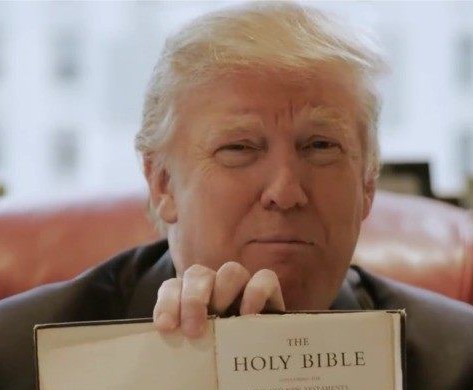
Trump holds up Bible he "received from his mother" to evangelicals
Trump holds up Bible he “received from his mother” to evangelicals

More:

Trump: “For many years I’ve said that if someone screws you, screw them back. When somebody hurts you, just go after them as viciously and as violently as you can.”

God: “But I say to you, Love your enemies and pray for those who persecute you. But if you do not forgive others their trespasses, neither will your Father forgive your trespasses” (Matthew 5:44, Matthew 6:15).

Trump: “I don’t like to have to ask for forgiveness. Why do I have to repent or ask for forgiveness, if I am not making mistakes?”

God: “If my people who are called by my name humble themselves, and pray and seek my face and turn from their wicked ways, then I will hear from heaven and will forgive their sin and heal their land” (2 Chronicles 7:14).

You know, when I think of the people I really admire in this world, I think of people like Jay Wesley Richards, Michael Licona, J. Warner Wallace, Bruce Gordon, Paul Copan, Scott Klusendorf, Tim McGrew, etc. If you asked me who takes the Bible seriously, I’d point to them. I can see how a thorough understanding of the Bible’s teaching has affected their character and behavior. I cannot imagine why anyone who claims to be a Bible-believer would support a man like Trump. It’s not that I insist on someone who agrees with me on every point of theology. My favorite podcast is the Ben Shapiro show, and he’s an Orthodox Jew! It’s that I expect that people who claim to take the Bible seriously to show it in their character and their behavior. Don’t hold up the Bible and claim to respect it when there isn’t anything in your life to show it.

Related posts


What was the Jesus Seminar? Should anyone have taken them seriously?

The Jesus Seminar and their pre-suppositions

A friend of mine was asking me about the “Jesus Seminar”, which is a group of people who claim to be able to speak for broad spectrum of scholars about who Jesus really was. She was telling me that someone’s child went to college, heard about the Jesus Seminar, and lost their faith because of their writings. I wanted to find a good article for her on this, and since Dr. William Lane Craig has debated most of the leading scholars in the Jesus seminar, (e.g. – John Dominic Crossan, Marcus Borg, Roy Hoover, Gerd Ludemann, Robert Price, John Shelby Spong, etc.), I chose an article by Dr. Craig. I also link to two debates that Dr. Craig did with Jesus Seminar people below.

First a short video (4 minutes):

If you can’t watch anything long, then watch that.

Here is the article, on the Reasonable Faith web site.

Intro:

In 1985 a prominent New Testament scholar named Robert Funk founded a think tank in Southern California which he called the Jesus Seminar. The ostensible purpose of the Seminar was to uncover the historical person Jesus of Nazareth using the best methods of scientific, biblical criticism. In Funk’s view the historical Jesus has been overlaid by Christian legend, myth, and metaphysics and thus scarcely resembled the Christ figure presented in the gospels and worshipped by the Church today. The goal of the Seminar is to strip away these layers and to recover the authentic Jesus who really lived and taught.

Excerpt:

The number one presupposition of the Seminar is antisupernaturalism or more simply, naturalism.Naturalism is the view that every event in the world has a natural cause. There are no events with supernatural causes. In other words, miracles cannot happen.

Now this presupposition constitutes an absolute watershed for the study of the gospels. If you presuppose naturalism, then things like the incarnation, the Virgin Birth, Jesus’ miracles, and his resurrection go out the window before you even sit down at the table to look at the evidence. As supernatural events, they cannot be historical. But if you are at least open to supernaturalism, then these events can’t be ruled out in advance. You have to be open to looking honestly at the evidence that they occurred.

[…][T]he second presupposition which I wanted to discuss, namely, sceptical critics presuppose that our most primary sources for the life of Jesus are not the Gospels, but rather writings outside the New Testament, specifically the socalled apocryphal gospels. These are gospels forged under the apostles’ names, like the Gospel of Thomas, the Gospel of Peter, the Gospel of Philip, and so forth. These extrabiblical writings are said to be the key to correctly reconstructing the historical Jesus.

In addition to that, there seems to be a third presupposition – radical religious pluralism.

John Dominic Crossan closed his opening speech in his debate with Dr. Craig with this:

When I look a Buddhist friend in the face, I cannot say with integrity, “Our story about Jesus’ virginal birth is true and factual. Your story that when the Buddha came out of his mother’s womb, he was walking, talking, teaching and preaching (which I must admit is even better than our story)—that’s a myth. We have the truth; you have a lie.” I don’t think that can be said any longer, for our insistence that our faith is a fact and that others’ faith is a lie is, I think, a cancer that eats at the heart of Christianity.

But of course, he thinks that all miracle claims are lies, because of his supernaturalism. What he is really trying to do here is redefine these claims so they are not truth claims at all, but personal preference claims.

But the main point is that the co-chair of the Jesus Seminar pre-supposes that nothing that Christianity claims that offends people in other religions can be true. Before he sits down to look at the evidence. I’m not saying that these guys can’t do history, I’m saying that the real debate with these guys should not be about history. The real debate should be about their presuppositions. We should work to defeat their pre-supposition naturalism with good scientific arguments like the origin of the universe, the fine-tuning, the origin of life, the Cambrian explosion, the habitability-discoverability argument, etc. And we should work to defeat their pre-supposition of pluralism by just asking them to defend it, and maybe point out that a person’s being offended by some claim about reality being true does not make that claim false. Logic requires that people who make claims that are made false by reality are wrong and no amount of crying and sobbing can change that.

The second article in the series that Dr. Craig mentioned in the article I linked above is a generic article on the evidence for the historical Jesus. If you have not read a case for the resurrection of Jesus, then read it, too. Or you can check out this lecture by Dr. Craig on the Jesus Seminar and the historical Jesus:

If you want to see a good debate between Dr. Craig and Marcus Borg, here it is:

Dr. Borg is one of the more respected Jesus Seminar people, and a really nice guy. But also, a really wrong guy.

The key thing to know about them is that they presuppose naturalism (miracles never happen) and radical pluralism (no exclusivist religion can be correct, because that would make people in the other religions feel bad).

Now is this the right way to do history? Suppose a historian began with the presupposition that the North and South never engaged in any battles and interpreted all of the Civil War history through that lens. Would he arrive at an accurate understanding of what happened?

The presuppositions are key to understanding the “historical work” of the Jesus Seminar.