Tag Archives: BGV

Bruce Gordon: problems with inflationary multiverse cosmologies

From Evolution News. Dr. Bruce Gordon reflects on whether the new BICEP2 results offer any support for the multiverse.

First, quick review of the Big Bang so we’re clear on the challenge that poses for naturalism:

Now, Big Bang theory has its theoretical basis in general relativity, which predicts that the universe is spatiotemporally expanding in the future direction and thus would be contracting if we were to reverse the direction of time. As Roger Penrose and Stephen Hawking showed in the late 1960s, no matter which general-relativistic model of our universe is chosen, this contraction leads to a beginning point in the finite past — a singularity, to use the technical term — from which not just matter and energy, but spacetime itself, emerged. This coming into existence of the universe from nothing (no space, no time, no matter, no energy, and hence no physical laws either) is what is known as the Big Bang. It is, as the agnostic astronomer Robert Jastrow once observed, startling evidence for the doctrine of creation ex nihilo. He famously put it this way:

For the scientist who has lived by his faith in the power of reason [editorial aside: Jastrow might better have said “faith in the sufficiency of materialist explanations” because the inference from the ex nihilo generation of the universe to a transcendent intelligent cause is eminently reasonable], the story ends like a bad dream. He has scaled the mountain of ignorance; he is about to conquer the highest peak; as he pulls himself over the final rock, he is greeted by a band of theologians who have been sitting there for centuries.

This having been established, as the physicist George Gamow demonstrated in 1948, one of the predictions of Big Bang theory is the existence of gravitational ripples and cosmic background radiation (CBR) that are an “echo of Creation,” as it were, throughout the whole observable universe. This cosmic background electromagnetic radiation was discovered in 1965 by Robert Wilson and Arno Penzias, a discovery for which they were awarded the Nobel Prize. In this regard, the alleged detection of gravitational waves would serve as further confirmation of the correctness of Einstein’s theory of general relativity and of the nature of the Big Bang itself. If corroborated by the scientific community, it would be a hugely important discovery, not just because of the evidence it provides for gravitational waves, but also because of the way this discovery is linked to another theory, namely, inflationary cosmology.

Inflationary cosmology is an enhancement to the standard Big Bang cosmology, and some models of inflationary theory can create additional universes. Some people are hoping that this will address the fine-tuning argument.

But Dr. Gordon is having none of that:

Of course, the inflationary mechanism is often regarded as generative of an unending and rapid succession of universes with the idea that, if enough universes are produced by such means, the improbabilities just mentioned don’t matter. Several things need to be said about this “inflationary multiverse” proposal:

(1) First of all, as pointed out by one of the physicists involved in the BICEP2 project, Kent Irwin at Stanford University, the BICEP2 results do not address the truth or falsity of inflationary multiverse theories.

(2) Secondly, attempting to swamp the improbabilities intrinsic to inflation by multiplying the number of universes it generates to the point of compensation has consequences that undermine scientific rationality. In a materialist multiverse resting on the hypothesis of an undirected and irreducibly probabilistic quantum inflationary mechanism that lacks any principle of sufficient material causality, anything can happen for no reason at all. What is more, quantum-mechanically speaking, everything that can happen, no matter how improbable, does happen, and it happens with unlimited frequency. In this environment we can have no confidence that the future will resemble the past in a way that legitimates uniformitarian assumptions and the very inductive inferences that make science possible. In short, taken seriously, the inflationary multiverse proposal completely undermines scientific rationality.

(3) Thirdly, at least two paradoxes result from the inflationary multiverse proposal that suggest our place in such a multiverse must be very special: the “Boltzmann Brain Paradox” and the “Youngness Paradox.” In brief, if the inflationary mechanism is autonomously operative in a way that generates a multiverse, then with probability indistinguishable from one (i.e., virtual necessity) the typical observer in such a multiverse is an evanescent thermal fluctuation with memories of a past that never existed (a Boltzmann brain) rather than an observer of the sort we take ourselves to be. Alternatively, by a second measure, post-inflationary universes should overwhelmingly have just been formed, which means that our existence in an old universe like our own has a probability that is effectively zero (i.e., it’s nigh impossible). So if our universe existed as part of such a multiverse, it would not be at all typical, but rather infinitely improbable (fine-tuned) with respect to its age and compatibility with stable life-forms.

(4) Fourthly, a mechanism that generates universes ad infinitum must have stable characteristics that constrain its operation if it is to avoid breaking down and sputtering to a halt. In short, universe-generators have finely tuned design parameters that themselves require explanation. So postulating a universe-generator to explain away the appearance of first-order design in a single universe does not obviate the inference to design, it merely bumps it up to the next level. Avoiding an infinite regress of explanatory demands leads to the recognition of actual design terminating in an Intelligence that transcends spacetime, matter and energy, and which, existing timelessly logically prior to creating any universe or multiverse, must also therefore exist necessarily, and therefore require no further explanation of its own existence.

(5) Fifthly and finally, as demonstrated by Arvind Borde, Alan Guth, and Alexander Vilenkin in 2003 (see further reading suggestions below), any inflationary multiverse has a beginning in the finite past: while inflationary models can, in theory, be eternal into the future, it is mathematically impossible for them to be eternal into the past. This means that the inflationary multiverse entails creation ex nihilo in precisely the same manner as the Big Bang. The universe thus manifests dependence on a transcendent reality in respect of its origin, but what is more, in virtue of the manifest absence of sufficient material causation in many aspects of its persistence as a quantum-mechanical phenomenon, the material universe also manifests dependence on a transcendent reality in respect of its operation (for an extended argument to this effect, see my article on quantum-theoretic challenges to philosophical naturalism referenced in the suggested readings).

What all of this reveals, of course, is that it’s intelligent design all the way through and all the way down and that theophobic scientific materialists, once they get past knee-jerk denials, must come to terms with what is, for them, a worldview-defeating fact.

The Boltzmann Brain paradox in point 3) came up as a problem with inflationary multiverse cosmologies in the recent Craig-Carroll debate.

I bolded part 4) because as Dr. Robin Collins has argued before, the multiverse-generation mechanism does not get rid of the fine-tuning, it just pushes it up one level. And I bolded part 5) because Dr. Gordon is alluding to the Borde-Guth-Vilenkin (BGV) theorem there, which always comes up in debates on cosmology. The theory applies to inflationary cosmologies: they still require an absolute beginning. These are serious problems that we should not gloss over when people push a speculative model like the multiverse in order to escape the fine-tuning argument.

I always thought of Dr. Gordon as kind of a moderate Canadian guy, but I love that last line, don’t you? :) Don’t fear the reaper, naturalists.
Tonight at 8 PM Eastern: live-streaming of William Lane Craig on the Kalam Cosmological argument

Dr. Craig is speaking on the kalam cosmological argument on Monday night at the Georgia Institute of Technology.

There will be a live-stream here.

Details:

What happened at the beginning of time? Dr. William Lane Craig will be using science and philosophy to pain a picture of what happened, and discuss how the implications should rule our lives. Dr. Craig is considered one of the world’s experts on this topic, so you won’t want to miss it! Door open at 8!

Time: Monday, March 3, 2014 at 8:00 pm to 9:30 pm EST

Here’s what Dr. Craig said about this event on Facebook:

Monday night I speak at Georgia Tech on the kalam cosmological argument. I plan to expand on things said in the Carroll debate.

Facebook Page: https://www.facebook.com/events/1469808433242091/

The Craig-Carroll debate

If you missed the Carroll debate, you can watch the video here:

That’s the debate, here’s the concluding remarks:

And here’s my short review, which contains a link to another review as well.

Tactical Faith will live-stream the responses to the Craig-Carroll debate on Saturday

The schedule of events for Saturday is on the Greer-Heard web site.

Saturday, Feb. 22nd, 2014 schedule: (ALL TIMES CENTRAL)

9:00 a.m. Tim Maudlin, ”Cosmology, Theology and Meaning”

10:00 a.m. Robin Collins, “God and the Fine-tuning of the Universe for Discovery”

11:00 a.m. Lunch (New Orleans Style Red Beans & Rice) Cafeteria

12:30 p.m. Alex Rosenberg, “How Physics Fakes Design, and Makes Things Difficult for Theism”

1:30 p.m. James Sinclair, “Cosmology and Cosmologists Within the ‘Does God Exist’ Question”

2:30 p.m. Concluding Comments from Sean Carroll and William Lane Craig

For Eastern times, add an hour.

Click here for the the live-stream. Note: You have to click on this link and go back to the main page each time a response ends, because the youtube link is different for each response.

Is there a recording?

I do have a recording of last night’s debates, but I’m not posting it unless I get permission.

Quick thoughts on the debate:

Carroll was as good of a speaker as Craig in terms of style. Very easy to listen to, very quick on his feet, very civil. There was no clear winner on style.

It was difficult to assess the truth value of scientific points being made, especially for the layperson. I explained a few of them in my posts earlier this week, but I think laypeople might struggle with them if they are hearing about these things for the first time.

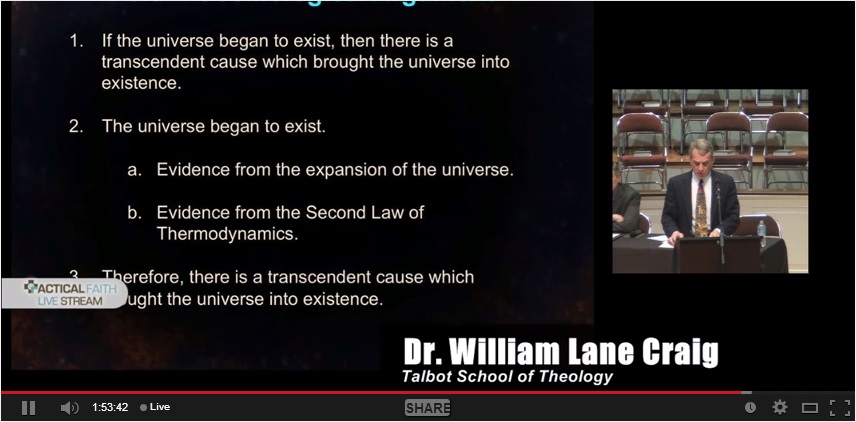
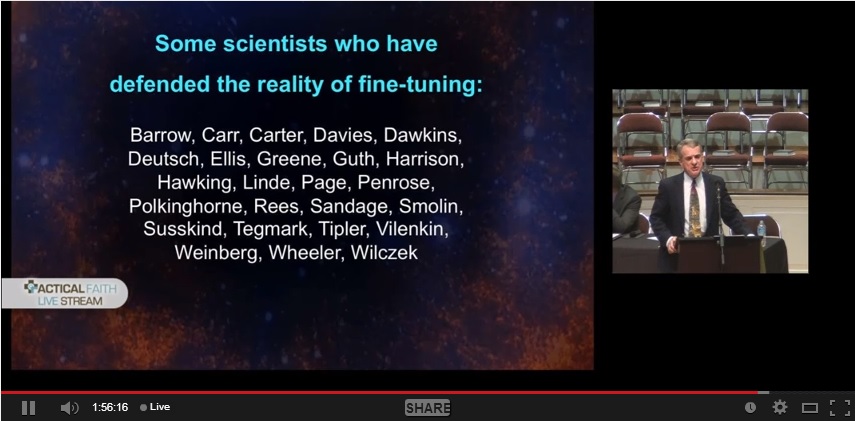
A couple of Craig’s slides: (click for larger images)

Slide 1 of 2:

Dr. Craig slide #1 of 2

Slide 2 of 2:

Dr. Craig slide #2 of 2

Quick summary: (this is not complete, because I couldn’t get everything they were saying noted)

Dr. Craig defended two arguments: 1) the kalam cosmological argument and the fine-tuning argument.

Dr. Craig supported the origin of the universe with 1) the expansion of the universe and 2) the second law of thermodynamics.

Dr. Craig said that the BGV theorem supports a beginning for the universe.

Dr. Craig said that the consensus of scientists did not accept Carroll’s naturalistic cosmology, quoting Stephen Hawking in support.

Dr. Craig said that multiverse models fall victim to the Boltzmann brain problem, where we should observe Boltzmann brains coming into existence and then phasing out again far more probably than embodied minds. But we observe embodied minds, and no Boltzmann brains.

Dr. Carroll said that science cannot study metaphysical questions.

Dr. Carroll said that science is about making models that may or may not be consistent with the experimental data.

Dr. Carroll said that the BGV theorem does not support a beginning for the universe.

Dr. Carroll proposed 17 alternative cosmologies, but did not provide a shred of scientific evidence for any of them, the way that Craig did for the standard model.

Dr. Carroll refuted Dr. Craig’s citation of Stephen Hawking, and Craig yielded the point.

Dr. Carroll speculated that science might progress to the point where the fine-tuning can be explained without an intelligent cause, and he gave an example of where that happened (inflation).

Dr. Craig argued that all 17 of the models suggested by Carroll either conflicted with evidence, had serious problems or did require a beginning.

Dr. Craig argued that Carroll’s own model required a beginning.

Dr. Craig argued that Carroll’s own model fell victim to the Boltzmann brain problem.

Dr. Craig argued that Carroll’s own model violated the second law of thermodynamics.

Dr. Craig re-stated his point that the baby universe spawning in Carroll’s model was speculative and incomplete, and cited Christopher Weaver’s work.

Dr. Carroll denied that things that pop into being out of nothing require a transcendent cause.

Dr. Carroll reiterated that science can only make naturalistic models, and that he did not have to answer questions about ultimate causes.

Dr. Carroll showed a photo of Alan Guth expressing his opinion that the universe is “probably” eternal. No evidence was given for this assertion.

Dr. Carroll said that the fine-tuning was not done in an optimal way, because one fine-tuned value was lower than it needed to be, and it should be exactly what it needed to be if God did it.

Dr. Carroll said that a finely-tuned universe is more probably in naturalism than in theism, because God can do anything he wants and doesn’t need a fine-tuned universe.

Dr. Carroll said he would stop defending his model now, and would instead defend Aguirre-Gratton.

Dr. Craig gave three reasons why the universe popping into being out of nothing requires a transcendent cause.

First, he said that nothing cannot cause anything to happen, because nothing is nothing.

Second, he said that if things pop into being out of nothing, then why don’t we see it happening all the time with other things.

Third, he said that we have no reason to dismiss the causal principle, especially when it is the basis of scientific inquiry and has been so fruitful in the progress of science.

Dr. Craig reiterated that baby universes in Carroll’s model would be dominated by Boltzmann brains, and we don’t observe that.

Dr. Craig said that even on the quantum gravity models that Carroll mentioned, there would still be a beginning.

Dr. Carroll said that Craig mustn’t say “popped into being” but instead that “there was a first moment of time”.

Dr. Carroll said that his model does indeed violate the second law of thermodynamics “YES!”.

At this point Carroll stopped talking about the topic of the debate and started expressing personal opinions about religion. It’s funny how often atheists do this in debates.

Dr. Carroll said that most theists don’t believe in God because of cosmology, but because of community and feelings.

Dr. Carroll said that science had learned a lot in the last 2000 years, so theism was false.

Dr. Carroll said that most philosophers don’t think that God exists, so theism was false.

Dr. Carroll said microscopes and telescopes were absent 2000 years ago, so theism was false.

Dr. Carroll said that religion should be about community and feelings, not about what is true.

Conclusion:

My conclusion was that Carroll lost because he is just satisfied to throw theories out and not to argue that they are true by citing evidence. Carroll never seemed to be interested in finding out what is true, but instead he just wanted to tell a story that didn’t include God, and assert that by Occam’s Razor, his story was a better explanation. I am not impressed with theoretical speculations, although the layperson might be. I kept waiting for him to respond to Craig’s points about how his model was falsified by experimental evidence and observations, e.g. – the Boltzmann brains or the baby universe generation, and he never cited the evidence I wanted him to cite. Craig did have some evidence for his views, but he could have been stronger in making his case. He could have shown the e-mail from Vilenkin that stated that he had understood the BGV theorem, and was using it correctly, for example.

For me the winning side comes down to evidence. The standard model is the standard model because of scientific evidence. Until that evidence is overturned, then speculative models are of no interest to anyone who is evidence-driven. Speculations are not science. A philosophical presupposition of metaphysical naturalism is not science.

The nice thing is that Robin Collins, one of Craig’s respondents, went deep into the science of the fine-tuning, especially on one of my favorite data points, the cosmic microwave background radiation. The paper he presented is now posted on his web site (H/T Christian Apologetics Alliance). I posted about the CMBR before in my post about particle physicist Michael Strauss lecture on cosmology and fine-tuning at Stanford University and the his more recent lecture at the University of Texas. Note that Strauss is an experimental physicist, not a theoretical physicist like Carroll.

Unfortunately, naturalistic respondent Tim Maudlin said nothing at all of value, choosing to use his time to speak about the evils of the coal industry and the threat of global warming, despite the fact that the IPCC says there has been no significant global warming in the past 17 years.

The last two respondents have started speaking. I’m expecting the philosopher Alex Rosenberg to stay away from the science, and then we’ll hear from the experimental scientist James Sinclair. Rosenberg spoke on Darwinian evoloution being incompatible with theism, and it was interesting, but off topic for this debate. James Sinclair is speaking now, and is giving a technical paper on cosmology.

I may be posting a more accurate summary sometime next week, especially if they release either the audio or the video. If not, this will be it.

UPDATE: here’s another review by Randy Everist of Possible Worlds blog. He explains the back-and-forth over Boltzmann brains and the BGV theorem in more detail.