
Tag Archives: Benefit

Is a college degree worth what you pay for it?

Michael Barone writing in Human Events.

Excerpt:

We are still suffering from the bursting of the housing bubble created by low interest rates, lowered mortgage standards, and subsidies to Fannie Mae and Freddie Mac. Those policies encouraged the granting of mortgages to people who should never have gotten them — and when they defaulted, the whole financial sector nearly collapsed.

Now some people see signs that another bubble is bursting. They call it the higher-education bubble.

For years, government has assumed it’s a good thing to go to college. College graduates tend to earn more money than non-college graduates.

Politicians of both parties have called for giving everybody a chance to go to college, just as they called for giving everybody a chance to buy a home.

So government has been subsidizing higher education with low-interest college loans, Pell grants, and cheap tuitions at state colleges and universities.

The predictable result is that higher education costs have risen much faster than inflation, much faster than personal incomes, much faster than the economy over the past 40 years.

Moreover, you can’t get out of paying off those college loans, even by going through bankruptcy. At least with a home mortgage, you can walk away and let the bank foreclose and not owe any more money.

Peter Thiel, the co-founder of PayPal, is adept at spotting bubbles. He sold out for $500 million in March 2000, at the peak of the tech bubble, when his partners wanted to hold out for more. He refused to buy a house until the housing bubble burst.

“A true bubble is when something is overvalued and intensely believed,” he has said. “Education may still be the only thing people still believe in in the United States.”

But the combination of rising costs and dubious quality may be undermining that belief.

For what have institutions of higher learning done with their vast increases in revenues? The answer in all too many cases is administrative bloat.

Take the California State University system, the second tier in that state’s public higher education. Between 1975 and 2008, the number of faculty rose by 3 percent, to 12,019 positions. During those same years, the number of administrators rose 221 percent, to 12,183. That’s right: There are more administrators than teachers at Cal State now.

These people get paid to “liaise” and “facilitate” and produce reports on diversity. How that benefits Cal State students or California taxpayers is unclear.

It is often said that American colleges and universities are the best in the world. That’s undoubtedly true in the hard sciences.

But in the humanities and to a lesser extent in the social sciences, there’s a lot of garbage. Is a degree in religious and women’s studies worth $100,000 in student loan debt? Probably not.

As economist Richard Vedder points out, 45 percent of those who enter four-year colleges don’t get a degree within six years. Given the low achievement level of most high school graduates, it’s hard to avoid the conclusion that many of them shouldn’t have bothered in the first place.

I think college is a good idea if you you don’t spend too much on it, and if you can make back the investment by getting a job in a good field. In general, no subject that is easy is worth spending $100,000 on, though. Engineering, science, medicine, law, etc. are worth it.
New study finds that immigration costs Canada up to $23 billion a year

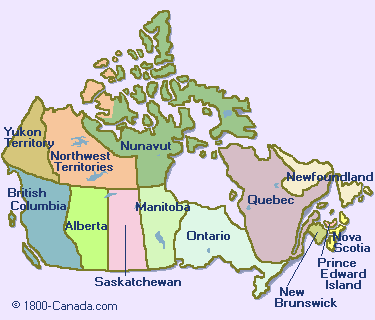
Map of Canada
Map of Canada

Story in the National Post. (H/T Andrew)

Excerpt:

Newcomers to the country generally make less money and chip in less in taxes than the national average.And allowing 250,000 immigrants into the country annually is costing us all billions of dollars each and every year, according to a study by the Fraser Institute.

The study, dubbed Immigration and the Canadian Welfare State, sharply criticizes Canada’s current immigration system, using earnings and other figures from the 2005-06 fiscal year reported by 844,476 people in the 2006 Census.

It claims the group as a whole earned on average about $10,000 more and paid about $2,500 more in income taxes annually than those within the sampling who had settled in Canada in the previous 18 years.

The study also found immigrants typically pay a little over $6,000 less in property and sales taxes than the national average.

That means the approximately 3.9 million immigrants who settled in Canada between 1987 and 2004 are shortchanging federal government coffers by between $16.3 billion and $23.6 billion annually, depending on how many of those newcomers have moved back home, emigrated elsewhere or died, the study said.

[…]The study also takes on the notion that immigrants are helping the country by taking menial jobs that most Canadians don’t want.”Immigrants do fill jobs that Canadians don’t want and thus benefit the economy but, in the absence of immigration, these jobs would pay higher wages and would be filled by Canadians or eliminated by the application of labour-saving technology,” the study states.

“Under these conditions, poverty in Canada would be reduced substantially.”

As for changes, the study suggests annual immigration numbers should be increased or decreased, depending largely on “market forces.”

The study also recommends Canada be more selective, allowing only newcomers who have employment lined up, offering them citizenship only if they hang onto their job for a set number of years and deporting those who lose their jobs.

Canada has a welfare state with single-payer health care, public housing, welfare payment and free public schools. So, people who cannot pull their own weight can rely on all of these goodies provided by the working Canadians. Because of these generous benefits, Canada has a lot of people who would like to move there from poor countries. And they can’t possibly take them all in because it is costing the working Canadians billions of dollars. But there is a way for them to allow more immigration – they just have to stop all of their government handouts. If there were no handouts then everyone could come to Canada freely, because they would go home again unless they held on to their job and pulled their own weight. They could even bring their families once they had worked hard enough to support them – but those family members would not be eligible to get money from the government.

So what do we as Americans learn from this? Well, we need to make sure that the people who come here are selected on the basis of their skills, their education, their ability to pay their own way. We need to have a big fence to keep illegal immigrants out, and we need to have a huge gate to allow skilled legal immigrants in. And they can even bring their families with them – as long as they don’t get a dime of taxpayer money in cash or through social programs – they should have to pay for everything they use, including schools and health care. And they should not be eligible for a dime of government money until they get their green cards after years of demonstrated hard work and clean living.

Governor Christie schools teacher on financial realities

I found a funny video on Hot Air and also on Ponder With Us.

I don’t agree with Governor Christie on everything – he is the governor of one of the bluest states in the Union. But this is just awesome.

Here’s more Chris Christie:

And even more:

He seems like a very authentic person and has a good command of the facts.