Tag Archives: Belief

Why do people become atheists? Can an unwise person be a Christian?

Why do people become atheists? Let’s take a look at some examples.

From this post on “Atheist Nexus“, there’s this blurb about Michael Shermer:

Dr. Shermer characterizes himself as a skeptic. As he confesses in his book, “What I want to believe based on emotions and what I believe based on evidence and empirical data may not coincide. I am a skeptic not because I don’t want to believe, but because I want to know. How can we tell the difference between what we would like to be true or what is actually true” (p. 2)? Dr. Shermer succumbed to skepticism after his girlfriend, Maureen, was critically injured in an auto accident and he appealed to God for her healing. “What finally tipped my belief into skepticism was the problem of evil–if God is all knowing, all powerful, and all good, then why do bad things happen to good people?” “A just and loving God who had the power to heal would surely heal Maureen. He didn’t. He didn’t. I now believe, not because God works in mysterious ways or he has a special plan for Maureen, but because there is no God” (p. 45).

Here’s what got John Loftus started on atheism, according to his own book:

Loftus starts off reminiscing on his deconversion story by stating that it was an appeal to the emotions, and not so much for intellectual reasons: “Some former believers have rejected their faith based upon the evidence itself. My initial reasons for rejecting the Christian faith are not the same ones that others have had…For me there were three major circumstances that happened in my life that changed my thinking. They all happened within the space of about five years, from 1991 to 1996. These things are associated with three people: A woman I’ll call Linda, Larry, and Jeff. It was Linda who brought a major crisis into my life. Larry brought new information into my life. Jeff took away my sense of a loving Christian community…” (first paragraph, pg. 25)

Not far off, things start to get a little weird: “I was the founding president of a shelter for the homeless in Angola, Indiana, where I was ministered. It was devoted to giving temporary shelter to people in need. I worked day by day with Linda, the executive director. She practically idolized me. She did everything I said to do, and would call me daily to ask for help in dealing with various situations that came up from running the shelter, along with her own personal issues. I was also having problems with my marriage at the time, and Linda made herself available to me. I succumbed and had an affair with her…”

Loftus does not hesitate to get into the details of his extramarital affair with someone who was an alledgely “a former stripper in her younger days” who “had it in for preachers.”

He complains that other Christians were “quick to condemn” him. He didn’t like being judged.

Previously, I wrote about Lewis Wolpert‘s decision to abandon God – because when he was a child, God would not help him find his cricket bat. (His own words in the linked pocast).

And here is the case of Dan Barker, who decided that wandering across the country singing for “love offerings” was a stable enough financial arrangement to support a family. When his sensible plan failed, he began appealing to more liberal Christians in order to make more money, and adapting his message to suit his audience. Eventually, the hypocrisy became uncomfortable and he dumped God. (This is my conclusion from his own words in the podcast).

Excerpt:

I think [Dan Barker] abandoned his faith because he wanted people to like him and because he needed to be invited to liberal churches in order to make money to pay for the “real life” needs of his family.

He seems to have thought that Christianity is about having his needs met and being liked by others. I think he wanted to feel good and to make people feel good with his preaching and singing. He seems to have become aware that the exclusive claims of Christianity made other people feel offended, so he cut them out. He hadn’t studied philosophy, science or history so that he would have been able to demonstrate to other people whether what he was saying was true. It’s hard to offend people when you don’t really know whether your claims are true or not, and when you don’t know how to demonstrate whether they are true or not.

I also think money was a factor. It seems to me that it would have hurt his career and reduced his invitations from liberal churches if he had kept up teaching biblical Christianity. In order to appeal to a wider audience, (like many Christian singers do – e.g. – Amy Grant, Jars of Clay, etc.), he would have felt pressured to water down the unpleasant parts of his preaching and singing. Lacking apologetics skill, he instead abandoned his message. He needed to account for his family’s needs and “real life”, and exclusive truth claims and Hell-talk would probably have reduced his ability to do that. It seems to me that he should have scaled back his extreme schedule of preaching and singing, and instead gotten a steady job so that he could afford “real life” and a family without being pressured into altering his message.

There never was a cognitive process for these atheists. There was just the dashed expectations in a Santa Claus God. I think that every person has to decide for themselves whether they have done a fair assessment of the evidence for and against God. You decide whether God exists based on whether he is nice to you, and whether he prevents suffering for you. It is a blessing to suffer for the sake of righteousness, and even Jesus suffered for being obedient to God. Your level of happiness simply has no bearing on the arguments and evidence for God’s existence. When it comes to arguments about the origin of the universe and the fine-tuning and the moral argument, your feelings and needs are irrelevant.
Melanie Phillips: The real intolerance comes from secularism

Here’s a great post by conservative British journalist Melanie Phillips. (I think she is Jewish, by the way)

Excerpt:

I have a rather different take on this great division of our age. My view is that while we may be in a post-biblical — and post-moral — age, we have not disposed of belief. Far from it. We have just changed what we believe in. Our society may have junked the Judaeo-Christian foundations of the West for secularism. But this has given rise to a set of other religions. Secular religions. Anti-religion religions.

These are also based on a set of dogmas. They proselytise. They involve faith. But unlike the Judaeo-Christian thinking they usurp, these secular anti-religions suspend truth and reason. What’s more, I would say that it was the Judaic foundations of the West which, far from denying reason, gave the world both reason and science in the first place.

God has been pronounced dead, and in his place have come man-made ideologies — in which people worship not a divine presence but an idea.

These ideas, which brook no dissent, give rise inescapably to intolerance and indeed to tyranny. Indeed, they are far more tyrannical in their effect than the God of the Hebrew Bible who gets such a bad press for being so authoritarian. In fact, he has a truly terrible time getting his way. His people are always complaining, refusing to do what he tells them, blaming him for everything and always, always arguing with him. But ideologies which represent the will of man bend everything to the governing idea, which cannot be gainsaid. There can be no argument with them.

Rather than being rational, I suggest these are irrational; not tolerant at all, but deeply illiberal; not open to other ideas, but as dogmatic as any medieval pope. Indeed, these atheistic ideologies are reminiscent not just of religion but of medieval persecutions, witch-hunts and inquisitions.

Let me illustrate all this with an anecdote. After a debate in which he took part some time ago, I pressed Richard Dawkins on his belief that the origin of all matter was most likely to have been an entirely spontaneous event — which meant he therefore surely believed that something could be created out of nothing. Since this ran counter to the scientific principle of verifiable evidence which he tells us should govern all our thinking, this itself seemed to be precisely the kind of irrationality which he scorns.

In reply, he acknowledged that I had a point but said that the alternative explanation — God — was more incredible. But then he remarked that he was not necessarily averse to the idea that life on Earth had been created by a governing intelligence — provided, however, that such an intelligence had arrived on Earth from another planet. Leaving aside the question of how that extra-terrestrial intelligence had itself been created in the first place, I put it to him that he appeared to be saying that “little green men” provided a more plausible explanation for the origin of life on Earth than God. Strangely, he didn’t react to this well at all.

However, Dawkins is not the first scientist to have suggested this. It is a theory which was put forward by no less than Professor Francis Crick, one of the discoverers of DNA.

A committed atheist, Francis Crick found it impossible to believe that DNA could have been the product of evolution. In 1973, Crick and the chemist Leslie Orgel published a paper in the journal Icarus suggesting that life may have arrived on Earth through “directed panspermia”. According to this theory, micro-organisms were supposed to have travelled in the head of an unmanned spaceship sent to Earth by a higher civilisation which had developed elsewhere some billions of years ago. The spaceship was unmanned so that its range would be as great as possible. Life started here when these organisms were dropped into the primitive ocean and began to multiply. Subsequently, Crick abandoned this theory and returned to the idea of the spontaneous origin of life from purely natural mechanisms.

How can someone so committed to reason be so irrational as to entertain such a fantasy?

What I found great about this article is that even though Melanie Phillips is a popular columnist, she actually deals with evidence when talking about God. So often on Christian blogs, you can read tons of posts that are really just inside baseball for Christians. It’s just pablum or lists of todos. The right way to talk about God is by talking about the evidence. Even Melanie Phillips sees that. Why don’t we?

I think we need to be very forthright when speaking with atheists and call them out for what they are. They are the people who hate astrophysics, and despise the Big Bang cosmology. They are the believers in the unobservable, untestable multiverse. They are the believers in the unobservable, untestable aliens who seed the Earth with life. They are the believers in the as-yet-undiscovered Cambrian precursor fossils. They believe that material processes can somehow produce creatures that have free will and consciousness. They are the ones who think that right and wrong are purely arbitrary – matters of opinion that are decided one way or the other in different times and places. They are the ones who believe that when you die, you are not accountable for anything you’ve done, and nothing that you’ve done has ultimate meaning. Let’s be up front about all of that, and hold them accountable for their anti-science, anti-morality, anti-human views. And let’s hold them accountable for running away from debates with their tails between their legs – like that coward Richard Dawkins did.

New study on tidal heating strengthens stellar habitability argument

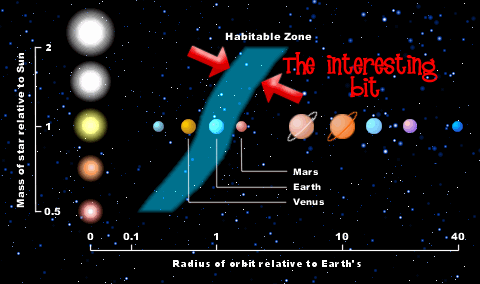
Circumstellar Habitable Zone

Note: If you need a refresher on the habitability argument, click here.

Here’s an article entitled “Tidal heating shrinks the ‘goldilocks zone’: Overlooked factor suggests fewer habitable planets than thought”. It appeared in Nature, the most prestigious peer-reviewed science journal.

The gist of it is that tidal forces can alter orbits so that planets don’t spend all of their orbit in the habitable zone. If planets go outside the habitable zone, it damages their supply of liquid water, and any life chemistry going on in there is disrupted.

Excerpt:

A previously little-considered heating effect could shrink estimates of the habitable zone of the Milky Way’s most numerous class of stars — ‘M’ or red dwarfs — by up to one half, says Rory Barnes, an astrobiologist at the University of Washington in Seattle. That factor — gravitational heating via tides — suggests a menagerie of previously undreamt-of planets, on which tidal heating is a major source of internal heat. Barnes presented the work yesterday at a meeting of the American Astronomical Society’s Division on Dynamical Astronomy in Timberline Lodge, Oregon.

The habitable zone is the orbital region close enough to a star for a planet to have liquid water, but not so close that all of the water evaporates. For our Sun, the zone extends roughly from the inner edge of the orbit of Mars to the outer edge of that of Venus. For smaller, cooler stars, such as M-class dwarfs, the zone can be considerably closer to the star than Mercury is to the Sun. And because close-in planets are easier to spot than more distant ones, such stars have been a major target for planet hunters seeking Earth-like worlds.

There’s just one problem with finding habitable planets around such stars, says Barnes. Because tidal forces vary dramatically with the distance between a planet and its star, closer orbits also result in massively larger tidal forces.

Since planets do not have perfectly circular orbits, these tidal forces cause the planet to flex and unflex each time it moves closer to or further from its star; kneading its interior to produce massive quantities of frictional heat. Substantial heat can be produced, he added, with even slight deviations from a perfectly circular orbit. And, Barnes notes, other factors — such as the rate of the planet’s rotation and its axial tilt — can also influence heat production.

A similar tidal process makes Jupiter’s moon Io the most volcanic body in the Solar System. “I’m just scaling that Io–Jupiter system up by a factor of 1,000 in mass,” Barnes said at the meeting. “It’s the same process, on steroids.”

So, stars that are smaller and cooler will have a habitable zone that is closer to the star, exposing them to more tidal forces. More tidal forces makes their orbits less likely to stay circular – within the habitable zone around the star. These variations cause an increase in heat production on the planet. Too much heat means that the planet is unable to support liquid water on the surface, making it inhospitable for life. Therefore, solar systems with less massive stars can be ruled out as possible sites for life, because of these tidal forces.