
Tag Archives: Balanced Budget

John Key leads New Zealand conservatives to 48-25 majority victory over leftists

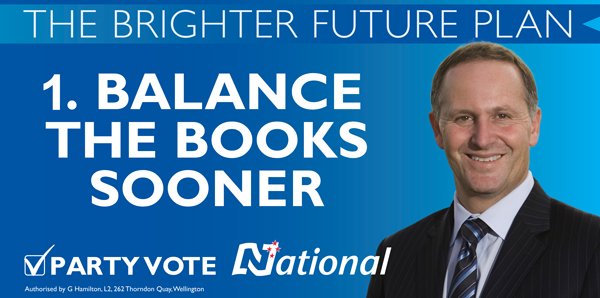
National Party leader John Key

Note: The New Zealand conservative party is called the National Party, but their policies are center-right, at least on fiscal issues.

The Wall Street Journal reports on a stunning victory.

Excerpt:

John Key is set to lead New Zealand for a third consecutive term after official results showed his party garnered 48% of the national vote, and would likely end up with 61 seats in a 121-member Parliament.

[…]David Cunliffe, leader of the main opposition Labour Party, conceded defeat late Saturday. The Labour Party picked up 25% of the overall vote, according to the Electoral Commission, while the Green Party, always thought to be its likeliest coalition partner, won 10%.

The 53-year-old Mr. Key has helped steer New Zealand to a level of prosperity rarely found in developed countries since the global financial crisis, campaigning against a backdrop of the strongest economic growth in a decade.

[…]Mr. Key’s victory was stronger than opinion polls were predicting. Meanwhile, Labour’s weak showing was the worst since the 1920s, prompting speculation of a possible change in leadership, though Mr. Cunliffe said he had no plans to resign. “I don’t believe that rotating the leaders is the key to changing and upgrading our party,” he said Sunday in a television interview. “If I did, I would simply stand down now.”

The University of Otago’s Mr. Edwards said it would be difficult for Mr. Cunliffe to reassert his authority after Labour’s poor result, but added that the party still had no obvious replacement.

The Green party’s support was little changed from 2011, despite opinion polls predicting it could win as much as 14% of the vote. Green Party Co-leader Metiria Turei said Sunday the party had consolidated its 2011 result and held on to its 10% support even though the country had swung to the right.

The National Party is not achieving this economic growth by raising taxes on individuals and job creators – New Zealand has the second lowest taxes in the industrialized world.

Look:

Many countries have been working hard to improve their tax codes. New Zealand is a good example of one of those countries. In a 2010 presentation, the chief economist of the New Zealand Treasury stated, “Global trends in corporate and personal taxes are making New Zealand’s system less internationally competitive.” In response to these global trends, New Zealand cut its top marginal income tax rate from 38 percent to 33 percent, shifted to a greater reliance on the goods and services tax, and cut their corporate tax rate to 28 percent from 30 percent. This followed a shift to a territorial tax system in 2009. New Zealand added these changes to a tax system that already had multiple competitive features, including no inheritance tax, no general capital gains tax, and no payroll taxes.

In a world where businesses, people, and money can move with relative ease, having a competitive tax code has become even more important to economic success. The example set by New Zealand and other reformist countries shows the many ways countries can improve their uncompetitive tax codes.

Compare that with the United States which is stuck down at 30 out of 32 countries! We have a lower median income and labor force participation than we did five years ago, despite packing over NINE TRILLION dollars onto the national debt.

John Key isn’t packing trillions onto his country’s national debt  they are set to balance the budget in the coming year. And more than the balance budget, he is also trying to privatize bloated, inefficient state-run companies. Imagine what we could do if we privatized the USPS, the departments of motor vehicles and AMTRAK. Just cut the fat out completely.

So now we have conservative majority governments in Canada (Harper), Australia (Abbott) and New Zealand (Key).

Would the Republican “cut, cap and balance” plan solve the debt crisis?

Let’s take a look at the Republican “Cut, Cap and Balance” plan, as reported by CBS News.

Excerpt:

The House next week will take a vote to raise the debt ceiling and pass a balanced budget amendment, House Republican leaders said today.

The plan is unlikely to go anywhere, since a balanced budget amendment would likely fail in the Democrat-led Senate, but GOP leaders nevertheless called it a serious plan to raise the debt ceiling. They said President Obama and Democrats have failed to come up with an equally serious plan.

“We asked the president to lead,” House Speaker John Boehner said in a press conference today. “We asked him to put forward a plan — not a speech, a real plan — and he hasn’t. We will.”

The “cut, cap and balance” proposal would make raising the debt ceiling contingent on Congress sending a balanced budget amendment to the states. It would also cap government spending at 18 percent of Gross Domestic Product over the next 10 years.

The plan would raise the debt ceiling by $2.4 trillion, since that is the increase requested by the president. However, the plan would actually make even more in spending cuts — as much as $111 billion in 2012 alone.

[…]Boehner said the House would vote on the “cut, cap and balance” plan and then decide how to proceed from there.”I don’t want to preclude any chance of coming to an agreement, but [Democrats have] been unwilling to put a real plan on the table,” Boehner said. “Without serious spending cuts or real reform to entitlement programs, this problem is not going to be solved.”

That’s what the Republicans would do if they were in control. The balanced budget amendment would cap spending at 18% of GDP, so that we would never have a debt crisis ever again. That’s the right solution, except that the Democrats cannot give up the idea of buying votes with the money they steal from job creators. They just can control their addiction to spending.

Now, let’s take a look at who caused the debt crisis, with this House Budget Committee article by fiscal hawk Paul Ryan. (H/T Washington Post)

Excerpt:

While President Obama has recently professed a newfound — and vague — desire to cut government spending, it’s useful to recall what the President has actually done since taking office in 2009. The President signed into law a massive spending spree that plunged us deeper into debt, and failed to deliver on its promise to create jobs.

  • 24% Increase in Base Spending. Non-defense discretionary spending grew by 24% for the first two years of the Obama Administration, adding $734 billion in spending over the next 10 years.
  • Record Government Spending. The Federal government will spend $3.6 trillion this year, 24% of gross domestic product (GDP) and the highest burden on the economy since World War II. Spending has historically averaged a little over 20% of GDP.
  • President’s Budget Makes Matter Worse. According to CBO, the President’s budget never spends less than 23% of GDP and by the end of the decade rises to 24% of GDP. His budget’s failure to address the drivers of our debt threatens the health and retirement security of America’s seniors, and the economic security of all Americans. The President’s budget seeks to spend $46 trillion in government spending over the next decade, and has subsequently fought against House Republican efforts to restrain his spending appetite down to $43.5 trillion.

During the four years when Nancy Pelosi was the Speaker of the House, and Harry Reid was in control of the Senate, the Democrats packed 5.34 trillion dollars onto the national debt.

What economic policies do left-wing and right-wing economists agree on?

This article is from Harvard economist Greg Mankiw. (H/T Michael)

Excerpt:

Here is the list, together with the percentage of economists who agree:

  1. A ceiling on rents reduces the quantity and quality of housing available. (93%)
  2. Tariffs and import quotas usually reduce general economic welfare. (93%)
  3. Flexible and floating exchange rates offer an effective international monetary arrangement. (90%)
  4. Fiscal policy (e.g., tax cut and/or government expenditure increase) has a significant stimulative impact on a less than fully employed economy. (90%)
  5. The United States should not restrict employers from outsourcing work to foreign countries. (90%)
  6. The United States should eliminate agricultural subsidies. (85%)
  7. Local and state governments should eliminate subsidies to professional sports franchises. (85%)
  8. If the federal budget is to be balanced, it should be done over the business cycle rather than yearly. (85%)
  9. The gap between Social Security funds and expenditures will become unsustainably large within the next fifty years if current policies remain unchanged. (85%)
  10. Cash payments increase the welfare of recipients to a greater degree than do transfers-in-kind of equal cash value. (84%)
  11. A large federal budget deficit has an adverse effect on the economy. (83%)
  12. A minimum wage increases unemployment among young and unskilled workers. (79%)
  13. The government should restructure the welfare system along the lines of a “negative income tax.” (79%)
  14. Effluent taxes and marketable pollution permits represent a better approach to pollution control than imposition of pollution ceilings. (78%)

I wonder which political party believes in most or all of these positions?

Hmmmmn.