Tag Archives: Atheists

Matt Dillahunty debates David Robertson on atheism, morality and evil

Two Rams butting heads: may the best ram win!

OK. So I think it’s safe to say that of all the Christian apologists out there, David Robertson is my least favorite debater. Why? Many reasons, but mostly because he does not bring in evidence, especially scientific evidence. And he seems to make these clever quips like G. K. Chesterton. I like evidence. I would rather that he talk about scientific and historical evidence.

Well, Dina asked me to listen to this debate between David Robertson and agnostic Matt Dillahunty (he’s not an atheist, he’s just an agnostic) and I went in absolutely convinced that Robertson was going to have his ass handed to him by Matt Dillahunty. And I could not have been more wrong.

Here’s the debate posted on YouTube (audio only):

This snarky summary is just a paraphrase from certain parts of the debate, it is not designed for accuracy, but for fun – to make you listen to the debate. Listen to the debate to get the exact words in context.

Summary:

  • Matt Dillahunty: he’s an agnostic who calls himself an atheist
  • David Robertson: he’s from Scotland, could we not get someone better?
  • Robertson opening statement is incredibly weak, as you might expect, he only had two arguments embedded in a long list of nonsense: 1) origin and design of the universe 2) reality of evil requires objective morality

1) Creation/Design:

Robertson: The fact is that matter exists. There are 3 views that could account for this fact: 1) created, 2) eternal, 3) self-generated out of nothing. 3) is self-contradictory, 1) requires a Creator, and 2) is falsified by the Big Bang cosmology. So what’s your view?

Dillahunty: You’re trying to get me to say what my view is, but I can just say “I don’t know” and get out of having to take any position on how matter got here.  I can say “I don’t know” to all the scientific evidence for the Big Bang cosmology, too!

2) Evil requires objective morality, requires a moral lawgiver:

Robertson: evil exists, e.g. – the Holocaust. If atheism is true, objective morality is impossible. Richard Dawkins agrees. Therefore, theism is the best explanation for the existence of evil.

Dillahunty: In my opinion, morality means doing what helps people have well-being. And I think that the Holocaust is obviously bad, because it hurts the well-being of the victims.

Robertson: The problem is that people decide what well-being is.If you were raised in the Social Darwinism of the Nazi regime, you would believe that the Holocaust was the best for the well-being of the society as a whole.

Dillahunty: Isn’t it obvious that killing people is bad for their well-being?

Robertson: Is it bad for the well-being of unborn children to kill them?

Dillahunty: Yes

Robertson: So you’re against abortion, then?

Dillahunty: No

Robertson: So you think that killing the child in the womb is against the well-being of the child, but you’re for that?

Dillahunty: I don’t know! I don’t know!

Then Dillahunty tried to claim Hitler was a Christian:

Dillahunty: here is a quote by Hitler saying that secular schools are bad, and religious schools are good – see, he’s a Christian!

Robertson: when was that said and to whom?

Dillahunty: I don’t know, I don’t know!

Robertson: It was said in 1933, during an election campaign, to Catholic authorities – he was a politician, looking for votes from Catholics so he could become Chancellor.

Good and evil on atheism:

Dillahunty: good actions results in states with more well-being, and evil actions result in states with less well-being.

Brierley: but when the Nazis slaughtered all those people, they believed they were increasing well-being

Dillahunty: But you could demonstrate to them that their action is not going to increase well-being. Survival of the fittest is descriptive of what happens, but it’s not prescriptive.

Robertson: Whose well-being will human beings think about most, if not their own? Do you really think that you can stop people like Charles Manson from being evil by sitting down and trying to prove to them that they are not helping their victim’s well-being?

(A BIT LATER)

Robertson (to Dillahunty): Is it a fact that Dachau (a concentration camp) was morally wrong?

Dillahunty: (literally, not a paraphrase) I DON’T KNOW

My thoughts:

When I listened to this debate, the overwhelming conviction that emerges is that Matt Dillahunty is not someone who forms his worldview based on evidence. His rejection of the Big Bang cosmology with “I don’t know” is just atrocious. His comments about slavery in the Bible and Hitler being a Christian show that his investigations of these issues is far below the level of a responsible adult. His dallying with the Jesus-never-existed view just shows him to be fundamentally anti-intellectual, as even Bart Ehrman denies that view. His definition of faith has nothing to do with the Bible, or Christian authorities, or Christian scholars – it’s just something that atheists invent and believe among themselves, with no reference to reality. Why? Because it makes them feel more intelligent to look down on others, even if they have to lie to themselves to do it. When asked to state his positions or respond to specific evidence, his response is very often “I don’t know”. It seems to me that atheism, to him, means not pursuing truth with the aim of grasping it. He wants to keep reality at a safe distance. This is not intellectually responsible – we are supposed to be searching for truth.

On morality, it’s even worse. It’s not surprising to me that he is pro-abortion and has no opinion about concentration camps being objectively evil. Most atheists are pro-abortion, by the way, which tells you a lot of their misappropriation of moral language when it suits them. When it comes to morality, Dillahunty only has his own personal opinions, and they refer to nothing outside his own mind. (His opinion of morality as related to well-being is utilitarianism – a very problematic view – but moreover, it is his view and different people will differ on what constitutes well-being). Without an after-life, there is no reason for anyone to care about the moral point of view when it goes against their self-interest, anyway. Atheists use moral language, but there is nothing substantial there, because their statements are not referring to any objective, prescriptive moral reality. Atheism is materialistic and therefore deterministic – it does not even ground the free will that is needed to make moral choices. Their view is Darwinian survival of the fittest, that’s what emerges from their origins story – and it does not rationally ground morality. The strong kill the weak, if they can. I’ve written before about how difficult it is for atheists to rationally condemn things like slavery, and nothing in Dillahunty’s presentation led me to believe that he had solved that problem.

Anybody can be an intellectually-satisfied atheist with an empty head – it’s knowledge that causes people to conform their beliefs to reality.

Positive arguments for Christian theism

How do atheists try to accommodate the Big Bang in their worldview?

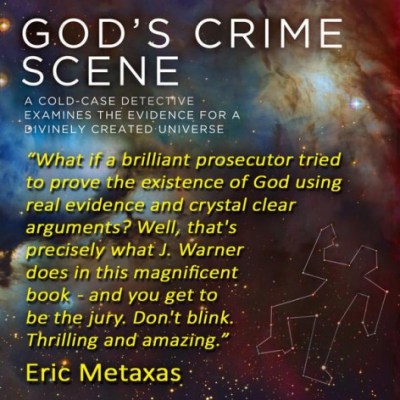
J. Warner Wallace: God's Crime Scene
J. Warner Wallace: God’s Crime Scene

OK, so J. Warner Wallace has a new book out and it’s about science and God. I know, because I saw pictures of his reading list, that he has read tons and tons of atheists like Carl Sagan, Lawrence Krauss and so on.

He’s writing about some of the things he learned from all this reading on his blog, and I wanted to link to something about Lawrence Krauss trying to accommodate the Big Bang within his worldview of atheism.

Wallace writes:

One of the key pieces of evidence in the universe is simply it’s origin. If our universe began to exist, what could have caused it’s beginning? How did everything (all space, time and matter) come into existence from nothing? One way atheist physicists have navigated this dilemma has simply been to redefine the terms they have been using. What do we mean when we say “everything” or “nothing”? At first these two terms might seem rather self-explanatory, but it’s important for us to take the time to define the words. As I’ve already stated, by “everything” we mean all space, time and matter. That’s right, space is “something”; empty space is part of “everything” not part of “nothing”. For some of us, that’s an interesting concept that might be hard to grasp, but it’s an important distinction that must be understood. When we say “nothing”, we mean the complete absence of everything; the thorough non-existence of anything at all (including all space time and matter). These two terms, when defined in this way, are consistent with the principles of the Standard Cosmological Model, but demonstrate the dilemma. If everything came from nothing, what caused this to occur? What is the non-spatial, atemporal, immaterial, uncaused, first cause of the universe? A cause of this sort sounds a lot like a supernatural Being, and that’s why I think many naturalists have begun to redefine the terms.

Lawrence Krauss, Arizona State University Professor (School of Earth and Space Exploration and Director of the Origins Initiative) wrote a book entitled, “A Universe from Nothing: Why There Is Something Rather than Nothing”. As part of the promotion for the book, Krauss appeared on the Colbert Report where he was interviewed by comedian Stephen Colbert. During the interview, Krauss tried to redefine “nothing” to avoid the need for a supernatural first cause:

“Physics has changed what we mean by nothing… Empty space is a boiling, bubbling brew of virtual particles popping in and out of existence… if you wait long enough, that kind of nothing will always produce particles.” (Colbert Nation, June 21st, 2012)

Now if you’re not careful, you might miss Krauss’ subtle redefinition. In describing the sudden appearance of matter (“particles”), Krauss assumes the prior existence of space (“empty space”) and time (“if you wait long enough”). If you’ve got some empty space and wait long enough, matter appears. For Krauss, the “nothing” from which the universe comes includes two common features of “everything” (space and time), and something more (virtual particles). This leaves us with the real question: “Where did the space, time and virtual particles come from (given all our evidence points to their origination at the beginning of our universe)?” Krauss avoids this inquiry by moving space and time from the category of “something” to the category of “nothing”.

If you’ve got a teenager in your house, you might recognize Krauss’ approach to language. I bet you’ve seen your teenager open the refrigerator door, gaze at all the nutritious fruits and vegetables on the shelves, then lament that there is “nothing to eat.”

I used to say that when I was a teenager, but I grew out of it. I didn’t go on the Comedy Channel and try to convince everyone that what I was saying about the refrigerator was scientific.

Anyway, here is a debate between William Lane Craig and Lawrence Krauss, if you want to see how Krauss defends his “refrigerator has nothing to eat” view of cosmology. I know everybody and even many Christians all think that we have something to hide when it comes to science, but if you would just watch these debates, you would see that there is nothing to fear from science at all. We own it.

Meanwhile, I want to show you that this is not at all rare among atheists.

Look, here is Peter Atkins explaining how he makes the Big Bang reconcile with his atheism – and notice that it’s a completely different view than Krauss:

So, just who is this Peter Atkins, and why is he a good spokesman for atheism?

From his Wikipedia bio.

Peter William Atkins (born August 10, 1940) is an English chemist and a fellow and professor of chemistry at Lincoln College of the University of Oxford. He is a prolific writer of popular chemistry textbooks, including Physical Chemistry, 8th ed. (with Julio de Paula of Haverford College), Inorganic Chemistry, and Molecular Quantum Mechanics, 4th ed. Atkins is also the author of a number of science books for the general public, including Atkins’ Molecules and Galileo’s Finger: The Ten Great Ideas of Science.

[…]Atkins is a well-known atheist and supporter of many of Richard Dawkins’ ideas. He has written and spoken on issues of humanism, atheism, and what he sees as the incompatibility between science and religion. According to Atkins, whereas religion scorns the power of human comprehension, science respects it.

[…]He was the first Senior Member for the Oxford Secular Society and an Honorary Associate of the National Secular Society. He is also a member of the Advisory Board of The Reason Project, a US-based charitable foundation devoted to spreading scientific knowledge and secular values in society. The organisation is led by fellow atheist and author Sam Harris.

Now watch that 6-minute video above. Peter Atkins thinks that nothing exists. He thinks he doesn’t exist. He thinks that you don’t exist. This is how atheism adapts to a world where the Big Bang creation event is fact.

I think Peter Atkins should join Lawrence Krauss on the Comedy Channel and present that view. I would laugh. Wouldn’t you?

The importance of having a narrative when confronting the assumption of naturalism

Apologetics and the progress of science

How do you present theism as a rational belief to a person who thinks that the progress of science has removed the need for God?

Canadian science writer Denyse O’Leary writes about the history of cosmology at Evolution News.

Excerpt:

What help has materialism been in understanding the universe’s beginnings?

Many in cosmology have never made any secret of their dislike of the Big Bang, the generally accepted start to our universe first suggested by Belgian priest Georges Lemaître (1894-1966).

On the face of it, that is odd. The theory accounts well enough for the evidence. Nothing ever completely accounts for all the evidence, of course, because evidence is always changing a bit. But the Big Bang has enabled accurate prediction.

In which case, its hostile reception might surprise you. British astronomer Fred Hoyle (1915-2001) gave the theory its name in one of his papers — as a joke. Another noted astronomer, Arthur Eddington (1882-1944), exclaimed in 1933, “I feel almost an indignation that anyone should believe in it — except myself.” Why? Because “The beginning seems to present insuperable difficulties unless we agree to look on it as frankly supernatural.”

One team of astrophysicists (1973) opined that it “involves a certain metaphysical aspect which may be either appealing or revolting.” Robert Jastrow (1925-2008), head of NASA’s Goddard Institute for Space Studies, initially remarked, “On both scientific and philosophical grounds, the concept of an eternal Universe seems more acceptable than the concept of a transient Universe that springs into being suddenly, and then fades slowly into darkness.” And Templeton Prize winner (2011) Martin Rees recalls his mentor Dennis Sciama’s dogged commitment to an eternal universe, no-Big Bang model:

For him, as for its inventors, it had a deep philosophical appeal — the universe existed, from everlasting to everlasting, in a uniquely self-consistent state. When conflicting evidence emerged, Sciama therefore sought a loophole (even an unlikely seeming one) rather as a defense lawyer clutches at any argument to rebut the prosecution case.

Evidence forced theorists to abandon their preferred eternal-universe model. From the mid 1940s, Hoyle attempted to disprove the theory he named. Until 1964, when his preferred theory, the Steady State, lost an evidence test.

Here is a quick summary of some of the experimental evidence that emerged in the last few decades that caused naturalists to abandon the eternal universe that they loved so much when they were younger.

The importance of having a narrative

Now I want to make a very, very important point about Christianity and the progress of science. And that point is that it is very important that Christians present the evidence in exactly the way that Denyse presented it in that article – in its historical context, featuring the conflict between naturalists and the experimental evidence.

All Christians should be familiar with the following basic pieces of evidence which fit the war between science and naturalism narrative:

  1. The origin of the universe
  2. The cosmic fine-tuning
  3. The origin of life (biological information)
  4. The sudden origin of the Cambrian phyla
  5. The habitability/observability correlation

When you talk about these evidences as a Christian theist to non-Christians, you have to have cultivated a genuine interest in reconciling your beliefs with science. You have to accept that there are two books that reveal God’s character and attributes. The book of nature, and the book of Scripture. And you need to be flexible about getting these two books to fit together. The book of nature gives us natural theology (see Romans 1). It tells us that God is Creator and Designer. The book of Scripture tells us that God stepped into history as a man to save us by taking the punishment for our headlong rush away from God, which the Bible calls sin. Science is one way that humans can recover some of basic knowledge about God. Knowledge that is only possible because God created and designed the universe (and us) in such a way that we are capable of making discoveries, and that the universe is capable of being explored and understood.

It’s very important to present these five basic evidences to non-Christians in the historical context. And here is the story you must tell: “In the beginning, there was the naturalism, and the naturalism tried to argue from ignorance that God was not Creator and God was not Designer. And then came the science, and now people have to give up their naturalism in order to not be crazy and irrational”. That’s the narrative you use when talking to non-Christians about science.

In the beginning was the naturalism:

  1. In pre-scientific times, atheists maintained that the universe was eternal
  2. In pre-scientific times, atheists maintained that a life-permitting universe was as likely as a life-prohibiting universe
  3. In pre-scientific times, atheists maintained that the cell was a simple blob of jello that could spontaneously emerge in some warm pond
  4. In pre-scientific times, atheists maintained that the sudden origin of the Cambrian phyla would be explained by subsequent fossil discoveries
  5. In pre-scientific times, atheists maintained that there was nothing special about our galaxy, solar system, planet or moon

But then science progressed by doing experiments and making observations:

  1. Scientists discovered redshift and the cosmic microwave background radiation (evidence for a cosmic beginning) and more!
  2. Scientists discovered the fine-tuning of gravity and of the cosmological constant and more!
  3. Scientists discovered protein sequencing and exposed the myth of “junk DNA” and more!
  4. Scientists discovered an even shorter Cambrian explosion period and the absence of precursor fossils and more!
  5. Scientists discovered galactic habitable zones and circumstellar habitable zones and more!

And now rational people – people who want to have true beliefs about reality – need to abandon a false religion (naturalism).

Now naturally, science is in a state of flux and things change. But you have to look at the trend of discoveries, and those trends are clearly going against naturalism, and in favor of Christian theism. No one is arguing for a deductive proof here, we are simply looking at the evidence we have today and proportioning our belief to the concrete evidence we have today. People who are guided by reason should not seek to construct a worldview by leveraging speculations about future discoveries and mere possibilities. We should instead believe what is more probable than not. That’s what a rational seeker of truth ought to do. Proportion belief to probabilities based on current, concrete knowledge.

Atheism, as a worldview, is not rooted in an honest assessment about what science tells us about reality. Atheism is rooted in a religion: naturalism. And the troubling thing we learn from looking at the history of science is that this religion of naturalism is insulated from correction from the progress of science. Nothing that science reveals about nature seems to be able to put a dent in the religion of naturalism, at least for most atheists.

It falls to us Christian theists, then, to hold them accountable for their abuse and misrepresentation of science. And that means telling the story of the progress of science accurately, and accurately calling out the religion of naturalism for what it is – a religion rooted in blind faith and ignorance that has been repeatedly and convincingly falsified by the progress of science in the modern era.

Positive arguments for Christian theism