
Tag Archives: Atheists

New study: belief in free will linked to ability to behave morally and to help others

Is it possible to choose to be moral if we are machines made out of meat?

A while back I finished reading “God’s Crime Scene”, the new book by J. Warner Wallace. I wanted to post something about some studies he mentioned in Chapter 6, on free will. This is one of the places where he found evidence in a surprising area.

Wallace says that free will makes more sense if theism is true, because we have non-material souls that interact with our bodies, but are not causally determined by them. On atheism, only matter exists, and you can’t get free will (or consciousness) from matter. So atheists like Sam Harris and Alex Rosenberg, for example, deny free will, because they are materialists and atheists.

Anyway, here’s what he writes on p. 256:

In 2008, researchers from the University of Minnesota and the University of British Columbia conducted experiments highlighting the relationship between a belief in determinism and immoral behavior. They found students who were exposed to deterministic literature prior to taking a test were more likely to cheat on the test than students who were not exposed to literature advocating determinism. The researchers concluded those who deny free will are more inclined to believe their efforts to act morally are futile and are, therefore, less likely to do so.

In addition, a study conducted by researchers from Florida State University and the University of Kentucky found participants who were exposed to deterministic literature were more likely to act aggressively and less likely to be helpful toward others.” Even determinist Michael Gazzaniga conceded: “It seems that not only do we believe we control our actions, but it is good for everyone to believe it.”” The existence of free will is a common characteristic of our experience, and when we deny we have this sort of free agency, there are detrimental consequences.

I decided to look up these studies.

Here’s the abstract for first study: (2008)

Does moral behavior draw on a belief in free will? Two experiments examined whether inducing participants to believe that human behavior is predetermined would encourage cheating. In Experiment 1, participants read either text that encouraged a belief in determinism (i.e., that portrayed behavior as the consequence of environmental and genetic factors) or neutral text. Exposure to the deterministic message increased cheating on a task in which participants could passively allow a flawed computer program to reveal answers to mathematical problems that they had been instructed to solve themselves. Moreover, increased cheating behavior was mediated by decreased belief in free will. In Experiment 2, participants who read deterministic statements cheated by overpaying themselves for performance on a cognitive task; participants who read statements endorsing free will did not. These findings suggest that the debate over free will has societal, as well as scientific and theoretical, implications.

And the abstract for the second study: (2009)

Laypersons’ belief in free will may foster a sense of thoughtful reflection and willingness to exert energy, thereby promoting helpfulness and reducing aggression, and so disbelief in free will may make behavior more reliant on selfish, automatic impulses and therefore less socially desirable. Three studies tested the hypothesis that disbelief in free will would be linked with decreased helping and increased aggression. In Experiment 1, induced disbelief in free will reduced willingness to help others. Experiment 2 showed that chronic disbelief in free will was associated with reduced helping behavior. In Experiment 3, participants induced disbelief in free will caused participants to act more aggressively than others. Although the findings do not speak to the existence of free will, the current results suggest that disbelief in free will reduces helping and increases aggression.

So what to make of this?

If you’re an atheist, then you are a physical object. And like every other physical object in the universe, your behavior is determined by genetic programming (if you’re alive) and external inputs. Material objects do not have the ability to make free choices, including moral choices.

Here’s prominent atheist Jerry Coyne’s editorial in USA Today to explain why atheists can’t ground free will.

Excerpt:

And that’s what neurobiology is telling us: Our brains are simply meat computers that, like real computers, are programmed by our genes and experiences to convert an array of inputs into a predetermined output. Recent experiments involving brain scans show that when a subject “decides” to push a button on the left or right side of a computer, the choice can be predicted by brain activity at least seven seconds before the subject is consciously aware of having made it. (These studies use crude imaging techniques based on blood flow, and I suspect that future understanding of the brain will allow us to predict many of our decisions far earlier than seven seconds in advance.) “Decisions” made like that aren’t conscious ones. And if our choices are unconscious, with some determined well before the moment we think we’ve made them, then we don’t have free will in any meaningful sense.

Atheist William Provine says atheists have no free will, no moral accountability and no moral significance:

Let me summarize my views on what modern evolutionary biology tells us loud and clear — and these are basically Darwin’s views. There are no gods, no purposes, and no goal-directed forces of any kind. There is no life after death. When I die, I am absolutely certain that I am going to be dead. That’s the end of me. There is no ultimate foundation for ethics, no ultimate meaning in life, and no free will for humans, either.

(Source)

If you don’t have free will, then you can’t make moral choices, and you can’t be held morally responsible. No free will means no morality. Can you imagine trying to get into any sort of enterprise with someone who has this view of moral choices? A marriage, or a business arrangement, etc? It would be crazy to expect them to behave morally, when they don’t even think that moral choices is possible. It just excuses all sorts of bad behavior, because no one is responsible for choosing to do the right thing.

Believers in materialism are going to struggle with prescriptive morality, including self-sacrificial care and concern for others. Their worldview undermines the rationality of the moral point of view. You might find atheists acting morally for their own purposes, but their worldview doesn’t rationally ground it. This is a big problem for people who can see objective morality woven into the universe – and themselves – because they have the awareness of objective right and wrong.

Choosing to do the right thing

I think what atheists like to say is “I can be moral, too”. That’s not interesting. What is interesting is whether it is rational for you to be moral when doing the right thing sets you back. When I look at the adultery of Dawkins, the polyamory of Carrier, the divorces of Shermer and Atkins, etc. I am not seeing anything that really wows me about their ability to do the right thing when it was hard for them to do it. They all deny free will of course, and think that trying to resist temptation is a waste of time.

Wallace explains how the awareness of free will and moral choices caused him to turn away from atheism, in this blog post.

He writes:

As an atheist, I chose to cling to naturalism, in spite of the fact that I lived each day as though I was capable of using my mind to make moral choices based on more than my own opinion. In addition, I sought meaning and purpose beyond my own hedonistic preferences, as though meaning was to be discovered, rather than created. I called myself a naturalist while embracing three characteristics of reality that simply cannot be explained by naturalism. As a Christian, I’m now able to acknowledge the “grounding” for these features of reality. My philosophical worldview is consistent with my practical experience of the world.

I think atheists who want to be honest about their own experience of first-person consciousness, free will, moral realism, etc. will do well to just accept that theism rationally grounds all of these things, and so you should accept theism. Theism is real. If you like morality, and want to be a virtuous person, then you should accept theism.
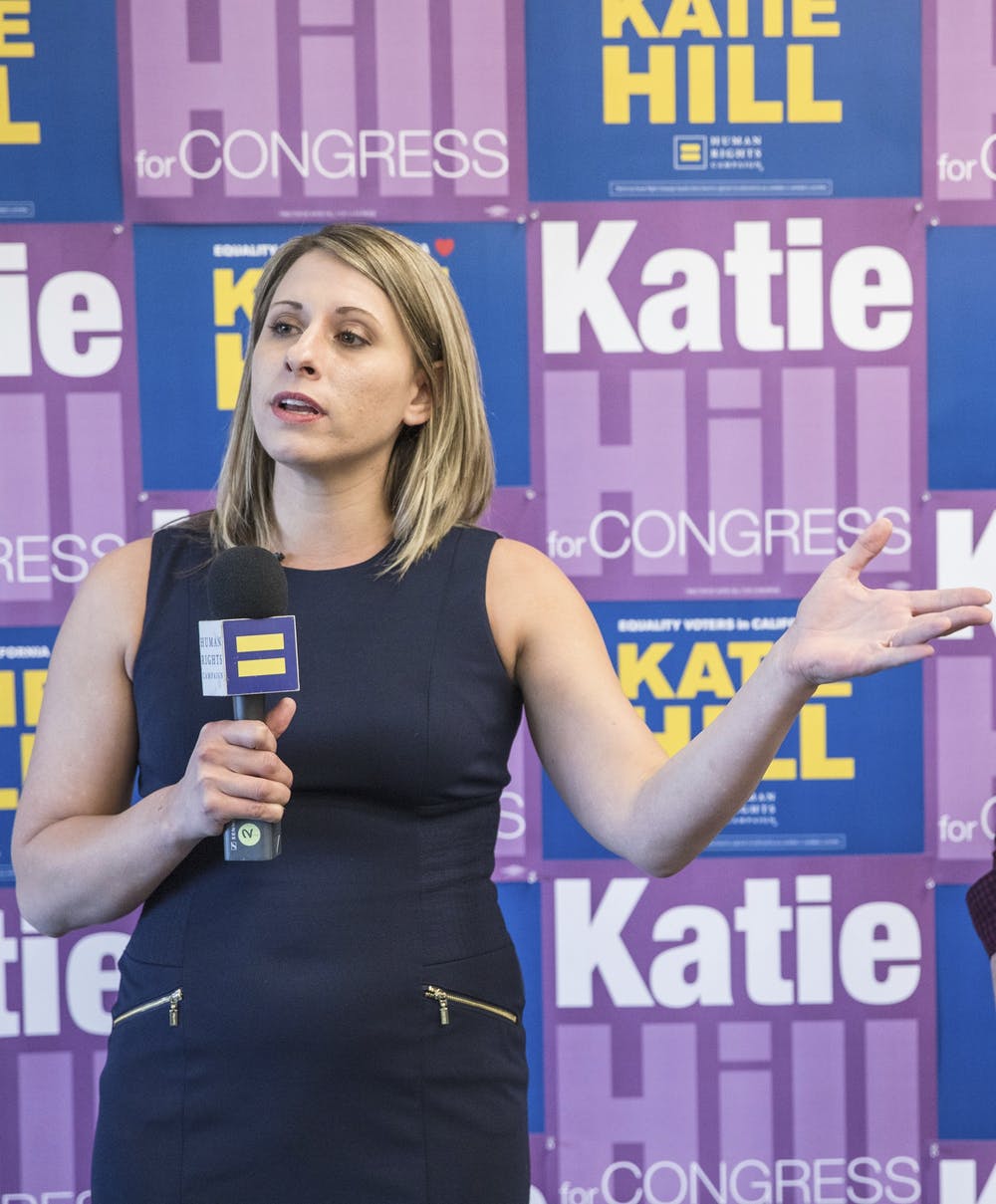
Gay rights activist Congresswoman admits to affair with younger campaign staffer

Here she is speaking for the Human Rights Campaign, a massive gay rights group
Katie Hill speaking for the Human Rights Campaign, a major gay rights group

When I saw all these stories coming out about Hollywood elites and Democrat mega-donors exposed for sexual harassment, pedophilia, rape, etc., I really started to wonder whether there is anything more to the Democrat party than championing sexual perversion and inflicting the consequences of that onto children, born and unborn. Here’s the latest Democrat sex scandal in the news.

Here’s the Washington Examiner reporting:

California Democratic Rep. Katie Hill was still paying consulting fees to her campaign staffer and former lover Morgan Desjardins, 24, as recently as last month.

According to FEC Records, since April 2019, Hill’s campaign has paid a little over $14,000 in fundraising-related consulting fees to Desjardins, doling out around $2,500 most months. Additionally, between 2017 and 2018, she made around $50,000 as a senior campaign staffer.

Hill, who is facing a House Ethics Committee investigation over allegations she had an intimate relationship with her legislative director, Graham Kelly, found herself under scrutiny after a nude photo of her brushing Desjardin’s hair was posted on the RedState.

Hill, 32, has admitted her relationship with Desjardins during her successful campaign for a House seat based in northern Los Angeles County but disputed any inappropriate relationship between her and Kelly occurred.

The image was posted along with text messages sent between Hill, the congresswoman’s estranged husband Kenny Heslep, whom she is divorcing, and Desjardins. According to the texts posted at RedState, the trio had an intimate three-way relationship during Hill’s first campaign for office, but it soured quickly after she won her race and went to Washington, D.C.

Now, the problem with having sex with your subordinates is that there is a power dynamic, because you are paying them. It’s easy to see what Katie Hill did as sexual assault and even rape, because her employees may have felt that they had to do whatever she wanted, e.g. – threesomes, with her, or they would lose their jobs. This is why companies outlaw relationships between employees – they don’t want people to use power within the company to pressure subordinates into sexual activities. Yet Democrats do this all the time and the mainstream media is silent about it.

Remember, even the pious, moral Muslim Ilhan Omar is now divorcing her husband because she had an affair with someone she was paying with campaign funds:

Rep. Ilhan Omar has filed for divorce from the father of her three kids, claiming the marriage is “irretrievable” — amid allegations that she had an affair with DC-based political consultant Tim Mynett.

[…]In August, The Post was first to report that DC-based doctor Beth Mynett had filed for divorce from her husband, Tim Mynett, alleging that he was carrying on an affair with Omar.

All the while, Omar’s campaign fund was paying Tim Mynett’s firm for work, including for travel.

Are Democrats really obsessed with sexual deviancy? Well, consider Democrats like Bill Clinton, Anthony Weiner, Eliot Spitzer, Eric Schneiderman, Ed Murray, etc. It seems like they are always involved in sex scandals. And in fact you can even see wealthy Democrat mega-donors like Jeffrey Epstein and Terry Bean getting charged with having sex with underage people all the time. (Terry Bean is the co-founder of the Human Rights Campaign, the largest gay rights group in the nation). The Democrat politicians who take money from the sexual deviants then try to change America to make what their donors are doing seem normal and even praiseworthy. That’s why Hillary Clinton threatened the women who accused her husband of rape and sexual assault.

Sexual deviancy seems to be the main plank in the Democrat party platform, and all the rest of the rhetoric about “free this” and “free that” is just to buy the votes needed to make all sorts of adult selfishness and sexual exploitation of the weak legal, and even immune to dissent and disapproval. Which is why Democrats are always using the government to attack Christians who disapprove of adult selfishness and sexual exploitation of the weak.

Now I have a question for you. What is it that young Democrat women are hoping to achieve by supporting the party of sexual deviance? Do they think that this will lead them to a faithful man, a stable marriage, well-behaved children and a peaceful home? If so, then maybe we ought to be having talks with young women about what sort of worldview grounds self-sacrificial love, commitment, and objective moral obligations. It sure isn’t the secular leftist nihilistic worldview of the Democrat party. If they want a Mike Pence marriage, then why not tell them to get the worldview of Mike Pence? They certainly won’t get to a Mike Pence marriage with the worldview of Katie Hill.

If you want to read more about Katie Hill’s destructive relationships, check out this story from Red State, which has blurred photos and text messages.

Non-Christian historian Bart Ehrman attended a Christian apologetics conference

Are we allowed to look at the Bible as a historical document?

My summaries of Bart Ehrman’s debates mock him for being a rigid Moody Bible Institute fundamentalist whose blind faith was shattered by 1) minor Bible difficulties, 2) disappointment that God allows good people to suffer, 3) wanting to look smart to his professors, and 4) the desire to make lots of money selling apostasy porn to the New York Times set. But maybe he is not as bad as I thought.

Consider this blog post in which Ehrman reports on his experiences at a recent apologetics conference, where he met with a few of the more effective and engaging evangelical scholars.

He writes:

I spent yesterday at a conservative evangelical apologetics conference outside of Chicago and, as you might imagine, I was the odd person out. But I was very well received, people were overwhelmingly gracious and receptive and openly grateful that I had come. There were jokes about being thrown into the lions’ den, but it didn’t really feel like it. It felt like I was speaking to a crowd that wanted to hear, respected what I said, and simply fundamentally disagreed. In particular there was a group of current Moody Bible Institute students there; really interesting, interested, and good humored, and we had a great time together.

What I was most interested in was how Christian apologetics – the intelligent “defense” of the claims of the faith – has changed in the many years since I was involved in the movement, shifted in ways I never would have imagined, very much away from our old fundamentalist assumptions and assertions into a far more reasonable and intellectually sustainable form of discourse that requires actual research and knowledge rather than hard-core theological assertion based on completely dubious premises.

[…]The issue at the conference were the “Contradictions” in the New Testament. How does one deal with apparent or real contradictions and still remain committed to an evangelical view of Scripture as inspired by God and in some sense “inerrant”?

[…]The discussions yesterday (well, most of them) were at a much, much higher academic/intellectual level than ones I’ve had, say, during a recent debate on the blog. I think some of the positions staked out yesterday were utterly, demonstrably, mind-bogglingly simply WRONG. But they were advanced with the kind of learning and historical knowledge that we simply didn’t see back in my apologetics days in the mid-1970s.

Roughly speaking I was hearing two positions, neither of them ones we were taught and advanced in the day (in my circles). One of the two strikes me as completely tenable, though again, only in a sense.

Our old position, back then, was that any contradiction in the New Testament Gospels (or the Bible, for that matter; but yesterday we were talking only about the Gospels) can in fact be reconciled if you look closely and deeply enough at the matter. ANY contradiction. To be sure, there may be places where you aren’t sure HOW to reconcile them, but in principle they are all reconcilable in one way or another.

And, as a corollary, everything the Bible says is literally true. There are no mistakes, of any kind, whatsoever, in the Bible.

[…]None of the three speakers yesterday has that view, even though they call the Bible inerrant and affirm that it is completely reliable. Their views strike me as odd – that they can admit there are, technically speaking, incorrect statements in the Bible but that it is still without error. But they consider my old view (no mistakes of any kind whatsoever) as a dated kind of fundamentalism that is simply not held by thinking Christians any more, and, even more interesting, that my objections to their views are rooted in fundamentalist views that I myself don’t accept but that I’m assuming in order to attack their alternative views. In other words, they think I’m kicking a dead horse.

Interesting.

And here are the two views that were presented:

One is indeed to “reconcile” them as best as possible; or, the term they appear to prefer, “harmonize” them: that is take the two texts that appear to contradict each other and show how they actually fit together, possibly in a complicated way, into a harmonized whole so that they round out and complement each other, rather than stand at odds with one another.

[…]The current view seems to be much more open to the possibility that there are places that we simply can’t figure it out, places that do appear to be contradictory. And here is the KICKER. When they (the evangelicals who take this view) admit there are apparent contradictions, then they say that the details are not important. What matters is the major message. The ultimate point. The big picture. The gist. The gist of what a passage is trying to teach is what is inspired and inerrant. Not the picayune details.

That is to say – a phrase you hear a lot in these circles – “the Bible is inerrant in what it affirms.” That is, it makes no mistakes in what what it is trying to teach.

So you might have a story in which Jesus heals someone, found, say, in both Matthew and Luke. There may be small contradictory details: in one he heals the person before he does this other thing, in the other he heals the person after he does the other thing. Small discrepancy. But the story is not trying to teach *when* Jesus did the miracle. It’s trying to teach that he did the miracle. And it is inerrant about that. He *did* do the miracle.

We never ever would have allowed that back in my days at Moody Bible Institute. But it’s becoming a thinking-person’s view among evangelicals who believe in the inerrancy of the Bible, apparently.

But the other change – the second position – strikes me as even more significant, a real step toward traditional scholarship, which tries to explain WHY there are contradictions, and then goes on to say that since we know why they are there, they are not really contradictions.

The reason I am posting this is because we are facing a problem in the church, the problem of massive numbers of young people leaving Christianity:

Christianity continues to decline among U.S. adults as the number of adults identifying as “nothing in particular” increases, Pew Research Center found.

The number of American adults who describe themselves as Christian dropped 12 percentage points over the past decade and the number of both Protestants and Catholics in the U.S. has dropped, according to Pew Research data released Thursday.

Surveys Pew conducted over the phone between 2018 and 2019 found 65% of American adults describe themselves as Christian. Meanwhile, 26% of American adults identify as atheist, agnostic or “nothing in particular,” a number that increased from 17% in 2009.

“The data shows that the trend toward religious disaffiliation documented in the Center’s 2007 and 2014 Religious Landscape Studies, and before that in major national studies like the General Social Survey (GSS), has continued apace,” according to Pew.

I was recently at the National Conference on Christian Apologetics, where I saw a debate featuring Michael Licona. Licona is an informed historian who published a book with Oxford University Press about differences in the gospels and the genre of ancient biography.

A video of the debate is here:

Licona argues that ALL ancient authors used “compositional devices” such as “time compression”, which would explain the differences between the gospel accounts. These compositional devices are found in the works of other authors of that period. Most people I polled in the audience liked both debaters, but they thought that Mike Licona won. Licona also emphasized over and over, in his speech, how questions about contradictions, gospel authorship, etc. do not undermine the core of Christianity, which is the bodily resurrection of Jesus. This is important, because even questions about peripheral issues should not affect the core, which is on solid historical grounds.

I think Ehrman’s post shows why apologetics is important for having productive conversations with non-Christians about the Christian worldview. Remember what happened to Antony Flew when someone took the time to share the evidence for a cosmic beginning and fine-tuning and origin of life with him. Bye-bye atheism. This is how the world really works – evidence is important to finding truth. Evangelism works best when we use reason and evidence to make our case that the Christian worldview is true.

We are living in a time when belief in God has been boosted by significant discoveries in the realm of science: origin of the universe, fine-tuning, habitability, origin of life, Cambrian explosion, molecular machines, etc. We have amazing work coming out of philosophers of religion like Alvin Plantinga, William Lane Craig, J.P. Moreland, etc. And now we are seeing ground-breaking, high-quality work coming out of scholars like Richard Bauckham, N.T. Wright, Craig Keener, and Michael Licona. When is the church going to realize the importance of scholarly research for evangelism?