Tag Archives: Atheist

Was Hitler a Christian? Is Nazism similar to Christianity?

A conflict of worldviews

One of the strangest things I have heard from atheists is the assertion that Christianity is somehow connected to the fascism, such as the fascism that existed under Adolf Hitler. Two posts by Jewish author Jonah Goldberg from National Review supply us with the facts to set the record straight.

Let’s start with the first post.

Here are some of the points:

1) Hitler wanted Christianity removed from the public square

Like the engineers of that proverbial railway bridge, the Nazis worked relentlessly to replace the nuts and bolts of traditional Christianity with a new political religion. The shrewdest way to accomplish this was to co-opt Christianity via the Gleichschaltung while at the same time shrinking traditional religion’s role in civil society.

2) Hitler banned the giving of donations to churches

Hitler banned religious charity, crippling the churches’ role as a counterweight to the state. Clergy were put on government salary, hence subjected to state authority. “The parsons will be made to dig their own graves,” Hitler cackled. “They will betray their God to us. They will betray anything for the sake of their miserable little jobs and incomes.”

3) Hitler replaced Christian celebrations with celebrations of the state

Following the Jacobin example, the Nazis replaced the traditional Christian calendar. The new year began on January 30 with the Day of the Seizure of Power. Each November the streets of central Munich were dedicated to a Nazi Passion play depicting Hitler’s Beer Hall Putsch. The martyrdom of Horst Wessel and his “old fighters” replaced Jesus and the apostles. Plays and official histories were rewritten to glorify pagan Aryans bravely fighting against Christianizing foreign armies. Anticipating some feminist pseudo history, witches became martyrs to the bloodthirsty oppression of Christianity.

4) Hitler favored the complete elimination of Christianity

When some Protestant bishops visited the Fuhrer to register complaints, Hitler’s rage got the better of him. “Christianity will disappear from Germany just as it has done in Russia . . . The Germanrace has existed without Christianity for thousands of years . . . and will continue after Christianity has disappeared . . . We must get used to the teachings of blood and race.”

5) Hitler favored the removal of mandatory prayers in schools

In 1935 mandatory prayer in school was abolished…

6) Hitler favored the banning of Christmas carols and nativity plays

…and in 1938 carols and Nativity plays were banned entirely.

7) Hitler abolished religious instruction for children

By 1941 religious instruction for children fourteen years and up had been abolished altogether….

And now the second post.

8) Hitler opposed the ideas of universal truth and objective moral absolutes

…Just as the Nazi attack on Christianity was part of a larger war on the idea of universal truth, whole postmodern cosmologies have been created to prove that traditional religious morality is a scam, that there are no fixed truths or “natural” categories, and that all knowledge is socially constructed.

Practically everything this man believed was 100% anti-Christian. But he fits in fine on the secular left.

Conclusion

Adolf Hitler was a man influenced by two big ideas: evolution and socialism. His party was the national SOCIALIST party. He favored a strong role for the state in interfering with the free market. He was in favor of regulating the family so that the state could have a bigger influence on children. And he favored the idea of survival of the fittest. His ideas are 100% incompatible with Christianity and with capitalism as well. Christians value individual rights and freedoms, small government and the autonomy of the family against the state. The commandments about not coveting and not stealing are incompatible with redistribution of wealth from those who produce to those who “need”. The differences are clear and significant. The Bible favors voluntary charity by individuals and churches. It does not favor redistribution of wealth by a secular government to equalize life outcomes regardless of personal responsibility.

Ignorant atheists and their myths

In a recent debate between Matt Dillahunty and David Robertson, Dillahunty made the claim that Hitler was a Christian, because in a campaign speech, he told a Catholic audience that secular schools were bad, and religious schools were good. Dillahunty thought that this meant that Hitler was a Christian. Robertson asked him when those words were spoken, and whether they formed the basis of any POLICY after Hitler was elected. Dillahunty didn’t know, because he just cited the quotation without knowing anything about the context, or about the historical period. Robertson informed him that the words were spoken in a campaign speech, prior to Hitler’s rise to power, and that nothing in Hitler’s policies ever took the words seriously after he came to power. It was the equivalent of Obama claiming to support natural marriage, then legalizing same-sex marriage once elected. He lied in order to be elected. This kind of ignorance is very prominent in the atheist (“secular humanist”) community, which survives on mythology which is never subjected to rational inquiry. Here’s another good example of this ignorance.

Incidentally, Dillahunty later said, in the same debate no less, that he “didn’t know” if the Holocaust was morally wrong. Right – because on atheism right and wrong are meaningless concepts, rationally speaking. They are reduced to personal preferences only, where each opinion is as valid as the opposite opinion, since there is no objective standard by which to judge different opinions. That’s why atheists can’t make moral judgements about anything, they just have preferences, like their preference for certain foods and certain clothes. Very important to realize this when talking to atheists, because they use moral language to describe their personal feelings and opinions.

Whenever I hear atheists speculating about whether Hitler was a Christian, I immediately know that they have not investigated anything very carefully, and are merely being insulting. It’s not worth having a conversation with people who are stupid AND insulting.

Brian Auten interviews philosopher Robin Collins on the fine-tuning argument

Christianity and the progress of science

Here’s a must-listen interview from Apologetics 315.

Details:

Today’s interview is with Robin Collins, professor of philosophy at Messiah College. His training is in physics and in philosophy and he is a leading advocate for using the fine-tuning of the universe as a design argument for theism. He talks about his background and training, the fine-tuning argument, the different types of fine-tuning with examples and illustrations (laws, constants and initial conditions), two different ways of presenting the fine-tuning argument, answering common objections to the argument, the uniqueness of life, variations of the multiverse hypothesis, the failure of multiverse theory to explain away fine-tuning, objections to Victor Stenger, upcoming books, simplifying the fine-tuning argument for practical use, common mistakes when presenting the argument, the most common objection (who designed God?), and more.

Get the MP3 file from Apologetics 315.

Dr. Collins is extremely cautious and circumspect in his assessment of the fine-tuning argument. He takes the objections to the argument, like the multiverse, seriously and that comes across in the interview. He is familiar with criticisms of the argument and he has engaged with skeptics like Victor Stenger in his published work. I highly recommend it. It is a little more suited to intermediate-level Christians, but not so advanced that it’s impossible for non-math beginners to follow the broad thrust of what’s being said.

About Robin Collins:

Robin Collins (PhD, University of Notre Dame, 1993), is professor of philosophy at Messiah College, Grantham, PA specializing in the area of science and religion. He has written over twenty-five articles and book chapters on a wide range of topics, such as the fine-tuning of the cosmos as evidence for the existence of God, evolution and original sin, the Doctrine of Atonement, Asian religions and Christianity, and Bohm’s theory of quantum mechanics. Some of his most recent articles/book chapters are “Philosophy of Science and Religion” in The Oxford Handbook of Science and Religion, “Divine Action and Evolution” in The Oxford Handbook of Philosophical Theology (2009) “The Multiverse Hypothesis: A Theistic Perspective,” in Universe or Multiverse? (Cambridge University Press), and “God and the Laws of Nature,” in Theism or Naturalism: New Philosophical Perspectives (Oxford University Press, forthcoming). He recently received a grant from the John Templeton Foundation to finish a book that presents the case for design based on physics and cosmology, tentatively entitled The Well-Tempered Universe: God, Cosmic Fine-tuning, and the Laws of Nature.

You can read Robin Collins’ testimony here.

The fine-tuning argument

Here’s a short article where Collins gives TWO examples of the fine-tuning. He is very modest in his argument, merely asserting that the fine-tuning is more compatible with theism than it is with atheism.

Excerpt:

Science is commonly thought to have undercut belief in God. As Nobel Prize winning physicist Steven Weinberg famously remarked, “the more we find out about the universe, the more meaningless it all seems.” Yet, the discoveries of modern physics and cosmology in the last 50 years have shown that the structure of the universe is set in an extraordinarily precise way for the existence of life; if its structure were slightly different, even by an extraordinarily small degree, life would not be possible. In many people’s minds, the most straightforward explanation of this remarkable fine-tuning is some sort of divine purpose behind our universe.

This fine-tuning falls into three categories: the fine-tuning of the laws of nature, the fine-tuning of the constants of physics, and the fine-tuning of the initial conditions of the universe. “Fine-tuning of the laws of nature” refers to the fact that if the universe did not have precisely the right combination of laws, complex intelligent life would be impossible. If there were no universal attractive force (law of gravity), for example, matter would be dispersed throughout the universe and the energy sources (such as stars) needed for life would not exist. Without the strong nuclear force that binds protons and neutrons together in the nucleus, there would not be any atoms with an atomic number greater than hydrogen, and hence no complex molecules needed for life. And without the Pauli-exclusion principle, all electrons would fall to the lowest orbital of an atom, undercutting the kind of complex chemistry that life requires.

Some fundamental physical numbers governing the structure of the universe—called the constants of physics—also must fall into an exceedingly narrow range for life to exist. For example, many have estimated that the cosmological constant—a fundamental number that governs the expansion rate of empty space—must be precisely set to one part in 10120 in order for life to occur; if it were too large, the universe would have expanded too rapidly for galaxies and stars to form, and if it were too small, the universe would have collapsed back on itself. As Stephen Hawking wrote in his book A Brief History of Time, “The remarkable fact is that the values of these numbers [i.e. the constants of physics] seem to have been very finely adjusted to make possible the development of life.” Finally, the initial distribution of mass energy at the time of the big bang must have an enormously special configuration for life to occur, which Cambridge University mathematical physicist Roger Penrose has calculated to be on the order of one part in 1010123. This is an unimaginably small number.

I know what you’re thinking: How do we know that non-Christian scientists acknowledge the fine-tuning of gravity in the way that Collins describes?

Well, the New Scientist actually talks about the fine-tuning of the force of gravity. And they’re not Christians.

Excerpt:

The feebleness of gravity is something we should be grateful for. If it were a tiny bit stronger, none of us would be here to scoff at its puny nature.

The moment of the universe‘s birth created both matter and an expanding space-time in which this matter could exist. While gravity pulled the matter together, the expansion of space drew particles of matter apart – and the further apart they drifted, the weaker their mutual attraction became.

It turns out that the struggle between these two was balanced on a knife-edge. If the expansion of space had overwhelmed the pull of gravity in the newborn universe, stars, galaxies and humans would never have been able to form. If, on the other hand, gravity had been much stronger, stars and galaxies might have formed, but they would have quickly collapsed in on themselves and each other. What’s more, the gravitational distortion of space-time would have folded up the universe in a big crunch. Our cosmic history could have been over by now.

Only the middle ground, where the expansion and the gravitational strength balance to within 1 part in 1015at 1 second after the big bang, allows life to form.

Here’s a very long paper by Collins on the fine-tuning argument, where he answers several objections to the argument, including the multiverse/many-universe hypothesis.

If you want a longer response to the multiverse argument, but you don’t want to shell out big bucks for Collins’ chapter in the “Blackwell Companion to Natural Theology“, then you can just get James Sinclair’s essay in “Contending With Christianity’s Critics“.

How the WMAP satellite confirmed nucleosynthesis predictions and falsified atheism

Christianity and the progress of science

Prior to certain scientific discoveries, most people thought that the universe had always been here, and no need to ask who or what may have caused it. But today, that’s all changed. Today, the standard model of the origin of the universe is that all the matter and energy in the universe came into being in an event scientists call “The Big Bang”. At the creation event, space and time themselves began to exist, and there is no material reality that preceded them.

So a couple of quotes to show that.

An initial cosmological singularity… forms a past temporal extremity to the universe. We cannot continue physical reasoning, or even the concept of spacetime, through such an extremity… On this view the big bang represents the creation event; the creation not only of all the matter and energy in the universe, but also of spacetime itself.

Source: P. C. W. Davies, “Spacetime Singularities in Cosmology,” in The Study of Time III, ed. J. T. Fraser (Berlin: Springer Verlag ).

And another quote:

[A]lmost everyone now believes that the universe, and time itself, had a beginning at the big bang.

Source: Stephen Hawking and Roger Penrose, The Nature of Space and Time, The Isaac Newton Institute Series of Lectures (Princeton, N. J.: Princeton University Press, 1996), p. 20.

So, there are several scientific discoveries that led scientists to accept the creation event, and one of the most interesting and famous is the discovery of how elements heavier than hydrogen were formed.

Nucleosynthesis: forming heavier elements by fusion

Here’s the history of how that discovery happened, from the National Aeronautics and Space Administration (NASA) web site:

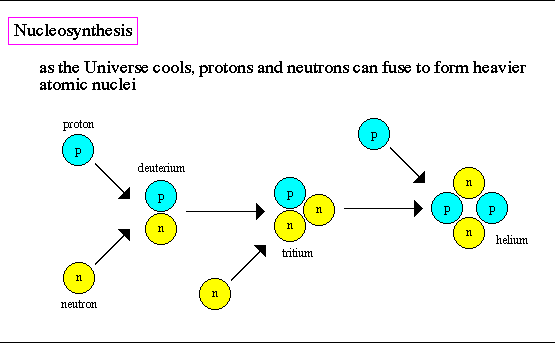
The term nucleosynthesis refers to the formation of heavier elements, atomic nuclei with many protons and neutrons, from the fusion of lighter elements. The Big Bang theory predicts that the early universe was a very hot place. One second after the Big Bang, the temperature of the universe was roughly 10 billion degrees and was filled with a sea of neutrons, protons, electrons, anti-electrons (positrons), photons and neutrinos. As the universe cooled, the neutrons either decayed into protons and electrons or combined with protons to make deuterium (an isotope of hydrogen). During the first three minutes of the universe, most of the deuterium combined to make helium. Trace amounts of lithium were also produced at this time. This process of light element formation in the early universe is called “Big Bang nucleosynthesis” (BBN).

The creation hypothesis predicts that there will be specific amounts of these light elements formed as the universe cools down. Do the predictions match with observations?

Yes they do:

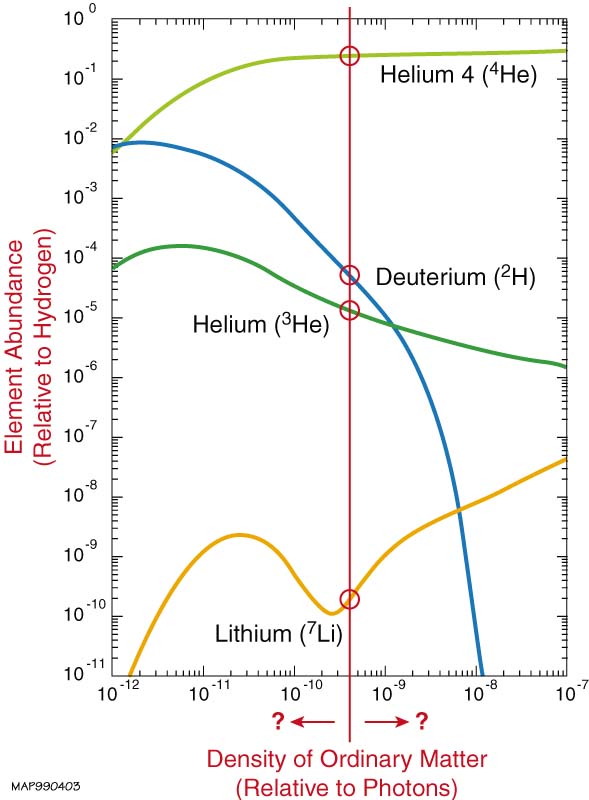
The predicted abundance of deuterium, helium and lithium depends on the density of ordinary matter in the early universe, as shown in the figure at left. These results indicate that the yield of helium is relatively insensitive to the abundance of ordinary matter, above a certain threshold. We generically expect about 24% of the ordinary matter in the universe to be helium produced in the Big Bang. This is in very good agreement with observations and is another major triumph for the Big Bang theory.

Moreover, WMAP satellite measurements of mass density agree with our observations of these light element abundances.

Here are the observations from the WMAP satellite:

Scientific observations match predictions

And here is how those WMAP measurements confirm the Big Bang creation event:

However, the Big Bang model can be tested further. Given a precise measurement of the abundance of ordinary matter, the predicted abundances of the other light elements becomes highly constrained. The WMAP satellite is able to directly measure the ordinary matter density and finds a value of 4.6% (±0.2%), indicated by the vertical red line in the graph. This leads to predicted abundances shown by the circles in the graph, which are in good agreement with observed abundances. This is an important and detailed test of nucleosynthesis and is further evidence in support of the Big Bang theory. 

“An important and detailed test”.

For completeness, we should learn how elements heavier than these light elements are formed:

Elements heavier than lithium are all synthesized in stars. During the late stages of stellar evolution, massive stars burn helium to carbon, oxygen, silicon, sulfur, and iron. Elements heavier than iron are produced in two ways: in the outer envelopes of super-giant stars and in the explosion of a supernovae. All carbon-based life on Earth is literally composed of stardust.

That’s a wonderful thing to tell a young lady when you are on a date: “your body is made of stardust”. In fact, as I have argued before, this star formation, which creates the elements necessary for intelligent life, can only be built if the fundamental constants and quantities in the universe are finely-tuned.

Now, you would think that atheists would be happy to find observations that confirm the origin of the universe out of nothing, but they are not. Actually, they are in denial.

Here’s a statement from the Secular Humanist Manifesto, which explains what atheists believe about the universe:

Religious humanists regard the universe as self-existing and not created.

For a couple of examples of how atheistic scientists respond to the evidence for a cosmic beginning, you can check out this post, where we get responses from cosmologist Lawrence Krauss, and physical chemist Peter Atkins.

You cannot have the creation of the universe be true AND a self-existing, eternal universe ALSO be true. Someone has to be wrong. Either the science is wrong, or the atheist manifesto is wrong. I know where I stand.

Positive arguments for Christian theism